This article was written by the NIPPON VISA & LIFE editorial team based on information from public organizations such as the national government and local governments. Rules and fees may differ depending on the city, ward, town or village where you live.
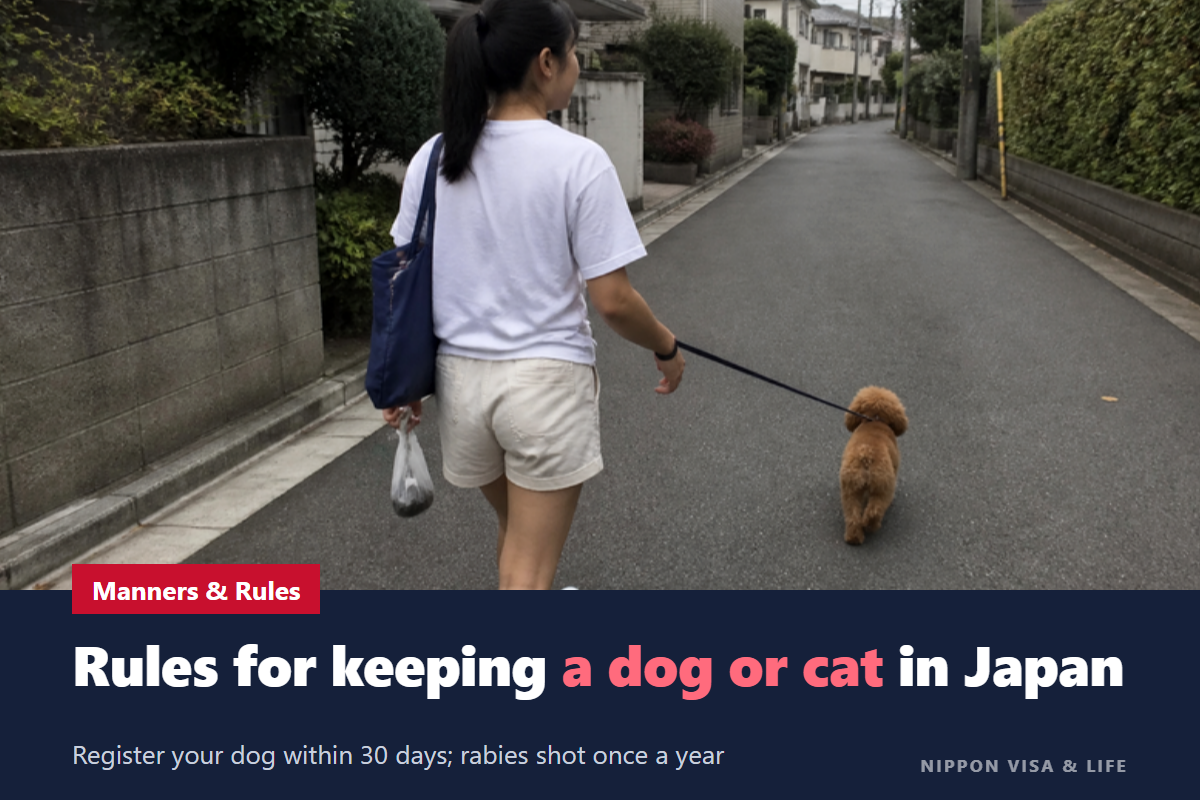
In Japan, people who keep a dog must do 3 things set by law: (1) register the dog with the city, ward, town or village, (2) have the dog vaccinated against rabies once every year, and (3) put the “dog license tag” (鑑札, kansatsu) and “vaccination tag” (注射済票, chushazumihyo) you receive on the dog. When you buy a dog or cat from a pet shop or similar, you also need to do a microchip “change of registration.”
The Short Answer: What to Do When You Start Keeping a Pet
| What to do | Who it applies to | Deadline | Where |
|---|---|---|---|
| Register the dog (receive the license tag) | Dogs | Within 30 days from the day you start keeping the dog (for puppies, see the explanation below) | The city, ward, town or village where you live |
| Rabies vaccination (receive the vaccination tag) | Dogs | Once every year | An animal hospital, or a group vaccination held by the city, ward, town or village |
| Put the license tag and vaccination tag on the dog | Dogs | At all times | ― |
| Change of microchip registration | Dogs and cats whose microchip is already registered | Within 30 days from the day you start keeping the animal | Online (the Ministry of the Environment’s “Microchip Information Registration for Dogs and Cats”) |
For cats, there is no obligation to register with the city, ward, town or village or to give rabies vaccinations. Microchip procedures apply to both dogs and cats.
For other manners and rules for living in Japan, see Manners and Rules to Know When Living in Japan: At Home, on Trains and Buses, at Hot Springs, with Neighbors, Alcohol and Tobacco, and Holidays.
(Sources: Ministry of Health, Labour and Welfare “Q&A on Rabies” Q20, e-Gov Laws and Regulations Search “Rabies Prevention Act” Articles 4 and 5, Ministry of the Environment “Microchip Information Registration for Dogs and Cats”: The Microchip Information Registration System)
3 Obligations When You Keep a Dog (Rabies Prevention Act)
Rabies (狂犬病, kyokenbyo) is a disease that kills almost 100% of people and animals who develop it. In Japan, there have been no cases in people since 1956 and none in animals since 1957. Even so, because there is a risk of it coming in from overseas, dog owners have the following obligations.
1. Dog Registration
- Apply for registration with the city, ward, town or village where you live within 30 days from the day you start keeping the dog
- If you start keeping a puppy that is within 90 days of birth, the deadline is within 30 days from the day after 90 days have passed since its birth
- When you register, you receive a “license tag” (a small tag with the dog’s registration number on it)
2. Rabies Vaccination
- Have your dog vaccinated against rabies once every year
- April to June every year is the period for rabies vaccinations
- The owner can choose whether to have the vaccination at an animal hospital (individual vaccination) or at a “group vaccination” held by the city, ward, town or village. Some cities, wards, towns and villages do not hold group vaccinations
- After the vaccination, you receive a “vaccination tag” (a tag that proves the dog was vaccinated that year) from the city, ward, town or village
3. Put On the License Tag and Vaccination Tag
Attach the license tag and the vaccination tag to the dog’s collar or similar, and keep them on the dog at all times.
What Happens If You Do Not Follow These Rules?
Dogs that are not registered or vaccinated, and dogs not wearing the license tag or vaccination tag, may be captured and detained (taken in and kept). The owner may be fined up to 200,000 yen.
Costs and How to Apply
How to apply for registration and vaccinations, the costs, and the group vaccination schedule differ by city, ward, town or village. Search for “犬の登録” (dog registration) or “狂犬病予防注射” (rabies vaccination) on your city, ward, town or village’s website, or ask at the office (such as the public health center or the environment or sanitation section).
(Sources: Ministry of Health, Labour and Welfare “Q&A on Rabies” Q1, Q8, Q20, Q23, Q24 and Q30, e-Gov Laws and Regulations Search “Rabies Prevention Act” Articles 4, 5, 6 and 27)
Microchips (Dogs and Cats)
What Is a Microchip?
A microchip is a small electronic tag about 8mm long. At an animal hospital, a veterinarian or similar inserts it under the skin of the dog or cat. It stores a 15-digit number, and when it is read with a special reader, the owner’s information can be found in a database. If you are separated from your pet because it gets lost or because of a disaster, this makes it easier for the pet to return to you. It does not show where the pet is, like GPS.
When You Buy from a Pet Shop or Similar
Breeders, pet shops and similar businesses are required to insert and register a microchip before selling a dog or cat. Because of this, a dog or cat you buy is already registered under the name of the previous owner (such as the shop).
- Within 30 days from the day you start keeping the animal, do a “change of owner registration” to change it to your information
- You need the PIN code written on the “registration certificate” the shop gives you
- You can do the procedure online on the Ministry of the Environment’s “Microchip Information Registration for Dogs and Cats” website
- The fee is 400 yen online (the fee for paper applications is different)
When You Receive a Pet from an Acquaintance or a Rescue Group
When you receive a dog or cat whose microchip is already registered, together with its registration certificate, do a “change of owner registration” within 30 days from the day you start keeping it, the same as when you buy from a shop.
Dogs and Cats Without a Microchip
Owners of dogs and cats without a microchip are expected to make efforts to have one inserted (an obligation to make efforts). When you have one inserted, use the “microchip insertion certificate” you get from the veterinarian to do “microchip information registration.”
Dog Microchips and Registration with the City, Ward, Town or Village
If the city, ward, town or village where you live takes part in a system called the “special provision of the Rabies Prevention Act,” the information from your dog’s microchip registration is sent to the city, ward, town or village, and this counts as applying for dog registration under the Rabies Prevention Act. In this case, the microchip takes the place of the license tag. Check with your city, ward, town or village whether it takes part and what the fees are.
(Sources: Ministry of the Environment “Microchip Information Registration for Dogs and Cats”: The Microchip Information Registration System, Same site “Frequently Asked Questions”, e-Gov Laws and Regulations Search “Act on Welfare and Management of Animals” Articles 39-2, 39-5, 39-6 and 39-7)
When You Move, the Owner Changes, or the Pet Dies
| Situation | Dog registration (city, ward, town or village) | Microchip (dogs and cats) |
|---|---|---|
| You moved | Notify the city, ward, town or village you moved to within 30 days | “Change of registered information” within 30 days (no fee) |
| The owner changed (you gave the pet away or received it) | The new owner notifies within 30 days | The new owner does a “change of owner registration” within 30 days |
| The pet died | Notify the city, ward, town or village within 30 days | “Notification of death, etc.” right away (no fee) |
When you give a dog or cat to someone, also hand over the microchip “registration certificate.”
For other moving procedures, see Checklist for Moving Within Japan: Moving-out and Moving-in Notifications, Residence Card, Electricity, Gas and Water, and Mail Forwarding.
(Sources: e-Gov Laws and Regulations Search “Rabies Prevention Act” Article 4, e-Gov Laws and Regulations Search “Act on Welfare and Management of Animals” Articles 39-5, 39-6 and 39-8, Ministry of the Environment “Microchip Information Registration for Dogs and Cats”: The Microchip Information Registration System, Same site “Frequently Asked Questions”)
Owners’ Responsibilities and Manners
Owners’ Responsibilities Set by Law
Under the Act on Welfare and Management of Animals (動物愛護管理法, dobutsu aigo kanri ho), owners are expected to make efforts to do the following.
- Keep the animal properly according to its species and habits, and protect its health and safety
- Make sure the animal does not injure people or cause trouble for people around you
- Prevent the animal from escaping
- As far as possible, keep the animal until the end of its life (lifelong care)
- Be careful about breeding so the animals do not increase to a number you cannot care for
Abandoning a dog, cat or other animal is a crime. It can be punished by imprisonment of up to 1 year or a fine of up to 1,000,000 yen.
Manners on Walks
The Ministry of the Environment’s guidelines give the following guidance.
- On walks, bring a bag for droppings, take the droppings home and dispose of them
- Keep your dog on a leash both on walks and in parks. As a rule, letting dogs run loose is prohibited
- If you want to let your dog play freely, use a dog run or similar facility
When Keeping a Pet in an Apartment or Condominium (Multi-Unit Housing)
- Before you start keeping a pet, check whether dogs or cats are allowed in the building and whether there are rules on size or number. If you rent, look at your contract; if it is a condominium, look at the management rules, and ask the landlord or management company
- Be careful about barking and meowing, and the noise of the animal running around the room
- Do not let dogs or cats out onto balconies that are common areas (areas everyone uses)
- Do not feed or water your pet, or let it use the toilet or brush it, anywhere other than the designated places
- In common areas such as hallways and elevators, carry your pet in your arms as much as possible
For how to get along with your neighbors, also see Manners and Rules to Know When Living in Japan: At Home, on Trains and Buses, at Hot Springs, with Neighbors, Alcohol and Tobacco, and Holidays.
(Sources: e-Gov Laws and Regulations Search “Act on Welfare and Management of Animals” Articles 7 and 44, Ministry of the Environment “Guidelines for the Proper Keeping of Dogs and Cats in Densely Populated Residential Areas” (PDF))
When You Come to Japan or Leave Japan with a Pet
- When you bring a dog or cat to Japan from overseas, it must go through import quarantine (検疫, ken-eki: an inspection to prevent diseases from being brought in) at the Animal Quarantine Service of the Ministry of Agriculture, Forestry and Fisheries
- Before arrival, notify the Animal Quarantine Service by the set deadline. If the conditions are not met, the animal may be held at the Animal Quarantine Service for up to 180 days. Before coming to Japan, check the procedures on the Animal Quarantine Service’s website
- When you leave Japan with a dog or cat, quarantine at the Animal Quarantine Service is also required. If the microchip is registered, do a “change of registered information” and select “moving overseas”
(Sources: Ministry of Agriculture, Forestry and Fisheries Animal Quarantine Service “Importing Dogs and Cats”, Ministry of Health, Labour and Welfare “Q&A on Rabies” Q26 and Q31, Ministry of the Environment “Microchip Information Registration for Dogs and Cats”: Frequently Asked Questions)
Troubles and Frequently Asked Questions
More than 30 days have passed. What should I do?
Regarding the microchip change of registration, the Ministry of the Environment’s website says that you are in violation of the law, and asks you to do the procedure right away. For dog registration as well, consult your city, ward, town or village as soon as you notice.
I was bitten by a dog in Japan. Do I need to worry about rabies?
According to the Ministry of Health, Labour and Welfare, rabies does not occur in Japan, so there is no need to worry about infection. For treatment of the injury, consult a hospital. For how to use hospitals, see When You Are Sick or Injured in Japan: The Basics of Hospitals, Ambulances, Medicine, Medical Insurance and Where to Get Advice.
What should I do with my pet in a disaster?
Check your city, ward, town or village’s disaster prevention information for how to act with your pet when evacuating. In case your pet gets lost, registering a microchip and putting an ID tag on its collar are helpful. For preparing for disasters, see Disasters and Emergencies in Japan: The Basics | Calling 119 and 110, Earthquakes, Tsunami, Heavy Rain, Volcanoes, Evacuation and Multilingual Information.
I do not know how to care for my pet / I have a problem
You can consult the animal welfare section of your prefecture, designated city or core city, an animal welfare center, a public health center, a veterinary association, or similar. For microchip procedures, you can contact the call center of the designated registration organization (03-6384-5320; Monday to Saturday, 9:00 to 18:00; closed on Sundays, national holidays, and January 1 to 3).
(Sources: Ministry of the Environment “Microchip Information Registration for Dogs and Cats”: Frequently Asked Questions, Ministry of Health, Labour and Welfare “Q&A on Rabies” Q13, Ministry of the Environment “Guidelines for the Proper Keeping of Dogs and Cats in Densely Populated Residential Areas” (PDF))
Primary Sources Used for This Article
- Ministry of Health, Labour and Welfare “Q&A on Rabies”
- e-Gov Laws and Regulations Search “Rabies Prevention Act”
- e-Gov Laws and Regulations Search “Act on Welfare and Management of Animals”
- Ministry of the Environment “Microchip Information Registration for Dogs and Cats”: The Microchip Information Registration System
- Ministry of the Environment “Microchip Information Registration for Dogs and Cats”: Frequently Asked Questions
- Ministry of the Environment “Guidelines for the Proper Keeping of Dogs and Cats in Densely Populated Residential Areas” (PDF)
- Ministry of Agriculture, Forestry and Fisheries Animal Quarantine Service “Importing Dogs and Cats”
This article is a translation of the original Japanese version.