This article was written by the NIPPON VISA & LIFE editorial team based on information from public organizations such as the national government and local governments. Rules and fees may differ depending on the city, ward, town or village where you live.
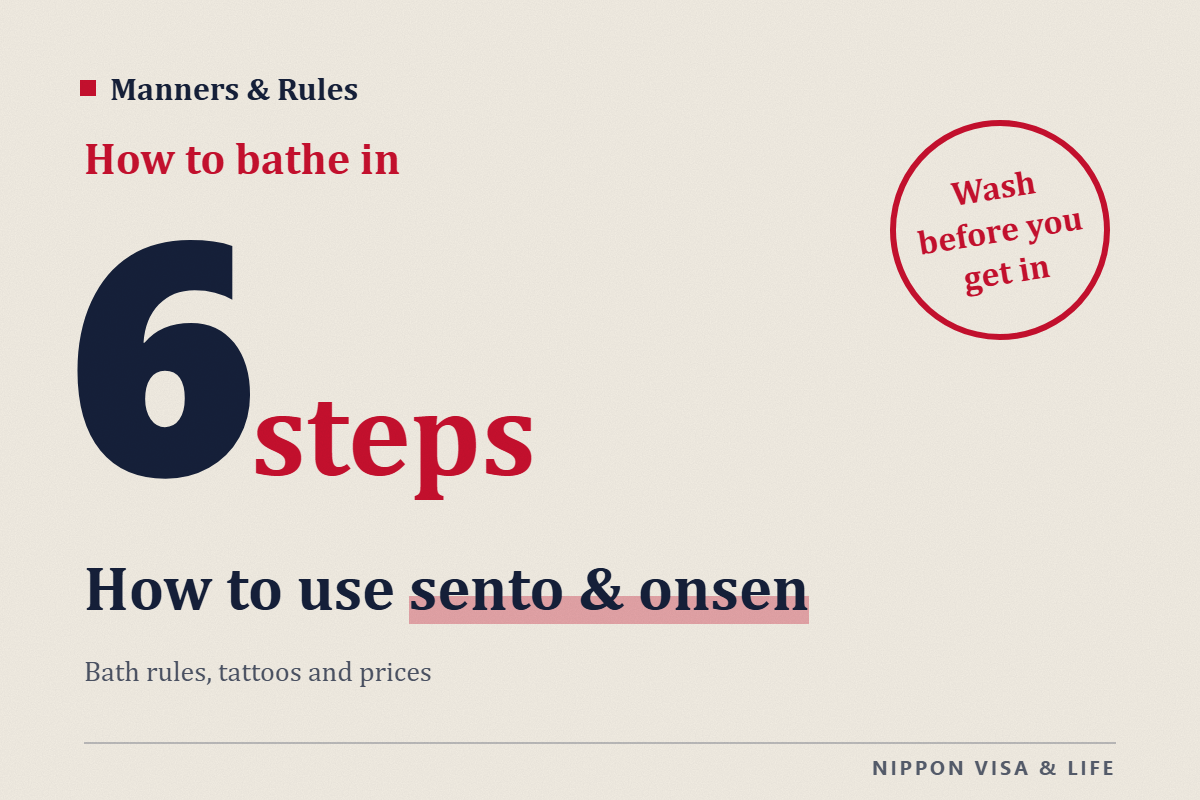
At a sento (public bath) or onsen (hot spring) in Japan, many people get into the same bath water. The basic rule is to wash your body before getting into the yubune (the bathtub), and not to put your towel in the bath. If you have a tattoo (irezumi), check with the facility first whether you can enter.
The Short Answer: The Steps for Bathing
- Pay the fee at the reception
- Take off your clothes in the datsuijo (changing room: the room where you undress), which is separate for men and women
- When you enter the bathing area, wash your body, then pour hot water over yourself starting from your hands and feet (kakeyu) to get your body used to the water
- After that, soak in the yubune (a large tub filled with hot water)
- Be quiet in the bath. Do not put your towel in the bath
- When you get out, dry your body with a towel
A sento is a large neighborhood bath that you pay to use. An onsen is a bath that uses water such as hot water that springs up from underground; onsen are found at facilities in hot spring areas and in the large shared baths of ryokan (Japanese-style hotels). The basic rules are the same for both, such as washing your body before getting into the bath and not putting your towel in the bath.
(Sources: Immigration Services Agency (ISA) “Guidebook on Living and Working” Chapter 12, Japan Tourism Agency “Ryokan Q&A”, Ministry of the Environment “Standards for Posting Contraindications and Precautions for Bathing or Drinking Under Article 18, Paragraph 1 of the Hot Springs Act”, Ministry of Health, Labour and Welfare “Guidelines for Hygiene Management at Public Bathhouses”, e-Gov Laws and Regulations Search “Hot Springs Act” Article 2)
Rules to Follow (by Situation)
Before Getting into the Bath
- Wash your body before getting into the bath. At the washing area (the place with showers and hot water taps), wash your body with soap and rinse well.
- Do kakeyu (pour hot water over yourself). To get your body used to the water temperature, pour hot water over your body starting from your hands and feet before getting into the bath. Some facilities have very hot water.
- If you have long hair, tie it up. Keep your hair out of the water.
In the Bath
- Do not put your towel in the bath. This is to keep the water clean.
- Do not wash your body or hair with soap or shampoo in the bath.
- Bathe quietly. Do not talk loudly. In the bath, only move your hands and feet lightly.
In the Bathing Area and Changing Room
- Do not wear a swimsuit. The Japan Tourism Agency’s guide to ryokan says that you should refrain from bathing in a swimsuit.
- Do not take photos. This is to protect other people’s privacy (things they do not want others to see).
- Do not do laundry in the bathing area.
- Stand up slowly when you get out of the bath. If you stand up suddenly, you may feel dizzy (lightheadedness).
(Sources: Immigration Services Agency “Guidebook on Living and Working” Chapter 12, Japan Tourism Agency “Ryokan Q&A”, Ministry of Health, Labour and Welfare “Guidelines for Hygiene Management at Public Bathhouses”, Ministry of the Environment “The ABCs of Using Hot Springs Safely and Securely”)
If You Have a Tattoo (Irezumi)
If you have a tattoo, you may not be allowed to enter a sento or onsen.
According to the Japan Tourism Agency’s guide, how ryokan deal with tattoos differs greatly from ryokan to ryokan. In Japan, tattoos can remind people of members of antisocial organizations, so there is a history of refusing bathing to people with tattoos. On the other hand, there are now ryokan like the following.
- They have no restrictions on tattoos at all
- They decide case by case, for example small tattoos are not a problem
- In addition to the large shared bath, they have kashikiri-buro (private baths: baths you book for a set time and use only with your own group) or baths in the guest rooms
Before you go, look at the facility’s website, or check by phone or email: “Can I enter if I have a tattoo?”
(Sources: Japan Tourism Agency “Ryokan Q&A” Q2, Immigration Services Agency “Guidebook on Living and Working” Chapter 12)
Going with Children: Age Guidelines for the Men’s and Women’s Baths
At a sento, the bathing areas are separate for men and women. The age up to which a child can go into the bathing area of the other sex together with a parent differs depending on the area and the facility. When you go with children, look at the facility’s information or ask at the reception.
The rules on age are set by prefectures and other local governments in jorei (ordinances: local rules). The national government’s (Ministry of Health, Labour and Welfare) guidelines state: “Do not let males and females aged approximately 7 or older bathe together.”
Also, the Ministry of the Environment’s standards for precautions when bathing in onsen say that it is desirable for elderly people, children and people with physical disabilities not to bathe alone. Children should bathe together with an adult.
(Sources: Ministry of Health, Labour and Welfare “On the Handling of Men and Women in Shared Baths at Public Bathhouses and Hotel and Inn Facilities” (June 23, 2023), Ministry of Health, Labour and Welfare “Guidelines for Hygiene Management at Public Bathhouses”, Ministry of the Environment “Standards for Posting Contraindications and Precautions for Bathing or Drinking Under Article 18, Paragraph 1 of the Hot Springs Act”)
Sento Fees and Towels
The bathing fees at sento (general public bathhouses) are subject to the Price Control Ordinance (bukka toseirei: a rule under which the national government controls prices). The governor of each prefecture sets the maximum fee (the controlled price). For this reason, fees differ from prefecture to prefecture.
| Example | Adults (12 and older) | Children (6 or older and under 12) | Small children (under 6) | Effective from |
|---|---|---|---|---|
| Example: Tokyo | 600 yen | 200 yen | 100 yen | August 1, 2026 |
| Example: Saitama Prefecture | 550 yen | 200 yen | 100 yen | April 1, 2026 |
These are the maximum fees. To check the fee in your area, search for “(name of your prefecture) 公衆浴場 入浴料金” (public bathhouse bathing fee), or check the sign at the entrance of the sento. For onsen facilities and ryokan, check the fee with each facility.
Towels and other items: Some facilities lend you towels. This differs from facility to facility, so check when you go for the first time.
(Sources: Saitama Prefecture “Revision of the Controlled Price of Public Bathhouse Bathing Fees” (February 24, 2026), Bunkyo City “Public Bathhouse Programs” (Tokyo’s controlled price), Ministry of Health, Labour and Welfare “Guidelines for Hygiene Management at Public Bathhouses”)
Taking Care of Your Health
Onsen facilities post precautions for bathing. The Ministry of the Environment’s standards say the following.
- Do not bathe right before or right after a meal, or after drinking alcohol. In particular, do not bathe when you are drunk
- When you are very tired, or for about 30 minutes after exercise, rest your body
- Before bathing, drink about one glass of water
- Elderly people, people with high blood pressure or heart disease, and people who have had a stroke should avoid hot water of 42℃ or higher
- If you start to feel unwell, ask someone nearby for help, get out of the bath slowly and lie down
The Ministry of the Environment’s standards say that you should not bathe in onsen when your illness is bad, such as when you have a fever, or when you have a serious heart or lung disease (these are called contraindications: kinkisho). If you have an illness, talk to a doctor. For the rules on alcohol, also see Rules for Alcohol and Tobacco in Japan: From Age 20, Penalties for Drunk Driving, and Where You Can Smoke.
(Sources: Ministry of the Environment “Standards for Posting Contraindications and Precautions for Bathing or Drinking Under Article 18, Paragraph 1 of the Hot Springs Act”, Ministry of the Environment “The ABCs of Using Hot Springs Safely and Securely”, Japan Tourism Agency “Ryokan Q&A” Q1)
Common Questions
Do I Need a Reservation?
You can usually use the large shared bath at a ryokan without a reservation. At many ryokan you can bathe even late at night or early in the morning, but you cannot bathe during cleaning time. Private baths may require a reservation. When you arrive at the ryokan, ask at the reception. To prevent accidents, avoid bathing late at night or after drinking alcohol.
(Sources: Japan Tourism Agency “Ryokan Q&A” Q1)
Should I Rinse Off with a Shower After Getting Out of the Bath?
For sento, the national government’s (Ministry of Health, Labour and Welfare) guidelines ask facilities to encourage users to rinse their bodies with a shower or similar when they get out of the bath, too.
For onsen, Ministry of the Environment materials say it is good to wipe the hot spring components off your body with a towel instead of washing them off. However, people with sensitive skin are advised to rinse off with hot water in the case of strongly irritating hot springs (such as acidic springs and sulfur springs).
(Sources: Ministry of Health, Labour and Welfare “Guidelines for Hygiene Management at Public Bathhouses”, Ministry of the Environment “The ABCs of Using Hot Springs Safely and Securely”)
Can I Drink the Hot Spring Water?
Ministry of the Environment materials say that when you drink hot spring water, you should drink fresh hot spring water that has received permission for insen (drinking hot spring water), using a clean cup. Check the amount you can drink on the sign at that place. Do not take the water home to drink.
(Sources: Ministry of the Environment “The ABCs of Using Hot Springs Safely and Securely”)
What If I Do Not Understand the Rules?
Ask the staff at the facility’s reception. In places such as the changing room, the bathing rules (things to follow) and precautions are posted. An overview of manners and rules in Japan is summarized in Manners and Rules to Know When Living in Japan: At Home, on Trains and Buses, at Hot Springs, with Neighbors, Alcohol and Tobacco, and Holidays.
(Sources: Ministry of Health, Labour and Welfare “Guidelines for Hygiene Management at Public Bathhouses”)
Primary Sources Used for This Article
- Immigration Services Agency “Guidebook on Living and Working” 8th Edition (Chapter 12 Rules and Customs in Daily Life, 1-6 Onsen and Sento)
- Japan Tourism Agency “Ryokan Q&A: Answering Your Questions!”
- Ministry of Health, Labour and Welfare “On the Guidelines for Hygiene Management at Public Bathhouses and Related Matters”
- Ministry of Health, Labour and Welfare “On the Handling of Men and Women in Shared Baths at Public Bathhouses and Hotel and Inn Facilities” (June 23, 2023)
- Ministry of the Environment “Standards for Posting Contraindications and Precautions for Bathing or Drinking Under Article 18, Paragraph 1 of the Hot Springs Act” (July 1, 2014)
- Ministry of the Environment “The ABCs of Using Hot Springs Safely and Securely”
- e-Gov Laws and Regulations Search “Hot Springs Act”
- Saitama Prefecture “Revision of the Controlled Price of Public Bathhouse Bathing Fees” (February 24, 2026)
- Bunkyo City “Public Bathhouse Programs” (Tokyo’s controlled price for bathing fees)
This article is a translation of the original Japanese version.