This article was written by the NIPPON VISA & LIFE editorial team based on information from public organizations such as the national government and local governments. Rules and fees may differ depending on the city, ward, town or village where you live.
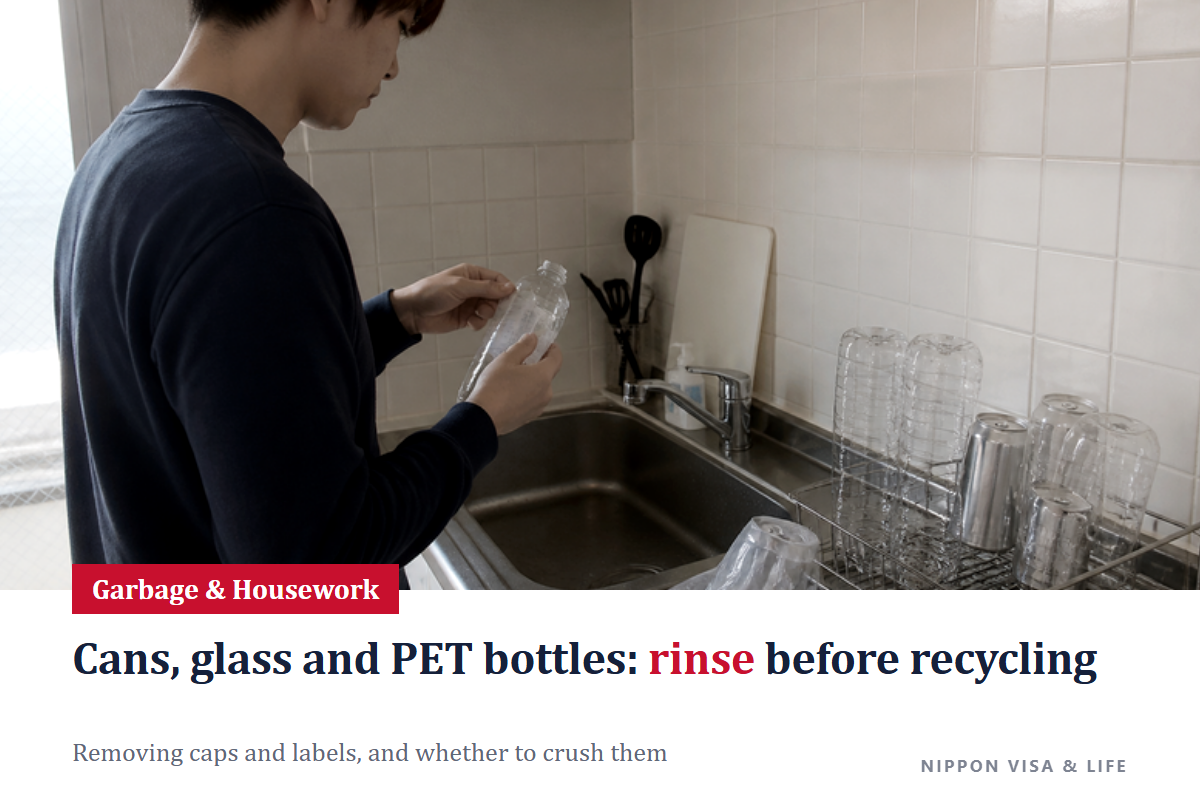
In Japan, PET bottles, cans and glass bottles are collected as “recyclables” (shigen, things that are recycled), separately from other garbage, in all of the municipalities checked for this article: Yokohama City, Nagoya City, Osaka City and Shinjuku City. Before putting them out, empty them and rinse them lightly, and for PET bottles, remove the cap and the label. The type of bag and whether to crush them differ by municipality, so please check the rules where you live.
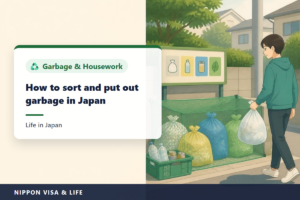
The overall rules for sorting garbage are summarized in How to Sort and Put Out Garbage in Japan: Basic Rules for Burnable, Recyclable and Oversized Garbage.
The Short Answer: Steps Until You Put Them Out
- Empty them: throw away any drink or food left inside.
- Rinse them lightly with water: quickly rinse the inside.
- Remove the caps and labels: remove the cap and label from PET bottles. Also remove the caps from glass bottles.
- Check how your municipality collects them: find out the type of bag, whether to crush them, and the collection day. Search online for “(name of your city/ward) ペットボトル 出し方”.
- Put them out at the designated place on the morning of the designated day: put them out at the garbage collection point (the place where garbage is put out).
What Can and Cannot Be Put Out
In the 4 municipalities checked for this article, what is collected as recyclables is mainly PET bottles, cans and glass bottles that contained drinks or food. Whether bottles for cosmetics and similar items are also collected differs by municipality.
| Type | Examples of what can be put out | Examples of what cannot be put out with them |
|---|---|---|
| PET bottles | Bottles for drinks, alcohol, soy sauce, mirin, vinegar, etc. that have the identification mark (the PET bottle mark) | Bottles without the mark, and bottles for cooking oil and sauce (Yokohama City and Nagoya City). In Yokohama City, bottles for dressing, detergent and chemicals are also not accepted |
| Cans | Aluminum and steel cans for drinks and food | Paint cans, spray cans, and large square cans (itto-kan) (example: Shinjuku City) |
| Glass bottles | Glass bottles for drinks and food | Tableware such as rice bowls and cups, heat-resistant glass, light bulbs and fluorescent lamps |
Which category to use for things that cannot be put out as recyclables differs by municipality. For example, bottles without the mark and bottles for oil and sauce are put out as “plastic recyclables” (purasuchikku shigen) in Yokohama City and Nagoya City. Glass bottles, cans and PET bottles that stay dirty even after washing are put out as “metal, ceramics and glass garbage” (kinzoku, toki, garasu gomi) in Shinjuku City.
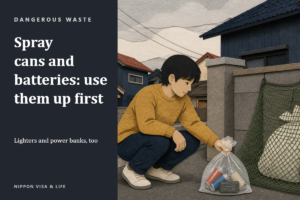
Spray cans are put out differently from ordinary cans. See How to Throw Away Spray Cans, Batteries and Lighters in Japan: Disposing of Dangerous Waste Such as Lithium-Ion Batteries and Gas Canisters.
(Sources: Yokohama City “Cans, Glass Bottles and PET Bottles”, Nagoya City “How to Sort and Put Out PET Bottles (Station Collection)”, Nagoya City “How to Sort and Put Out Empty Glass Bottles”, Shinjuku City “How to Put Out Bottles, Cans, PET Bottles, Spray Cans, Gas Canisters, Dry-Cell Batteries, etc.”)
How to Put Out PET Bottles
Why Remove the Caps and Labels?
Nagoya City gives these reasons: caps and labels are made of a different material from the bottle itself, and caps left on the bottle get in the way of the sorting work. To keep recycling working well, the city asks residents to remove them before putting the bottles out.
(Source: Nagoya City “Why Do We Remove the Caps and Labels from PET Bottles?”)
Where Do the Removed Caps and Labels Go?
There are also rules for throwing away the caps and labels you removed. Yokohama City, Nagoya City and Osaka City ask residents to put out plastic caps and labels as “plastic recyclables” (purasuchikku shigen). Nagoya City says that labels that are not plastic go in “burnable garbage” (kanen gomi, garbage that burns).
- Labels that are hard to peel off: Nagoya City says you do not have to peel them off.
- The ring left under the cap: Osaka City says that if it comes off easily, remove it and put it out as plastic recyclables; if it does not come off, you can put the bottle out as it is.
(Sources: Nagoya City “How to Sort and Put Out PET Bottles (Station Collection)”, Osaka City “How to Put Out Recyclable Garbage”, Yokohama City “Cans, Glass Bottles and PET Bottles”)
Why Should You Not Leave Drinks Inside?
In an article on “Plastics Smart,” a website of the Ministry of the Environment, the Japan Soft Drink Association (an organization of drink manufacturers) explains that recycling plants crush the bottles into small pieces, so any drink left inside splashes around and makes the machines dirty. Empty the bottles and rinse them lightly before putting them out.
(Source: Ministry of the Environment Plastics Smart “Q. What Are PET Bottles Recycled Into?”)
How to Put Out Cans and Glass Bottles
- Empty them and quickly rinse them with water.
- Remove the caps from glass bottles. Plastic caps are put out as “plastic recyclables.” How to put out metal caps differs by municipality (Yokohama City: “small metal items” (chiisana kinzoku-rui); Nagoya City: “non-burnable garbage” (funen gomi, garbage that does not burn); Osaka City: “recyclable garbage” (shigen gomi)).
- Labels on glass bottles: Yokohama City says that labels and inner lids that are hard to remove can be left as they are. Nagoya City also says you do not have to remove the labels.
- Whether to crush cans: as shown in the table below, some municipalities have opposite rules.
(Sources: Yokohama City “Cans, Glass Bottles and PET Bottles”, Nagoya City “How to Sort and Put Out Empty Glass Bottles”, Osaka City “How to Put Out Recyclable Garbage”)
Examples by Municipality
This is what was checked on each municipality’s official website in October 2026. In all of these municipalities, collection is once a week.
| Municipality | Bags and containers | Whether to crush them |
|---|---|---|
| Yokohama City | Put cans, glass bottles and PET bottles together in a clear or semi-transparent bag. Do not put them in the same bag as “small metal items” | Do not crush cans and glass bottles. Crush PET bottles |
| Nagoya City | Sort by type. Put PET bottles in the designated bag for recyclables or a colorless clear bag of 45 liters or less (semi-transparent bags cannot be used). Do not put glass bottles in a bag; put them in the blue basket at the collection point. Cans go in a bag or a basket, depending on the ward | No instructions |
| Osaka City | Put cans, glass bottles, PET bottles and metal household goods together in one bag. Use a bag you can see through (in some areas, PET bottles are collected on a different day) | Crush cans and PET bottles as much as possible |
| Shinjuku City (Tokyo) | Put glass bottles, cans and PET bottles in separate bags by type, using bags you can see through. Put them out by 8 a.m. | No instructions |
(Sources: Yokohama City “Cans, Glass Bottles and PET Bottles”, Nagoya City “How to Sort and Put Out PET Bottles (Station Collection)”, Nagoya City “How to Sort and Put Out Empty Glass Bottles”, Nagoya City “How to Sort and Put Out Empty Cans”, Osaka City “How to Put Out Recyclable Garbage”, Shinjuku City “How to Put Out Bottles, Cans, PET Bottles, Spray Cans, Gas Canisters, Dry-Cell Batteries, etc.”)
As you can see, even for the same PET bottles, the type of bag and whether to crush them differ by municipality. When you move, check the rules of your new municipality. Besides the municipality’s website, information may also be given in the printed materials you receive when you register your move-in, or in apps for looking up how to sort garbage.
You Can Also Use Collection Boxes at Supermarkets
PET bottles are sometimes also collected in collection boxes at stores such as supermarkets (according to the information from Yokohama City and Osaka City). In Nagoya City, you can put them in the collection boxes at supermarkets, ward offices and other places at any time during opening hours. According to Nagoya City’s information, PET bottles go into the box as they are, without a bag. Removing the cap and label and rinsing the bottle before putting it in is the same as when you put it out at the collection point.
(Sources: Yokohama City “Cans, Glass Bottles and PET Bottles”, Osaka City “How to Put Out Recyclable Garbage”, Nagoya City “How to Sort and Put Out PET Bottles (Collection at Drop-Off Points)”)
When You Are in Trouble: Common Mistakes
Can I Put Other Garbage in the Box Next to a Vending Machine?
Please do not. In the Ministry of the Environment’s “Plastics Smart” article, the Japan Soft Drink Association explains that the box next to a vending machine is not a trash can but a recycling box for collecting only drink containers. If things such as lunch box containers or cigarette butts are put in, there is no room for the PET bottles that should be collected, and it also gets in the way of recycling.
(Source: Ministry of the Environment Plastics Smart “Q. What Are PET Bottles Recycled Into?”)
Can I Put Spray Cans in with Other Cans?
Please do not. Yokohama City reports accidents in which spray cans and similar items got mixed in and workers at sorting facilities were injured. Put out spray cans separately from other cans, in the way your municipality has decided.
(Source: Yokohama City “Cans, Glass Bottles and PET Bottles”)
What About Cosmetics Bottles and Glass Cups?
It depends on the municipality. In Yokohama City, cosmetics bottles are not recyclables but “non-burnable garbage” (moenai gomi). Nagoya City and Shinjuku City collect cosmetics bottles as recyclables too. Tableware such as glass cups is “non-burnable garbage” (funen gomi) in Nagoya City and “metal, ceramics and glass garbage” in Shinjuku City.
(Sources: Yokohama City “Cans, Glass Bottles and PET Bottles”, Nagoya City “How to Sort and Put Out Empty Glass Bottles”, Shinjuku City “How to Put Out Bottles, Cans, PET Bottles, Spray Cans, Gas Canisters, Dry-Cell Batteries, etc.”)
What If I Do Not Know Where the Collection Point Is?
Nagoya City does not publish the places for putting out recyclables on its website, and asks residents to ask people living nearby or the ward’s Environmental Services Office. If you live in an apartment building, you may be able to find out by asking the building’s management company or your landlord.
(Source: Nagoya City “How to Sort and Put Out Empty Glass Bottles”)
Where to Ask
- How to put them out, collection days, and the location of the collection point: the garbage section of your city, ward, town or village (cleaning office, environmental services office, etc.).
- Large furniture and similar items: see How to Put Out Oversized Garbage in Japan: Basics of Applying, Disposal Tickets (Stickers), and the Day and Place to Put It Out.
Primary Sources Used for This Article
- Yokohama City “Cans, Glass Bottles and PET Bottles”
- Nagoya City “How to Sort and Put Out PET Bottles (Station Collection)”
- Nagoya City “How to Sort and Put Out PET Bottles (Collection at Drop-Off Points)”
- Nagoya City “How to Sort and Put Out Empty Glass Bottles”
- Nagoya City “How to Sort and Put Out Empty Cans”
- Nagoya City “Why Do We Remove the Caps and Labels from PET Bottles?”
- Osaka City “How to Put Out Recyclable Garbage (Cans, Glass Bottles, PET Bottles, Metal Household Goods, and Spray Cans and Gas Canisters)”
- Shinjuku City “How to Put Out Bottles, Cans, PET Bottles, Spray Cans, Gas Canisters, Dry-Cell Batteries, etc.”
- Ministry of the Environment Plastics Smart “Q. What Are PET Bottles Recycled Into?”
This article is a translation of the original Japanese version.