This article was written by the NIPPON VISA & LIFE editorial team based on information from public organizations such as the national government and local governments. Rules and fees may differ depending on the city, ward, town or village where you live.
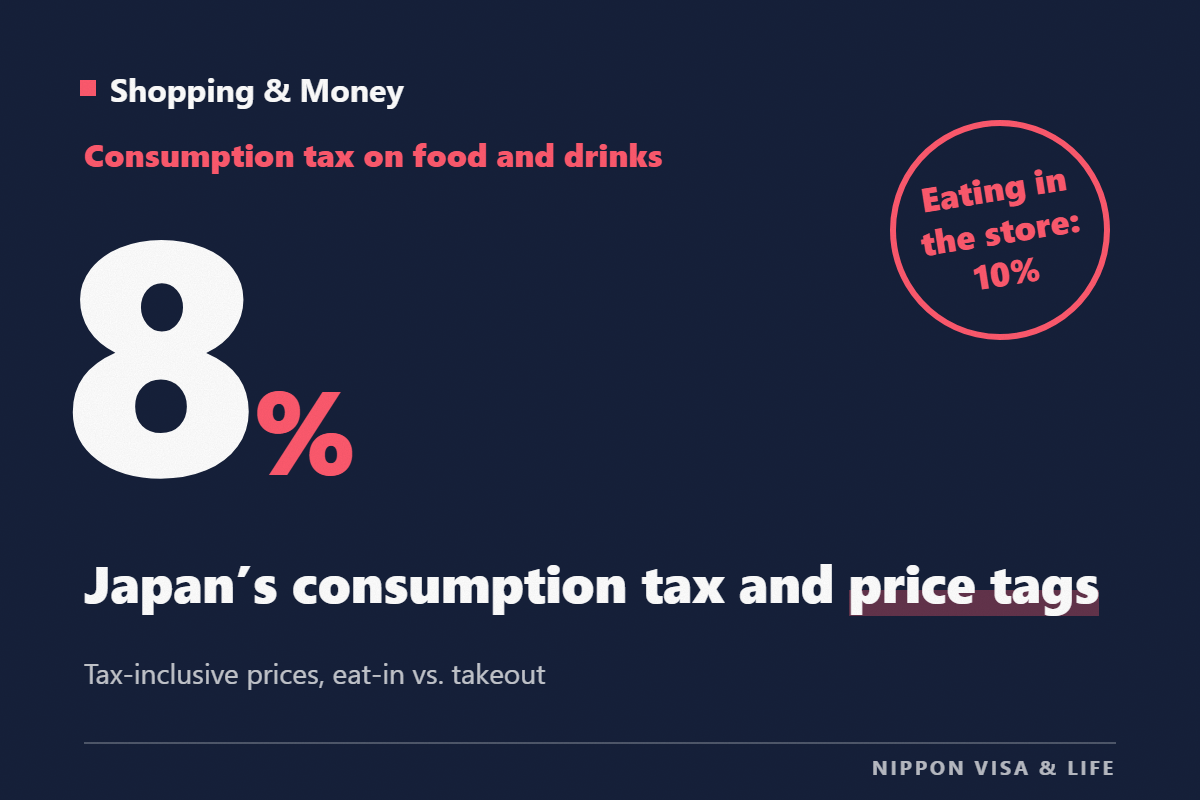
In Japan, consumption tax (shohizei, a tax on purchases and services) is charged on almost everything you buy. The tax rate is usually 10%, and 8% for food and drinks (excluding alcohol and eating out). Stores are required to show prices that include the tax (tax-included prices, zeikomi kakaku) on their price labels.
An overview of money and shopping is given in The Basics of Money and Shopping in Japan: Bank Accounts, Ways to Pay, Consumption Tax, Smartphone Contracts, Sending Money Abroad and Where to Get Help.
The Short Answer: What to Remember
- There are 2 tax rates: usually 10%, and 8% for food and drinks (excluding alcohol and eating out).
- Read the tax-included price on the label: stores are supposed to show prices that include the tax. The price marked “税込” (zeikomi, tax included) is a guide to what you pay at the register.
- Eating inside the store is 10%: if you eat in the eat-in area (a place to eat inside the store) of a convenience store or supermarket, the rate is 10%, the same as eating out. If you take it home, it is 8%.
- Check your receipt: many receipts show the total for each tax rate.
- A change is planned from April 2027: the tax rate on food and drinks is planned to be cut to 1% for 2 years (if the law is passed).
(Sources: National Tax Agency Tax Answer No.6303 “Tax Rates of Consumption Tax and Local Consumption Tax”, National Tax Agency Tax Answer No.6902 “Mandatory Tax-Inclusive Price Display”)
8% and 10%: Which Rate Applies to What?
There are 2 consumption tax rates: the standard rate of 10% and the reduced rate of 8%. The reduced tax rate (a lower tax rate) started in October 2019.
| Tax rate | Main items | Examples |
|---|---|---|
| 8% (reduced rate) | Food and drinks (excluding alcohol), and newspapers by subscription (published at least twice a week) | Rice, vegetables, meat, bread, snacks, juice, bottled water (mineral water), and take-out lunch boxes (bento) |
| 10% (standard rate) | Everything not listed above | Clothes, daily goods, home appliances, alcohol, eating out, medicines (pharmaceuticals and quasi-drugs), electricity, gas and water |
Things to be careful about:
- Alcohol: it is 10% even though it is a drink.
- Eating out: when you eat at a place with tables and chairs, such as a restaurant, it is 10%.
- Medicines: pharmaceuticals and quasi-drugs are not counted as “food,” so they are 10%.
- Tap water: mineral water is 8%, but tap water (water charges) is 10%.
- Snacks with toys and similar items: for a set of food and non-food items, if the price is 10,000 yen or less before tax and the food makes up two-thirds or more of the price, the whole set is 8%. Otherwise, the whole set is 10%.
(Sources: National Tax Agency Tax Answer No.6102 “Reduced Tax Rate System for Consumption Tax”, National Tax Agency “Q&A on the Reduced Tax Rate System for Consumption Tax (Individual Cases)” I. Scope of “Transfer of Food and Beverages,” etc.)
How to Read Price Labels: Tax-Included and Tax-Excluded
In Japan, when a store shows prices to consumers in advance, it is required to show the price including consumption tax (tax-included price). This is called “total price display” (sogaku hyoji). It applies to any form of display, such as price labels, flyers and advertisements.
The National Tax Agency gives the following as examples of total price display (examples for an item taxed at 10%).
| How the label is written | Price you pay |
|---|---|
| 11,000円 | 11,000 yen |
| 11,000円(税込) | 11,000 yen |
| 11,000円(税抜価格10,000円) | 11,000 yen |
| 11,000円(うち消費税額等1,000円) | 11,000 yen |
| 10,000円(税込価格11,000円) | 11,000 yen |
As in the last example, it is allowed for the tax-excluded price to be written in large numbers as long as the tax-included price is also shown. When you see 2 numbers, check which one is the tax-included price. (On labels, “税込” means tax included, and “税抜” means tax excluded.)
(Source: National Tax Agency Tax Answer No.6902 “Mandatory Tax-Inclusive Price Display”)
Example Calculation
If you buy an item that costs 1,000 yen before tax, you pay the following (how amounts of less than 1 yen are rounded may differ by store).
| Item | Tax rate | Price you pay |
|---|---|---|
| Food (take-out) | 8% | 1,080 yen |
| Daily goods, alcohol, eating out | 10% | 1,100 yen |
Convenience Stores, Supermarkets and Fast Food: Eating In vs. Taking Out
Even for the same lunch box or bread, the tax rate changes depending on whether you eat it inside the store or take it out.
- Taking it out (take-out): this is a sale of food and drinks, so it is 8%.
- Eating inside the store (eat-in): this counts as “providing meals,” so it is 10%.
The tax rate is decided when you buy (when you pay at the register). The National Tax Agency explains that at convenience stores and supermarkets, the store decides the tax rate by checking with the customer whether they will eat in the store or take the food out. The store does not have to ask every customer; some stores check by putting up a notice such as “If you will use the eat-in area, please tell us.”
If you will eat in the eat-in area, tell the staff at the register: “Tennai de tabemasu” (I will eat in the store).
At fast-food restaurants and similar places, some show different prices for eating in and taking out, and some show only one of the two prices. How prices are set differs by store.
(Sources: National Tax Agency “Q&A on the Reduced Tax Rate System for Consumption Tax (Individual Cases)” III. Scope of Eating Out, Same Q&A, VII. Price Display)
How to Read a Receipt
Receipts and invoices often show totals divided by tax rate and the amount of consumption tax. Invoices (qualified invoices) issued by businesses that have applied to and registered with the tax office (invoice-issuing businesses) are required to show amounts divided by tax rate. Some receipts, such as those from stores that are not registered, may not show this. National Tax Agency materials show, as an example, a receipt with a mark such as “※” next to 8% items and the note “※印は軽減税率対象商品” (items marked ※ are subject to the reduced tax rate). How items are marked differs by store.
If you want to check the tax rate after buying, look at the total lines on the receipt, such as “8%対象” (8% items) and “10%対象” (10% items).
(Sources: National Tax Agency Tax Answer No.6102 “Reduced Tax Rate System for Consumption Tax”, National Tax Agency “Q&A on the Reduced Tax Rate System for Consumption Tax (Individual Cases)” VI. How to Fill In Classified Invoices, etc.)
From April 2027: Planned Cut in the Tax Rate on Food and Drinks to 1%
The National Tax Agency and the Ministry of Finance announce that the consumption tax rate on food and drinks is planned to be cut to 1% for 2 years, from April 1, 2027 (Reiwa 9) to March 31, 2029 (Reiwa 11). This is the content of a policy decided by the government (Cabinet decision) on September 15, 2026, and it will apply only if a bill is submitted to the Diet and is passed and enacted (as of October 25, 2026).
| Food and drinks | Newspapers by subscription | Others | |
|---|---|---|---|
| Planned tax rate (April 2027 to March 2029) | 1% | 8% | 10% |
- Items covered: the same range as the food and drinks that are taxed at 8% now. Alcohol and eating out will stay at 10%, as now.
- Changing price labels: for stores that cannot replace their price labels in time, a special rule is planned for the period from February 1 to May 31, 2027 (Reiwa 9): as long as a notice is displayed so that customers do not mistake the label for the price they actually pay, the labels for food and drinks may show the tax-included price at either 8% or 1%. During this period, the price on the label and the price at the register may be different. Check your receipt.
- Regular deliveries and mail order: even for food and drinks delivered on or after April 1, 2027, items under certain regular-delivery contracts or bought by mail order may stay at 8%.
Example calculation (planned): if you buy food that costs 1,000 yen before tax and take it out, at 1% you pay 1,010 yen.
For the latest information, check the National Tax Agency’s “Special Website on the Consumption Tax Rate Cut.”
(Sources: National Tax Agency “Special Website on the Consumption Tax Rate Cut”, National Tax Agency leaflet “About the 2-Year Consumption Tax Rate Cut on Food and Beverages” (September 2026))
When You Are in Trouble: Common Questions
What If the Price on the Label and the Price at the Register Are Different?
First, compare the tax-included price on the label with the price at the register or on the receipt. The tax rate may have changed because of eating in vs. taking out. If you do not understand why they are different, ask the store staff on the spot.
Do Foreign Residents in Japan Also Pay Consumption Tax?
The National Tax Agency explains that the consumption tax paid by consumers is the national consumption tax and the local consumption tax combined (10% or 8%). When people living in Japan shop at stores in Japan, they pay the consumption tax included in the price.
Where Can I Ask Questions About How Consumption Tax Works?
The National Tax Agency’s “Consumption Tax Reduced Tax Rate and Invoice Call Center” takes general questions about the cut in the tax rate on food and drinks and about the reduced tax rate.
- Phone: 0120-205-553 (free of charge)
- Hours: 9:00 to 17:00 (closed on Saturdays, Sundays, national holidays and the year-end and New Year holidays)
For general questions about consumption tax other than the reduced tax rate and invoices, contact the National Tax Agency’s Telephone Consultation Center (0570-00-5901; choose “1” in the voice guidance).
What About Problems With Things I Bought or With a Store?
For problems with a store, such as a strange price display or being sold something different from what was explained, call the Consumer Hotline (188). You will be directed to a consultation service near you, such as the Consumer Affairs Center of your city, ward, town or village, or prefecture. Consultation is free, but you pay the phone charges. For details, see Where to Get Help With Shopping and Contract Problems in Japan: Consumer Hotline 188, Consumer Affairs Centers and Cooling-off.
(Sources: National Tax Agency Tax Answer No.6303 “Tax Rates of Consumption Tax and Local Consumption Tax”, National Tax Agency “Consumption Tax Reduced Tax Rate and Invoice Call Center”, National Tax Agency leaflet “About the 2-Year Consumption Tax Rate Cut on Food and Beverages”, Consumer Affairs Agency “Consumer Hotline”)
Primary Sources Used for This Article
- National Tax Agency Tax Answer No.6303 “Tax Rates of Consumption Tax and Local Consumption Tax”
- National Tax Agency Tax Answer No.6102 “Reduced Tax Rate System for Consumption Tax”
- National Tax Agency Tax Answer No.6902 “Mandatory Tax-Inclusive Price Display”
- National Tax Agency “Q&A on the Reduced Tax Rate System for Consumption Tax (Individual Cases)” I. Scope of “Transfer of Food and Beverages,” etc.
- National Tax Agency “Q&A on the Reduced Tax Rate System for Consumption Tax (Individual Cases)” III. Scope of Eating Out
- National Tax Agency “Q&A on the Reduced Tax Rate System for Consumption Tax (Individual Cases)” VI. How to Fill In Classified Invoices, etc.
- National Tax Agency “Q&A on the Reduced Tax Rate System for Consumption Tax (Individual Cases)” VII. Price Display
- National Tax Agency “Special Website on the Consumption Tax Rate Cut”
- National Tax Agency leaflet “About the 2-Year Consumption Tax Rate Cut on Food and Beverages” (September 2026)
- National Tax Agency “Consumption Tax Reduced Tax Rate and Invoice Call Center”
- Consumer Affairs Agency “Consumer Hotline”
This article is a translation of the original Japanese version.