

In Japan, you can in principle apply for Permission to extend period of stay (在留期間の更新許可) from 3 months before the expiration date of your period of stay up to the expiration date. If you apply by the expiration date, you can continue to stay with your current status of residence until the result comes out (up to 2 months from the expiration date at the longest), even if the expiration date passes during the examination. This is called the “special period” (特例期間). On the other hand, once the expiration date has passed, you can no longer apply for an extension.
The timing of the application and the way the special period works are the same regardless of the type of status of residence, such as work, Student (留学), Dependent (家族滞在), or Long-Term Resident (定住者). Permanent residents (永住者) do not have a period of stay to extend (renewing the validity period of a permanent resident’s residence card is a separate procedure). When to apply if your period of stay is less than 6 months is explained below. The contents are based on the guidance of the Immigration Services Agency (出入国在留管理庁, ISA) as of October 24, 2026. The documents for each status of residence and the question of whether permission will be granted are explained in other articles.
From when and until when can you apply for an extension?
To give the conclusion first: if your period of stay is 6 months or longer, you can apply “from 3 months before the expiration date up to the expiration date.” For example, if the expiration date of your period of stay is March 31, 2027, you can apply from around the end of December 2026. If you are unsure how to count the days, check with the office where you will apply.
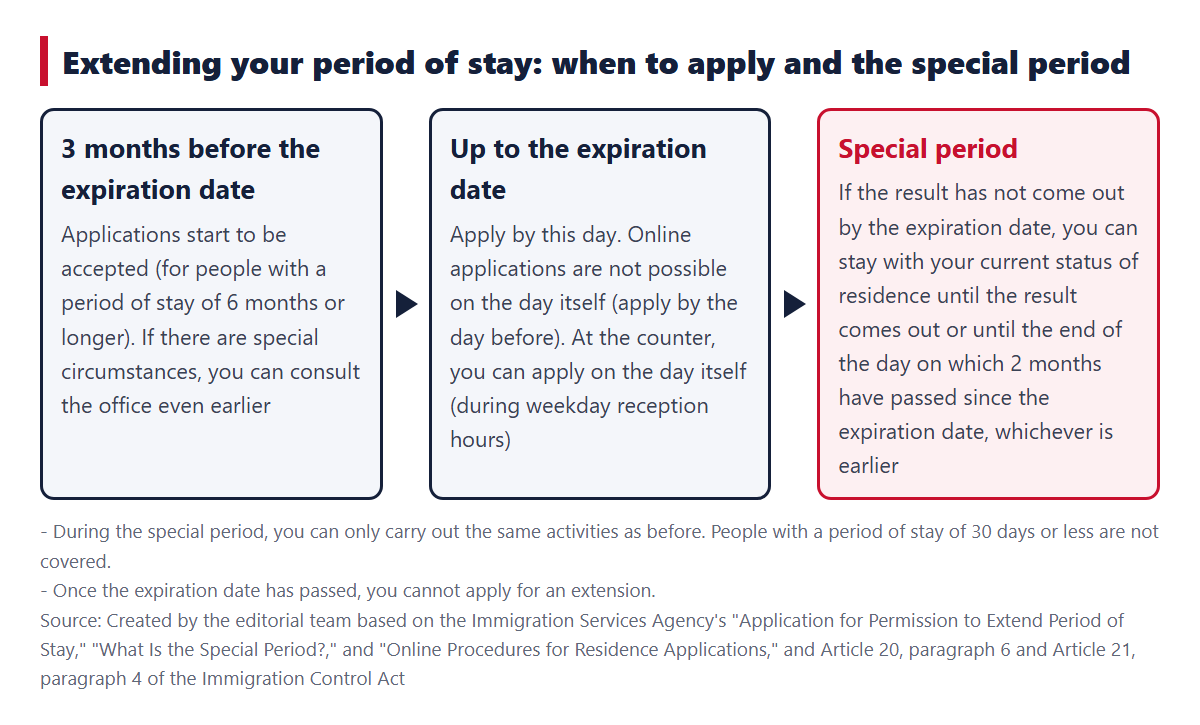
Sources: Created by the editorial team (Immigration Services Agency, “Application for Permission to Extend Period of Stay” (https://www.moj.go.jp/isa/applications/procedures/16-3.html), “What Is the Special Period?” (https://www.moj.go.jp/isa/applications/procedures/tokureikikan_00001.html), “Online Procedures for Residence Applications” (https://www.moj.go.jp/isa/applications/online/onlineshinsei.html), Article 20, paragraph 6 of the Immigration Control Act)
The left of the figure shows when applications start to be accepted, the center shows the last day for applying, and the right shows the special period when the expiration date passes during the examination.
- How to check the expiration date: Look at the “period of stay (date of expiration)” (在留期間満了日) on the front of your residence card. How to read the card is summarized in the following article.
- If your period of stay is less than 6 months: The ISA procedure guidance only says “on or before the expiration date” and does not show from when you can apply. The internal examination guidelines of the immigration authorities state that applications for an extension are accepted from when the remaining period of stay becomes roughly 3 months or less, and that if the period of stay is 3 months or less, they are accepted from when roughly half of that period of stay has passed. For example, if your period of stay is 4 months, the guide is from roughly 3 months before the expiration date, the same as for a period of stay of 6 months or longer. This is not written in the public guidance, so check with the office where you will apply early.
- Where to apply: The Regional Immigration Services Bureau (地方出入国在留管理官署) that has jurisdiction over your place of residence. Reception hours are 9:00 a.m. to 12:00 noon and 1:00 p.m. to 4:00 p.m. on weekdays. However, the ISA says that days and hours may be set differently depending on the procedure, and advises you to contact the Regional Immigration Services Bureau or the Immigration Information Center (外国人在留総合インフォメーションセンター).
- Who can apply: Besides the applicant, people such as staff of the employer or school who have been approved by the Regional Immigration Services Bureau (application agents, 申請取次者), and gyoseishoshi lawyers (行政書士) and attorneys who are qualified to act as agents (those who have notified the Director-General of the Regional Immigration Services Bureau) can submit the application on the applicant’s behalf. Even when an agent submits the application, the applicant must be in Japan.
→ How to obtain an Application Agent Certificate
How the permitted period of stay (how many years) is decided is not covered in this article. The example of Specified Skilled Worker (i) (特定技能1号) is explained in the following article.
→ How is the period of stay for Specified Skilled Worker (i) decided?
(Sources: Immigration Services Agency, “Application for Permission to Extend Period of Stay”, Immigration and Residence Examination Guidelines (入国・在留審査要領), Part 10 (materials disclosed in response to an information disclosure request))
If you want to apply earlier than 3 months before: examples of “special circumstances”
The rule is from 3 months before, but if there are truly unavoidable special circumstances, applications may be accepted 3 months or more in advance. In that case, contact the Regional Immigration Services Bureau where you will apply in advance, with supporting documents.
The ISA lists the following 8 examples. The ISA also shows the documents that need to be submitted.
| Example of special circumstances | Documents to prepare (from the ISA list) |
|---|---|
| Studying abroad | Documents such as the letter of admission from the school abroad, a document showing your contact details and place of stay while studying abroad, and a copy of your flight ticket |
| A long overseas business trip or overseas assignment by order of your employer | The company’s business trip or assignment order, the schedule, a document showing your contact details and place of stay during the trip or assignment, and a copy of your flight ticket (for a business trip, also the hotel reservation confirmation) |
| Pregnancy, with the time of childbirth overlapping the application period | A copy of the Maternal and Child Health Handbook |
| Going back to your home country to give birth | A doctor’s medical certificate, the schedule, a document showing your contact details and place of stay while in your home country, and a copy of your flight ticket |
| Being hospitalized for medical treatment | A doctor’s medical certificate, documents of the hospital, the treatment schedule, and documents showing your place of stay before admission and after discharge |
| Planning to be hospitalized in your home country for medical treatment | A doctor’s medical certificate, documents of the hospital, the treatment schedule, documents showing your place of stay before admission and after discharge, and a copy of your flight ticket |
| Family members applying at the same time | A statement of reasons stating that you wish to apply at the same time |
| A remaining period of stay in Japan of 6 months or more is required to obtain a visa for another country | Documents on that country’s visa, a statement of reasons stating the purpose of obtaining the visa, the travel schedule, and a document showing your contact details and place of stay during the trip |
The ISA says that it may ask for additional documents besides these. Also, reasons such as “I am busy with work” or “I am going on a trip” are not among the examples. Whether an early application is accepted for a reason not in the examples is up to the office where you apply.
Applying early is unlikely to cost you part of your period of stay
Some people worry that applying early will bring forward the start of the new period of stay and put them at a disadvantage. The guidelines state that if permission is granted and the residence card is issued before the expiration date, the new period of stay starts on the day after the current expiration date. If permission is granted after the special period has started, it starts on the day after the residence card is issued.
(Sources: Immigration Services Agency, “Application for Permission to Extend Period of Stay”, Types of unavoidable special circumstances and the supporting documents that must be submitted, Immigration and Residence Examination Guidelines, Part 10 (materials disclosed in response to an information disclosure request))
Can you still make it at the last minute? The expiration date itself, holidays, and online applications
Even on the expiration date itself, you can apply at the counter of the Regional Immigration Services Bureau. However, online applications cannot be used on the expiration date itself.
- On the expiration date itself: Apply at the counter during reception hours.
- Online application: The ISA says that you cannot apply through the online residence application system on the last day of your period of stay (the expiration date itself). Online applications are accepted 24 hours a day, and the day you send the application becomes the date of receipt, so sending it by the day before is in time. However, the ISA warns that the system may be unavailable due to maintenance or heavy access. Make online applications with plenty of time to spare, and apply at the counter when the deadline is close.
- When the expiration date falls on a Saturday, Sunday, or public holiday: This is not written in the ISA procedure guidance. The guidelines state that if the expiration date is a holiday and you apply on the first business day after that, the application is accepted as one made within the period. However, the guidelines also state that this does not extend the period during which you can stay. It is safest to apply by the last business day before the holiday.
How cases are handled when the expiration date approaches before all the documents are ready could not be confirmed in the ISA’s public materials. As soon as you realize you will not make it in time, consult the office where you will apply or a specialist early.
(Sources: Immigration Services Agency, “Application for Permission to Extend Period of Stay”, Immigration Services Agency, “Online Procedures for Residence Applications”, Immigration Services Agency, “Q&A on Online Application Procedures”, Immigration Services Agency, “[Caution Heavy Access to the Online Residence Application System”](https://www.moj.go.jp/isa/11_00121.html), Immigration and Residence Examination Guidelines, Part 10 (materials disclosed in response to an information disclosure request))
If your period of stay expires during the examination: the special period (up to 2 months)
If you apply by the expiration date and the result does not come out by the expiration date, you can continue to stay with your current status of residence. This lasts until whichever of the following comes first:
- When the result (permission or denial) comes out
- The end of the day on which 2 months have passed since the expiration date
During this time, you can carry out the same activities as before. This is called the “special period” and is provided for in Article 20, paragraph 6 of the Immigration Control Act (extensions are treated the same way under Article 21, paragraph 4). The same applies to people who have applied for a change of status of residence.
Points to note during the special period
- You can only carry out your previous activities: You can continue things such as your work at your current employer. Even while an application for a change of status of residence is pending, you cannot work at the new employer or in the new job after the change. The procedures for changing jobs are explained in the following article.
→ Procedures for changing jobs on Specified Skilled Worker status
- Not applicable if your period of stay is 30 days or less: If your period of stay is 30 days or less, the special period does not apply.
- The 2 months are not a deadline for the examination: If the result still has not come out as the 2 months approach, contact the office where you applied.
Proof that an application is pending
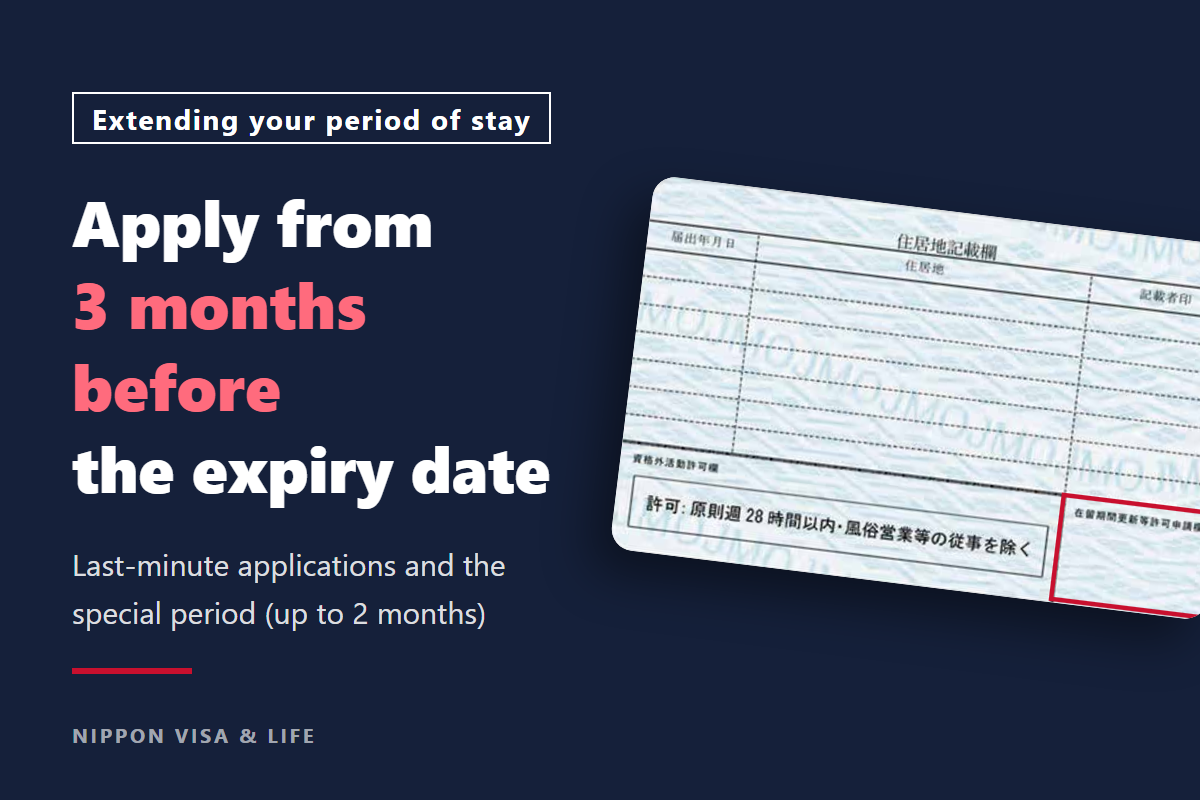
When you apply at the counter, the fact that an application is pending is written in the “Application for Permission to Extend Period of Stay, etc.” column (在留期間更新等許可申請欄) on the back of your residence card. If the expiration date on the front has passed, also look at the back.
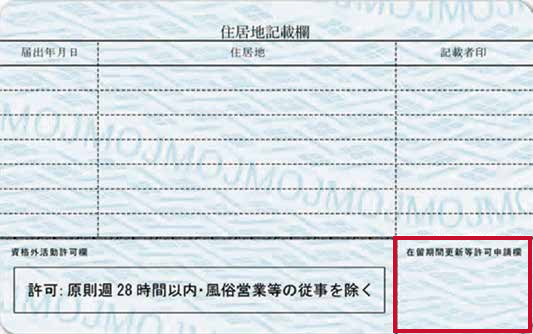
Sources: Immigration Services Agency leaflet “Please Cooperate in the Proper Employment of Foreign Nationals,” page 2 (https://www.moj.go.jp/isa/content/001462230.pdf). The red frame was added by the editorial team
The column in the red frame at the bottom right of the image is where the note that an application is pending is entered.
When you apply online, no “application pending” stamp is put on the back of your residence card. For this reason, always carry the “receipt completion email showing the application receipt number, etc.” together with your residence card. This email is sent to the applicant and to the person who made the application (the user) on the day after the receipt is completed. Be especially careful if the applicant does not have an email address and the application was made with someone else’s address.
(Sources: Immigration Services Agency, “What Is the Special Period?”, Immigration Services Agency, “Proving That an Application Is Pending (Including the Special Period) When You Applied Online”, Immigration Control and Refugee Recognition Act (e-Gov Law Search))
Cautions during the special period: leaving Japan, denial, and missing the deadline
The special period is “a period for waiting for the result.” Note the following points about leaving Japan and about cases where the result is a denial.
Leaving Japan during the special period
You can leave Japan with a special re-entry permit (みなし再入国許可: a system that lets you leave without obtaining a re-entry permit if you return within 1 year of departure). However, under the Immigration Control Act, for a person in the special period, the special re-entry permit is valid only until the end of the special period (the day on which 2 months have passed since the expiration date).
The guidelines state that a person in the special period who wishes to leave Japan is to be told the following:
- If you do not return within the special period, you lose your status of residence when the special period ends
- Even if you re-enter, unless you are granted permission at the Regional Immigration Services Bureau where you applied, you will become an illegal overstayer
It is safest to avoid leaving Japan during the special period as much as possible. If it is truly necessary, consult the office where you applied before you leave.
If your application is denied
If the application is denied during the special period, the guidelines state that, if the applicant wishes, a change to a status of residence for preparing to leave Japan (Designated Activities, 特定活動) will be permitted, and as a rule a period of stay of 30 days or less will be decided. The treatment varies depending on the circumstances, so when you receive the notice, listen carefully to the explanation from the office where you applied and consult a specialist.
If you did not apply by the expiration date
Once the expiration date has passed, you cannot apply for an extension. If you continue to stay, you become an “illegal overstayer” (不法残留), which is subject to deportation and penalties under the Immigration Control Act. If you notice that your deadline has passed, consult the Regional Immigration Services Bureau immediately.
(Sources: Immigration Services Agency, “Special Re-entry Permit”, Immigration Control and Refugee Recognition Act (e-Gov Law Search), Immigration and Residence Examination Guidelines, Part 10 (materials disclosed in response to an information disclosure request))
Quick reference table by situation
Check your situation in the following table.
| Your current situation | What you can do | Basis |
|---|---|---|
| 4 months left until the expiration date | You cannot apply yet (consult if there are special circumstances). Start preparing the documents | ISA procedure guidance |
| 3 months or less until the expiration date | You can apply (if your period of stay is 6 months or longer) | ISA procedure guidance |
| Today is the expiration date | You can apply at the counter. Online is not possible | ISA online procedures |
| The expiration date falls on a Saturday, Sunday, or public holiday | It is safest to apply before the holiday | Examination Guidelines |
| The expiration date passed while the application is pending | Special period. You can continue the same activities as before | Article 20, paragraph 6 and Article 21, paragraph 4 of the Immigration Control Act |
| 2 months from the expiration date are approaching, but there is no result | Contact the office where you applied | Article 20, paragraph 6 of the Immigration Control Act |
| The expiration date passed without an application | You cannot apply for an extension. Consult the Regional Immigration Services Bureau immediately | ISA procedure guidance, Article 24 of the Immigration Control Act |
(Sources: Immigration Services Agency, “Application for Permission to Extend Period of Stay”, Immigration Services Agency, “What Is the Special Period?”, Immigration Services Agency, “Online Procedures for Residence Applications”, Immigration Control and Refugee Recognition Act (e-Gov Law Search))
Preparation starting 3 months before, and the flow up to permission
Start preparing the documents about 3 months before the expiration date. The required documents differ depending on the status of residence. Many documents, such as the resident tax certificate of taxation and certificate of tax payment, are obtained from your city, ward, town, or village office, so check them early. The documents for each status of residence are explained in separate articles (example: Engineer/Specialist in Humanities/International Services, 技術・人文知識・国際業務).
→ What is Engineer/Specialist in Humanities/International Services?
The flow from application to permission is as follows.
- Application: Apply at the counter of the Regional Immigration Services Bureau or online.
- Examination: The standard processing period (a guide to how long the examination takes) shown by the ISA is 2 weeks to 1 month.
- Notice of permission: If permission is granted, you pay the fee. The fee for an application at the counter is 10,000 yen to 75,000 yen, depending on the permitted period of stay (for applications accepted on or after October 1, 2026). For applications accepted by September 30, 2026, the fee is the pre-revision 6,000 yen, even if permission is granted on or after October 1.
→ Fees for visa extensions and changes rise to up to 75,000 yen
- Receiving the new residence card: You receive a card showing the new period of stay.
If HR staff keep a list of the expiration dates of the period of stay for each foreign employee and remind the employee 3 months in advance, applications are less likely to be delayed.
(Sources: Immigration Services Agency, “Application for Permission to Extend Period of Stay”)
Frequently asked questions
Q1. If I apply earlier than 3 months before, will my application not be accepted?
The rule is from 3 months before. If there are special circumstances listed by the ISA, such as studying abroad, a long overseas assignment, childbirth, hospitalization, or family members applying at the same time, the application may be accepted earlier than that. Contact the office where you will apply in advance, with supporting documents (ISA, “Application for Permission to Extend Period of Stay”).
Q2. Can I work during the special period?
You can continue if it is the same work as before. People with a pending application for a change of status of residence cannot work at the new employer or in the new job after the change (Article 20, paragraph 6 of the Immigration Control Act; ISA, “What Is the Special Period?”).
However, Technical Intern Training (技能実習) is an activity carried out under an approved technical intern training plan, so after the period of the plan ends, you cannot engage in (work as) technical intern training, even if you can continue to stay during the special period. For example, for the case where the plan for No. 1 ends while an application for a change to the next stage (Technical Intern Training (ii)) is pending, the Operational Guidelines for the Technical Intern Training Program state that staying in Japan until the result comes out is allowed, but engaging in technical intern training is not (Immigration Services Agency and Ministry of Health, Labour and Welfare, “Operational Guidelines for the Technical Intern Training Program,” April 2026 (Reiwa 8) edition). The immigration examination guidelines also state that technical intern training beyond the period of the plan, including that during the special period, may be an activity outside the scope of the status of residence.
Q3. Can I go back to my home country temporarily during the special period?
You can leave Japan with a special re-entry permit, but you need to return by the day on which 2 months have passed since the expiration date. We do not recommend it. If it is truly necessary, consult the office where you applied before you leave (ISA, “Special Re-entry Permit”; Article 26-2 of the Immigration Control Act).
Q4. If I apply online, is nothing written on my residence card?
Nothing is written. Carry the receipt completion email, which arrives the next day, together with your residence card (ISA, “Proving That an Application Is Pending (Including the Special Period) When You Applied Online”).
Q5. Can my family members’ extensions be applied for at the same time?
Family members applying at the same time is one of the examples of special circumstances for which applications are accepted earlier than 3 months before. Prepare a statement of reasons stating that you wish to apply at the same time (ISA, “Types of unavoidable special circumstances and the supporting documents that must be submitted”).
Summary and where to get advice
- If your period of stay is 6 months or longer, you can apply from 3 months before the expiration date up to the expiration date.
- If there are special circumstances, you can consult the office even earlier than 3 months before.
- On the expiration date itself, you cannot apply online; you can only apply at the counter (during reception hours). Apply online with time to spare and send it by the day before.
- Even if the expiration date passes during the examination, you can carry out the same activities as before during the special period (up to 2 months from the expiration date).
- If you leave Japan during the special period and cannot return within the 2-month limit, you may lose your status of residence.
- Once the expiration date has passed, you cannot apply for an extension.
Questions about how to fill in the application form and about procedures are handled by the Regional Immigration Services Bureau that has jurisdiction over your place of residence, or by the Immigration Information Center (0570-013904; from IP phones and from overseas, 03-5796-7112). If you are unsure whether you will make it in time given your circumstances, or which documents you need, consult a specialist.
Primary Sources Referenced in Article Creation
- Immigration Services Agency, “Application for Permission to Extend Period of Stay”
- Immigration Services Agency, “What Is the Special Period?”
- Immigration Services Agency, “Types of unavoidable special circumstances and the supporting documents that must be submitted”
- Immigration Services Agency, “Application for Permission to Change Status of Residence”
- Immigration Services Agency, “Online Procedures for Residence Applications”
- Immigration Services Agency, “Q&A on Online Application Procedures”
- Immigration Services Agency, “[Caution Heavy Access to the Online Residence Application System”](https://www.moj.go.jp/isa/11_00121.html)
- Immigration Services Agency, “Proving That an Application Is Pending (Including the Special Period) When You Applied Online”
- Immigration Services Agency, “Special Re-entry Permit”
- Immigration Services Agency leaflet, “Please Cooperate in the Proper Employment of Foreign Nationals”
- Immigration Services Agency, “Guidebook on Living and Working”
- Immigration Control and Refugee Recognition Act (Articles 20, 21, 24, 26-2, and 70) (e-Gov Law Search)
- Immigration Services Agency and Ministry of Health, Labour and Welfare, “Operational Guidelines for the Technical Intern Training Program” (April 2026 (Reiwa 8))
- Immigration and Residence Examination Guidelines, Parts 10 and 12 (materials disclosed in response to an information disclosure request)
This article is a translation of the original Japanese version.