This article was written by the NIPPON VISA & LIFE editorial team based on information from public organizations such as the national government and local governments. Rules and fees may differ depending on the city, ward, town or village where you live.
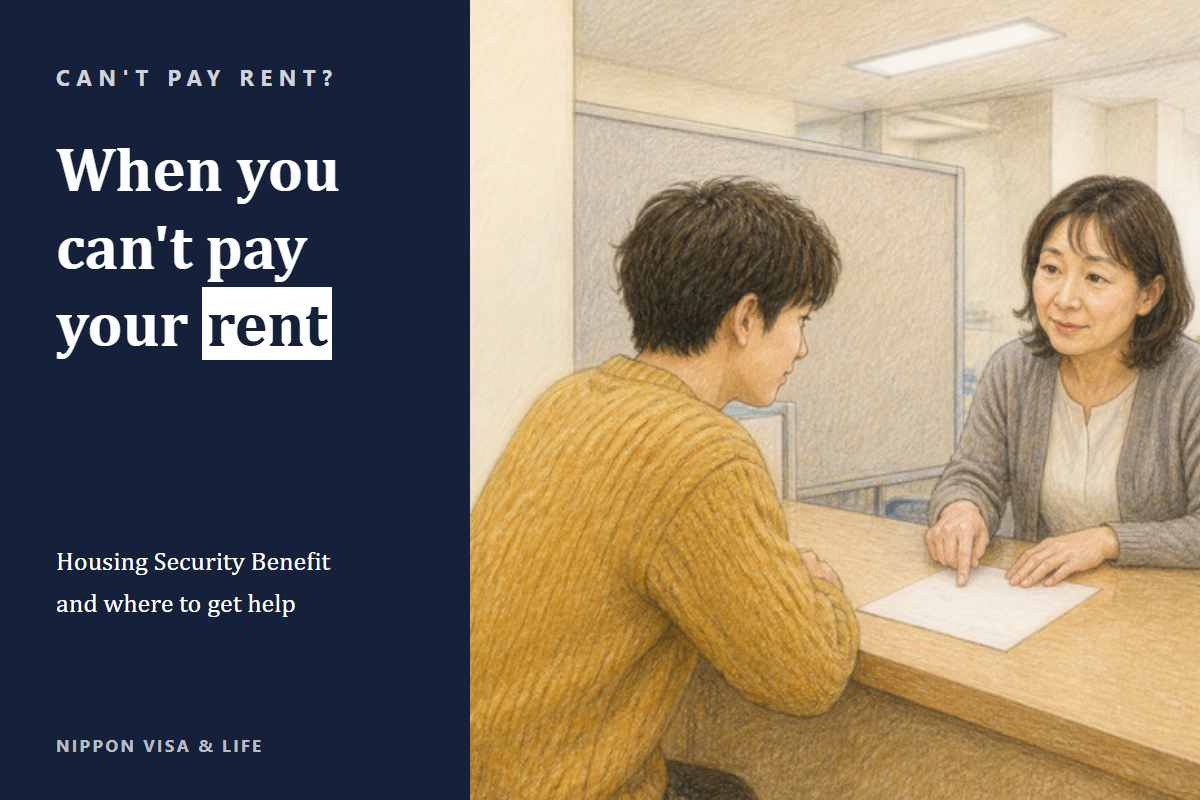
If you lose your job or your income goes down in Japan and you may not be able to pay your rent, do not worry alone. Consult the Self-Reliance Support Consultation Office (jiritsu sodan shien kikan, 自立相談支援機関; a place to get help for people having trouble making a living) in the area where you live as early as possible. If you meet the conditions, you may be able to receive support for the amount of your rent through the national government’s Housing Security Benefit (jukyo kakuho kyufukin, 住居確保給付金).
The whole process of renting an apartment is explained in How to Rent an Apartment and Move in Japan: Finding a Home, Contracts, Move-in Costs, Moving In, House Rules and Moving Out.
The Short Answer: What to Do If You May Not Be Able to Pay Your Rent
- Check your contract again for the rent amount, the payment date and how to pay
- If you have left your job or your income has gone down, consult the Self-Reliance Support Consultation Office in the area where you live
- If you meet the conditions, apply for the Housing Security Benefit (support for rent)
- If you need to move to an apartment with lower rent, also ask about the Housing Security Benefit’s support for moving costs
- When you look for a job, register as a job seeker at Hello Work (the national government’s job search office)
(Sources: Ministry of Health, Labour and Welfare “Guide to the Housing Security Benefit”, Ministry of Health, Labour and Welfare “Self-Reliance Support System for Needy Persons”)
The Basics of Paying Rent in Japan
In rental housing in Japan, you pay rent every month by a set date. The Ministry of Land, Infrastructure, Transport and Tourism’s “Apartment Search Guidebook” explains it as follows.
| Item | Details |
|---|---|
| Rent (yachin) | The fee for renting an apartment. It is common to pay the next month’s rent by the end of each month |
| Common service fee (kyoekihi) / management fee | The cost of electricity and cleaning for places everyone uses, such as stairs and hallways. It is separate from the rent, and it is common to pay it together with the rent |
| Moving in or out in the middle of a month | As a rule, rent is calculated per day (based on the number of days you used the apartment) |
Check the payment date and how to pay in your contract or in the explanation you received when you moved in.
(Sources: Ministry of Land, Infrastructure, Transport and Tourism “Apartment Search Guidebook”)
If You Use a Guarantee Company
Rental contracts in Japan require you to use a rent guarantee company (yachin saimu hosho gaisha; a company that takes the place of a guarantor) or to have a joint guarantor (a person who pays for you if you cannot pay the rent). If you cannot pay the rent, the guarantee company pays that money to the landlord. However, this is not insurance. The guarantee company will later ask the tenant to pay back the money it paid. Be careful: it does not mean you no longer have to pay the rent.
(Sources: Ministry of Land, Infrastructure, Transport and Tourism “Apartment Search Guidebook”)
What Is the Housing Security Benefit?
The Housing Security Benefit is a national government benefit based on a law called the “Act on Self-Reliance Support for Needy Persons” (seikatsu konkyusha jiritsu shien ho). It is money to protect the homes of people who have lost their home or who may not be able to pay their rent. There are the following two types.
| Type | Details |
|---|---|
| Support for rent | For people whose income has gone down because they left their job or for similar reasons and who are having trouble paying rent. It supports the amount of the rent, on conditions such as looking for a job |
| Support for moving costs | For people whose income has gone down a lot and who need to move to an apartment with lower rent. It supports the cost of moving |
The support for moving costs started in April 2025.
(Sources: Ministry of Health, Labour and Welfare “Guide to the Housing Security Benefit”, Ministry of Health, Labour and Welfare “Main System Changes Related to the Ministry of Health, Labour and Welfare (April 2025)”)
Support for Rent: Who Is Covered and the Main Conditions
Who Is Covered
People who have lost their home or who may not be able to pay their rent, and who fall under ① or ② below.
- People within 2 years of leaving their job or closing their business
- People whose income has gone down because of a leave of absence or similar situation that was not their own fault or their own choice
Main Conditions
- Income: Your income must be less than the “standard amount” plus the “rent amount”. There is an upper limit on the rent amount.
- Assets: The total of your savings and the cash you have must be no more than 6 times the standard amount (if that amount is more than 1,000,000 yen, no more than 1,000,000 yen).
- Looking for a job: You must register with Hello Work or a similar office and look for a job. Self-employed people and others may meet the condition by working to improve their business.
The standard amount is different depending on the local government where you live. Check the amount for your situation at the consultation office below.
How Much You Can Receive and for How Long
| Item | Details |
|---|---|
| Amount | The rent amount (with an upper limit) |
| Period | As a rule, 3 months (up to 9 months) |
| How it is paid | As a rule, the local government pays it directly into the bank account of the landlord or similar (the person renting out the apartment) |
As a rule, the benefit is not paid into your own account but directly to the landlord or similar.
(Sources: Ministry of Health, Labour and Welfare “Guide to the Housing Security Benefit”)
Support for Moving Costs: When You Move to an Apartment With Lower Rent
This is for people whose income has gone down a lot, who have lost their home or may not be able to pay their rent, and who need to move to an apartment with lower rent to get their household finances back on track.
- Examples of who is covered: people whose household income went down because their spouse died, and people who left their job because of illness and cannot work to increase their income
- Conditions: The income and asset conditions are the same as for the support for rent. In addition, as part of the household budget support at the consultation office, it must be recognized that moving will improve your household finances.
- What is paid: The cost of moving. However, there is an upper limit, and some costs are not covered, such as the security deposit (shikikin) and advance rent (rent paid ahead of time).
Even if the rent at your new home is a little higher than now, you may be covered if your household finances improve overall, for example because you live closer to your hospital and your transportation costs go down.
(Sources: Ministry of Health, Labour and Welfare “Guide to the Housing Security Benefit”)
Where to Consult and Apply
Self-Reliance Support Consultation Office
The place to ask about the Housing Security Benefit is the Self-Reliance Support Consultation Office in the area where you live. A Self-Reliance Support Consultation Office is a place to get help for people having trouble making a living, and it gives advice on work, household finances, housing and more. A support worker listens to you, thinks together with you about what kind of support you need, and makes a support plan.
How to find one
- Open the “List of Self-Reliance Support Consultation Offices” and choose the prefecture where you live.
- Find the phone number of the office for the city, ward, town or village where you live, and contact them.
- If the contact information is not in the list, ask your prefecture or your city, ward, town or village.
(Sources: Ministry of Health, Labour and Welfare “Guide to the Housing Security Benefit”, Ministry of Health, Labour and Welfare “Self-Reliance Support System for Needy Persons”, Immigration Services Agency “Guidebook on Living and Working”)
If You Want to Borrow Money for Living Costs: The Council of Social Welfare
There is also the “Livelihood Welfare Fund Loan Program” (seikatsu fukushi shikin kashitsuke seido, 生活福祉資金貸付制度), through which households with low income and others can borrow money they need for living. This is a loan (borrowing money), so you need to pay it back later. The place to apply is the Council of Social Welfare (shakai fukushi kyogikai, 社会福祉協議会) of the city, ward, town or village where you live. There is also a call center for the Livelihood Welfare Fund Loan Program (phone 0120-46-1999, weekdays 9:00 to 17:00).
(Sources: Ministry of Health, Labour and Welfare “Livelihood Welfare Fund Loan Program”)
If You Have a Problem
I Just Left My Job and Have Not Found the Next One
Register as a job seeker at Hello Work. Looking for a job is a condition of the Housing Security Benefit’s support for rent. If you were covered by employment insurance at your company, you may be able to receive benefits for when you lose your job. For details, see Unemployment Benefits in Japan After Leaving Your Job: Separation Notice, Hello Work Procedures, Conditions and How Long You Can Receive Them.
(Sources: Ministry of Health, Labour and Welfare “Guide to the Housing Security Benefit”)
If I Receive the Housing Security Benefit, Can I Always Keep Paying My Rent?
Not necessarily. Whether you meet the conditions depends on your income, assets and other factors. Also, the payment period is limited (as a rule 3 months, up to 9 months), and there is an upper limit on the amount. It is important to work on finding your next job and getting your household finances back on track while you receive the benefit.
(Sources: Ministry of Health, Labour and Welfare “Guide to the Housing Security Benefit”)
I Cannot Find a New Apartment to Rent
If you have trouble when looking for an apartment with lower rent, for example because you have no guarantor or you are turned down, you can also use the national government’s housing support. For “Safety Net Housing”, rental housing registered as housing that does not refuse people who have difficulty renting, such as foreign residents, and “Housing Support Corporations”, which help people find an apartment, see Where to Get Help When It Is Hard to Rent an Apartment in Japan: Safety Net Housing, Housing Support Corporations, Rent Guarantee Companies and Help in Foreign Languages.
Primary Sources Used for This Article
- Ministry of Health, Labour and Welfare “Guide to the Housing Security Benefit”
- Ministry of Health, Labour and Welfare “Main System Changes Related to the Ministry of Health, Labour and Welfare (April 2025)”
- Ministry of Health, Labour and Welfare “Self-Reliance Support System for Needy Persons”
- Ministry of Health, Labour and Welfare “Livelihood Welfare Fund Loan Program”
- List of Self-Reliance Support Consultation Offices (information sharing site for the Self-Reliance Support System for Needy Persons)
- Ministry of Land, Infrastructure, Transport and Tourism “Apartment Search Guidebook” (Japanese version)
- Immigration Services Agency “Guidebook on Living and Working”
This article is a translation of the original Japanese version.