This article was written by the NIPPON VISA & LIFE editorial team based on information from public organizations such as the national government and local governments. Rules and fees may differ depending on the city, ward, town or village where you live.
In Japan, the minimum rules on working hours, breaks and holidays are set by a law called the Labor Standards Act. When you work beyond the set hours, the company must pay “overtime pay” (premium wages), which is more than your usual pay. The same rules apply not only to regular employees but also to part-time workers, “arubaito” (casual part-time) workers, dispatched workers and contract employees.
The Short Answer: An Overview of the Rules on Working Hours
- In principle, working hours are up to 8 hours a day and 40 hours a week (statutory working hours)
- When you work more than 6 hours a day, you get a break of at least 45 minutes, and when you work more than 8 hours, a break of at least 60 minutes
- You get holidays at least once every week, or at least 4 days in 4 weeks (statutory holidays)
- To have employees work beyond the statutory working hours or on statutory holidays, a written agreement between the company and a representative of the workers (the 36 Agreement) is required
- Premium wages are paid for hours worked beyond the statutory working hours, and for hours worked on statutory holidays or late at night
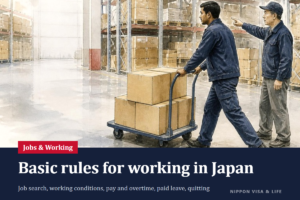
An overview of finding a job and working is available in The Basics of Finding a Job and Working in Japan: Hello Work, Working Conditions, Wages and Overtime, Paid Leave, Quitting and Where to Get Help.
Working Hours: 8 Hours a Day and 40 Hours a Week
- Under the Labor Standards Act, employees must not be made to work more than 8 hours a day or 40 hours a week, excluding break time. These are called the “statutory working hours”
- The working hours set by the company in its work rules or employment contract are called the “scheduled working hours” (shotei rodo jikan). The scheduled working hours may be shorter than the statutory working hours
- You can check your own scheduled working hours in the notice of working conditions (a document that states your working conditions) you receive before starting work, or in your employment contract
There Are 2 Kinds of “Overtime”
The time usually called “overtime” (zangyo) includes the following 2 kinds.
| Kind | Example (a company where the scheduled working hours are 7 hours a day) | Premium wages |
|---|---|---|
| Hours beyond the scheduled working hours but within the statutory working hours (8 hours a day) | The 1 hour from the end of the 7th hour up to 8 hours | No premium is set by law. How it is paid is decided by the work rules or the employment contract |
| Hours beyond the statutory working hours (overtime work) | Hours beyond 8 hours | A premium of 25% or more is required |
In both cases, you are paid wages for the hours you worked. Check how your company handles this in its work rules or your notice of working conditions.
(Sources: Labor Standards Act Articles 32 and 37 (e-Gov Laws and Regulations Search))
Breaks: 45 Minutes After More Than 6 Hours, 60 Minutes After More Than 8 Hours
| Working hours in a day | Break time (at least) |
|---|---|
| 6 hours or less | Not set by law |
| More than 6 hours and up to 8 hours | 45 minutes |
| More than 8 hours | 60 minutes |
- Breaks are given during working hours. They cannot be put together before work starts or after work ends
- In principle, break time is time you can use freely
- In principle, breaks are given to everyone at the workplace at the same time. However, if the company and a representative of the workers make a written agreement, breaks can also be taken in turns
(Sources: Labor Standards Act Article 34 (e-Gov Laws and Regulations Search), Immigration Services Agency “Guidebook on Living and Working” Chapter 3, 2-2)
Holidays: Once Every Week, or 4 Days in 4 Weeks
- The company must give at least 1 holiday every week. Another way is to give 4 or more holidays over 4 weeks. These holidays set by law are called “statutory holidays”
- Even at a company where both Saturday and Sunday are days off, only 1 of those days is the holiday set by law (statutory holiday). Check which day is the statutory holiday in the work rules or similar documents
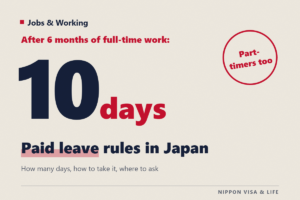
- In addition to holidays, there is “annual paid leave”, which lets you take days off with pay under set conditions. If you work continuously for 6 months and come to work on at least 80% of the set working days, you get 10 days of annual paid leave. For part-time workers and others who work fewer days or hours a week, the number of days you get is smaller, depending on the number of days you work
(Sources: Labor Standards Act Article 35 (e-Gov Laws and Regulations Search), Immigration Services Agency “Guidebook on Living and Working” Chapter 3, 2-2)
Overtime (Overtime Work and Holiday Work) and the 36 Agreement
- When a company has employees work beyond the statutory working hours or on statutory holidays, it must make a written agreement with the labor union (or, if there is none, with a person representing a majority of the workers). Because it is in Article 36 of the Labor Standards Act, it is called the “36 Agreement” (saburoku kyotei)
- There are upper limits on overtime hours. In principle, the limits are 45 hours a month and 360 hours a year
- Even when there are special temporary circumstances, the following limits apply
| Item | Limit |
|---|---|
| Overtime work | Within 720 hours a year |
| Overtime work + holiday work | Less than 100 hours a month |
| Overtime work + holiday work (average over 2 to 6 months) | The average for every period must be within 80 hours a month |
| Months in which overtime work may exceed 45 hours a month | Up to 6 months a year |
For some jobs, such as driving vehicles, the upper limits are different or these upper limits do not apply.
(Sources: Immigration Services Agency “Guidebook on Living and Working” Chapter 3, 2-3 (1) Overtime Work and Holiday Work, Labor Standards Act Article 36 and Supplementary Provisions Article 140 (e-Gov Laws and Regulations Search))
Premium Rates for Overtime Pay (Premium Wages)
| Hours worked | Premium rate |
|---|---|
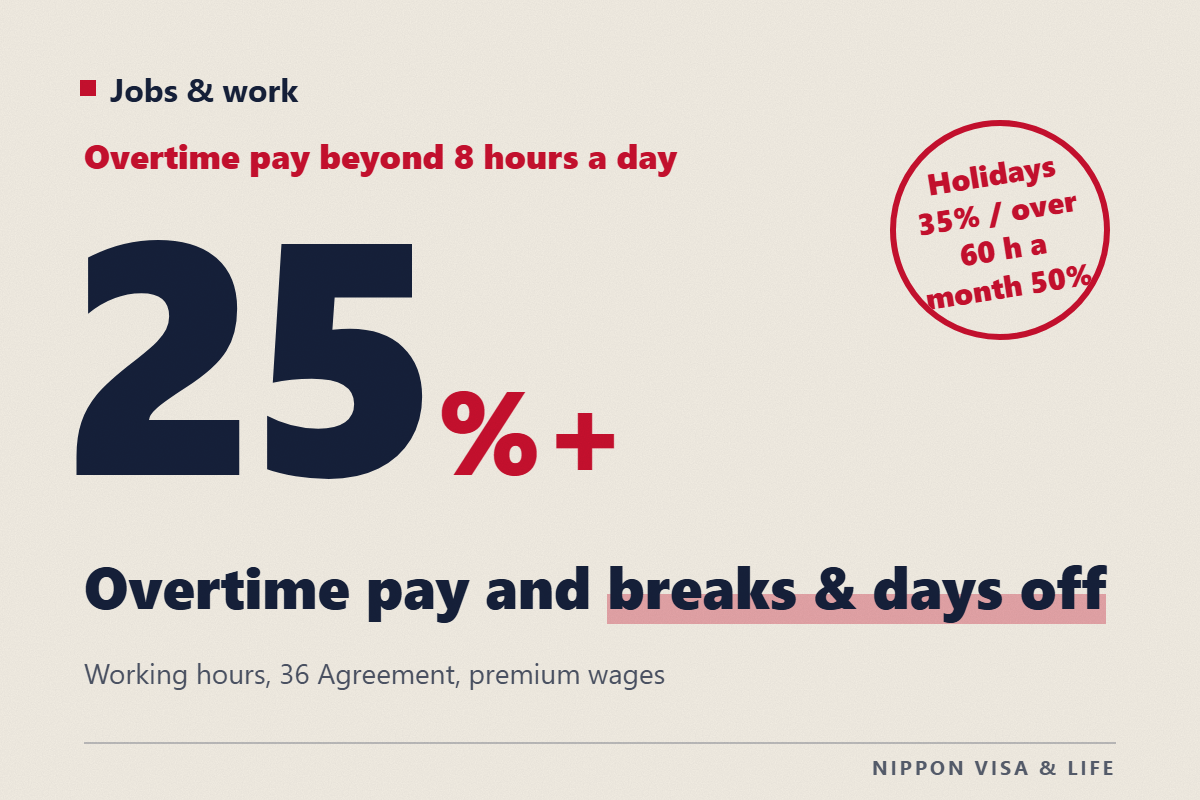
| When you work beyond the statutory working hours (overtime work) | 25% or more |
| The part of overtime work that exceeds 60 hours in a month | 50% or more |
| When you work on a statutory holiday (holiday work) | 35% or more |
| When you work from 10 p.m. to 5 a.m. (late-night work) | 25% or more |
- The rates can be combined. For example, when you work beyond the statutory working hours and also late at night, the premium is 25% + 25% = 50% or more
- “A premium of 25% or more” means that you are paid at least 1.25 times your usual hourly wage
- The law sets that family allowances, commuting allowances and similar allowances are not included in the base wages used to calculate premium wages
- Premium wages apply to all workers regardless of their type of employment. They must also be paid to dispatched workers, contract employees, part-time workers and “arubaito” workers
How to read the overtime hours and overtime pay sections of your pay slip is explained in How to Read a Pay Slip in Japan: Payments, Deductions and Attendance Sections, and How Income Tax, Resident Tax and Social Insurance Premiums Are Deducted.
(Sources: Immigration Services Agency “Guidebook on Living and Working” Chapter 3, 2-3 (2) Premium Wages, Labor Standards Act Article 37 (e-Gov Laws and Regulations Search))
When You Have a Problem and Common Questions
Do Part-Time and “Arubaito” Workers Also Get Overtime Pay?
Yes. Premium wages apply to all workers regardless of their type of employment. Premium wages are paid for hours worked beyond the statutory working hours, and for hours worked on statutory holidays or late at night.
Can I Refuse Overtime While Pregnant?
People who are pregnant and people who gave birth less than 1 year ago can choose not to do overtime work, holiday work or late-night work if they request it from their company.
Should I Keep Records of the Hours I Worked?
When you discuss overtime pay with your company or consult a consultation service, having records of when and how many hours you worked makes it easier to explain. It is a good idea to keep your own records of the times you started and finished work, copies of your time cards, and your pay slips.
Can I Claim Unpaid Overtime Pay Later?
Under the Labor Standards Act, the period during which you can claim unpaid wages (including overtime pay) is currently 3 years (5 years for retirement allowances). After this period has passed, you may no longer be able to claim them. For how this applies to your own case, consult the consultation services below.
What If Overtime Pay Is Not Paid or the Overtime Is Too Long?
For problems with working conditions, such as unpaid overtime pay, not being able to take breaks, or overtime that is too long, you can consult the Labour Standards Inspection Office in charge of the area where your company is located, or the Ministry of Health, Labour and Welfare’s consultation services in foreign languages (see “Consultation Services Available in Foreign Languages” below). If you feel unwell from working too much, go to a hospital early.
Consultation Services Available in Foreign Languages
- For problems with working conditions such as wages, overtime pay and working hours, you can consult by telephone in foreign languages through the Ministry of Health, Labour and Welfare’s “Consultation Dial for Foreign Workers” and “Working Conditions Consultation Hotline”. Check the telephone numbers and days for each language on the Ministry of Health, Labour and Welfare’s “Consultation Services for Foreign Workers” page
- You can also consult the Labour Bureau of each prefecture or a Labour Standards Inspection Office. Only some Labour Bureaus and Labour Standards Inspection Offices have services available in foreign languages. Check the locations, days and hours on the page above, and if there is none near you, use the telephone consultation services
Primary Sources Used for This Article
- Immigration Services Agency “Guidebook on Living and Working” (8th edition) (Chapter 3: Employment and Labor)
- Labor Standards Act Articles 32, 34, 35, 36, 37 and 115, Supplementary Provisions Articles 140 and 143 (e-Gov Laws and Regulations Search)
- Ministry of Health, Labour and Welfare “Consultation Services for Foreign Workers” (Check Working Conditions)
This article is a translation of the original Japanese version.