This article was written by the NIPPON VISA & LIFE editorial team based on information from public organizations such as the national government and local governments. Rules and fees may differ depending on the city, ward, town or village where you live.
In Japan, the lowest amount of pay (the minimum wage) is set by law. The amount differs for each prefecture and changes around autumn every year. Companies must pay workers at least the minimum wage. This article explains how to check the minimum wage and how to make sure your pay is not below it.
The Short Answer: How to Check the Minimum Wage
- Check the prefecture where you work (not where you live)
- On the Ministry of Health, Labour and Welfare’s “List of Regional Minimum Wages Nationwide“, look up that prefecture’s amount (the amount per hour) and the date the new amount starts to apply (the effective date)
- Convert your pay into an amount per hour and compare it with the minimum wage (if you are paid by the hour, compare it as it is)
- If your pay is below the minimum wage, check with your company, or consult the Labour Standards Inspection Office or a consultation service in foreign languages
An overview of finding a job and working is available in The Basics of Finding a Job and Working in Japan: Hello Work, Working Conditions, Wages and Overtime, Paid Leave, Quitting and Where to Get Help.
What Is the Minimum Wage?
The minimum wage is the lowest amount of pay set by the national government based on a law called the Minimum Wage Act. Companies must pay at least that amount.
- Even if a worker and a company agree on “pay lower than the minimum wage”, that agreement is invalid by law. It is treated as an agreement for the same amount as the minimum wage
- If a company pays only less than the minimum wage, the company must pay the difference
- For companies that pay only less than the regional minimum wage, the Minimum Wage Act sets a penalty (a fine of up to 500,000 yen)
(Source: Ministry of Health, Labour and Welfare “Minimum Wage System” What Is the Minimum Wage?)
It Also Applies to Part-Time and “Arubaito” Workers
The regional minimum wage applies to all workers who work at a workplace in that prefecture, regardless of their way of working (type of employment) or what they are called, such as part-time workers, “arubaito” (casual part-time) workers, temporary workers or “shokutaku” (contract) workers.
As an exception, only when a company has received permission from the Director of the Prefectural Labour Bureau, the minimum wage may be lowered for some people, such as people in a probationary period (a period of working on a trial basis) (special reduction rule). Without permission, at least the minimum wage must be paid even during a probationary period.
(Source: Ministry of Health, Labour and Welfare “Minimum Wage System” Who Does It Apply To?)
There Are Two Types of Minimum Wage
| Type | What kind of minimum wage | Number |
|---|---|---|
| Regional minimum wage | Applies to everyone working in that prefecture, regardless of industry or type of job | 1 for each prefecture (47 in total) |
| Specified (industry-specific) minimum wage | Applies to people working in specific industries. The amount is higher than the regional minimum wage | 223 nationwide (as of April 1, Reiwa 8) |
If both apply to you, you must be paid at least the higher amount. The specified (industry-specific) minimum wage may not apply to people such as those under 18 or 65 and over, and the details differ for each minimum wage. Check whether your job is covered using “How to Check the Minimum Wage” below.
(Source: Ministry of Health, Labour and Welfare “Minimum Wage System” What Types of Minimum Wage Are There?)
Regional Minimum Wages for FY Reiwa 8 (47 Prefectures)
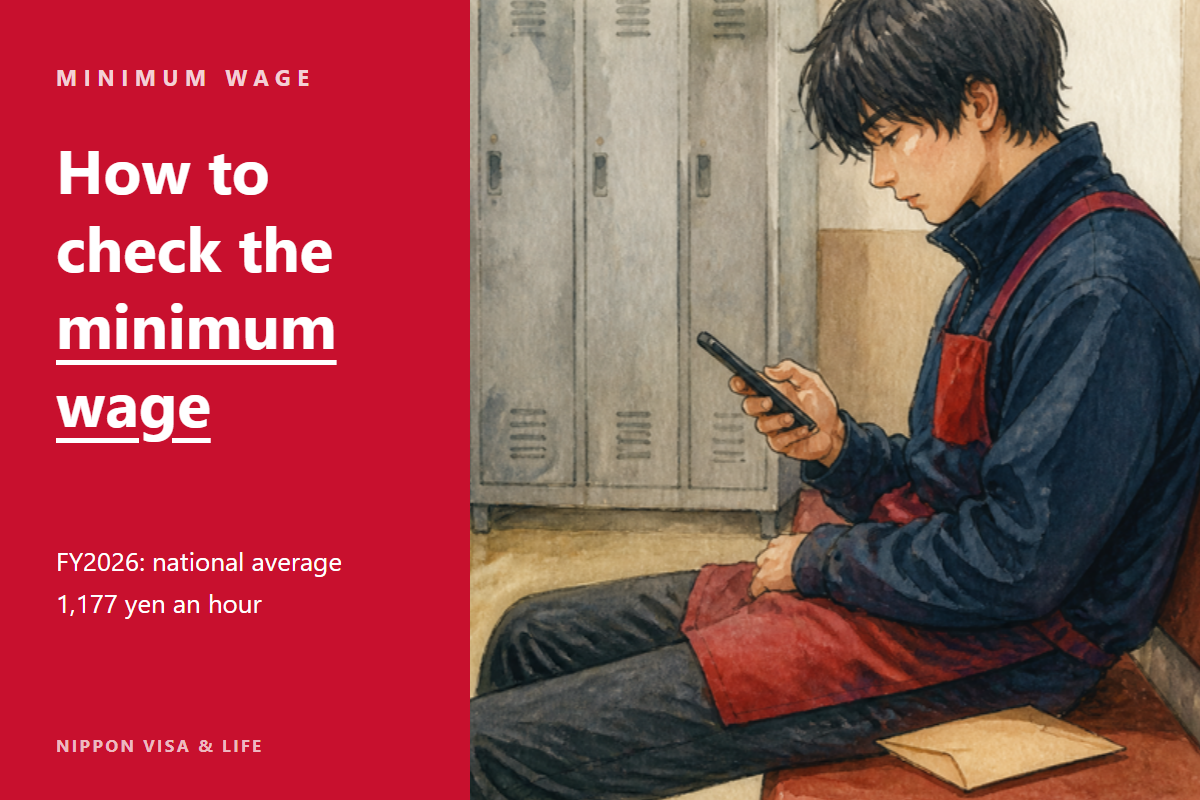
In FY Reiwa 8, the minimum wage went up in all 47 prefectures. The national weighted average (a guide to the nationwide average) is 1,177 yen per hour (the previous year was 1,121 yen).
The date the new amount starts to apply (the effective date) differs for each prefecture (October 1 to December 2, Reiwa 8). Until the day before the effective date, the previous year’s amount applies.
| Prefecture | Minimum wage (hourly) | Effective date | Previous year’s amount |
|---|---|---|---|
| Hokkaido | 1,131 yen | October 1, Reiwa 8 | 1,075 yen |
| Aomori | 1,090 yen | October 29, Reiwa 8 | 1,029 yen |
| Iwate | 1,090 yen | December 1, Reiwa 8 | 1,031 yen |
| Miyagi | 1,098 yen | October 1, Reiwa 8 | 1,038 yen |
| Akita | 1,090 yen | October 14, Reiwa 8 | 1,031 yen |
| Yamagata | 1,092 yen | October 30, Reiwa 8 | 1,032 yen |
| Fukushima | 1,094 yen | October 16, Reiwa 8 | 1,033 yen |
| Ibaraki | 1,136 yen | October 18, Reiwa 8 | 1,074 yen |
| Tochigi | 1,125 yen | October 1, Reiwa 8 | 1,068 yen |
| Gunma | 1,120 yen | October 3, Reiwa 8 | 1,063 yen |
| Saitama | 1,196 yen | October 1, Reiwa 8 | 1,141 yen |
| Chiba | 1,195 yen | October 1, Reiwa 8 | 1,140 yen |
| Tokyo | 1,280 yen | October 1, Reiwa 8 | 1,226 yen |
| Kanagawa | 1,279 yen | October 1, Reiwa 8 | 1,225 yen |
| Niigata | 1,108 yen | October 1, Reiwa 8 | 1,050 yen |
| Toyama | 1,119 yen | October 1, Reiwa 8 | 1,062 yen |
| Ishikawa | 1,113 yen | October 3, Reiwa 8 | 1,054 yen |
| Fukui | 1,112 yen | October 4, Reiwa 8 | 1,053 yen |
| Yamanashi | 1,113 yen | November 1, Reiwa 8 | 1,052 yen |
| Nagano | 1,117 yen | October 2, Reiwa 8 | 1,061 yen |
| Gifu | 1,121 yen | October 1, Reiwa 8 | 1,065 yen |
| Shizuoka | 1,154 yen | October 15, Reiwa 8 | 1,097 yen |
| Aichi | 1,195 yen | October 1, Reiwa 8 | 1,140 yen |
| Mie | 1,143 yen | October 1, Reiwa 8 | 1,087 yen |
| Shiga | 1,136 yen | October 3, Reiwa 8 | 1,080 yen |
| Kyoto | 1,180 yen | November 16, Reiwa 8 | 1,122 yen |
| Osaka | 1,231 yen | October 1, Reiwa 8 | 1,177 yen |
| Hyogo | 1,172 yen | October 1, Reiwa 8 | 1,116 yen |
| Nara | 1,107 yen | October 4, Reiwa 8 | 1,051 yen |
| Wakayama | 1,101 yen | October 3, Reiwa 8 | 1,045 yen |
| Tottori | 1,090 yen | October 3, Reiwa 8 | 1,030 yen |
| Shimane | 1,092 yen | October 10, Reiwa 8 | 1,033 yen |
| Okayama | 1,104 yen | October 2, Reiwa 8 | 1,047 yen |
| Hiroshima | 1,141 yen | October 11, Reiwa 8 | 1,085 yen |
| Yamaguchi | 1,101 yen | October 8, Reiwa 8 | 1,043 yen |
| Tokushima | 1,103 yen | November 1, Reiwa 8 | 1,046 yen |
| Kagawa | 1,092 yen | October 1, Reiwa 8 | 1,036 yen |
| Ehime | 1,093 yen | November 1, Reiwa 8 | 1,033 yen |
| Kochi | 1,086 yen | October 29, Reiwa 8 | 1,023 yen |
| Fukuoka | 1,114 yen | October 4, Reiwa 8 | 1,057 yen |
| Saga | 1,095 yen | November 15, Reiwa 8 | 1,030 yen |
| Nagasaki | 1,087 yen | November 2, Reiwa 8 | 1,031 yen |
| Kumamoto | 1,092 yen | December 1, Reiwa 8 | 1,034 yen |
| Oita | 1,096 yen | November 1, Reiwa 8 | 1,035 yen |
| Miyazaki | 1,085 yen | October 24, Reiwa 8 | 1,023 yen |
| Kagoshima | 1,090 yen | October 25, Reiwa 8 | 1,026 yen |
| Okinawa | 1,086 yen | December 2, Reiwa 8 | 1,023 yen |
The minimum wage changes every year. Always check the latest amount using “How to Check the Minimum Wage” below.
(Sources: Ministry of Health, Labour and Welfare “List of Regional Minimum Wages Nationwide for FY Reiwa 8”, Ministry of Health, Labour and Welfare “List of Regional Minimum Wages Nationwide”)
How to Check the Minimum Wage
Which Prefecture’s Amount to Look At
The minimum wage that applies is the amount for the prefecture where your workplace (place of business) is located. For example, a person who lives in Saitama Prefecture and works at a workplace in Tokyo looks at Tokyo’s minimum wage.
For dispatched workers, the minimum wage that applies is not the one for where the staffing agency is located, but the one for the prefecture where the workplace you are dispatched to is located. If a specified (industry-specific) minimum wage applies to the workplace you are dispatched to, you must be paid at least that amount.
Pages to Look Up the Amount
- Regional minimum wage: You can see the amounts and effective dates on the Ministry of Health, Labour and Welfare’s “List of Regional Minimum Wages Nationwide“
- Specified (industry-specific) minimum wage: The Ministry of Health, Labour and Welfare’s minimum wage website “Minimum Wage System” has a nationwide list of specified (industry-specific) minimum wages
- If you do not understand how to calculate, you can ask the section in charge of wages at the Prefectural Labour Bureau (wage section) or the Labour Standards Inspection Office
(Source: Ministry of Health, Labour and Welfare “Minimum Wage System” How to Check the Minimum Wage)
How to Check Whether Your Pay Is at Least the Minimum Wage
Pay That Is and Is Not Compared With the Minimum Wage
What is compared with the minimum wage is the basic pay paid every month. The following are not included in the pay that is compared.
- Pay paid on a temporary basis (such as a marriage allowance)
- Pay paid for periods longer than 1 month (such as a bonus)
- Pay for work beyond the set working hours (scheduled working hours) (such as overtime pay (premium wages for overtime))
- Pay for work on days other than the set working days (such as premium wages for holidays)
- The premium portion for work from 10 p.m. to 5 a.m. (such as premium wages for late-night work)
- Perfect attendance allowances (allowances for coming to work without taking days off), commuting allowances and family allowances
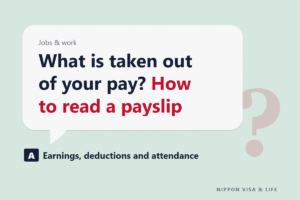
What each section of your pay slip means is explained in How to Read a Pay Slip in Japan: Payments, Deductions and Attendance Sections, and How Income Tax, Resident Tax and Social Insurance Premiums Are Deducted.
(Source: Ministry of Health, Labour and Welfare “Minimum Wage System” What Wages Are Covered?)
How to Calculate (by How You Are Paid)
The regional minimum wage is set as an amount per hour (hourly amount). Convert your pay into an amount per hour and compare.
| How you are paid | How to compare |
|---|---|
| Hourly wage | Hourly wage ≧ minimum wage (hourly amount) |
| Daily wage | Daily wage ÷ scheduled working hours per day ≧ minimum wage (hourly amount) |
| Monthly salary | Monthly salary ÷ average scheduled working hours per month ≧ minimum wage (hourly amount) |
| Piece-rate pay (commission pay) | Total commission pay ÷ total hours worked for that pay ≧ minimum wage (hourly amount) |
When your pay is a combination, such as a daily basic wage and monthly allowances, convert each into an amount per hour, add them up, and compare the total with the minimum wage.
“Average scheduled working hours per month” is the total of the scheduled working hours (the working hours set by the company) for 1 year divided by 12. Scheduled working hours are written in your Notice of Working Conditions and in the work rules (the company’s rules on how people work).
(Source: Ministry of Health, Labour and Welfare “Minimum Wage System” How to Check the Minimum Wage)
Calculation Examples
The following examples were made by the editorial team to show how to calculate.
Example 1: A person paid a daily wage (workplace in Tokyo, on or after October 1, Reiwa 8)
- Daily wage 10,000 yen, scheduled working hours per day 8 hours
- 10,000 yen ÷ 8 hours = 1,250 yen
- This is lower than Tokyo’s minimum wage of 1,280 yen, so it is below the minimum wage
Example 2: A person paid a monthly salary (workplace in Tokyo, on or after October 1, Reiwa 8)
- Basic salary 200,000 yen, job allowance 20,000 yen, commuting allowance 10,000 yen, overtime pay 30,000 yen (total 260,000 yen)
- Scheduled working days per year 245 days, scheduled working hours per day 8 hours
- ① Remove the pay that is not compared (commuting allowance and overtime pay): 260,000 yen − (10,000 yen + 30,000 yen) = 220,000 yen
- ② Convert into an amount per hour: (220,000 yen × 12 months) ÷ (245 days × 8 hours) = about 1,347 yen
- This is higher than Tokyo’s minimum wage of 1,280 yen, so it is at least the minimum wage
When You Have a Problem and Common Questions
The Minimum Wage Went Up, but My Hourly Wage Is the Same as Before. Is That OK?
From the effective date, you must be paid at least the new minimum wage. Even if your hourly wage stays the same, there is no problem if it is at least the new minimum wage. If it is lower than the new minimum wage, first check with your company. You can check the amount of your pay on your Notice of Working Conditions and your pay slip.
What If I Am Told My Hourly Wage Is Lower Than the Minimum Wage “Because It Is a Probationary Period”?
The minimum wage for people in a probationary period can be lowered only when the company has received permission from the Director of the Prefectural Labour Bureau. If you are not sure, consult the Labour Standards Inspection Office.
Is the Minimum Wage the Same for Foreign Nationals?
The regional minimum wage applies to all workers who work at a workplace in that prefecture, regardless of their way of working or what they are called. The same minimum wage also applies to foreign workers.
What If I Am Paid Less Than the Minimum Wage?
First, remove the pay that is not included in the calculation (such as commuting allowances and overtime pay) and check that you have calculated correctly. If your pay is still lower, check with your company, or consult the Labour Standards Inspection Office in charge of the area where your workplace is located, or the consultation services in foreign languages below. Keeping records of the hours you worked (the times you started and finished work, copies of your time card) and your pay slips will make it easier to explain your situation.
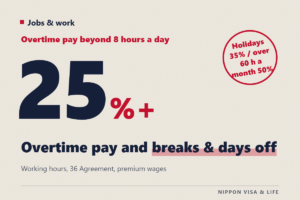
The rules on overtime pay are explained in Overtime and Overtime Pay Rules in Japan: The Basics of Working Hours, Breaks, Holidays and Premium Wages (25%, 35% and 50%).
Consultation Services Available in Foreign Languages
- For problems with working conditions such as wages and working hours, you can consult by telephone in foreign languages through the Ministry of Health, Labour and Welfare’s “Consultation Dial for Foreign Workers” and “Working Conditions Consultation Hotline”. Check the telephone numbers and days for each language on the Ministry of Health, Labour and Welfare’s “Consultation Services for Foreign Workers” page
- You can also consult the Labour Bureau or Labour Standards Inspection Office in each prefecture. Only some Labour Bureaus and Labour Standards Inspection Offices have consultation services in foreign languages. Check the locations, days and hours on the page above, and if there is none near you, use the telephone consultation services
Primary Sources Used for This Article
- Ministry of Health, Labour and Welfare “List of Regional Minimum Wages Nationwide”
- Ministry of Health, Labour and Welfare “List of Regional Minimum Wages Nationwide for FY Reiwa 8” (PDF)
- Ministry of Health, Labour and Welfare “Minimum Wage System” What Is the Minimum Wage?
- Ministry of Health, Labour and Welfare “Minimum Wage System” What Types of Minimum Wage Are There?
- Ministry of Health, Labour and Welfare “Minimum Wage System” Who Does It Apply To?
- Ministry of Health, Labour and Welfare “Minimum Wage System” What Is the Minimum Wage for Dispatched Workers?
- Ministry of Health, Labour and Welfare “Minimum Wage System” What Wages Are Covered?
- Ministry of Health, Labour and Welfare “Minimum Wage System” How to Check the Minimum Wage
- Ministry of Health, Labour and Welfare “Consultation Services for Foreign Workers” (Check Working Conditions)
This article is a translation of the original Japanese version.