This article was written by the NIPPON VISA & LIFE editorial team based on information from public organizations such as the national government and local governments. Rules and fees may differ depending on the city, ward, town or village where you live.
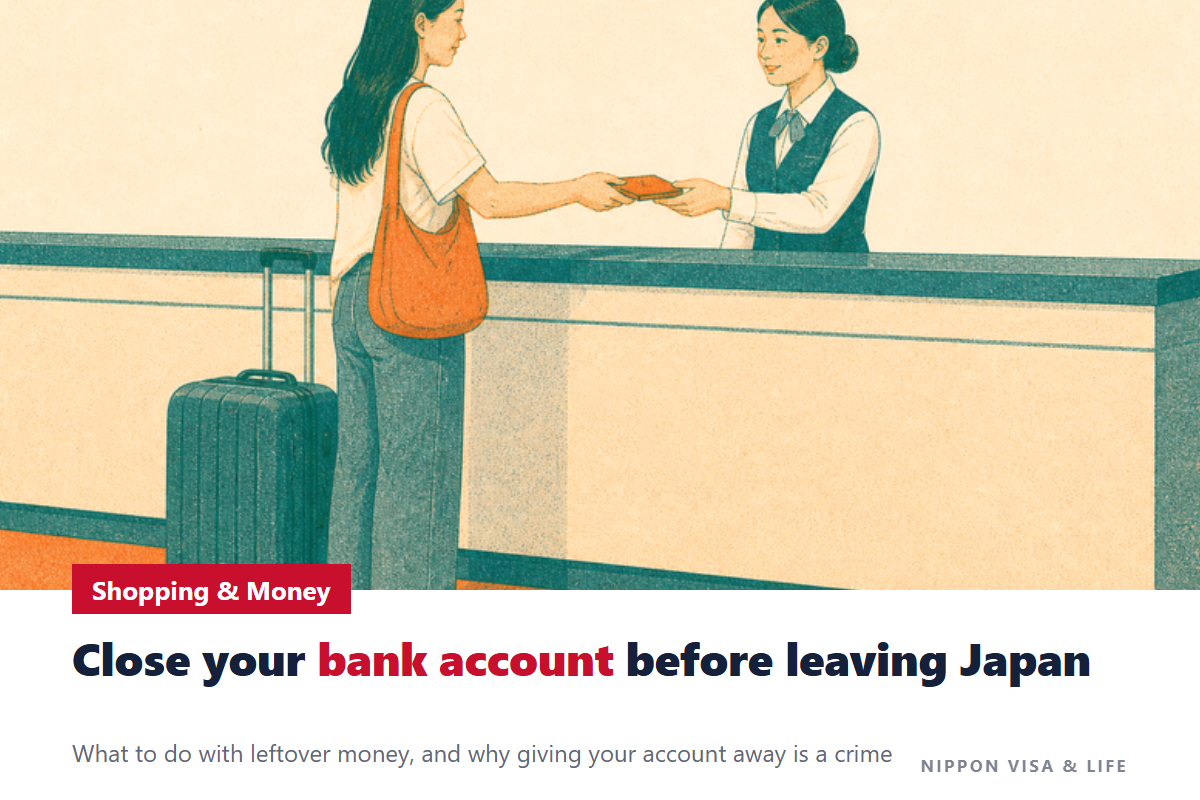
When you will no longer use your bank account in Japan, for example because you are returning home, close the account at the bank where you opened it before you leave Japan. Selling or giving away your account (your bankbook, cash card, login ID, password, etc.) is a crime. Even if someone asks, “Let me use your account after you go home,” do not hand it over.
For an overview of money and shopping in Japan, see The Basics of Money and Shopping in Japan: Bank Accounts, Ways to Pay, Consumption Tax, Smartphone Contracts, Sending Money Abroad and Where to Get Help.
The Short Answer: What to Do Before You Leave Japan
- Check whether anything is paid automatically from your account (electricity, gas, water, phone bills, etc.), and decide how you will pay them after the account is closed.
- Decide what to do with the money left in your account (withdraw it, send it home, etc.).
- Before you leave Japan, go through the account closing procedure at the bank where you opened the account. You can do this at the counter of a bank branch. The way to close an account and what you need differ depending on the bank, so check early.
- Do not sell or give your account, bankbook, cash card, login ID or password to anyone.
- Even if you are not leaving Japan yet, when you extend your period of stay or similar, tell your bank by the day your period of stay ends (your period of stay expiration date). If you do not, you may not be able to use your account.
(Source: Immigration Services Agency, “Guidebook on Living and Working,” 3-5 Bank accounts (PDF), Financial Services Agency, “How to Use Bank Accounts and Money Transfers for Living in Japan” (PDF))
Why Close Your Account Before You Leave?
- The Immigration Services Agency advises that if you will no longer use your account, for example because you are returning home, you should close it. You can close an account at a bank branch.
- The Financial Services Agency, the National Police Agency and the Immigration Services Agency warn that there are many cases of accounts being misused after their owners can no longer be contacted, for example because their period of stay has ended.
- The National Police Agency warns that accounts that are no longer used may be passed to other people and used for crimes such as special fraud (crimes that trick people out of money by phone or email).
To keep your own account from being used for crime, do not leave an account you will no longer use as it is. Close it.
(Source: Immigration Services Agency, “Guidebook on Living and Working,” 3-5 Bank accounts (PDF), Financial Services Agency, National Police Agency and Immigration Services Agency, “Preventing the Misuse of Savings Accounts” (PDF), National Police Agency, “Transferring Bankbooks and Cash Cards Is a Crime!”)
What to Check Before Closing
Things Paid Automatically from Your Account
In Japan, you can pay electricity, gas, water, phone bills and so on automatically from your account (automatic account transfer). Once you close the account, these can no longer be paid from it. Before you leave, check with each company you have a contract with how to cancel the contract and how to pay the final bill.
(Source: Financial Services Agency, “How to Use Bank Accounts and Money Transfers for Living in Japan” (PDF))
For taxes to pay before you leave, see “What About When You Leave Japan (Return Home)?” in How Resident Tax Works in Japan: When, How Much and How to Pay, Deduction from Salary vs. Paying Yourself, and What to Do When You Quit Your Job or Leave Japan.
If You Want to Receive the Pension Lump-Sum Withdrawal Payment in a Japanese Account
The lump-sum withdrawal payment (money that foreign nationals who were enrolled in the Japanese pension system can claim after leaving Japan) can also be received in an account at a Japanese financial institution. However, the Japan Pension Service gives the following information:
- It cannot be received at Japan Post Bank or at some internet-only banks.
- To receive it at a Japanese financial institution, the account name (account holder’s name) must be registered in katakana.
- When you make the claim, attach a document showing that the account is in your own name (such as a certificate issued by the financial institution).
On the other hand, if you do not notify your bank by the day your period of stay ends, transactions on your account may be restricted from the next day (see “Even If You Are Not Leaving Yet” below). If you want to receive the payment in a Japanese account, talk to your bank before you leave Japan about how you will withdraw the money you receive and when you will close the account. Check how to claim the lump-sum withdrawal payment on the Japan Pension Service’s website.
(Source: Japan Pension Service, “Procedures for Claiming the Lump-Sum Withdrawal Payment”, Immigration Services Agency, “Guidebook on Living and Working,” 1-3 Lump-sum withdrawal payment (PDF), Financial Services Agency, National Police Agency and Immigration Services Agency, “Preventing the Misuse of Savings Accounts” (PDF))
What to Do with Your Remaining Money
Sending It Home
- You can send money abroad through banks or funds transfer service providers (companies that provide money transfer services) that are licensed or registered with the Financial Services Agency. You can check the list of licensed or registered companies on the Financial Services Agency’s website.
- Businesses that are not licensed or registered are illegal. Do not use them.
- You may need documents that show the purpose and details of the transfer. It may also take time for the money to arrive, so start the procedure early.
- Whether you can send money abroad, and to which countries and regions, differs depending on the bank or funds transfer service provider.
(Source: Financial Services Agency, “How to Use Bank Accounts and Money Transfers for Living in Japan” (PDF), Immigration Services Agency, “Guidebook on Living and Working,” 3-5 Bank accounts (PDF))
Carrying It Home in Cash
If you leave Japan carrying cash and similar items (the total of Japanese and foreign currency, checks, securities such as stock certificates, etc.) worth more than 1,000,000 yen, you must declare it to customs.
- Fill in the “Declaration of Carrying Means of Payment, etc. (Export/Import)” and submit it at the customs office at the airport or at the customs departure counter in front of the departure immigration area.
- If you put it in baggage you check in with the airline, declare it at the customs office before checking the baggage in.
- Depending on the country you are going to, the threshold amount may be different.
(Source: Japan Customs, “7305 Carrying Out (Bringing In) Cash, etc.”)
What If You Left Japan Without Closing Your Account?
- Deposits with no transactions such as deposits or withdrawals for 10 years or more become “dormant deposits, etc.,” are transferred to the Deposit Insurance Corporation of Japan, and are used for private-sector public interest activities (this applies to deposits whose last transaction was on or after January 1, 2009).
- Even after they become dormant deposits, you can withdraw them at the financial institution where you had the account. There is no deadline for withdrawal. Bring your bankbook, cash card, identity documents, etc., to do the procedure. Whether you receive the money in cash or can keep using the account differs depending on the financial institution.
- When 9 years or more have passed since the last transaction, the financial institution makes a “public notice” (an announcement on the internet, etc.). If the balance is 10,000 yen or more, a “notification” is sent to your registered address. If your address has changed, the notification will not reach you.
However, as explained above in “Why Close Your Account Before You Leave?”, leaving an unused account as it is also carries the risk of misuse. Close any account you will no longer use before you leave Japan.
(Source: Financial Services Agency, “Do You Have Deposits with No Transactions for a Long Time?”, Financial Services Agency, “Dormant Deposits Utilization Act Q&A (for Depositors, etc.)” (PDF))
Giving Your Account to Someone Else Is a Crime
Watch Out for Requests Like These
The Financial Services Agency’s pamphlet gives the following examples of requests:
- “After you go back to your country, I’d like to use your account…”
- “I want you to send this money from your account. I’ll give you 10,000 yen.”
Even if you are asked like this, do not hand over your account or send money for people you do not know. Money laundering (hiding where money obtained through crime came from) is illegal.
(Source: Financial Services Agency, “How to Use Bank Accounts and Money Transfers for Living in Japan” (PDF))
What Crime Is It?
- The National Police Agency warns that giving your account to someone else is a crime whether or not you receive money for it (whether paid or free).
- Under the law (Act on Prevention of Transfer of Criminal Proceeds, Article 26), the following people face imprisonment of up to 3 years or a fine of up to 5,000,000 yen (or both): people who hand over a bankbook, cash card, or information needed for withdrawals or transfers (ID, password, etc.) knowing it will be misused; people who hand them over for money without a legitimate reason; people who receive them for the purpose of using them while pretending to be someone else; and people who pay money to receive them without a legitimate reason. If it is done repeatedly as a business, the penalty is imprisonment of up to 5 years or a fine of up to 10,000,000 yen (or both). People who invite others to do it are also punished.
- The Financial Services Agency warns that if you do something illegal, such as giving your account to someone else, you may no longer be able to stay in Japan or come to Japan.
(Source: National Police Agency, “Transferring Bankbooks and Cash Cards Is a Crime!”, Act on Prevention of Transfer of Criminal Proceeds, Article 26 (e-Gov Laws and Regulations Search), Financial Services Agency, “How to Use Bank Accounts and Money Transfers for Living in Japan” (PDF))
For common scam email and phone tricks and where to get help, see What to Do About Scam Emails, Text Messages and Phone Calls in Japan: Tricks Pretending to Be Delivery Companies, the Police or Immigration, and Where to Get Help (#9110 and 188).
Even If You Are Not Leaving Yet: Tell Your Bank When You Extend Your Period of Stay
- When your address, period of stay expiration date, status of residence, workplace or similar changes, or when you apply to extend your period of stay or change your status of residence, contact the bank where you opened your account right away.
- Tell your bank by the day your period of stay ends that you have extended your period of stay or that you have applied for an extension or similar. If you do not, transactions on your account may be restricted from the next day.
- Your bank may also contact you to check whether your information has changed. If you do not respond or do not do what the bank asks, you may no longer be able to use your account.
For how to open a bank account and a list of situations where you need to notify your bank, see How to Open a Bank Account in Japan: What You Need, Why You May Not Be Able to Open One, and Telling Your Bank When Your Address or Period of Stay Changes.
(Source: Immigration Services Agency, “Guidebook on Living and Working,” 3-5 Bank accounts (PDF), Financial Services Agency, National Police Agency and Immigration Services Agency, “Preventing the Misuse of Savings Accounts” (PDF))
Where to Get Help
- Closing your account or notifying your bank: The bank (financial institution) where you opened your account. What you need to close an account differs depending on the bank, so check before you go.
- Problems with accounts or money transfers: Financial Services Agency, Counseling Office for Financial Services Users 0570-016811 (from IP phones, 03-5251-6811; weekdays 10:00 to 17:00). The English contact is equestion@fsa.go.jp.
- Someone asked you to sell or lend your account, or you think it may be a scam: Police consultation hotline #9110
- Money trouble or contracts: Consumer Hotline (188)
(Source: Financial Services Agency, “How to Use Bank Accounts and Money Transfers for Living in Japan” (PDF), National Police Agency, “Transferring Bankbooks and Cash Cards Is a Crime!”)
Primary Sources Referenced in This Article
- Immigration Services Agency, “Guidebook on Living and Working” (PDF) 1-3 Lump-sum withdrawal payment, 3-5 Bank accounts
- Financial Services Agency, “How to Use Bank Accounts and Money Transfers for Living in Japan” (PDF, revised September 2024)
- Financial Services Agency, National Police Agency and Immigration Services Agency, “Preventing the Misuse of Savings Accounts” (PDF)
- National Police Agency, “Transferring Bankbooks and Cash Cards Is a Crime!”
- Act on Prevention of Transfer of Criminal Proceeds (e-Gov Laws and Regulations Search) Article 26
- Financial Services Agency, “Do You Have Deposits with No Transactions for a Long Time?”
- Financial Services Agency, “Dormant Deposits Utilization Act Q&A (for Depositors, etc.)” (PDF)
- Japan Pension Service, “Procedures for Claiming the Lump-Sum Withdrawal Payment”
- Japan Customs, “7305 Carrying Out (Bringing In) Cash, etc.”
This article is a translation of the original Japanese version.