This article was written by the NIPPON VISA & LIFE editorial team based on information from public organizations such as the national government and local governments. Rules and fees may differ depending on the city, ward, town or village where you live.
When you work for a company in Japan, you receive a “pay slip” (kyuyo meisai: a paper or data showing the breakdown of your wages) on payday. Taxes and social insurance premiums are deducted from your wages based on the law, so the amount transferred to you is less than the total of your wages. This article explains what each section of the pay slip means and how to check what has been deducted.
The Short Answer: The 3 Sections of a Pay Slip
The format of pay slips differs from company to company, but most are divided into the following 3 sections.
- Attendance (kintai): the number of days you came to work, the hours you worked, overtime hours, the number of days you were absent, etc.
- Payments (shikyu): the breakdown of the wages the company pays (basic salary, allowances, overtime pay, etc.). The total is called the “total payment amount” (sou-shikyugaku)
- Deductions (kojo): what is deducted from your wages (social insurance premiums, taxes, etc.). The total is called the “total deductions” (kojo gokei)
The amount left after subtracting the total deductions from the total payment amount is the amount you actually receive. It is written as the “net payment amount” (sashihiki shikyugaku) and is commonly called “take-home pay” (tedori).
When you receive your pay slip, it is easy to understand if you check it in the following order.
- Do the days and hours in the attendance section match your own records?
- Do the basic salary and allowances in the payments section match your employment contract or your notice of working conditions (a document that states your working conditions)?
- What has been deducted, and how much, in the deductions section?
A list of articles about work is available in The Basics of Finding a Job and Working in Japan: Hello Work, Working Conditions, Wages and Overtime, Paid Leave, Quitting and Where to Get Help.
Sample Pay Slip (Examples of Items)
The table below shows examples of items often found on pay slips. No amounts are included. The actual names and order of the items differ from company to company.
| Section | Common item | Meaning |
|---|---|---|
| Attendance | Days worked and days absent | The number of days you worked and the number of days you were absent |
| Attendance | Paid leave | The number of days of annual paid leave you used and the number of days remaining |
| Attendance | Hours of overtime work, holiday work and late-night work | The hours you worked overtime, on holidays or at night |
| Payments | Basic salary | The base amount of your wages |
| Payments | Various allowances | Allowances set by the company (commuting allowance, housing allowance, family allowance, etc.) |
| Payments | Overtime allowance (overtime pay) | Wages for the time you worked overtime, on holidays or late at night |
| Deductions | Health insurance premium | The premium for medical insurance that helps pay for hospital costs |
| Deductions | Long-term care insurance premium | Only for people aged 40 or older and under 65. It is added to the medical insurance premium (it may be included in the health insurance premium) |
| Deductions | Employees’ pension insurance premium | The premium for the pension that company employees join |
| Deductions | Employment insurance premium | The premium for the national insurance for cases such as losing your job |
| Deductions | Income tax | Tax paid to the national government |
| Deductions | Resident tax | Tax paid to the prefecture and the city, ward, town or village where you had your address on January 1 of that year |
| Deductions | Other | Items agreed in an agreement between the company and a representative of the workers (dormitory fees, meal costs, etc.) |
| Total | Net payment amount (take-home pay) | Total payment amount − total deductions |
What May Be Deducted from Your Wages
Under Japanese law (the Labor Standards Act), wages must in principle be paid in full. However, the following may be deducted from wages.
- Items set by laws and regulations, such as income tax and social insurance premiums
- Other items for which the company has made a written agreement with a labor union or with a person representing a majority of the workers
There are also the following rules on how wages are paid.
- In principle, wages are paid in currency (money). If the worker agrees, they can also be paid by bank transfer
- Wages are paid directly to the worker themselves
- Wages are paid at least once a month on a fixed day (bonuses and similar payments are exceptions)
If there is an item in the deductions section that you do not understand, ask your company “What is this?” to check.
(Sources: Immigration Services Agency (ISA) “Guidebook on Living and Working” Chapter 3, 2-1 How Wages Are Paid, Labor Standards Act Article 24 (e-Gov Laws and Regulations Search))
How to Read the Deductions Section
Social Insurance Premiums (Health Insurance, Long-Term Care Insurance, Employees’ Pension Insurance and Employment Insurance)
People who work for a company join health insurance and employees’ pension insurance if they meet the conditions. Not only regular employees but also part-time workers and “arubaito” (casual part-time) workers join if they meet conditions such as working hours.
- Health insurance premium: In principle, the company and the worker each pay half. There is no premium for family members who are your dependents (dependents)
- Employees’ pension insurance premium: The company and the worker each pay half. Your share is calculated as “monthly wages (standard monthly remuneration) × premium rate ÷ 2”. It is also deducted in the same way from bonuses
- Long-term care insurance premium: People aged 40 or older and under 65 pay it on top of their medical insurance premium. Because of this, when you turn 40, it starts being deducted together with your health insurance premium. On a pay slip, it may be written on a separate line or included in the health insurance premium
- Employment insurance premium: People whose set weekly working hours (scheduled working hours) are 20 hours or more and who are expected to be employed for 31 days or more join employment insurance. The same applies to dispatched workers, contract employees, part-time workers and “arubaito” workers. However, students attending daytime schools do not join. Both the worker and the company pay the premium
If the social insurance premium section is blank and you are not sure whether you are enrolled, check with your company. The employment insurance money you can receive when you leave a company is explained in Unemployment Benefits in Japan After Leaving Your Job: Separation Notice, Hello Work Procedures, Conditions and How Long You Can Receive Them.
Income Tax
- For people who receive wages, the company deducts income tax in advance when it pays wages. This is called “withholding” (gensen choshu)
- At the time of the last wage payment of the year, the income tax for the whole year is recalculated, and any overpayment or shortfall is adjusted. This is called “year-end adjustment” (nenmatsu chosei). Because of this, the income tax amount on your pay slip around December may be different from usual
- You receive a “withholding tax slip” (gensen choshuhyo) from your company, which shows the amount of wages paid to you in the year and other information. You will use it for later procedures such as the final tax return, so be careful not to lose it
- If there is a tax treaty (an agreement between countries about taxes) between your home country and Japan, your income tax may be reduced or you may not have to pay it if you meet the conditions
Resident Tax
- Resident tax is a tax paid to the prefecture and the city, ward, town or village where you have (had) your address on January 1. It consists of the “income-based portion” (shotokuwari), calculated from wages and other income you received from January 1 to December 31 of the previous year, and the “per-capita portion” (kintowari), a fixed amount paid regardless of income
- For people who work for a company, in principle, the company deducts resident tax from wages and pays it to the city, ward, town or village. This is called “special collection” (tokubetsu choshu). In this case, you do not need to pay it to the city, ward, town or village yourself
- With special collection, one year’s resident tax is divided into 12 payments and deducted from your wages every month from June to May of the following year. Because of this, the resident tax amount may change on your June pay slip
- Resident tax is decided by your wages and other income of the previous year and by whether you had an address on January 1, so when you have just started working in Japan, resident tax may not appear on your pay slip
- When you leave a company, you can either pay the resident tax that has not yet been paid yourself (ordinary collection) or have the company deduct it all at once from your last wages or retirement allowance
(Sources: Immigration Services Agency “Guidebook on Living and Working” Chapter 8, 2 Resident Tax, Local Tax Act Article 321-5 (e-Gov Laws and Regulations Search))
How to Read the Payments Section
Overtime Pay (Premium Wages)
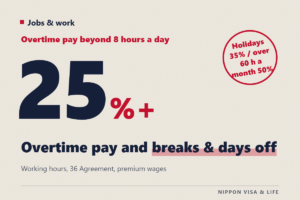
When you work beyond the set hours, overtime pay is entered in the payments section. The premium rates set by law are as follows.
| Hours worked | Premium rate |
|---|---|
| When you work beyond the statutory working hours (in principle, 8 hours a day and 40 hours a week) | 25% or more |
| When the hours beyond the statutory working hours exceed 60 hours in a month | 50% or more |
| When you work on a statutory holiday | 35% or more |
| When you work late at night, from 10 p.m. to 5 a.m. | 25% or more |
Overtime pay must also be paid to dispatched workers, contract employees, part-time workers and “arubaito” workers. Compare the overtime hours in the attendance section and the overtime pay in the payments section with your own records.
When You Have a Problem and Common Questions
What If I Do Not Receive a Pay Slip?
A company that pays wages in Japan to a person living in Japan (a resident) is required to give the person receiving the wages a payment statement that shows the amount of wages and other information (Income Tax Act). If the worker agrees, it can be given as data (by email, through the company’s system, etc.) instead of on paper. Even in that case, if the worker requests it, the company must give it on paper. If you do not receive one, first ask your company.
(Sources: Income Tax Act Article 231 (e-Gov Laws and Regulations Search))
Why Is My Take-Home Pay Less Than I Expected?
Take-home pay is the amount left after social insurance premiums, income tax, resident tax and other items are deducted from the total payment amount. The wage amounts on job postings and contracts are usually the amounts before deductions. Look at the items in the deductions section one by one and check what is being deducted. Ask your company about any items you do not understand.
Should I Keep My Pay Slips?
When you discuss wages or overtime pay with your company, they serve as documents that show the hours you worked and the amounts you received. It is a good idea to keep them together with your withholding tax slip so that you do not lose them.
What If My Wages Are Not Paid or the Calculation Seems Wrong?
For problems with working conditions, such as unpaid wages or unpaid overtime pay, you can consult a Labour Standards Inspection Office or the Ministry of Health, Labour and Welfare’s consultation services in foreign languages (see “Consultation Services Available in Foreign Languages” below). If your company goes bankrupt and can no longer pay wages, there is a system in which the national government pays part of the unpaid wages on behalf of the company (advance payment of unpaid wages).
(Sources: Immigration Services Agency “Guidebook on Living and Working” Chapter 3)
Consultation Services Available in Foreign Languages
- For problems with working conditions such as wages and working hours, you can consult by telephone in foreign languages through the Ministry of Health, Labour and Welfare’s “Consultation Dial for Foreign Workers” and “Working Conditions Consultation Hotline”. Check the telephone numbers and days for each language on the Ministry of Health, Labour and Welfare’s “Consultation Services for Foreign Workers” page
- General consultations about national taxes such as income tax are also accepted in English at the “Telephone Consultation Center” of the Regional Taxation Bureaus. You can look up frequently asked questions on the National Tax Agency’s website (Tax Answer)
- For details about resident tax, contact the prefecture or the city, ward, town or village where you live
(Sources: Ministry of Health, Labour and Welfare “Consultation Services for Foreign Workers” (Check Working Conditions), Immigration Services Agency “Guidebook on Living and Working” Chapter 8, 6 Contacts for Inquiries about Taxes)
Primary Sources Used for This Article
- Immigration Services Agency “Guidebook on Living and Working” (8th edition) (Chapter 3: Employment and Labor, Chapter 6: Medical Care, Chapter 7: Pension and Welfare, Chapter 8: Taxes)
- Labor Standards Act Article 24 (e-Gov Laws and Regulations Search)
- Income Tax Act Article 231 (e-Gov Laws and Regulations Search)
- Local Tax Act Article 321-5 (e-Gov Laws and Regulations Search)
- Ministry of Health, Labour and Welfare “Consultation Services for Foreign Workers” (Check Working Conditions)
This article is a translation of the original Japanese version.