

There is no amount set by the government for the salary in Employment for Skill Development (育成就労) in Japan. The legal condition is that the pay must be “equal to or higher than the remuneration a Japanese person would receive for the same work.” The working period is 3 years in principle, and in cases such as when you could not pass the tests, it may be possible to extend it by up to 1 year. After the 3 years, if you pass the skills test and the Japanese language test, there is a path to move to Specified Skilled Worker (i) (特定技能1号) and keep working.
The Employment for Skill Development system starts on April 1, 2027. This article explains, in order, the rules on salary, what is deducted from your salary, pay raises, the fees you pay before coming to Japan, the working period, and the path after the 3 years. The contents are based on the Immigration Services Agency’s (出入国在留管理庁, ISA) “Employment for Skill Development System Operational Guidelines” and “Q&A on the Employment for Skill Development System,” checked on October 19, 2026.
The Employment for Skill Development system as a whole (purpose, fields, transfers, Japanese language requirements, and so on) is explained in the following article.
→ What is the Employment for Skill Development system? A full guide to the differences from Technical Intern Training, transfers, and Japanese requirements [Starts April 2027](https://kisaragi-office.com/immigration_journal/en/archives/4796)
Salary rules in Employment for Skill Development: equal to or higher than Japanese workers
The salary in Employment for Skill Development (called “remuneration” (報酬) in the law) must be equal to or higher than the amount a Japanese person would receive for the same work. This is one of the conditions for a company to receive certification of its Employment for Skill Development plan (育成就労計画). Making the salary unfairly low “because the worker is a foreign national” is not allowed.
How does the company show that pay is “equal to or higher”?
When a company applies for certification of the plan, it shows in the employment contract (雇用契約書), the statement of employment conditions (雇用条件書), and other documents that the salary is equal to or higher than that of Japanese workers. Under the Operational Guidelines, this is checked as follows.
- If there is a Japanese person doing the same work: The company explains that the work content and the level of responsibility are the same, and shows that the pay is equal to or higher than that Japanese person’s pay
- If there is no Japanese person doing the same work: If there are wage regulations, the company shows this in light of those regulations. If there are none, it compares with the Japanese person whose work is closest and shows how they differ
Labor rules such as the minimum wage are the same as for Japanese workers
People working in Employment for Skill Development are “workers.” Labor laws such as the Labor Standards Act and the Minimum Wage Act apply to them in the same way as to Japanese workers. The minimum wage is set for each prefecture. You can check the minimum wage where you work in the Ministry of Health, Labour and Welfare’s “National List of Regional Minimum Wages.”
Discrimination because you are a foreign national is prohibited
Treating workers differently because they are in Employment for Skill Development is prohibited. This covers how salaries are decided, education and training, and welfare benefits such as company dormitories and medical facilities. The Operational Guidelines give, as an example of discrimination, not paying a bonus only because the person is in Employment for Skill Development.
Receive an explanation of your working conditions in your native language
The company and the supervising and support organization (監理支援機関) are to explain the details of your working conditions to you directly and in detail in your native language. At that time, they prepare an “Explanation of Important Matters Concerning Treatment during the Period of Employment for Skill Development” that includes your native language. The employment contract and the statement of employment conditions are also required to include your native language. It is reassuring to keep the documents you were given with the explanation even after you come to Japan.
(Sources: Immigration Services Agency, “Employment for Skill Development System Operational Guidelines,” Chapter 4 (labor-related laws at the beginning), Section 2, Part 3 (direct explanation of the employment contract), and Part 10 (treatment of foreign nationals in Employment for Skill Development), Immigration Services Agency, “Key Points of the Employment for Skill Development System Operational Guidelines”, Ministry of Health, Labour and Welfare, “National List of Regional Minimum Wages”)
What counts as “remuneration” and what does not
Some items are included in, and some are excluded from, the “remuneration” that is compared to make sure pay is “equal to or higher than Japanese workers.” The explanation in the Operational Guidelines can be summarized as follows.
| Category | Examples |
|---|---|
| Included in remuneration | Basic salary, bonuses, and allowances paid according to attendance or work content (perfect attendance allowance, job allowance, hazardous work allowance, etc.) |
| Not included in remuneration | Items that reimburse costs actually incurred, such as commuting allowance and housing allowance (except those that are taxed) |
In other words, paying a large commuting allowance does not make it acceptable to set the basic salary lower than that of Japanese workers. What is compared is the basic salary, bonuses, and allowances based on attendance or work content.
What is deducted from your salary: taxes, social insurance premiums, meals, and rent
The salary written in the statement of employment conditions (the gross amount) is not what you actually receive. Taxes and social insurance premiums are deducted, and you may also pay rent for a company dormitory or for meals. In the explanation before you come to Japan, the company is to explain the amounts and details of what will be deducted, and especially your take-home pay, while pointing to the relevant parts of the statement of employment conditions.
Meals, rent, and utilities: only “the agreed amount equivalent to actual costs”
Costs that you pay regularly every month, such as meals, housing costs (rent), and utilities, are subject to the following rules.
- You must fully understand what you are paying for (the meals and the room) and agree on it with the company
- The amount must be appropriate, such as an amount equivalent to the costs actually incurred
The Operational Guidelines show, for example, the following ways of thinking about upper limits.
- Rooms rented by the company (leased properties): No more than the rent, management fees, and so on divided by the number of Employment for Skill Development workers living there
- Utilities: No more than the amount actually incurred divided by the total number of people living together
- Company cafeteria: No more than the amount received from employees who are not in Employment for Skill Development
When the amount you pay is changed, for example because utility costs have risen, the company must explain this to you in advance and gain your understanding. If you ask about the amount you pay for utilities, the company is to explain it by showing something that indicates the actual costs, such as invoices.
Taxes: income tax and resident tax apply to Employment for Skill Development salaries
Some technical intern trainees did not have to pay tax on their salaries because of agreements between countries (tax treaties (租税条約)). In Employment for Skill Development, workers are, in principle, not covered by tax treaty exemptions, and income tax applies. Resident tax applies in the same way. When thinking about your take-home pay, calculate it on the assumption that taxes will be deducted.
How you receive your salary
Your salary is paid by a method that allows the amount actually paid to be checked, such as a bank transfer to your own account. If you wish, it can also be paid into an account with a fund transfer service provider (so-called digital payment). However, there are conditions, such as the need for a labor-management agreement at the workplace. In the case of bank transfers, you may not be able to withdraw the money in your home country after returning. You are to check with the company in advance how you will receive your salary just before returning home.
Your salary cannot be lowered for these reasons
It is not allowed to lower your salary because of fees for tests such as skills tests (技能検定), or because of the fees the company pays to the supervising and support organization (supervision and support fees). In addition, when you are made to work overtime, premium wages must be paid.
(Sources: Immigration Services Agency, “Employment for Skill Development System Operational Guidelines,” Chapter 4, Section 2 (direct explanation of the employment contract; Part 10 (5) regularly paid costs, (6) bank transfers of remuneration, etc., and (1) amount of remuneration), Immigration Services Agency, “Q&A on the Employment for Skill Development System,” Q80, National Tax Agency, “Taxation of Salaries Paid to Foreign Nationals in Employment for Skill Development by Implementing Organizations (Inquiry)”)
Will your salary go up? Pay raises in the 2nd and 3rd years
For people who continue working, salaries are required to be graded according to how well they acquire skills, such as raising them in the 2nd and 3rd years compared with the previous year. This is to increase workers’ motivation to acquire skills. However, how many yen the raise will be is not set. Check how pay raises work in your statement of employment conditions or the company’s wage regulations.
In fields where the transfer restriction is 2 years, better treatment is required
In Employment for Skill Development, moving to another company at your own request (a transfer (転籍)) is allowed under certain conditions. One condition is that you have worked at your current company for longer than a certain period (the transfer restriction period). There are also other conditions, such as your skill and Japanese language levels, the new company being an excellent company, and the move being within the same job category. The restriction period is 1 year or 2 years depending on the field. Even in fields with 2 years, a company can choose to make it 1 year at its own discretion.
If a company chooses a restriction period longer than 1 year (2 years), it must take measures to improve treatment as set for each field. For example, in the industrial product manufacturing field, the council decides and announces a pay raise rate every year. Companies that set the restriction period at 2 years are to raise scheduled wages by that rate from the 1st year to the 2nd year.
| Transfer restriction period | Fields |
|---|---|
| 2 years | Nursing care, construction, shipbuilding and ship machinery, automobile repair and maintenance, food service, industrial product manufacturing, food and beverage manufacturing, resource recycling |
| 1 year | Building cleaning, accommodation, agriculture, fishery, forestry, wood industry, railway, linen supply, logistics warehousing |
The conditions and procedures for transfers will be explained in detail in a separate article.
(Sources: Immigration Services Agency, “Employment for Skill Development System Operational Guidelines,” Chapter 4, Section 2, Part 10 (1) points to note and (8) improved treatment for transfer restriction periods longer than 1 year, Immigration Services Agency, “Q&A on the Employment for Skill Development System,” Q47 and Q50, Immigration Services Agency, “Key Points of the Employment for Skill Development System Operational Guidelines”, Immigration Services Agency, “Field-Specific Employment for Skill Development System Operational Guidelines (Industrial Product Manufacturing Field)”, Immigration Services Agency, “Main Contents of the Field-Specific Operational Policies”)
Fees paid before coming to Japan: payments to sending organizations are limited to 2 months’ salary
There is an upper limit on the fees you pay to the sending organization (送出機関) in your home country. The limit is 2 months of the monthly salary (scheduled wages (所定内賃金)) written in the Employment for Skill Development plan. You cannot be made to pay the amount above the limit; the accepting company or the supervising and support organization pays it.
- What scheduled wages are: The monthly amount of the basic salary plus allowances that are paid regularly (commuting allowance, perfect attendance allowance, etc.). Overtime pay, holiday work allowance, and late-night allowance are not included.
- Fees covered: All fees paid to the sending organization in the sending process, regardless of what they are called. Tuition at schools linked with the sending organization and fees paid to brokers are also covered.
- Keep receipts: The company and the supervising and support organization check whether the limit has been exceeded, using receipts and other documents issued by the sending organization. Always get a receipt when you pay, and keep it.
The limit does not mean “it is fine to collect up to this amount.” The Operational Guidelines state that it is desirable to keep the fees paid by the worker as low as possible.
(Sources: Immigration Services Agency, “Employment for Skill Development System Operational Guidelines,” Chapter 4, Section 2, Part 14 (amount of fees paid to sending organizations), Immigration Services Agency, “Q&A on the Employment for Skill Development System,” Q73, Immigration Services Agency, “Key Points of the Employment for Skill Development System Operational Guidelines”)
The working period in Employment for Skill Development is 3 years in principle
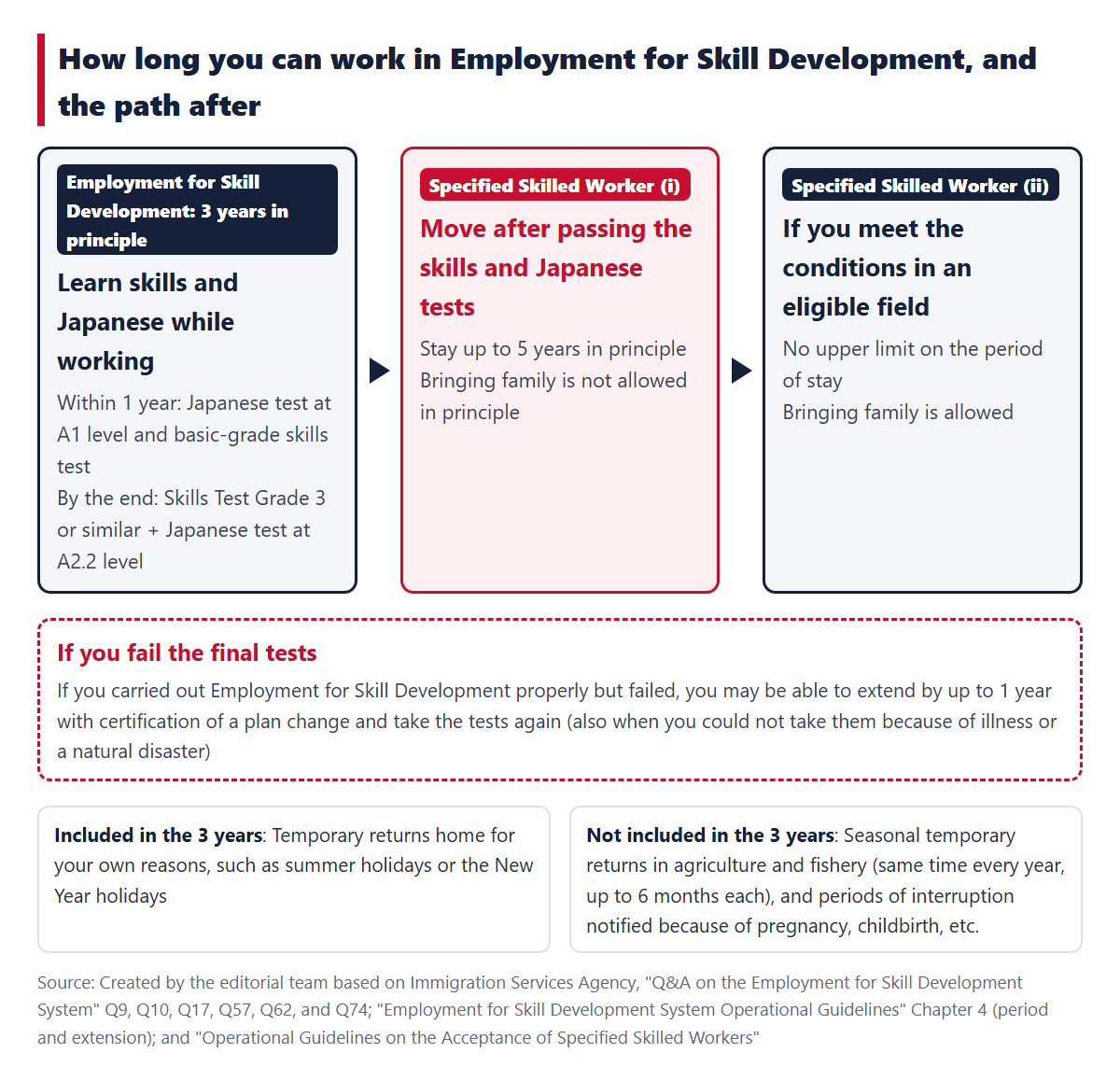
The period of Employment for Skill Development is within 3 years, and 3 years in principle. A plan shorter than 3 years may not be certified, on the grounds that proper skill development cannot be carried out. Unlike Technical Intern Training (技能実習), there are no stages (i), (ii), and (iii); a 3-year plan is made from the start and certified.
Sources: Created by the editorial team (based on Immigration Services Agency, “Q&A on the Employment for Skill Development System” (https://www.moj.go.jp/isa/applications/faq/ikusei_qa_00002.html), “Employment for Skill Development System Operational Guidelines” (https://www.moj.go.jp/isa/content/001467946.pdf), and “Operational Guidelines on the Acceptance of Specified Skilled Workers” (https://www.moj.go.jp/isa/content/001468647.pdf))
The upper row of the diagram shows the flow of the period. The lower part shows when an extension is possible and how the 3 years are counted.
If you could not pass the tests, an extension of up to 1 year
The goal of Employment for Skill Development is to pass the skills and Japanese language tests required for Specified Skilled Worker (i). If you carried out Employment for Skill Development properly according to the plan but could not pass the target tests, it may be possible to extend the period by up to 1 year after receiving certification of a change to the plan. The same applies if you could not take the tests because of illness, injury, natural disasters, or similar reasons. The length of the extension is applied for taking into account the period needed to take the tests again and find out the results. Whether the extension is approved is decided in the examination of the plan change.
How periods of temporary return home are counted
- Temporary returns home for your own reasons: Periods when you temporarily return home with a re-entry permit (including a special re-entry permit), such as during summer holidays or the New Year holidays, are included in the 3 years.
- Periods interrupted by pregnancy, childbirth, etc.: Periods when you returned home after the company or others submitted a notification of interruption (notification of difficulty in carrying out Employment for Skill Development) are not included. To resume, a procedure to change the plan is required.
- Seasonal temporary returns in agriculture and fishery: In agriculture and fishery, a plan can be made for you to return home at the same time every year during periods when there is little work. Each return home can be up to 6 months, and that period is not included in the 3 years. The plan is made so that the total period of working in Japan is 3 years. Travel costs for returning home are paid by the accepting company or the supervising and support organization.
Also watch the expiration date on your residence card
The period approved in the plan and the period of stay (在留期間) on your residence card (在留カード) are not always the same. Even in the middle of the plan period, you need to apply for Permission to extend period of stay (在留期間の更新許可) at a Regional Immigration Services Bureau (地方出入国在留管理局) before your period of stay expires.
(Sources: Immigration Services Agency, “Employment for Skill Development System Operational Guidelines,” Chapter 4, Section 2 (period of Employment for Skill Development and seasonal temporary returns) and Chapter 4, Section 5 (extension of the period of Employment for Skill Development), Immigration Services Agency, “Q&A on the Employment for Skill Development System,” Q10, Q17, Q27, Q57, and Q62)
Can you keep working in Japan after the 3 years? Moving to Specified Skilled Worker (i) and (ii)
Employment for Skill Development is a system for developing people to the level of Specified Skilled Worker (i). If you pass the skills and Japanese language tests during the 3 years, there is a path to change your status of residence (在留資格) to Specified Skilled Worker (i) and keep working in Japan.
Tests for moving to Specified Skilled Worker (i)
| Type | Required tests |
|---|---|
| Skills | Skills Test Grade 3 or similar, or the Specified Skilled Worker (i) evaluation test |
| Japanese | A test of Japanese language ability at A2.2 level or higher (JFT-Basic at A2.2 level, Japanese-Language Proficiency Test (JLPT) N4, etc.) |
Depending on the field, a Japanese language level higher than A2.2 may be required. Under the current Specified Skilled Worker system, people who have completed Technical Intern Training (ii) in good standing are exempt from the tests if the work is related to the occupation and work of their training. When moving from Employment for Skill Development, there is no such exemption, and you need to pass both tests.
Period of stay and family
| Status of residence | Period you can stay | Bringing family |
|---|---|---|
| Employment for Skill Development | 3 years in principle (an extension of up to 1 year may be possible, such as when you fail the tests) | Not allowed in principle |
| Specified Skilled Worker (i) | Up to 5 years in principle | Not allowed in principle |
| Specified Skilled Worker (ii) | No upper limit | Allowed (Dependent (家族滞在)) |
Specified Skilled Worker (ii) (特定技能2号) covers 11 of the 19 Specified Skilled Worker fields. Going through Specified Skilled Worker (i) does not mean you automatically move to (ii); whether you have the level for (ii) is decided by passing tests and other means.
Can you move to Specified Skilled Worker (i) partway through?
The policy is to allow moving to Specified Skilled Worker (i) before the 3 years are over, under certain conditions. The conditions are that, in addition to having passed the tests, the period you have worked at your current accepting company exceeds a certain length. As of the time of writing, the Immigration Services Agency has not yet shown how long that period is.
If you were a technical intern trainee
Periods when you did Technical Intern Training in the past are treated as periods of Employment for Skill Development. A person who did Technical Intern Training for 2 years or more basically cannot come to Japan again and do Employment for Skill Development in a field different from their Technical Intern Training. How people who are in Technical Intern Training when the system starts are treated is explained in the following article.
(Sources: Immigration Services Agency, “Q&A on the Employment for Skill Development System,” Q9, Q12, Q58, Q74, Q75, Q76, and Q79, Immigration Services Agency, “Operational Guidelines on the Acceptance of Specified Skilled Workers” (bringing family, accepted fields, and Specified Skilled Worker (ii)))
Frequently asked questions
Q. What is the typical salary in Employment for Skill Development? A. There is no typical rate or average amount published by the government. The rules are that pay must be equal to or higher than what a Japanese person would receive for the same work, and must not be below the minimum wage of the prefecture where you work. Check the specific amount in your statement of employment conditions.
Q. What should I do if my salary is different from the statement of employment conditions? A. First, tell the company and the supervising and support organization. If it is not resolved, you can consult the native-language consultation service of the Organization for Employment for Skill Development of Foreign Nationals (外国人育成就労機構), and if there are facts that violate the law, you can also report them. Violations of the Labor Standards Act and other laws can also be reported to the Labor Standards Inspection Office (労働基準監督署). The company is prohibited from treating you unfavorably because you made a report. For working conditions, you can also consult by phone in foreign languages through the Ministry of Health, Labour and Welfare’s “Consultation Dial for Foreign Workers” (the days of the week are set for each language, and call charges apply).
Q. How many hours of overtime are allowed? A. In principle, up to 45 hours a month and 360 hours a year. Even when there are special circumstances, the upper limits are 720 hours a year, less than 100 hours in 1 month (including holiday work), and an average of 80 hours over multiple months (including holiday work). Overtime is paid at premium rates.
Q. If I fail the tests after 3 years, do I have to go home right away? A. If you carried out Employment for Skill Development properly but still failed, it may be possible to extend the period by up to 1 year and take the tests again. Whether the extension is approved is decided in an individual examination. Talk with the company and the supervising and support organization early.
(Sources: Immigration Services Agency, “Employment for Skill Development System Operational Guidelines,” Chapter 4, Section 2, Part 10 (1) points to note, Chapter 6 (reports), and Chapter 7, Section 1 (consultation), Immigration Services Agency, “Q&A on the Employment for Skill Development System,” Q10 and Q74, Ministry of Health, Labour and Welfare, “Consultation Dial for Foreign Workers”)
Summary
- There is no fixed salary amount in Employment for Skill Development. The condition is that pay is equal to or higher than what a Japanese person would receive for the same work, and labor rules such as the minimum wage are the same as for Japanese workers.
- The “remuneration” that is compared is the basic salary, bonuses, and allowances based on attendance or work content. Items that reimburse costs actually incurred, such as commuting allowance and housing allowance, are generally not included.
- Taxes and social insurance premiums, as well as the agreed costs of meals, rent, and so on (appropriate amounts, such as amounts equivalent to actual costs), are deducted from your salary. Employment for Skill Development salaries are, in principle, not exempt under tax treaties.
- In the 2nd and 3rd years, a system that raises salaries according to skills is required.
- Fees paid to the sending organization are limited to 2 months of your monthly salary. The amount above this is paid by the accepting side.
- The working period is 3 years in principle. If you fail the tests or in similar cases, it may be possible to extend it by up to 1 year.
- If you pass the skills and Japanese language tests, there is a path to Specified Skilled Worker (i) (up to 5 years in principle) and, in eligible fields, further to Specified Skilled Worker (ii) (no upper limit).
The specific conditions for salary and period vary depending on the company and the work. Read your statement of employment conditions carefully, and check anything you do not understand with the company and the supervising and support organization. If you are unsure how to judge your individual situation, consult a specialist.
→ What is the Employment for Skill Development system? A full guide to the differences from Technical Intern Training, transfers, and Japanese requirements [Starts April 2027](https://kisaragi-office.com/immigration_journal/en/archives/4796)
Primary Sources Referenced in Article Creation
- Immigration Services Agency, “Employment for Skill Development System Operational Guidelines”
- Immigration Services Agency, “Key Points of the Employment for Skill Development System Operational Guidelines”
- Immigration Services Agency, “Field-Specific Employment for Skill Development System Operational Guidelines (Industrial Product Manufacturing Field)”
- Immigration Services Agency, “Q&A on the Employment for Skill Development System”
- Immigration Services Agency, “Main Contents of the Field-Specific Operational Policies”
- Immigration Services Agency, “Operational Guidelines on the Acceptance of Specified Skilled Workers”
- National Tax Agency, “Taxation of Salaries Paid to Foreign Nationals in Employment for Skill Development by Implementing Organizations (Inquiry)”
- Ministry of Health, Labour and Welfare, “National List of Regional Minimum Wages”
- Ministry of Health, Labour and Welfare, “Consultation Dial for Foreign Workers”
This article is a translation of the original Japanese version.