

To employ foreign nationals as Specified Skilled Worker (i) (特定技能1号) in the construction field in Japan, both “CCUS business operator registration” by the accepting company and “CCUS technician registration” by the foreign national are required. The accepting company cannot apply to MLIT (Ministry of Land, Infrastructure, Transport and Tourism) for the Acceptance Plan (建設特定技能受入計画) until it has obtained a business operator ID (事業者ID). The fee for technician registration through online application is 2,500 yen for the simplified type (簡略型) and 4,900 yen for the detailed type (詳細型) (tax included).
For a person living in Japan, the foreign national’s technician ID (技能者ID) document is submitted when the Acceptance Plan is applied for. A person entering from overseas registers after entry, and the document is submitted to MLIT, in principle, within 1 month after entry.
What you will learn in this article:
- What CCUS is, and why registration is required for Specified Skilled Worker (construction)
- What the accepting company does (business operator registration) and what the foreign national does (technician registration)
- The timing for submitting documents, which differs for people living in Japan and people entering from overseas
- Whether to register with the simplified type or the detailed type
- How to register, identity documents, costs, and JAC support
- Points to note after registration
The contents were checked on October 19, 2026 against the operational guidelines (construction field), MLIT’s application guide, and the official pages of the Foundation for Construction Industry Promotion and JAC. The overall flow of the Acceptance Plan is explained in the following article.
What is the Construction Career Up System (CCUS): why it is required for Specified Skilled Workers
The Construction Career Up System (CCUS) (建設キャリアアップシステム) is an industry-wide system that records the experience and qualifications of technicians who work at construction sites. For Specified Skilled Worker (construction), registration of both the accepting company and the foreign national in category (i) is a requirement for the Minister of Land, Infrastructure, Transport and Tourism to approve the Acceptance Plan.
How CCUS works
CCUS is operated by the Foundation for Construction Industry Promotion (建設業振興基金), a general incorporated foundation. Technicians register after identity verification and receive a card with an ID (technician ID). They then record the following.
- When, at which site, in which trade, and in which position (such as foreman) they worked (work history)
- The qualifications they hold and the training courses they have taken
The Foundation lists, as a benefit for technicians, being able to prove their own qualifications and work history. Even if the site where they work changes, the records remain under their own ID.
Why it is required for Specified Skilled Workers
A notice of the Minister of Land, Infrastructure, Transport and Tourism sets the following 2 points as requirements for approval of the Acceptance Plan.
- The accepting company (the affiliated organization of the Specified Skilled Worker; 特定技能所属機関) is registered with CCUS
- The foreign national in category (i) is registered with CCUS
The operational guidelines explain that using CCUS has the following effects.
- Wages can be paid according to skills and experience, using the same objective standards as for Japanese workers
- For each construction site, the foreign national’s status of residence, safety qualifications, and social insurance enrollment can be checked
- Illegal work can be prevented
(Source: Operational guidelines (construction field), Foundation for Construction Industry Promotion “About CCUS”)
What is required of the accepting company: CCUS business operator registration
The accepting company must complete CCUS business operator registration before applying for the Acceptance Plan. While the registration application is still pending, you cannot apply for the Acceptance Plan.
Requirements for approval of the Acceptance Plan
To obtain approval of the Acceptance Plan, the accepting company must mainly meet the following requirements.
- It has a construction business license
- It is registered with CCUS as a business operator
- It belongs to JAC (Japan Association for Construction Human Resources), etc.
An accepting company that accepts only foreign nationals in Specified Skilled Worker (ii) is also required to register with CCUS. There is no approval of an Acceptance Plan for category (ii), but the notice sets this as a requirement for the accepting company.
Apply after obtaining the business operator ID
The operational guidelines require you to register with CCUS in advance and write in the plan the “business operator ID” given after registration. MLIT’s application guide also states that you cannot apply until you have obtained the business operator ID.
The documents to attach in the Foreign Worker Employment Management System (外国人就労管理システム) are as follows.
- Document No. 4: A copy of the postcard or email showing the business operator ID (a printout of the CCUS login screen is also acceptable)
- Always black out the initial password on the postcard or email
Start early, beginning with business operator registration
MLIT advises that CCUS registration takes a certain amount of time, so you should apply early once you decide to accept Specified Skilled Workers. Joining JAC also takes time, so it is a good idea to proceed with both in parallel.
The Foundation for Construction Industry Promotion recommends the order of business operator registration → technician registration. Registering the business operator first makes it smoother to register the technician’s affiliated business office.
The procedure for joining JAC is explained in the following article.
(Source: Operational guidelines (construction field), MLIT Guide to New Applications, Foundation for Construction Industry Promotion “Register”)
What is required of the foreign national: CCUS technician registration and when to submit
The foreign national in category (i) completes technician registration with CCUS. The timing for submitting the technician ID document to MLIT differs for people living in Japan and people entering from overseas.
People living in Japan (such as those who have completed technical intern training)
When hiring someone living in Japan, such as a person who has completed technical intern training, you apply for the Acceptance Plan after technician registration is complete. At the time of application, you submit the technician ID document (a copy of the CCUS card) (Document No. 11).
MLIT’s guide states that you cannot apply for the Acceptance Plan while technician registration is still “registration application pending.” Please wait until the card and ID have been received.
Some people already registered with CCUS during technical intern training. For the procedures in that case (such as a change when the affiliated business operator changes), please check with the Foundation for Construction Industry Promotion.
The overall procedure for moving from technical intern training to Specified Skilled Worker is explained in the following article.
People entering from overseas
A person living overseas completes technician registration after receiving the residence card (在留カード). The accepting company applies for technician registration promptly after the worker starts working.
Then, in principle within 1 month after entry, the technician ID document is submitted to MLIT. MLIT asks that it be submitted together with the acceptance report (within 1 month from the start of acceptance). Once the technician ID is issued, correct the technician ID field in the acceptance report.
Quick reference: when, who, and what to submit
| Registration | Applicant | Timing | Document to submit to MLIT |
|---|---|---|---|
| Business operator registration | Accepting company | Before applying for the Acceptance Plan (after obtaining the business operator ID) | Copy of the postcard or email showing the business operator ID (Document No. 4) |
| Technician registration (people living in Japan) | The worker (proxy application by the accepting company is also possible) | Before applying for the Acceptance Plan (after registration is complete) | Copy of the card (Document No. 11) |
| Technician registration (people entering from overseas) | The worker (proxy application by the accepting company is also possible) | Promptly after entry. The document in principle within 1 month after entry | Copy of the card (together with the acceptance report) |
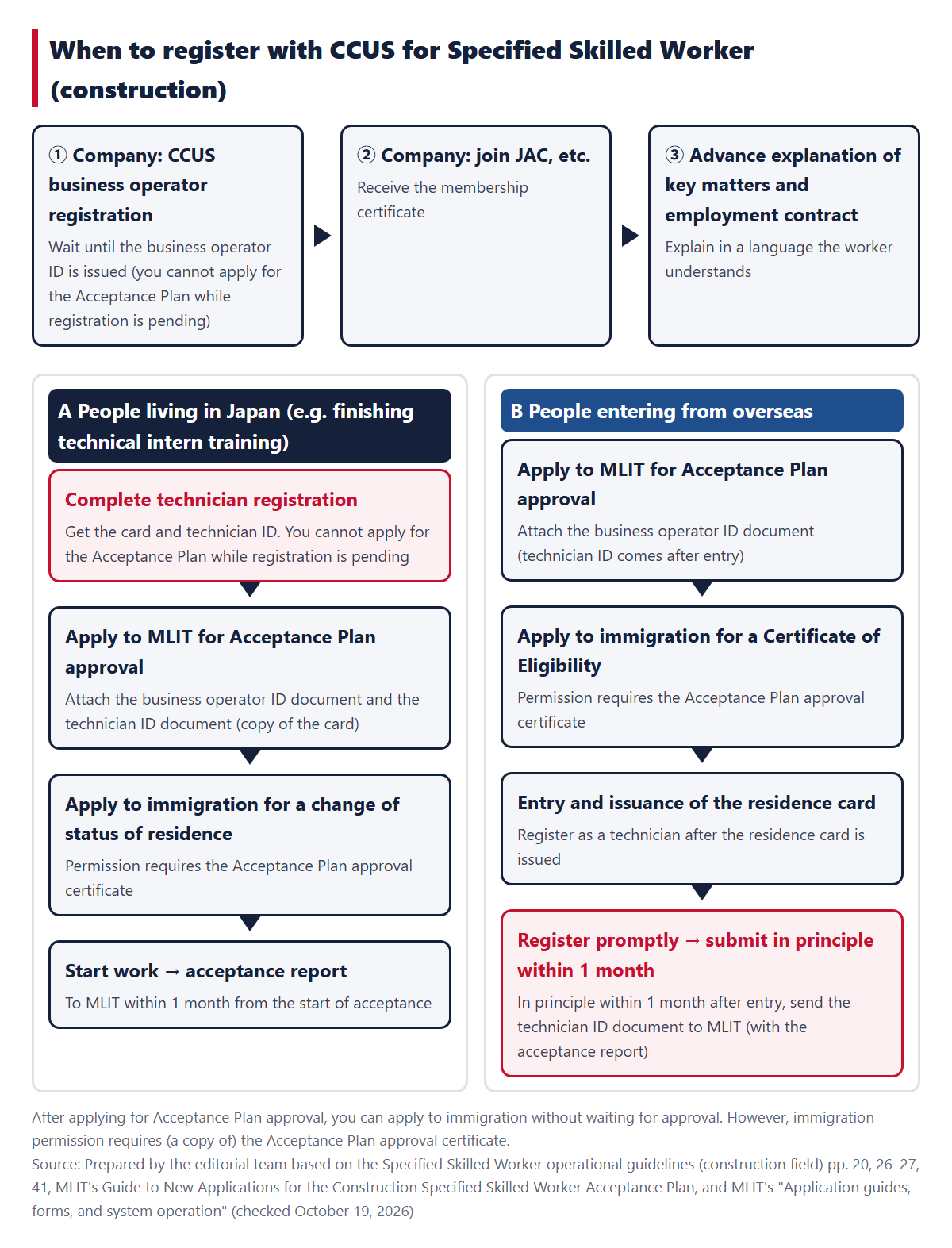
Sources: Prepared by the editorial team (based on the flow chart in the operational guidelines (construction field) and MLIT’s Guide to New Applications)
The red boxes in the figure are the points where procedures tend to get stuck. People living in Japan (A) cannot apply for the Acceptance Plan until registration is complete. People entering from overseas (B) must submit within 1 month after entry.
(Source: Operational guidelines (construction field), MLIT Guide to New Applications, MLIT “Application guides, forms, and system operation”)
Simplified type or detailed type: which to register with
As a requirement for Specified Skilled Worker, technician registration may be either the simplified type or the detailed type. However, companies that use CCUS level-ups as a condition for pay raises or allowances need to register with the detailed type.
When the detailed type is required
CCUS has a “skill evaluation (level assessment)” that determines a technician’s level based on registered experience and qualifications. This level assessment is available only with the detailed type.
The operational guidelines and MLIT’s guide state that the detailed type is required if CCUS level-ups are used as a condition for pay raises or qualification allowances. If you will give a pay raise when the CCUS level goes up, you need to write the expected raise amount and other details in the employment contract and the Acceptance Plan in advance.
Points to note when writing pay raise conditions in the employment contract are explained in the following article.
Those aiming for category (ii) should start with the detailed type
MLIT’s guide recommends that people considering moving to Specified Skilled Worker (ii) register with the detailed type from the start.
Category (ii) requires, in addition to passing a test, practical experience as a “team leader” (班長) who works at the site while guiding multiple technicians. For trades that have CCUS skill evaluation standards, the number of working days equivalent to Level 3 (foreman + team leader) is treated as the required practical experience.
You can also change to the detailed type after registering with the simplified type. Make the change before taking the level assessment.
Comparison of the simplified type and the detailed type
| Item | Simplified type | Detailed type |
|---|---|---|
| Registration fee (online, tax included) | 2,500 yen | 4,900 yen |
| Application at an authorized registration office (counter) | Not on the fee table (the counter handles the detailed type) | 4,900 yen |
| Skill evaluation (level assessment) | Not available | Available |
| Specified Skilled Worker requirement | Met | Met |
| Suitable when | You want to complete registration first | You use levels for pay raises or allowances, or aim for category (ii) |
Building skills after acceptance
The operational guidelines ask the accepting company to make efforts in the following. After acceptance, as soon as possible, have the worker take the safety and health training set out in the skill evaluation standards for each trade. Also, provide skills education equivalent to CCUS Level 2.
(Source: Operational guidelines (construction field), MLIT Guide to New Applications, Foundation for Construction Industry Promotion “About CCUS”, MLIT “CCUS Portal: About the skill evaluation system”)
How to register: online, at a counter, or by proxy application, and the required documents
You apply for registration online or at the counter of an authorized registration office (認定登録機関). A “proxy application,” in which a business operator applies on behalf of a technician, is also possible.
The 2 ways to apply
- Online application: Apply from the CCUS website on a computer or smartphone
- Application at an authorized registration office (counter): A counter that accepts documents and helps with filling them in. Most require a reservation, so check by phone in advance
People who do not have an identity document with a photo can apply only at a counter.
Technician registration (online) proceeds in the following order.
- Application
- Payment of the registration fee
- Checking and review
- Registration complete
- Receive the CCUS card and the technician ID notification
Identity documents for foreign nationals
Foreign nationals can verify their identity with any of the following, whether applying online or at a counter.
- Residence card (if you have changed your place of residence, also submit the back side)
- Special Permanent Resident Certificate
- Passport + resident record (juminhyo) (hide the resident record code and the Individual Number 〈My Number〉)
People without a document with a photo can also apply with combinations such as “resident record + health insurance card,” but only when applying at a counter.
Proxy application by a business operator
To make a proxy application, business operator registration is required first. A consent form filled in by the technician is also required. For a foreign national who is a minor, the person in charge at the accepting company signs as guardian.
For screen operations, please check the Foundation for Construction Industry Promotion’s “Online Application Guidance.”
(Source: Foundation for Construction Industry Promotion “Register”, Foundation for Construction Industry Promotion “Technician registration application”, Foundation for Construction Industry Promotion “List of sample proof documents: technicians”)
Costs: registration fees, administrator ID fees, and JAC support
CCUS has 4 types of costs: the technician registration fee, the business operator registration fee, the administrator ID (管理者ID) fee, and the site usage fee. JAC has a program that fully covers the accepting company’s administrator ID fee.
CCUS fees (tax included)
| Cost | Amount | Who pays / period |
|---|---|---|
| Technician registration fee | Simplified type 2,500 yen / detailed type 4,900 yen (at a counter, detailed type 4,900 yen) | The card is valid until the first birthday after 9 years have passed since issuance |
| Card reissue | 1,000 yen (actual cost) | When lost or damaged, etc. |
| Business operator registration fee | Depends on capital (table below) | Business operator. Valid for 5 years |
| Administrator ID fee | 11,400 yen per ID per year (2,400 yen for sole-proprietor workers) | Business operator. Every year |
| Site usage fee | 10 yen per person, per day, per site | The prime contractor that registered the site |
Examples of the business operator registration fee are as follows.
| Capital | Business operator registration fee (tax included) |
|---|---|
| Sole-proprietor worker (一人親方) | 0 yen |
| Less than 5,000,000 yen (including sole proprietors) | 6,000 yen |
| 5,000,000 yen or more, less than 10,000,000 yen | 12,000 yen |
| 10,000,000 yen or more, less than 20,000,000 yen | 24,000 yen |
| 20,000,000 yen or more, less than 50,000,000 yen | 48,000 yen |
| 50,000,000 yen or more, less than 100 million yen | 60,000 yen |
For business operators with larger capital, please check the fee table of the Foundation for Construction Industry Promotion. The card’s validity period is different for people who are 60 or older at the time of application and for people who did not submit an identity document.
JAC’s CCUS fee support
JAC fully covers the administrator ID fee of accepting companies that employ Specified Skilled Workers, and the skill evaluation fee for foreign nationals in category (i).
- Administrator ID fee: The accepting company first pays the Foundation for Construction Industry Promotion, and JAC later pays the full amount to the accepting company. Apply through JAC’s web form
- Skill evaluation fee: The Foundation for Construction Industry Promotion has fully covered the application fee since August 1, 2025. Because this was extended from April 1, 2026 for the time being, no payment is currently needed
Prime contractors that are members of the Japan Federation of Construction Contractors (日建連), the Japan Construction Federation (全建), or the Japan Federation of Small and Medium-sized Construction Companies (全中建) apply under a separate JAC program (就労履歴蓄積等促進支援制度, support program for promoting the accumulation of work history, etc.). For eligibility and procedures, please check with JAC (0120-220-353, weekdays 9:00–17:30).
(Source: Foundation for Construction Industry Promotion “About CCUS” (usage fees), JAC “CCUS fee support”)
Points to note after registration
CCUS continues to be used after acceptance. Using the card at the site and completing procedures for changes to registered information are important.
Record with the card at the site
At the site, the card is used when entering and leaving to record work history. If the accepting company is a subcontractor, it submits a site entry notification to the prime contractor when bringing the foreign national in category (i) onto the site. The company must follow the prime contractor’s guidance.
The contents of the approved Acceptance Plan are provided to the Foundation for Construction Industry Promotion, which operates CCUS, and accumulated in the system. Prime contractors may give guidance based on that information.
When registered information changes
- If the name, address, or nationality changes, make a CCUS change application. This is confirmed with the residence card (including the back side), etc.
- When the period of stay is renewed, the residence card number changes. Each time, also correct the residence card number in the acceptance report to MLIT
- If the card is lost, it can be reissued for 1,000 yen
When changing jobs
When a Specified Skilled Worker changes jobs, the previous accepting company submits a resignation report and the new accepting company submits an acceptance report to MLIT. The flow of the procedures is explained in the following article.
(Source: Operational guidelines (construction field), MLIT “Application guides, forms, and system operation”, Foundation for Construction Industry Promotion “List of sample proof documents: technicians”)
Summary
- The accepting company applies for the Acceptance Plan after obtaining a CCUS business operator ID. It cannot apply while registration is pending.
- People living in Japan complete technician registration and submit a copy of the card when the Acceptance Plan is applied for. People entering from overseas register after entry and, in principle, submit the technician ID document within 1 month after entry.
- If CCUS levels are used for pay raises or allowances, or if the worker aims for category (ii), register with the detailed type.
Please check registration methods with the Foundation for Construction Industry Promotion (CCUS inquiries), and the Acceptance Plan with MLIT (Regional Development Bureaus, etc.) and the JAC help desk. The order and timing of preparation vary depending on the situation of the accepting company and the worker. If you are unsure, please consult a professional.
Primary Sources Referenced in Article Creation
- Operational Guidelines on the Acceptance of Specified Skilled Workers in Specific Fields: Standards for the Construction Field (特定の分野に係る特定技能外国人受入れに関する運用要領-建設分野の基準について-)
- MLIT “Online Application for the Construction Specified Skilled Worker Acceptance Plan [New” (April 4, 2025)](https://www.mlit.go.jp/tochi_fudousan_kensetsugyo/content/001603430.pdf)
- MLIT “Application guides, forms, and system operation [Specified Skilled Worker system (construction field)”](https://www.mlit.go.jp/tochi_fudousan_kensetsugyo/tochi_fudousan_kensetsugyo_tk3_000001_00005.html)
- MLIT “CCUS Portal: About the skill evaluation system”
- Foundation for Construction Industry Promotion “About CCUS”
- Foundation for Construction Industry Promotion “Register”
- Foundation for Construction Industry Promotion “Technician registration application”
- Foundation for Construction Industry Promotion “List of sample proof documents: technicians”
- Japan Association for Construction Human Resources (JAC) “CCUS fee support”
This article is a translation of the original Japanese version.