

In Japan, since August 20, 2026, applications concerning residence for Specified Skilled Worker (ii) (特定技能2号) have required the submission of the “Written Pledge on the Duties of a Specified Skilled Worker (ii) Foreign National” (2号特定技能外国人の業務内容に関する誓約書) (Reference Form No. 1-32 / 参考様式第1-32号). The accepting organization (the specified skilled worker’s affiliated organization / 特定技能所属機関) prepares it, and the (ii) worker signs it. The form was revised on October 19, 2026, and the way of counting the people who receive guidance (people receiving guidance) changed.
Two points are especially confusing:
- How specifically to describe the duties the (ii) worker performs and how they differ from those of technical intern trainees and (i) workers
- Whom, and how many people, to list as “people receiving guidance”
This article explains each field of the revised form using images of the form, and then sets out how to count the people receiving guidance, based on Immigration Services Agency materials. The differences from the pre-revision form and how applications filed on the old form are handled are summarized at the end.
The content was checked on October 23, 2026, against the Immigration Services Agency’s reference forms (updated October 19, 2026), the Operational Guidelines (revised October 19, 2026), and the Q&A on the Specified Skilled Worker system.
What the written pledge on duties is|When and who submits it
This written pledge is a document in which the accepting organization declares that the (ii) foreign national is engaged in “(ii) duties” that differ from those of technical intern trainees and (i) workers. It also lists the people who receive guidance from the (ii) worker.
The Operational Guidelines set out the following for (ii) foreign nationals:
- The duties they normally perform must not be the same as the duties of technical intern trainees or Specified Skilled Worker (i) foreign nationals
- They perform guidance and management duties, or professional and technical duties based on their own judgment
- They normally need to be guiding at least the number of people set for each field, and they are required to continue doing so in a stable manner
The Immigration Services Agency’s notice (August 5, 2026) explains that the field-specific operational policies define (ii) duties as, for example, “guiding multiple workers” or “managing processes,” and that these duties differ from those of trainees and (i) workers. On that basis, for applications concerning residence filed on or after Thursday, August 20, this written pledge must be submitted so that the difference in duties, the people receiving guidance, and other matters can be confirmed. It is also listed as a document subject to checking in the “Specified Skilled Worker (ii)” section of the Operational Guidelines.
| Item | Details |
|---|---|
| Form | Reference Form No. 1-32 (posted in Word format on the Immigration Services Agency’s list of forms) |
| Prepared by | The specified skilled worker’s affiliated organization (accepting organization) |
| Signatures and entries | The (ii) foreign national (signature), the affiliated organization (name or company name), the person responsible for preparing it (name and position) |
| When it is submitted | Applications concerning residence for (ii) on or after August 20 (including applications for a Certificate of Eligibility (在留資格認定証明書)) |
If the content written differs from the actual situation, the status of residence (在留資格) may be revoked. Writing false content falls under the grounds for disqualification of the affiliated organization (reasons it cannot be an accepting company). Because the content greatly affects whether an application is approved, the notice and the form ask that everything be written specifically.
Note that when a (ii) foreign national changes their affiliated organization or field, Permission to change status of residence (在留資格の変更許可) is required.
(Sources: Immigration Services Agency, “On the Duties of Specified Skilled Worker (ii) Foreign Nationals” (August 5, 2026), Operational Guidelines on Accepting Specified Skilled Worker Foreign Nationals (main text), Comparison table of old and new texts for the partial revision of the Operational Guidelines (August 20, 2026), List of application and notification forms for Specified Skilled Worker)
Overview of the written pledge|Checking the fields on the 2 pages with images
The form has 2 pages. Page 1 contains the duties and the list of people receiving guidance; page 2 contains the notes, the reference table, and the signature fields. The red frames (A to J) in the images correspond to the explanations in the following sections.
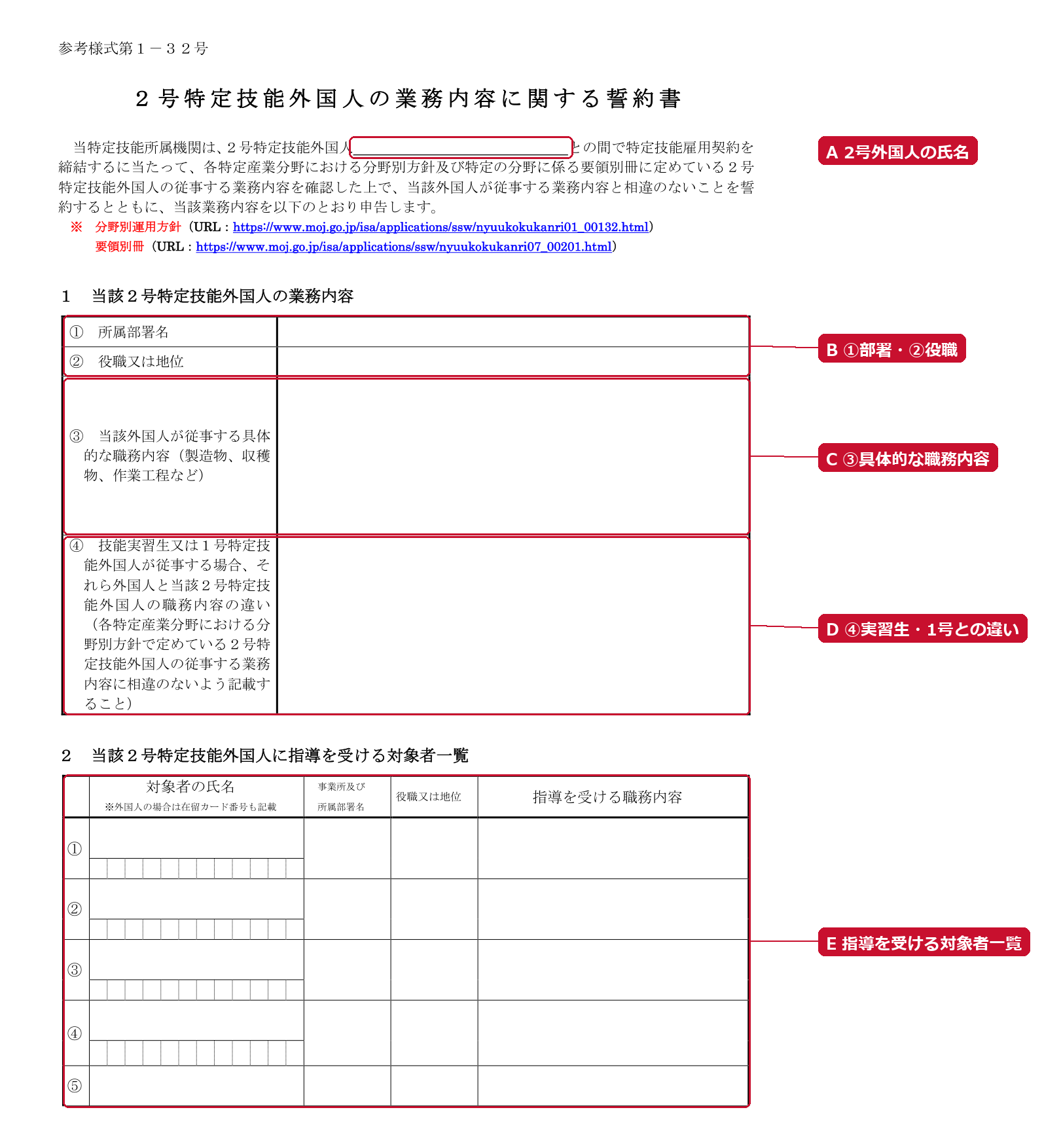
Sources: Immigration Services Agency, “List of application and notification forms for Specified Skilled Worker,” Reference Form No. 1-32
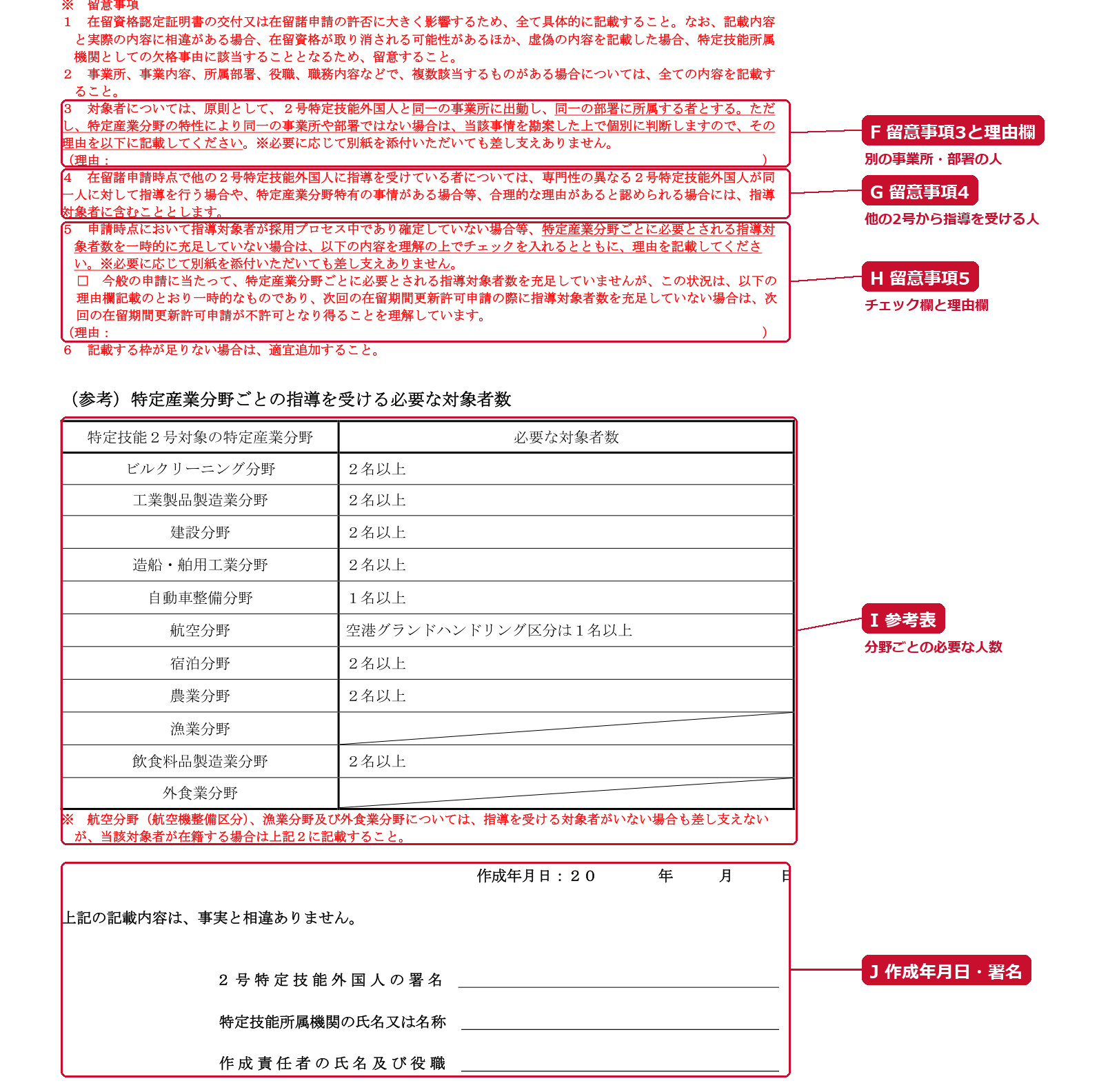
Sources: Immigration Services Agency, “List of application and notification forms for Specified Skilled Worker,” Reference Form No. 1-32
| Mark in image | Field | Section that explains it |
|---|---|---|
| A to D | Name at the top, 1 Duties (① to ④) | Entries by field ① |
| E | 2 List of people receiving guidance (spaces for 5 people, ① to ⑤) | Entries by field ② |
| F to I | Notes 3 to 5, reference table | How to count the people receiving guidance ① and ② |
| J | Date of preparation and signatures | Date of preparation, signatures, and checks before submission |
If there are not enough spaces, you may add more as appropriate (note 6). For the reason fields, you may attach a separate sheet if necessary (notes 3 and 5).
The images are PDFs made from the Immigration Services Agency’s Word form. The page breaks may differ slightly from the Agency’s version.
(Source: List of application and notification forms for Specified Skilled Worker (Reference Form No. 1-32))
Entries by field ①|”1 Duties” (name, department, position, job duties)
“1 Duties” is the field for describing the duties the (ii) foreign national actually performs. Write it so that it is clear the duties match the (ii) duties defined in the field-specific operational policies and other rules.
Name at the top (image A)
On the underlined space in the opening sentence, write the name of the (ii) foreign national who concludes the specified skilled worker employment contract. It is safer to check it against the residence card (在留カード) to make sure the spelling matches the other application documents.
① Department and ② position or status (image B)
Write the department the (ii) foreign national belongs to and their position or status. If more than one workplace, department, position, job duty, etc. applies, write all of them (note 2).
③ Specific job duties (image C)
The form says “products manufactured, crops harvested, work processes, etc.” Write specifically what is manufactured (or handled), in which process, and what is guided and managed.
Before writing, check the (ii) duties for that field in the field-specific operational policies and the separate volume of the guidelines, and in the Immigration Services Agency’s “Job Description for each field of Specified Skilled Worker (ii).” For example, the Job Description says the following:
| Field (category) | Outline of (ii) duties (from the Job Description) |
|---|---|
| Building cleaning | Duties of engaging in cleaning the interior of buildings while guiding multiple workers and managing the site, as well as management duties such as planning and progress control for those duties |
| Industrial product manufacturing (machining and metalworking category) | Engaging in work in the manufacturing processes for formed and fabricated material products, industrial machinery, etc. while guiding multiple skilled workers, and managing the processes |
In ③, write what this “engaging while guiding” and “managing” actually means, based on your company’s own work.
Fictional example (industrial product manufacturing): “In Production Section 2, in charge of the process of machining parts for industrial machinery (numerically controlled lathe). Guides workers on work procedures, confirms dimensional inspections after machining, and manages the progress of the process in line with the daily production plan.”
④ Difference in job duties from technical intern trainees and (i) workers (image D)
If technical intern trainees or (i) workers work at the same workplace, write how their duties differ from the (ii) worker’s duties. The form asks that this be written so that it does not differ from the (ii) duties defined in the field-specific operational policies.
The Operational Guidelines state that the normal duties of a (ii) worker “must not be the same” as those of trainees and (i) workers. For this reason, avoid wording that could be read as “doing the same work.”
Fictional example: “Technical intern trainees and (i) workers carry out machining work following the instructed procedures. The (ii) worker guides workers on procedures, confirms inspection results, manages the progress of the process, and decides the work setup based on their own judgment.”
The examples are only a guide to how to write. Write according to the actual duties. If you are unsure about the scope of duties in a field, consult the ministry or agency in charge of the field or an expert.
(Sources: Reference Form No. 1-32, Job Description for each field of Specified Skilled Worker (ii), Basic policy, field-specific operational policies, and Operational Guidelines, Operational Guidelines on Accepting Specified Skilled Worker Foreign Nationals (main text))
Entries by field ②|”2 List of people receiving guidance”
In “2 List of people receiving guidance,” write the people who receive guidance from the (ii) foreign national, one person per row (image E).
| Column | What to write |
|---|---|
| Name of the person | Name. For a foreign national, also write the residence card number |
| Workplace and department | The workplace the person reports to and the department they belong to |
| Position or status | The person’s position or status |
| Duties on which guidance is received | The work on which the person receives guidance from the (ii) worker |
As a guide, the “duties on which guidance is received” are easier for the reader to understand if they correspond to the (ii) worker’s guidance duties written in ③ specific job duties (image C) of “1 Duties.” For example, if you wrote “guiding workers on work procedures” in ③ of “1 Duties,” write something like “machining parts with a numerically controlled lathe” in the person’s row.
There are spaces for 5 people. If there are not enough, you may add more (note 6).
Whom, and how many people, to list is explained in the next 2 sections.
(Source: Reference Form No. 1-32)
How to count the people receiving guidance ①|The required number for each field and who counts
The required number is shown for each field in the reference table on the form (image I). In most fields it is 2 or more.
| Field | Required number of people receiving guidance |
|---|---|
| Building cleaning field | 2 or more |
| Industrial product manufacturing field | 2 or more |
| Construction field | 2 or more |
| Shipbuilding and marine industry field | 2 or more |
| Automobile repair and maintenance field | 1 or more |
| Aviation field | 1 or more for the airport ground handling category |
| Accommodation field | 2 or more |
| Agriculture field | 2 or more |
| Fishery field | Not stated (struck through) |
| Food and beverage manufacturing field | 2 or more |
| Food service field | Not stated (struck through) |
In the aviation field (aircraft maintenance category), the fishery field, and the food service field, it is acceptable to have no people receiving guidance. However, if such people are employed, list them in the list (2) (note to the reference table).
→ [Breaking News Japan Building Maintenance Association Announces Schedule for the Building Cleaning Specified Skilled Worker (ii) Test on December 18 (October 20, 2026)](https://kisaragi-office.com/immigration_journal/en/archives/8359)
The number is not “only at the time of application”
The revised Operational Guidelines state that a (ii) worker “normally” needs to be guiding at least the number of people set for the field, and is required to “do so in a stable and continuous manner.” It is safer not to assume that it is enough to have the number in place only at the time of application.
The principle for who counts
In principle, the people receiving guidance are people who report to the same workplace and belong to the same department as the (ii) worker (note 3). How to handle people who do not fit this is explained in the next section.
People who are not full-time, and Japanese employees
The pre-revision Operational Guidelines and form stated that people who do not work full-time are not included among the people receiving guidance. With the October 19 revision, this statement was deleted from the Operational Guidelines and the form. However, there is no sentence saying they “may be included” either. The Immigration Services Agency’s Q&A (Q102) explains that it received inquiries about circumstances such as people receiving guidance not being full-time, and made a review.
As for whether Japanese employees can be listed, the form says “for a foreign national, also write the residence card number.” The wording does not limit the list to foreign nationals, but we could not find a sentence in the Immigration Services Agency’s materials that states this clearly.
In both cases, the decision may change depending on individual circumstances. It is safer to check with the Regional Immigration Services Bureau where you apply, or with an expert, before listing them.
(Sources: Reference Form No. 1-32, Comparison table of old and new texts for the partial revision of the Operational Guidelines (October 19, 2026), Q&A on the Specified Skilled Worker system)
How to count the people receiving guidance ②|3 confusing situations and where to write them
Even in situations that do not fit the principle, they may be handled flexibly if there are reasonable circumstances. In that case, write the reason in the designated field of the form.
| Situation | Handling after the revision | Field to write in |
|---|---|---|
| People at another workplace or in another department | In principle not included. Decided case by case if there are reasonable circumstances due to the characteristics of the field, etc. | Reason field for note 3 (image F). A separate sheet is also acceptable |
| People who receive guidance from another (ii) worker | Included if there is a reasonable reason | Note 4 (image G). There is no dedicated reason field |
| The number is temporarily short | Handled flexibly if there are reasonable circumstances | Checkbox and reason field for note 5 (image H). A separate sheet is also acceptable |
People at another workplace or in another department (image F)
The form asks you to write the reason when, due to the characteristics of the field, the people are not at the same workplace or in the same department, because such cases are decided individually taking the circumstances into account (note 3).
The Q&A (Q104) states that cases where the (ii) worker or the people receiving guidance have multiple places of work, or where it is recognized from the structure of the affiliated organization or department that guidance is being given appropriately, will be handled flexibly even if the people are at another workplace or in another department.
In the reason field, write specifically where and how guidance is given. Examples include circumstances where the work site changes from day to day, or where the worker goes around several workplaces to give guidance.
People who receive guidance from another (ii) worker (image G)
People who already receive guidance from another (ii) worker are included among the people receiving guidance when there is recognized to be a reasonable reason (note 4). Examples given include cases where (ii) workers with different specialties guide the same person, and cases where there are circumstances specific to the field.
The form has no dedicated reason field for this situation. In the editorial team’s view, it seems easier to understand if you write separately, in “duties on which guidance is received” in the list, what guidance the person receives from each (ii) worker, or explain the circumstances on a separate sheet. It is safer to check with the office where you apply about how to write it.
When the number is temporarily short (image H)
If, at the time of application, the required number is temporarily not met, for example because the people receiving guidance are still being recruited and have not yet been decided, check the box after understanding the content of note 5, and write the reason (a separate sheet is also acceptable).
The gist of the checkbox statement is as follows:
- In this application, the required number of people receiving guidance is not met
- This situation is temporary, as described in the reason field
- I understand that if the number is not met at the time of the next application for Permission to extend period of stay (在留期間の更新許可), the next extension may be denied
The Q&A (Q103) gives, as examples of “temporary,” cases where the people receiving guidance are still being recruited and have not been decided, and cases where there is temporarily no one to guide because a person left the job or took leave, etc.
In the reason field, writing by when, how many people, and how they will be secured (such as the progress of recruitment) makes it easier to show that the situation is temporary.
(Sources: Reference Form No. 1-32, Q&A on the Specified Skilled Worker system, Operational Guidelines on Accepting Specified Skilled Worker Foreign Nationals (main text))
Date of preparation, signatures, and checks before submission
At the end of the form are the date of preparation and the sentence “The above content does not differ from the facts.” Below it, write the following 3 items (image J):
- Signature of the Specified Skilled Worker (ii) foreign national
- Name or company name of the specified skilled worker’s affiliated organization
- Name and position of the person responsible for preparing it
The Immigration Services Agency’s list of forms states that, in principle, no seal is required on submitted documents, including application forms.
Checking with the following table before submission helps prevent omissions.
| Item to check | Relevant field |
|---|---|
| Do the job duties in ③ match the (ii) duties in the field-specific operational policies and the Job Description? | C |
| Can ④ be read as the same duties as trainees and (i) workers? | D |
| Is the number of people receiving guidance at least the number in the reference table? If it is short, did you check 5 and write the reason? | E, H, I |
| If you listed people at another workplace or department, did you fill in the reason field for 3? | F |
| If you listed people who receive guidance from another (ii) worker, are the circumstances clear? | E, G |
| Did you write the residence card numbers of foreign people receiving guidance? | E |
| Did you write all of the workplaces, departments, and positions if there are several? | B, E |
| Is there the (ii) worker’s own signature? | J |
Even after the application, make sure the written content does not differ from the actual duties and guidance structure (note 1).
(Sources: List of application and notification forms for Specified Skilled Worker, Reference Form No. 1-32)
The October 19 revisions and applications filed on the old form
On October 19, 2026, the Operational Guidelines and the form were revised. The main differences are as follows.
| Item | Before the revision | After the revision |
|---|---|---|
| Required number | “Must be guiding” at least the required number of people | “Normally” needs to be guiding at least the required number of people, and is required to “do so in a stable and continuous manner” |
| People who report to another workplace | Not included | In principle not included, but handled flexibly if there are reasonable circumstances depending on the characteristics of the field |
| People who receive guidance from another (ii) worker | Not included (not listed) | Included if there is a reasonable reason, such as when (ii) workers with different specialties guide the same person |
| People who do not work full-time | Not included (limited to people working full-time) | This statement was deleted (no statement sets out how they are handled) |
| The number is temporarily short | No provision | Handled flexibly if there are reasonable circumstances. Checkbox and reason field in note 5 of the form |
| Note to the reference table | Fields and job categories with no required number stated may have no such people | The aviation field (aircraft maintenance category), the fishery field, and the food service field may have no such people |
The required number of people receiving guidance for each field itself did not change before and after the revision. The list of people receiving guidance has also had spaces for 5 people since before the revision.
If you applied on the old form between August 20 and October 19
According to the Q&A (Q105), cases applied for between August 20 and the October 19 review will also be examined under the post-review handling. For this reason, in principle, a written pledge on the new form will need to be submitted again.
However, it states that if the old form already lists the required number of people receiving guidance for the field, there is no need to replace it with the new form.
The Q&A does not state how or where to submit it again. If you have an application under review, check with the Regional Immigration Services Bureau where you applied.
(Sources: Comparison table of old and new texts for the partial revision of the Operational Guidelines (October 19, 2026), Q&A on the Specified Skilled Worker system, Specified Skilled Worker Operational Guidelines and forms)
Supervisor’s comment
This written pledge has been required since August 20, 2026, but the Immigration Services Agency may not yet have unified standards for examining it. As of now (October 26, 2026), our office has received examination results for several Specified Skilled Worker (ii) applications in which this written pledge was submitted, and we have not received any strict comments about this document. Even so, decisions may differ between regional immigration bureaus and individual examiners, so we recommend writing the information as accurately as possible.
Summary
- For (ii) applications concerning residence, the written pledge on Reference Form No. 1-32 must be submitted from August 20. The accepting organization prepares it, and the (ii) worker signs it
- Write ③ and ④ specifically, matching the (ii) duties in the field-specific operational policies and the Job Description, so that they cannot be read as the same duties as trainees and (i) workers
- In most fields, 2 or more people receiving guidance are required. In principle they are people at the same workplace and in the same department, and the (ii) worker is required to normally guide them in a stable manner
- Write people at another workplace in the reason field for 3, and, when the number is temporarily short, use the checkbox and reason field for 5
- If you applied on the old form, in principle submit again on the new form. If the required number is already listed, no replacement is needed
For points where the handling changes depending on individual circumstances, consult the Regional Immigration Services Bureau or an expert before applying.
Primary Sources Referenced in Article Creation
- Immigration Services Agency, “List of application and notification forms for Specified Skilled Worker” (Reference Form No. 1-32, Written Pledge on the Duties of a Specified Skilled Worker (ii) Foreign National)
- Immigration Services Agency, “On the Duties of Specified Skilled Worker (ii) Foreign Nationals” (August 5, 2026)
- Immigration Services Agency, partial revision of the “Operational Guidelines on Accepting Specified Skilled Worker Foreign Nationals” (October 19, 2026, comparison table of old and new texts)
- Immigration Services Agency, “Operational Guidelines on Accepting Specified Skilled Worker Foreign Nationals” (main text)
- Immigration Services Agency, comparison table of old and new texts for the partial revision of the Operational Guidelines (August 20, 2026)
- Immigration Services Agency, “Q&A on the Specified Skilled Worker system”
- Immigration Services Agency, “Specified Skilled Worker Operational Guidelines and forms”
- Immigration Services Agency, “Basic policy, field-specific operational policies, and Operational Guidelines”
- Immigration Services Agency, “Job Description for each field of Specified Skilled Worker (ii)”
This article is a translation of the original Japanese version.