

In Japan, because Specified Skilled Worker (i) (特定技能1号) in the food service industry field is approaching its projected acceptance number (the acceptance cap of 50,000 people), the issuance of Certificates of Eligibility (在留資格認定証明書) has been temporarily suspended since April 13, 2026. Applications for a Certificate of Eligibility accepted on or after April 13 will in principle not be issued, and changes from statuses of residence other than the food service industry are also, with some exceptions, in principle not permitted. On the other hand, job changers already holding Specified Skilled Worker (i) in the food service industry, extensions of the period of stay, and changes to Specified Skilled Worker (ii) are being reviewed as usual.
First, check the route of the person you want to hire, and then prepare to join the Food Industry Specified Skilled Worker Council (食品産業特定技能協議会) and the documents. This article sets out how each route is handled during the suspension and the basics of acceptance (eligible restaurants, work, requirements, the council, documents, and the process).
How each route is handled is based on the review status published by the Immigration Services Agency (posted October 19, 2026). The review status is updated, so check the latest page before applying. The field-specific standards were checked against the operational guidelines partially revised on October 26, 2026.
The suspension in the food service industry field: since when, and what has stopped
What has stopped are applications to bring people in from overseas and changes from statuses of residence other than the food service industry.
Background
The number of residents with Specified Skilled Worker (i) in the food service industry field reached about 46,000 at the end of February 2026 (preliminary figure), and it was expected to exceed the projected acceptance number around May. For this reason, the Ministry of Agriculture, Forestry and Fisheries (MAFF) and the Immigration Services Agency announced a policy on March 27, and since April 13 they have taken measures to temporarily suspend the issuance of Certificates of Eligibility under Article 7-2, paragraphs 3 and 4 of the Immigration Control Act.
The figure of 50,000 people is the projected acceptance number up to the end of March of Reiwa 11, decided by the Cabinet on January 23, 2026. The Immigration Services Agency’s page on the food service industry field still shows the earlier figure (53,000 people), but the current cap is 50,000 people.
What has stopped
How each route is handled is shown in the table under the next heading. In addition, new changes to Designated Activities (Preparation for Transition to Specified Skilled Worker (i)) (特定活動(特定技能1号移行準備)) in the food service industry field are not permitted, except for cases such as job changes. The Food Service Industry Specified Skilled Worker (i) Evaluation Exam will also not be held, either in Japan or overseas, for the time being.
Whether and when acceptance will resume has not been decided. MAFF’s Q&A says that resumption is expected to be announced in advance if it is judged appropriate, after considering factors such as whether there is sufficient room under the cap.
(Sources: Immigration Services Agency, “Operation of the Acceptance Cap for Specified Skilled Worker in the ‘Food Service Industry Field'”, MAFF, “Operation of the Acceptance Cap”, the same, Q&A, Main points of the field-specific operational policies, Immigration Services Agency, “Food Service Industry Field”)
Which case applies to your hiring? How each route is handled (review status posted October 19, 2026)
How the application is handled depends on the current status of residence of the person you want to hire.
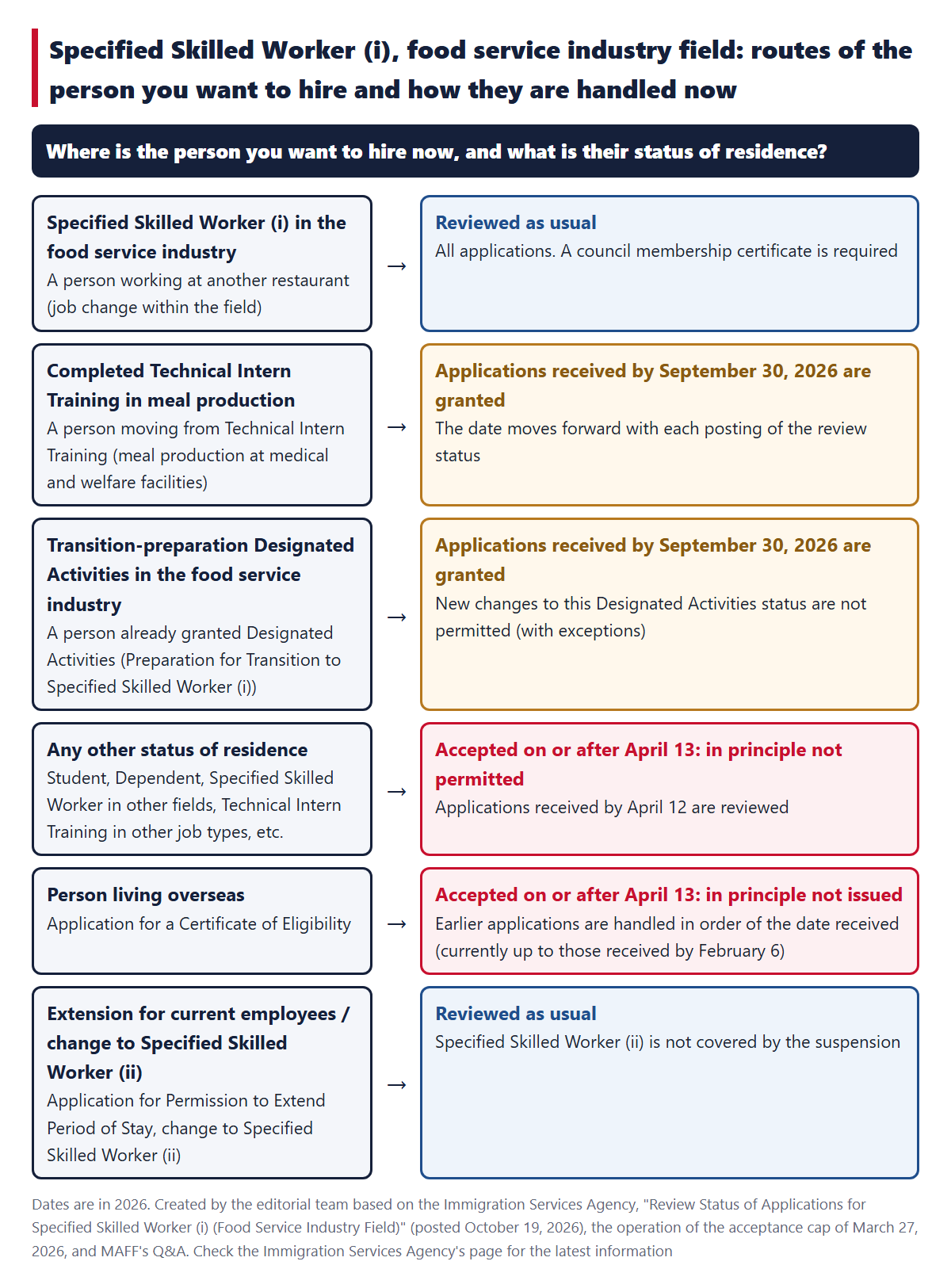
Sources: Created by the editorial team (based on the Immigration Services Agency, “Review Status of Applications for Specified Skilled Worker (i) (Food Service Industry Field)”)
| Person you want to hire | Application to immigration | How it is handled now |
|---|---|---|
| Person living overseas | Application for a Certificate of Eligibility | Applications accepted by April 12 are issued in order of the date received, while giving priority to change applications (currently, applications received by February 6, 2026). Applications accepted on or after April 13 are in principle not issued |
| Person with Specified Skilled Worker (i) in the food service industry (job change) | Application for Permission to Change Status of Residence (在留資格変更許可申請) | All applications are reviewed as usual |
| Person who has completed Technical Intern Training (meal production at medical and welfare facilities) | Application for Permission to Change Status of Residence | Applications received by September 30, 2026 are granted as soon as the review is completed as usual |
| Person already granted Designated Activities (Preparation for Transition to Specified Skilled Worker (i)) in the food service industry | Application for Permission to Change Status of Residence | Likewise, applications received by September 30, 2026 |
| Others (international students, dependents, Specified Skilled Worker in other fields, Technical Intern Training in other job types, etc.) | Application for Permission to Change Status of Residence | Applications received by April 12 are reviewed. Applications accepted on or after April 13 are in principle not permitted |
| Person you currently employ | Application for Permission to Extend Period of Stay (在留期間更新許可申請) | Reviewed as usual |
| Person moving to Specified Skilled Worker (ii) | Application for Permission to Change Status of Residence | Not covered by the measures; reviewed as usual |
The dates for Technical Intern Training in meal production and for the transition-preparation Designated Activities move forward with each posting (up to August 31 in the September 10 posting).
If the period of stay may expire while the application is pending
For applications where the period of stay may expire before their turn comes, the Immigration Services Agency says it may advise the applicant to apply for a change to Designated Activities (Preparation for Specified Skilled Worker (i)) (food service industry field) (特定活動(特定技能1号準備)(外食業分野)) or to request a change to the content of the extension application. The extension is allowed only once.
If a person granted this Designated Activities status wishes to continue the same activities, they apply for a change to Specified Skilled Worker (i) before the period of stay expires (about 3 months before). At that time, only the application form and a photo need to be submitted.
Other points to note
- Technical intern trainees cannot work after completing their training plan. For changes from Technical Intern Training, applicants are asked to apply at least 2 months before the planned start date of work.
- The Immigration Services Agency, regional immigration bureaus, and MAFF will not answer inquiries about the status of issuance or permission. Check the progress on the review status page.
A job change from Specified Skilled Worker in another field to the food service industry also counts as a change from a status of residence other than the food service industry. The general procedures for changing jobs across fields are explained in the following article.
The requirements for the transition-preparation Designated Activities and how they are handled in the food service industry are explained in the following article.
How the review status has changed with each update, and actual examples of the time from application to issuance, are explained in the following article.
(Sources: Immigration Services Agency, “Review Status of Applications for Specified Skilled Worker (i) (Food Service Industry Field)” (posted October 19, 2026), Immigration Services Agency, “Operation of the Acceptance Cap for Specified Skilled Worker in the ‘Food Service Industry Field'”, MAFF Q&A)
What is Specified Skilled Worker in the food service industry field? Eligible restaurants and what workers must not be made to do
The food service industry field is the field of food and drink services that provide food and beverages prepared to customers’ orders, such as diners, restaurants, takeout, catered meals and bento delivery, and catering and meal services. The competent ministry is MAFF (Food Service Industry and Food Culture Division). The standards specific to this field are set out in a MAFF public notice (MAFF Public Notice No. 527 of Heisei 31) and the operational guidelines.
Revision of the operational guidelines on October 26, 2026
The operational guidelines (food service industry field) were partially revised on October 26, 2026. The main points are as follows.
- The underlying policy was changed to the field-specific operational policies (the policies for Specified Skilled Worker and Employment for Skill Development) decided by the Cabinet on January 23, 2026.
- The name of the skills exam became “Evaluation Exam.” People who passed the former skills test are deemed to have passed the Evaluation Exam.
- The Japanese language level is now described using the “Japanese Language Education Reference Framework,” and the handling from April 1, 2027 was added.
- References to the business license from the public health center and similar documents were removed from the documents to be checked.
- A chapter on the “Development and Career Formation Program” was added.
Eligible workplaces
The workplace where the foreign national works must carry out one of the following 4 types of food and drink services.
| Type | Examples |
|---|---|
| ① Food and drink consumed on the premises | Eating places such as diners, restaurants, and restaurants serving cuisine, and coffee shops |
| ② Takeout (no facilities for eating and drinking) | Takeout-only shops |
| ③ Delivery | Catered meal and bento shops, delivery-only shops, and meal delivery service businesses |
| ④ Cooking at a place requested by the customer | Catering service shops and meal service businesses |
A “customer” is a specific person who consumes the food and beverages themselves (including cases through a representative, such as group meal services). Providing food to a buyer who purchases it in order to sell it to unspecified consumers is wholesale (so-called B2B) and is not eligible.
The sales of the food and drink services section do not need to be the main part of the sales of the whole business. For this reason, foreign nationals can also work in the food and beverage sections of accommodation facilities such as hotels and in the meal service sections of hospitals and welfare facilities. A form in which food is made in a factory and sold wholesale is on the boundary with the food and beverage manufacturing field.
What workers must not be made to do
- Working at the business premises of an adult entertainment business or a sex-related special business
- Entertaining customers (not allowed even as related work)
- Dispatch (you can neither dispatch the foreign national nor accept a dispatched person)
An exception is a business place inside a facility licensed for ryokan or hotel business that has a license under the Adult Entertainment Business Act (adult entertainment business under Article 2, paragraph 1, item 1). Even where food and drink with entertainment of customers is provided, for example in a banquet hall, the foreign national may be engaged in food service work in that ryokan or hotel’s restaurant or banquet hall. However, they must not be made to entertain customers; the company must prepare a manual for preventing entertainment of customers, set up a consultation system, and submit a written pledge and the manual to the council.
The operational guidelines state that if a company dispatches or accepts dispatched workers, it will not be able to accept Specified Skilled Workers for 5 years thereafter. The only form of employment allowed is direct employment.
If you are unsure whether your business is eligible, the operational guidelines advise you to contact the MAFF Food Service Industry and Food Culture Division (03-6744-2053) before applying to join the council. This is because if the council judges your business to be ineligible, you cannot employ the person.
(Sources: Operational guidelines (food service industry field, partially revised October 26, 2026), Comparison table of old and new provisions, MAFF, “Acceptance of Foreign Human Resources in the Food Service Industry Field”)
Permitted work: food and drink preparation, customer service, and store management
There is one job category for Specified Skilled Worker (i), “food service industry,” and the worker engages broadly in food and drink preparation, customer service, and store management. However, depending on the workplace situation, it is acceptable to have the worker engage only in specific work, for example by assigning them to cooking for part of their period of stay.
| Work | Examples (operational guidelines) |
|---|---|
| Food and drink preparation | Preparing ingredients, cooking with heat, cooking without heat, seasoning, plating, preparing food and beverages |
| Customer service | Showing customers to their seats, taking orders, serving, clearing tables, receiving payment, taking reservations, handling complaints, and liaison and coordination with the recipients at meal service businesses |
| Store management | Hygiene management, shift management, guidance and training of employees, accounting work, ordering and inspecting goods, planning and developing menus, preparing work manuals |
Related work that Japanese employees doing the same job normally do (such as producing agricultural, forestry, and fishery products used as ingredients in the shop, or selling goods other than prepared food) may be done incidentally. The worker cannot be made to do only related work.
Foreign nationals on Specified Skilled Worker (ii) also take on store operation (business analysis, business management, contract-related work, etc.) and work as personnel who manage the store as a whole.
(Sources: Operational guidelines (food service industry field, partially revised October 26, 2026))
Requirements for the foreign national: exams, Japanese language, and transition from Technical Intern Training (ii)
To obtain Specified Skilled Worker (i), the person in principle needs to pass a skills exam and a Japanese language exam. There are exemptions for people who have satisfactorily completed Technical Intern Training (ii) (技能実習2号).
| Route of the foreign national | Skills | Japanese language |
|---|---|---|
| Person who passed the exams | Pass the Food Service Industry Specified Skilled Worker (i) Evaluation Exam | A2.2 equivalent or higher on the JFT-Basic (Japan Foundation Test for Basic Japanese), or N4 or higher on the Japanese-Language Proficiency Test |
| Person who satisfactorily completed Technical Intern Training (ii) in meal production at medical and welfare facilities | Exempt | Exempt |
| Person who satisfactorily completed Technical Intern Training (ii) in another job type | Must pass the exam | Exempt |
The revised operational guidelines state that from April 1, 2027, proof of skills and Japanese language will basically be required for Specified Skilled Worker (i). However, people who have satisfactorily completed Technical Intern Training (ii) in meal production at medical and welfare facilities will not need proof for the time being. People who have satisfactorily completed Technical Intern Training (ii) in other job types need proof of skills, while their Japanese language is treated as proven.
As skills exams for Specified Skilled Worker (i), the revised operational guidelines list, in addition to the Food Service Industry Specified Skilled Worker (i) Evaluation Exam, the “Meal Production at Medical and Welfare Facilities Employment for Skill Development Evaluation Exam (Specialist Level),” which is an evaluation exam for Employment for Skill Development.
Points to note during the suspension
The Evaluation Exam for Specified Skilled Worker (i) will not be held, either in Japan or overseas, for the time being. Even people who have already passed are, if they are overseas or are international students or similar, currently in principle not issued a certificate or not permitted (see the quick reference table above).
The procedures for moving from Technical Intern Training to Specified Skilled Worker are explained in the following article.
(Sources: Operational guidelines (food service industry field, partially revised October 26, 2026), MAFF, “Acceptance of Foreign Human Resources in the Food Service Industry Field”)
What is required of the accepting organization: additional conditions in the food service industry field
In addition to the standards common to all fields (employment contract, support plan, etc.), the public notice adds the following conditions.
| Condition | Details |
|---|---|
| 1. Do not have the worker work at adult entertainment premises | Business premises of adult entertainment businesses (except the exception inside hotels) and sex-related special businesses |
| 2. Do not have the worker entertain customers | Including related work |
| 3. Measures at exception premises | At business premises inside a hotel licensed under the Adult Entertainment Business Act, take measures to prevent entertainment of customers |
| 4. Become a member of the council | Join before applying for residence procedures |
| 5. Cooperate with the council | Cooperation with surveys, information sharing, etc. |
| 6. Cooperate with MAFF | Cooperation with surveys, guidance, etc. |
| 7. The contractor must also meet the conditions | If you fully outsource support, use a registered support organization that meets conditions 4 to 6 |
| 8. Explain the career advancement plan | Before the employment contract, give and explain it in writing (electronic data is also acceptable) |
| 9. Certify work experience | If the worker requests it, issue a document certifying their work experience |
Career advancement plan and certificate of work experience
The career advancement plan has no prescribed format. As examples of its contents, the operational guidelines list the expected career route, the work at each level and the number of years as a guide to proficiency, and the experience, achievements, and qualifications needed to move up a level. When advancing the worker’s career, appoint them to the position with a letter of appointment, a written job order, or the like.
If you do not issue a requested certificate of work experience, you will not meet the standards and will no longer be able to accept workers. The same applies if you do not cooperate with the council.
The “Development and Career Formation Program” added by the revision is a guideline created by MAFF with the industry for development from Employment for Skill Development through to Specified Skilled Worker (ii). The operational guidelines ask companies to refer to and make use of the program on MAFF’s website.
(Sources: Operational guidelines (food service industry field, partially revised October 26, 2026))
Joining the Food Industry Specified Skilled Worker Council: before the immigration application, allow 2 to 3 months
The council is an organization jointly set up by the food service industry field and the food and beverage manufacturing field. Its members are accepting organizations and the registered support organizations to which support is outsourced.
- When to join: when accepting a worker for the first time, join before applying to immigration for residence procedures. You do not need to join again for the second and subsequent workers.
- Review period: the membership review takes 2 to 3 months.
- Documents to submit: written pledge (No. 14-1), the business license of the shop where the foreign national will work, a written pledge on the code of conduct, etc. (membership application guide for the food service industry field)
- Fees: for the time being, no admission fee or annual fee is charged.
- Contact: Food Industry Specified Skilled Worker Council (within MAFF) 03-6744-2397
In practice during the suspension: a membership certificate is required even when hiring a job changer
Even when hiring a job changer with Specified Skilled Worker (i) in the food service industry, the council membership certificate is required for the Application for Permission to Change Status of Residence that accompanies the job change. MAFF’s Q&A says that companies that applied for membership on or after March 28 can also become the new employer, and urges companies to apply early.
If a company that is already a member in the food and beverage manufacturing field will also accept workers in the food service industry field, it needs to go through new membership procedures for the food service industry field. The following articles for the food and beverage manufacturing field are also helpful for the flow of the membership application.
(Sources: MAFF, “Acceptance of Foreign Human Resources in the Food Service Industry Field”, MAFF, “About the Food Industry Specified Skilled Worker Council”, MAFF Q&A, Membership Application Guide: Food Service Industry Field, the same: Food and Beverage Manufacturing Field, Operational guidelines (food service industry field, partially revised October 26, 2026))
Food service industry field documents to submit to immigration: Table 3-16
In addition to the documents common to all fields, submit the documents for the food service industry field. The application for a Certificate of Eligibility and the change application for Specified Skilled Worker (i) use the same list (Table 3-16).
| Document | Who submits it / points to note |
|---|---|
| Proof of skills | For exam passers, a copy of the certificate of passing. For people who satisfactorily completed Technical Intern Training (ii) in meal production at medical and welfare facilities, a copy of the certificate of passing the practical test of the Technical Intern Training Evaluation Exam (Specialist Level), or the evaluation report on the technical intern trainee |
| Proof of Japanese language | A copy of the certificate of passing the Japanese-Language Proficiency Test (N4 or higher), or a copy of the JFT-Basic result notification. People who satisfactorily completed Technical Intern Training (ii) (2 years and 10 months or more) may omit it regardless of job type, but documents proving satisfactory completion are required |
| Written pledge (Field Reference Form No. 14-1) | Everyone |
| Certificate of membership in the council | Everyone |
| Copies of business licenses under the Hotel Business Act and the Adult Entertainment Business Act | When working at a ryokan or hotel |
| Written pledge of the registered support organization (No. 14-2) and its certificate of membership | When fully outsourcing support |
Some documents may be omitted if they were submitted in a previous application, their contents have not changed, and they are still valid.
In the list, the name of the skills exam is still “skills test.” Under the revised operational guidelines, people who passed the skills test are deemed to have passed the Evaluation Exam. References to business licenses and similar documents were removed from the documents to be checked in the revised operational guidelines (for the council membership application, the shop’s business license is submitted). Check the Immigration Services Agency’s page before applying to see whether the list will change.
What you pledge in the written pledge (Field Reference Form No. 14-1)
A new version of the written pledge form was posted on the same day as the revision (revising how the work is described and allowing proof of work experience to be submitted as electronic data).
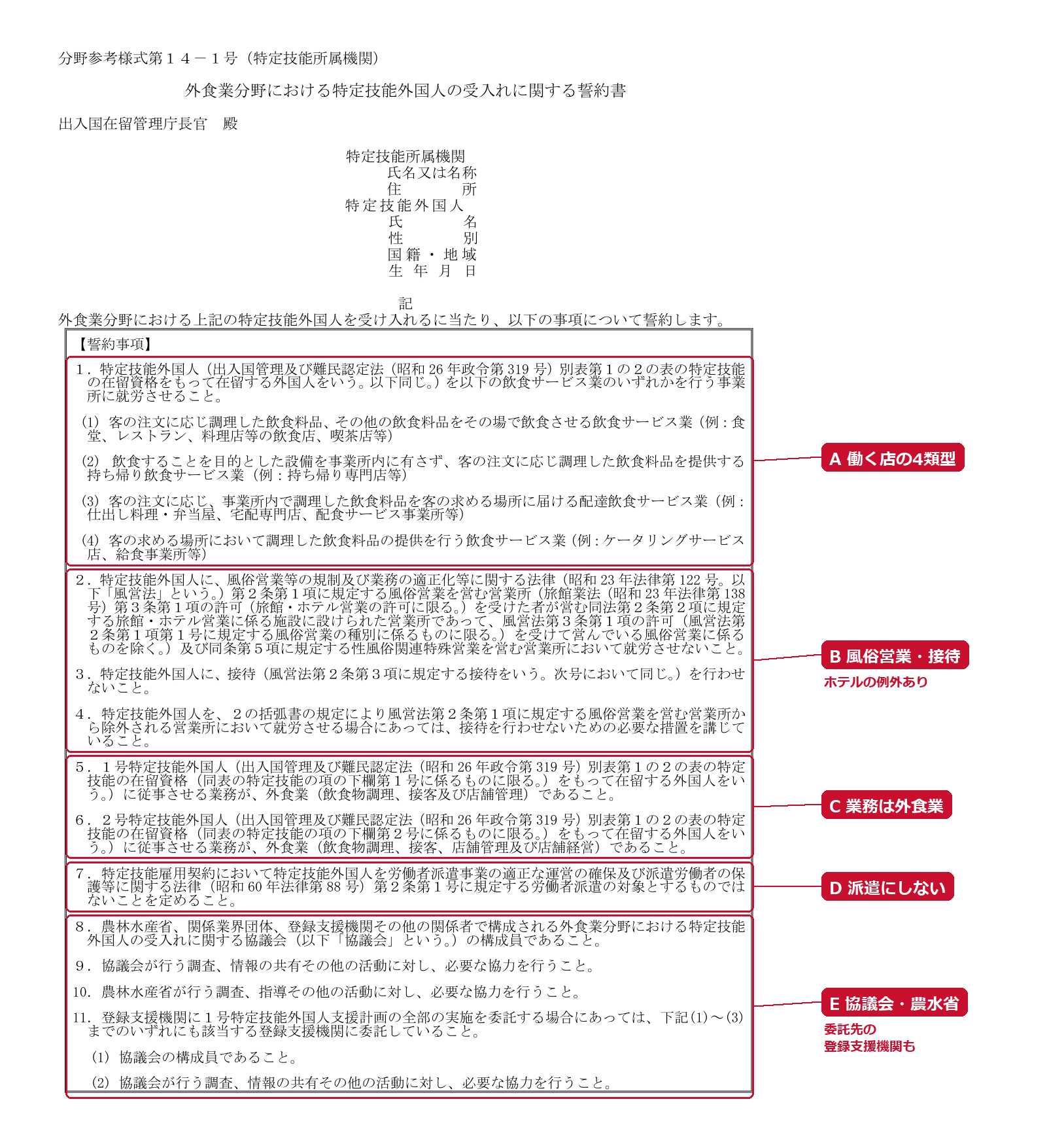
Sources: Immigration Services Agency, Field Reference Form No. 14-1

Sources: Immigration Services Agency, Field Reference Form No. 14-1
In the images, A is the 4 types of restaurants where the worker may work, B is the ban on adult entertainment and entertaining customers, C is the work, D is the ban on dispatch, E is cooperation with the council and MAFF, F is the career advancement plan, and G is certification of work experience. If you can no longer comply with what you pledged, report it to the Immigration Services Agency and the administrative body in charge of the field (note on the form).
The common documents are explained in the following articles.
(Sources: Table 3-16 (for Certificate of Eligibility), Table 3-16 (for change of status), Immigration Services Agency, “Status of Residence ‘Specified Skilled Worker'”, Operational guidelines (food service industry field, partially revised October 26, 2026), Field Reference Form No. 14-1)
The process up to acceptance: using a “job changer with Specified Skilled Worker in the food service industry,” who can still be hired during the suspension, as an example
During the suspension, the people who can newly be accepted are mainly job changers with Specified Skilled Worker (i) in the food service industry. Because the change application cannot be made without a membership certificate, start with the application to join the council.
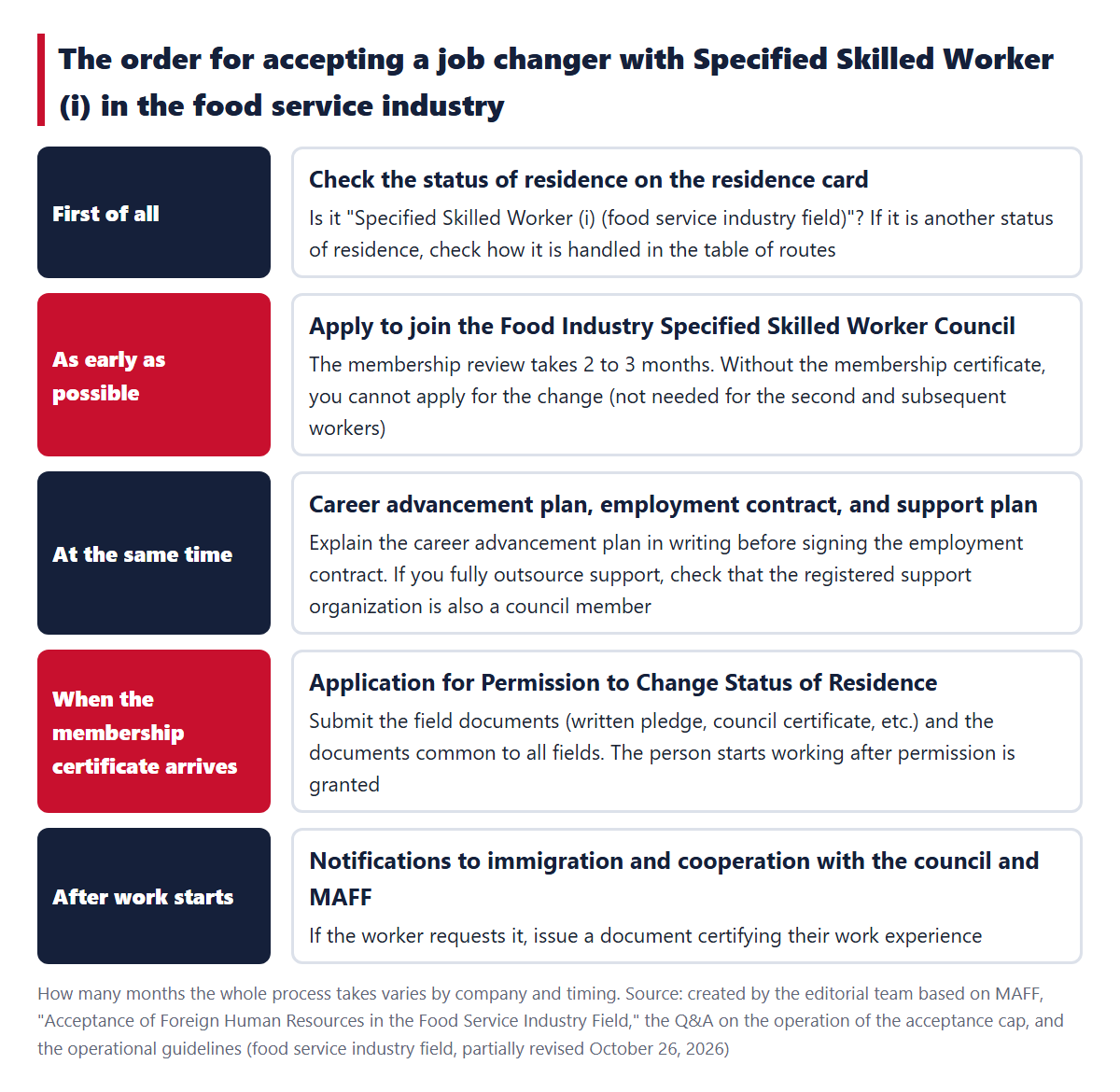
Sources: Created by the editorial team (based on MAFF, “Acceptance of Foreign Human Resources in the Food Service Industry Field,” the Q&A, and the operational guidelines)
- Check on the residence card that the status of residence is “Specified Skilled Worker (i) (food service industry field)”
- Apply to join the council (the membership review takes 2 to 3 months; not needed for the second and subsequent workers)
- Explain the career advancement plan in writing, sign the employment contract, and prepare the support plan
- When the membership certificate arrives, apply for Permission to Change Status of Residence
- After permission is granted, the person starts working at your company
- Submit notifications to immigration and cooperate with surveys by the council and MAFF
The order of the job change procedures and the notifications by the former company are explained in the following articles. The standard processing period for a change of status of residence is 1 to 2 months.
Notifications after acceptance are summarized in the following article.
(Sources: MAFF Q&A, MAFF, “Acceptance of Foreign Human Resources in the Food Service Industry Field”, Immigration Services Agency, “Application for Permission to Change Status of Residence”)
Specified Skilled Worker (ii): not covered by the measures. Exam, N3, and 2 years of experience in guidance and similar roles
Specified Skilled Worker (ii) is not covered by the suspension and is reviewed as usual.
There are 3 requirements for Specified Skilled Worker (ii).
- Passing the Food Service Industry Specified Skilled Worker (ii) Evaluation Exam (held in Japan in CBT format)
- Passing the Japanese-Language Proficiency Test at N3 or higher (only if judged to be equivalent to CEFR B1 or higher)
- 2 years of practical experience, at a restaurant or similar business licensed under the Food Sanitation Act, as a person who engages in work including customer service while guiding and supervising multiple (2 or more) employees and who assists with store management (such as a deputy store manager)
The practical experience is basically assumed to be within 5 years of finishing it and is limited to experience not more than 10 years old; it is checked when taking the Specified Skilled Worker (ii) exam.
The revised operational guidelines state that from April 1, 2027, B1 equivalent or higher under the “Japanese Language Education Reference Framework” will be required for Specified Skilled Worker (ii), and that the handling will be announced separately.
When a Specified Skilled Worker (i) worker you currently employ approaches the upper limit of the total period of stay (5 years), consider Specified Skilled Worker (ii). If requirements such as scoring at least 80% of the passing score on the Specified Skilled Worker (ii) exam are met and there is found to be good reason, the worker can stay for up to 1 year beyond the total period of stay for Specified Skilled Worker (i) (in the food service industry field, passing the Japanese-Language Proficiency Test at N3 or higher, or a score of at least 80% of the passing score at N3 or higher, is also required).
The overall picture of Specified Skilled Worker (ii) and how to fill out the written pledge are explained in the following articles.
(Sources: Operational guidelines (food service industry field, partially revised October 26, 2026), MAFF Q&A, MAFF, “Acceptance of Foreign Human Resources in the Food Service Industry Field”)
Frequently asked questions
Q What happens to applications for a Certificate of Eligibility submitted before April 13? A They are issued in order of the date received, within the projected acceptance number (in the October 19 posting, applications received by February 6, 2026). Because change applications are given priority, considerable delays are expected.
Q Can we hire a person with Specified Skilled Worker status in the food service industry who works at another restaurant? A Yes. For job changes within the field, all applications are reviewed as usual. However, the council membership certificate is required for the change application.
Q Can we hire an international student working part-time, or a person with Specified Skilled Worker status in another field? A This counts as a change from a status of residence other than the food service industry, and applications accepted on or after April 13 are in principle not permitted. When this will resume has not been decided.
Q Can we hire workers for the meal service section of a hospital or nursing care facility? A The operational guidelines state that it is also possible to have the worker work in the meal service sections of medical and welfare facilities and similar places.
(Sources: Immigration Services Agency, “Review Status of Applications for Specified Skilled Worker (i) (Food Service Industry Field)”, MAFF Q&A, Operational guidelines (food service industry field, partially revised October 26, 2026))
Summary and where to get advice
- During the suspension, how an application is handled depends on whom you hire. Job changers with Specified Skilled Worker (i) in the food service industry, extensions of the period of stay, and Specified Skilled Worker (ii) are being reviewed as usual.
- Join the council before applying for residence procedures; the membership review takes 2 to 3 months. A membership certificate is required even when hiring a job changer.
- Check the conditions specific to this field, such as the 4 types of restaurants, the bans on entertaining customers, adult entertainment businesses, and dispatch, and the career advancement plan.
Public contacts when you need help are as follows.
- Latest handling: the Immigration Services Agency’s review status page
- Whether your work or workplace falls under the food service industry field: MAFF Food Service Industry and Food Culture Division 03-6744-2053
- Joining the council: Food Industry Specified Skilled Worker Council 03-6744-2397
- The system in general: Specified Skilled Worker System Consultation Desk (a MAFF-subsidized project, free of charge) 03-6630-8179 (10:00–17:30, excluding Saturdays, Sundays, public holidays, and the year-end and New Year holidays)
- Applications for status of residence: Regional Immigration Services Bureaus
How an application is handled may change depending on the status of residence of the person you want to hire and the timing of the application. If you are unsure, consult a specialist.
Primary Sources Referenced in Article Creation
- Immigration Services Agency, “Review Status of Applications for Specified Skilled Worker (i) (Food Service Industry Field)” (posted October 19, 2026)
- Immigration Services Agency, “Operation of the Acceptance Cap for Specified Skilled Worker in the ‘Food Service Industry Field'” (March 27, 2026)
- Operational Guidelines on the Acceptance of Specified Skilled Workers in Specific Fields: Standards for the Food Service Industry Field (Ministry of Justice and MAFF, partially revised October 26, 2026)
- The same, comparison table of old and new provisions (October 26, 2026)
- Field Reference Form No. 14-1: Written Pledge on the Acceptance of Specified Skilled Workers in the Food Service Industry Field (Specified Skilled Worker affiliated organization)
- Immigration Services Agency, “Specified Skilled Worker Operational Guidelines and Forms”
- Main points of the field-specific operational policies (Cabinet decision of January 23, 2026)
- Policy on the Operation of the System for the Status of Residence of Specified Skilled Worker and Policy on the Operation of the System for Employment for Skill Development in the Food Service Industry Field (Cabinet decision of January 23, 2026)
- Immigration Services Agency, “Food Service Industry Field”
- Immigration Services Agency, “Status of Residence ‘Specified Skilled Worker'” (lists of documents to submit)
- List of Documents to Submit for “Specified Skilled Worker (i),” Table 3-16 Food Service Industry (for Application for Certificate of Eligibility)
- List of Documents to Submit for “Specified Skilled Worker (i),” Table 3-16 Food Service Industry (for Application for Permission to Change Status of Residence)
- Immigration Services Agency, “Application for Permission to Change Status of Residence”
- MAFF, “Acceptance of Foreign Human Resources in the Food Service Industry Field”
- MAFF, “Operation of the Acceptance Cap for Specified Skilled Worker in the ‘Food Service Industry Field'” (March 27, 2026)
- MAFF, “Operation of the Acceptance Cap for Specified Skilled Worker in the ‘Food Service Industry Field’: Q&A”
- MAFF, “About the Food Industry Specified Skilled Worker Council (Food and Beverage Manufacturing Field and Food Service Industry Field)”
- Food Industry Specified Skilled Worker Council, “Membership Application Guidebook: Food Service Industry Field” (revised August 31, 2026)
- Food Industry Specified Skilled Worker Council, “Membership Application Guidebook: Food and Beverage Manufacturing Field”
This article is a translation of the original Japanese version.