This article was written by the NIPPON VISA & LIFE editorial team based on information from public organizations such as the national government and local governments. Rules and fees may differ depending on the city, ward, town or village where you live.
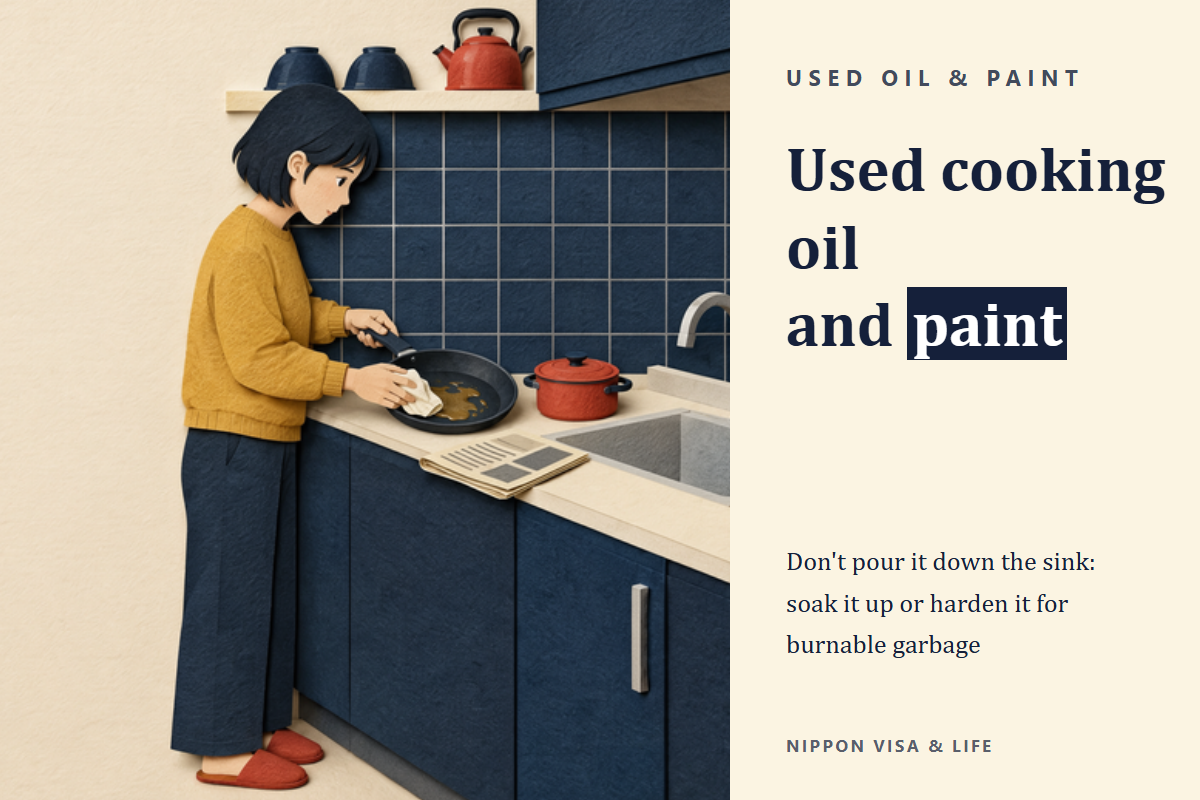
In Japan, used cooking oil such as tempura oil and leftover paint must not be put out as garbage while still liquid or poured down the kitchen sink. Many municipalities (cities, wards, towns and villages) advise residents to soak them into paper or cloth, or solidify them, and then put them out as “burnable garbage” (燃やすごみ, moyasu gomi). Cooking oil can also sometimes be recycled using a municipality’s collection boxes.
The overall rules for sorting garbage are summarized in How to Sort and Put Out Garbage in Japan: Basic Rules for Burnable, Recyclable and Oversized Garbage.
Basic Rules for Throwing Away Liquid Waste
- Do not pour it down the kitchen sink: It causes sewer pipes to clog.
- Do not put it in a bag while it is still liquid: During garbage collection, the bag or container may burst and the contents may splash out.
- Soak it into paper or cloth, or solidify it: Then put it out as “burnable garbage.”
- Let cooking oil cool down first: If you dispose of it while it is still hot, a fire may start inside the garbage bag.
- Some municipalities do not collect certain liquids: For example, Hiroshima City does not collect petroleum products, pesticides and similar items, and advises residents to consult the store where they bought them.
Why You Must Not Put Out Liquids as They Are
Garbage Bags Burst and the Contents Splash Out
In Funabashi City, Chiba Prefecture, there was an accident in which cooking oil was put in a container or plastic bag while still liquid and put out as “burnable garbage” (可燃ごみ, kanen gomi: another name for burnable garbage). The bag burst during collection work and the contents splashed out, dirtying cars and other things at nearby houses. Accidents have also occurred in which paint containers with paint still inside burst during collection work and the contents splashed out.
Funabashi City warns that in such accidents the contents may splash onto workers, passers-by and passing cars, which could lead to a serious accident.
(Source: Funabashi City “About Splashing Accidents Caused by Cooking Oil Put Out as Burnable Garbage in Liquid Form”, Funabashi City “About Splashing Accidents Caused by Paint Put Out as Burnable Garbage”)
Pouring Oil Down the Sink Clogs Sewer Pipes
The Bureau of Sewerage of the Tokyo Metropolitan Government explains that oil that flows from the kitchen cools and hardens inside sewer pipes, causing the pipes to clog and creating bad smells. If sewer pipes become clogged, daily life becomes difficult; for example, you may be unable to drain water from the kitchen, bath or toilet.
The Bureau of Sewerage of the Tokyo Metropolitan Government asks people to wipe off oily dirt before washing dishes and pots.
How to Throw Away Used Cooking Oil
Putting It Out as Burnable Garbage
Cooking oil such as tempura oil and salad oil is generally put out as “burnable garbage” using one of the following methods (examples: Koto Ward and Shinjuku Ward in Tokyo, Funabashi City in Chiba Prefecture).
| Method | How to do it |
|---|---|
| Soak it into paper or cloth | Soak the oil into paper or cloth you no longer need, and put it in a garbage bag |
| Solidify it with a solidifying agent | Solidify the oil using a solidifying agent (凝固剤, gyokozai: a product for hardening oil), and put it in a garbage bag |
Funabashi City advises residents to always let the oil cool down before disposing of it, to prevent spontaneous combustion (a fire starting by itself without anyone lighting it) and similar problems.
(Source: Koto Ward “How to Put Out Burnable Garbage”, Shinjuku Ward “How to Put Out Burnable Garbage”, Funabashi City)
Read the Instructions Before Using a Product for Disposing of Oil
Uruma City in Okinawa Prefecture introduces a case in which someone disposed of tempura oil using a paper oil absorbent (a product that soaks up oil) and threw it into a garbage bag, and the garbage bag caught fire.
According to Uruma City, products for disposing of oil carry warnings such as “use when the oil is below a certain temperature.” This is because using them at a high temperature makes the oil oxidize easily (combine with oxygen and give off heat easily), and a fire may start by itself inside a trash can or garbage bag. Before using such a product, be sure to read its instructions and warnings.
(Source: Uruma City “Beware of Tempura Oil Fires!”)
Recycling It Using Collection Boxes
Some municipalities collect cooking oil used at home and recycle it into fuel and other things. The collection places and the types of oil accepted differ by municipality.
| Example municipality | Where it is collected | How to put it out |
|---|---|---|
| Kitakyushu City | Collection boxes at stores such as supermarkets and at citizens’ centers | Put it in a plastic container such as a PET bottle, and put the whole container in the collection box |
| Kumamoto City | Collection containers at community halls, community centers and similar places (free of charge) | Put it in a PET bottle (2 liters or smaller) with a screw cap, and close the cap tightly |
| Setagaya Ward, Tokyo | Ward facilities and similar places (collection staff receive it on set days and times; there is a collection box at the ward’s Umegaoka Branch Office) | Bring it in a container such as a glass bottle or PET bottle. Take the container home with you |
(Source: Kitakyushu City “Please Cooperate with the Separate Collection of Used Cooking Oil”, Kumamoto City “Please Cooperate with the Collection of Recyclables at Collection Points”, Setagaya Ward “Collection of Recyclables at Public Facilities and Other Places (Collection Points: Hand-Over to Collection Staff)”)
Some oils cannot be put in collection boxes. According to the guidance of Kitakyushu City, Kumamoto City and Setagaya Ward, mainly the following oils are not collected.
- Oils that are solid at room temperature (margarine, shortening, etc.)
- Animal fats (lard, butter, etc.)
- Oils that are not for eating, such as kerosene and engine oil
- Oil produced by businesses such as stores and companies
Kumamoto City advises that if you cannot put used tempura oil out at a collection point, you can put it out as “burnable garbage.”
How to Throw Away Leftover Paint
Paint is generally put out with the contents and the container separated. The guidance of Chuo Ward in Tokyo and Funabashi City in Chiba Prefecture is as follows.
| What you put out | Chuo Ward | Funabashi City |
|---|---|---|
| Contents (liquid paint) | Soak it into paper or cloth you no longer need, put it in a see-through bag or container, and put it out as “burnable garbage” | Soak it into paper or cloth you no longer need, put it in a designated bag, and put it out as “burnable garbage” (kanen gomi) |
| Metal can | Put it in a see-through bag and put it out as “non-burnable garbage” (燃やさないごみ, moyasanai gomi) | Put it in a designated bag and put it out as “non-burnable garbage” (不燃ごみ, funen gomi) |
| Plastic container | Not stated on this page | Put it in a designated bag and put it out as “burnable garbage” (kanen gomi) |
| Paint that has hardened | Put it out as it is as “non-burnable garbage” | Put it out together with the container |
As this shows, even for the same paint, the way to put it out differs slightly by municipality. Check the guidance of the municipality where you live.
(Source: Chuo Ward “I Want to Dispose of a Paint Can (with Paint Still Inside). What Should I Do?”, Funabashi City)
Liquids That Some Municipalities Do Not Collect (Petroleum Products, Pesticides, etc.: The Example of Hiroshima City)
Some municipalities do not collect certain liquids in garbage collection. For example, Hiroshima City states that the city does not collect the following items.
- Items that catch fire easily or may explode (petroleum products, etc.)
- Toxic items (pesticides, other chemicals, etc.)
Hiroshima City advises residents to have such items taken back by the store where they bought them, or to ask a specialized disposal company. If you do not know a specialized disposal company, you can contact the city’s responsible office.
If you have leftover oil such as kerosene or engine oil, or leftover pesticides or chemicals, check how to put them out on the website of the municipality where you live, or ask the office in charge of garbage, before putting them out as garbage. Before asking a company that says “We collect for free,” please also read How to Spot Junk Removal Companies in Japan That Say “We Collect for Free”: The Permit a Company Needs to Collect Household Garbage, and Where to Get Help If You Are Charged a High Fee.
(Source: Hiroshima City “What Is Garbage That the City Does Not Collect?”)
When You Are Unsure: Frequently Asked Questions
Is It OK to Pour a Small Amount of Oil Down the Sink?
Please do not pour it down the sink. The Bureau of Sewerage of the Tokyo Metropolitan Government asks people to wipe off oily dirt before washing dishes and pots. Wipe off even a small amount of oil left in a frying pan with paper you no longer need, and put it out as “burnable garbage.”
Can I Dispose of Hot Oil Right After Deep-Frying?
Do not dispose of it right away. Funabashi City advises residents to always let the oil cool down before disposing of it, to prevent spontaneous combustion and similar problems. When you use a product such as a solidifying agent, follow the temperature stated in the product’s warnings.
How Do I Throw Away the Glass Bottles and PET Bottles That Contained Oil?
After emptying them, put out the containers according to your municipality’s rules for glass bottles, PET bottles and so on. For how to put them out, see How to Throw Away PET Bottles, Cans and Glass Bottles in Japan: Removing Caps and Labels, Rinsing, and Whether to Crush Them. Whether oil containers can be put out as recyclables differs by municipality, so check the guidance.
What Should I Do with Spray Paint Cans?
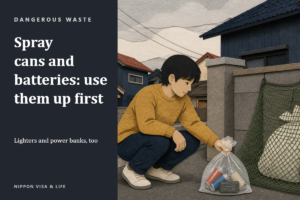
Spray cans have separate rules, such as using up the contents before putting them out. See How to Throw Away Spray Cans, Batteries and Lighters in Japan: Disposing of Dangerous Waste Such as Lithium-Ion Batteries and Gas Canisters.
How to Find the Rules of the Municipality Where You Live
- Search online: Search with the name of your municipality, such as “○○市 食用油 捨て方” (○○ city, cooking oil, how to throw away) or “○○区 ペンキ ごみ” (○○ ward, paint, garbage).
- Look at the list of how to sort garbage: The municipality’s website may have a list (such as a “sorting dictionary,” 分別辞典) where you can look up how to put out each item.
- Look at the garbage guide distributed by the municipality: Check how to put out each item and the days of the week it is collected.
- Ask the responsible office: Ask the section in charge of garbage and recycling, or the sanitation office.
Primary Sources Referred to in Writing This Article
- Funabashi City “About Splashing Accidents Caused by Cooking Oil Put Out as Burnable Garbage in Liquid Form”
- Funabashi City “About Splashing Accidents Caused by Paint Put Out as Burnable Garbage”
- Tokyo Metropolitan Government “Notice of the Intensive Month of the ‘Yu-Dan-Kaiteki! Sewerage’ (Oil Caution for Comfortable Sewerage) Campaign” (September 17, 2026)
- Koto Ward “How to Put Out Burnable Garbage”
- Shinjuku Ward “How to Put Out Burnable Garbage”
- Uruma City “Beware of Tempura Oil Fires!”
- Kitakyushu City “Please Cooperate with the Separate Collection of Used Cooking Oil”
- Kumamoto City “Please Cooperate with the Collection of Recyclables at Collection Points”
- Setagaya Ward “Collection of Recyclables at Public Facilities and Other Places (Collection Points: Hand-Over to Collection Staff)”
- Chuo Ward “I Want to Dispose of a Paint Can (with Paint Still Inside). What Should I Do?”
- Hiroshima City “What Is Garbage That the City Does Not Collect?”
This article is a translation of the original Japanese version.