This article was written by the NIPPON VISA & LIFE editorial team based on information from public organizations such as the national government and local governments. Rules and fees may differ depending on the city, ward, town or village where you live.
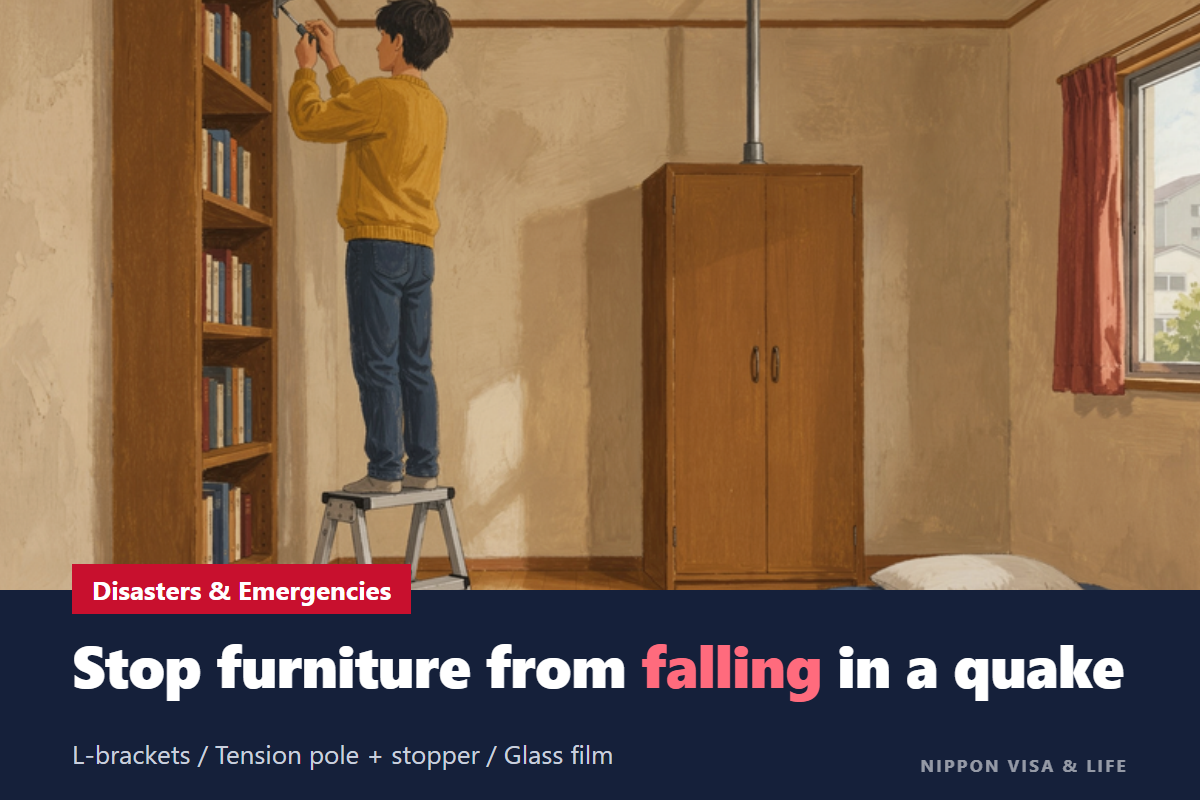
In Japan, many people are injured in large earthquakes by furniture that falls on them or objects that drop from above. Earthquake safety at home is done in this order: (1) reduce your furniture → (2) change where you place it → (3) fix your furniture in place. Even in a rented room where you cannot drill holes in the walls, there is a way to do this by combining two devices that do not require drilling.
Based on the Tokyo Fire Department’s “Handbook on Measures to Prevent Furniture from Falling Over, Dropping and Moving” and other sources, this article explains the measures you can take at home. What to do when an earthquake happens is summarized in What to Do When an Earthquake Hits in Japan: During the Shaking, After the Shaking Stops, and Everyday Preparation, and how to prepare food and water is summarized in Preparing for Disasters in Japan: Stockpiling Food and Water (3 Days to 1 Week) and What to Put in an Emergency Grab Bag.
Why Do You Need to Take Measures for Your Furniture?
According to the Tokyo Fire Department, about 30–50% of the people injured in recent earthquakes were injured because furniture and similar items fell over, dropped or moved.
When furniture falls over, there are the following “3 dangers.”
| Danger | What it means |
|---|---|
| Injury | Furniture that falls over or objects that drop hit your body. You are cut by broken glass or dishes |
| Fire | Fallen furniture or other items may press the switch of an electric heater, and nearby flammable items may catch fire |
| Being unable to escape | Fallen furniture may stop doors from opening or block passageways |
The disaster preparedness guidance of the Prime Minister’s Office also explains that in a major earthquake you should think of furniture as “something that will definitely fall over,” and that you need to take measures to keep it from falling over.
According to the explanation of the Japan Meteorological Agency’s seismic intensity scale (shindo, the strength of shaking) included in the Tokyo Fire Department’s handbook, at seismic intensity 5 lower (震度5弱) furniture that is not fixed may move, and at seismic intensity 5 upper (震度5強) furniture that is not fixed may fall over.
The Short Answer: How to Proceed with Earthquake Safety at Home
The Tokyo Fire Department advises taking measures in the following order.
- Reduce your furniture: Put your belongings together in closets, oshiire (Japanese-style closets) and built-in storage, and reduce the furniture in the rooms where you sleep and spend time as much as possible
- Change where you place it: Do not place furniture that falls over easily near where you sleep or sit, or at entrances, exits and passageways
- Fix your furniture in place: Use devices to keep furniture and home appliances from falling over or dropping
- Keep it from moving: If you live on roughly the 10th floor or higher, you must also take measures to keep furniture from moving, to prepare for earthquakes that shake slowly and widely (long-period ground motion)
Changing Where You Place Furniture: Protect the Place Where You Sleep and Your Escape Route
Before fixing furniture, review where you place it.
- Avoid placing furniture where you sleep or sit as much as possible. If you do place furniture there, choose low furniture, or place it facing a direction where it will not hit your body even if it falls over
- Do not place furniture that falls over or moves easily near entrances and exits or in hallways. Fallen furniture may stop doors from opening
- Do not place heavy objects or things that fall over easily near windows. There is a danger that objects will fall outside
- In bookshelves and shelves, put heavy objects on the lower shelves so they are less likely to fall over
- Do not put things on top of refrigerators or furniture
Create a “Safe Space” in Your Home
The Tokyo Fire Department advises creating a “safe space” in your home (such as a bedroom or hallway) where you keep as few objects as possible. When you receive an Earthquake Early Warning (緊急地震速報, an alert that warns you before strong shaking arrives), move to the safe space, get low and protect yourself.
Near the safe space and the place where you sleep, keep thick gloves and shoes or slippers with thick soles so you are not injured by broken glass or dishes. The guidance of the Prime Minister’s Office also says to keep a flashlight, slippers and a whistle within reach.
Types of Devices Used to Fix Furniture and How Effective They Are
Devices for fixing furniture are sold at home centers (DIY stores), furniture stores, the disaster prevention goods sections of department stores and similar places. According to the Tokyo Fire Department, prices differ by type of device, from a few hundred yen for cheaper ones to a few thousand yen for more expensive ones.
| Device | What it is | Effect and how to use it (from the Tokyo Fire Department’s handbook) |
|---|---|---|
| L-shaped bracket | A metal bracket that attaches furniture to the wall with screws | The most effective. It must be attached to a strong part of the wall, such as a stud (間柱) inside the wall |
| Pole type (tension pole, tsuppari-bo) | A pole placed between the top of the furniture and the ceiling that pushes against both | The ceiling needs to be strong. It is highly effective when combined with a stopper type or mat type |
| Stopper type | A board placed under the front of the furniture that tilts the furniture slightly toward the wall | The effect is small when used alone (not suitable for large furniture) |
| Mat type (adhesive mat) | A sticky mat attached under furniture or home appliances | The effect is small when used alone. Used for relatively small items and home appliances. Pay attention to its expiration period |
| Belt type / chain type | Connects furniture and the wall with a belt or chain | The wall needs to be strong. Used for refrigerators and similar items |
| Strap type | Connects a TV or similar item to its stand with belts | Used for home appliances such as TVs. Increase the number of straps according to the weight |
The Tokyo Fire Department compared the effects of the devices in experiments that reproduced shaking of seismic intensity 6 upper (震度6強). Based on the results, it explains the following.
- Attaching furniture directly to the wall with screws using L-shaped brackets or similar devices is the most effective method
- When using a pole type, it is highly effective to use it together with a stopper type or mat type
- Using only one stopper type or mat type has a small effect, and in general it is not suitable for large furniture
Points to Note When Attaching Furniture to the Wall with L-Shaped Brackets
The Tokyo Fire Department explains that when fixing furniture to the wall with L-shaped brackets, it is important to attach them to base materials such as the studs (間柱) inside the wall. Use fairly long screws and screw them in all the way to the head. You can find the position of the studs with a special sensor or with a pin that you push into the wall.
For furniture divided into upper and lower sections, first connect the upper and lower sections with brackets, and then fix it to the wall.
Points to Note When Using a Pole Type (Tension Pole)
- Attach the poles at both the left and right ends, at the back on the wall side of the furniture
- Check that the ceiling is strong enough. If the ceiling is not strong enough, reinforce it by placing a board at least as wide as the furniture against it
- A pole type is not suitable when the gap between the ceiling and the furniture is large. It is also not suitable for shallow furniture
- Lay the stopper type from one end of the furniture to the other
How to Fix Furniture When You Cannot Drill Holes in the Walls of a Rented Room
For people in rented housing and similar places who do not want to drill holes in the walls or furniture, the Tokyo Fire Department recommends combining two or more devices that do not require drilling.
For example, combining a pole type (tension pole) and a stopper type, or a pole type and a mat type, is said to be expected to have about the same effect as an L-shaped bracket, which is the most effective device.
The Government of Japan’s public relations website also explains that there are various ways to fix furniture depending on the type of housing (apartment building, detached house, owned home, rented home and so on) and the type of furniture. For example, keeping the gap between the furniture and the ceiling within 2cm, fixing items with adhesive mats, and laying anti-tip boards under furniture.
If you want to attach furniture to the wall of a rented room with screws, first check your lease contract, or consult your landlord or the management company.
Fixing Home Appliances: TVs, Refrigerators and Microwave Ovens
When fixing a home appliance, follow the method written in that appliance’s instruction manual.
| Home appliance | Method advised by the Tokyo Fire Department |
|---|---|
| TV | Attaching the TV directly to the TV stand with screws is the most reliable. If you cannot, fix it with straps (4 or more) or mats. A TV has a high center of gravity and may fall over together with its stand, so fix the TV stand as well |
| Refrigerator | Lock the refrigerator’s feet, and then connect the upper part of the back of the refrigerator to the wall with a belt. Attach devices that are screwed into the wall to a strong part of the wall |
| Microwave oven | Fix the microwave oven to its stand with straps or mats. Also fix the stand to the floor or wall |
For furniture with casters (wheels), lock the casters when you are not moving it.
Measures to Avoid Being Injured by Broken Glass and Dishes
When the doors of a cupboard open in an earthquake, the dishes inside may fall and break, and you may be injured by the pieces.
- Glass shatter-prevention film: A film attached to glass so that broken glass does not scatter. It is more effective when attached to both sides of a glass door. If you attach it to only one side, attach it to the outer side
- Door-opening prevention devices: Devices that keep doors from opening when shaking. Attach them to double doors that open to the left and right (kannon-biraki)
- Preventing items from falling from bookshelves: Attach devices such as bars or tape so that items on the shelves do not fall
Additional Measures for People Living on High Floors (Roughly the 10th Floor or Higher)
In a questionnaire survey that the Tokyo Fire Department conducted in Tokyo after the Great East Japan Earthquake, the higher the floor, the greater the proportion of furniture that fell over, dropped or moved. Earthquakes that shake slowly and widely (long-period ground motion) are thought to be one of the causes.
The Tokyo Fire Department advises people living on roughly the 10th floor or higher to also check the following.
- For furniture with casters, lock the casters when you are not moving it, and connect it to the wall with a belt or similar device
- For tables and other items that are not attached to the wall, put anti-slip pads on the legs
- Keep lights hanging from the ceiling from swinging
- Use drawers with a mechanism (latch) that keeps them from sliding out when shaking
- Fix aquariums to their stands, and also fix the stands to the wall
A Checklist to Check Your Own Room
Based on the Tokyo Fire Department’s handbook and checklist, we have summarized what you can do at home. Start with the items you have not done yet, and take measures little by little.
- There is no tall furniture near the place where I sleep
- Fallen furniture will not block entrances, exits or passageways
- There is no large furniture or home appliance near window glass
- Heavy objects on bookshelves and shelves are on the lower shelves
- There is nothing that can easily fall on top of the refrigerator or furniture
- The TV is fixed to the TV stand, and the TV stand is also fixed
- The refrigerator is fixed to the wall with a belt or similar device
- The microwave oven is fixed to its stand, and the stand is also fixed
- Furniture divided into upper and lower sections has its upper and lower sections connected
- When I use a pole type (tension pole), I use it together with a stopper type or mat type
- Shatter-prevention film is attached to the glass
- Devices that keep the doors from opening are attached to the cupboard doors
When You Have Trouble with Earthquake Measures for Furniture: Frequently Asked Questions
Which furniture should I take measures for first?
According to the Tokyo Fire Department, there is no fixed standard for the height or weight of furniture that needs measures. Taking measures for all furniture is the safest, but if that is difficult, first make efforts such as not placing furniture in the bedroom and placing furniture with the direction it would fall in mind, and then take measures in order, starting with heavy furniture and tall furniture.
What if I cannot install the devices myself?
According to the Tokyo Fire Department, local builders (工務店), Silver Human Resources Centers (シルバー人材センター) and others may install the devices for you. Some furniture stores and home centers have staff you can consult about how to fix furniture and how to apply film.
Are there programs that give out devices or help with installation?
According to the Tokyo Fire Department, some wards, cities, towns and villages in Tokyo distribute devices free of charge or for a small fee, or help with installation, for households such as those of elderly people and people with disabilities. Whether similar support is available in other areas differs depending on the city, ward, town or village. Search the website of your city, ward, town or village with words such as “家具 転倒防止 助成” (furniture, preventing falling over, subsidy), or ask the disaster prevention counter of your city, ward, town or village.
If I live in a seismically isolated apartment building, do I not need to take measures?
Even in a seismically isolated apartment building (a building with a system that reduces shaking), the shaking does not disappear completely. In the Tokyo Fire Department’s survey on the Kumamoto Earthquake, furniture fell over, dropped or moved in about 30% (約3割) of households even in seismically isolated apartment buildings. People who live in seismically isolated apartment buildings should also take measures.
What if I cannot read instructions written in Japanese?
The Tokyo Fire Department’s web page on furniture measures can be displayed in English, Chinese (Simplified and Traditional) and Korean. For how to fix home appliances, manufacturers may provide instruction manuals in foreign languages on their websites.
Information on Daily Life and Disasters You Can Read in Foreign Languages
- Guidebook on Living and Working (Immigration Services Agency, 出入国在留管理庁): a guide that summarizes the information you need to live in Japan. There is also a version in easy Japanese (『生活・仕事ガイドブック』)
- How to receive disaster information in foreign languages is summarized in Disasters and Emergencies in Japan: The Basics | Calling 119 and 110, Earthquakes, Tsunami, Heavy Rain, Volcanoes, Evacuation and Multilingual Information
Primary Sources Referenced in Writing This Article
- Tokyo Fire Department “Handbook on Measures to Prevent Furniture from Falling Over, Dropping and Moving” (PDF, January of Reiwa 6)
- Tokyo Fire Department “Furniture Measures at Home”
- Tokyo Fire Department “Furniture Measures: Frequently Asked Questions”
- Tokyo Fire Department “10 Preparations for Earthquakes”
- Prime Minister’s Office “Preparing for Disasters: What You Can Do in Advance”
- Government of Japan public relations website “(Disaster Prevention Special Feature) ACTION01 Prepare for Disasters in Advance”
- Japan Meteorological Agency “About Seismic Intensity”
- Immigration Services Agency “Guidebook on Living and Working”
This article is a translation of the original Japanese version.