This article was written by the NIPPON VISA & LIFE editorial team based on information from public organizations such as the national government and local governments. Rules and fees may differ depending on the city, ward, town or village where you live.
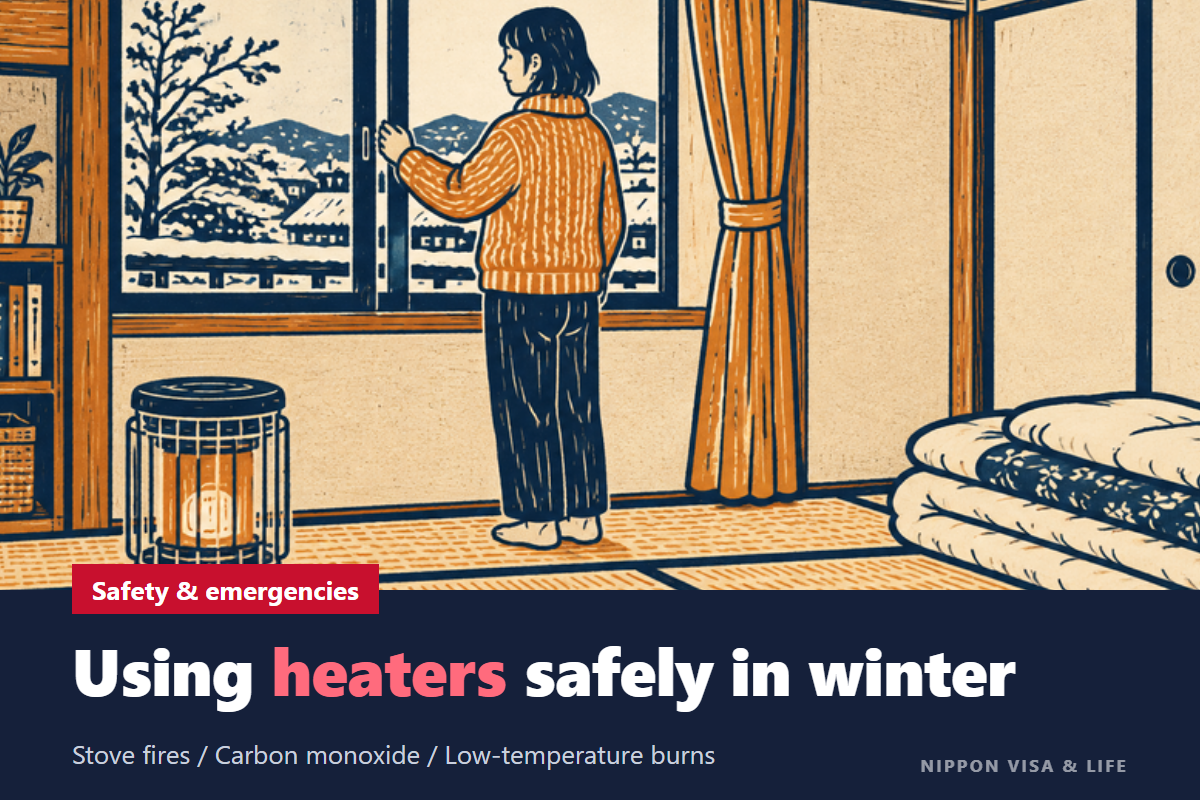
In winter in Japan, fires and accidents caused by heaters such as stoves increase. For heaters that burn kerosene or gas and release the exhaust gas into the room (open-type heaters), open a window or similar 1 or 2 times an hour to ventilate the room. For every kind of heater, the basic rules are do not put flammable things around it, and turn it off when you go to sleep and when you go out.
The Short Answer: 6 Points for Using Heaters Safely
- Do not put flammable things around heaters: curtains, futons, laundry, paper, spray cans, etc.
- Turn heaters off when you go to sleep and when you go out: For electric heaters, turn off the power and unplug them.
- Ventilate the room when you use open-type heaters that burn kerosene or gas: Open a window or similar 1 or 2 times an hour.
- Refuel only after putting out the fire: when you put kerosene into the tank of a kerosene heater or kerosene fan heater
- Use hot water bottles and electric foot warmers to warm your futon before going to bed: Take them out of the futon when you go to sleep.
- Check your residential fire alarm: Press the button or pull the cord to check that it makes a sound.
(Source: Gov-Online, “Are You Okay? Product Accidents in Winter”, Tokyo Fire Department, “STOP! Residential Fires”)
Why Accidents with Heaters Increase in Winter
According to the Tokyo Fire Department, deaths in residential fires in Tokyo are concentrated in the 4 months from December to March of the following year. In winter, people use heaters more often and the air becomes dry, so fires break out more easily.
National materials also show that “stoves (heaters)” are, along with “cigarettes,” one of the most common sources of fires in which people died in residential fires.
(Source: Tokyo Fire Department, “STOP! Residential Fires”, Gov-Online, “10 Points to Protect Your Life from Residential Fires”)
Types of Heaters and What to Be Careful About with Each Type
| Heater | Main dangers | What to be careful about |
|---|---|---|
| Kerosene heaters and kerosene fan heaters (burn kerosene) | Fire, carbon monoxide poisoning | Ventilate the room. Refuel only after putting out the fire. Turn them off when you go to sleep |
| Gas heaters and gas fan heaters | Carbon monoxide poisoning | Ventilate the room. Use a dedicated gas hose to connect them to the gas outlet |
| Electric heaters | Fire | Do not put things around them. Turn off the power and unplug them when you go to sleep and when you go out |
| Hot water bottles, electric foot warmers, kotatsu and electric carpets | Low-temperature burns | Do not warm the same part of your body for a long time |
(Source: Gov-Online, “Are You Okay? Product Accidents in Winter”)
When Using Kerosene Heaters and Gas Heaters
Ventilate the Room 1 or 2 Times an Hour
Among heaters that burn kerosene or gas, those that release the exhaust gas into the room (open-type heaters, such as kerosene heaters, kerosene fan heaters and gas fan heaters used at home) burn using the air in the room. Gov-Online calls on people to open a window or similar 1 or 2 times an hour to ventilate the room.
If there is not enough ventilation, there is not enough oxygen, which causes “incomplete combustion” (fuel not burning properly), and carbon monoxide is produced.
(Source: Gov-Online, “Are You Okay? Product Accidents in Winter”, NITE (National Institute of Technology and Evaluation), “Kerosene Heaters: Incomplete Combustion Due to Insufficient Ventilation”)
Always Put Out the Fire Before Refueling a Kerosene Heater
When you put kerosene into the tank of a kerosene heater or kerosene fan heater, always put out the fire first. There have been accidents in which a person took out the tank and refueled it while the heater was still burning, the cap was not closed properly, and the kerosene leaked and caught fire. Before putting the tank back, check that the cap is completely closed.
(Source: Gov-Online, “Are You Okay? Product Accidents in Winter”)
Do Not Use a Kerosene Heater While Sleeping, and Clean the Dust off the Air Intake and the Reflector
NITE calls on people not to use kerosene heaters while sleeping and to make sure to put out the fire before going to bed. If you use the heater while dust has built up in the opening that takes in air, there may not be enough air, and incomplete combustion can occur. Remove dust from the stand and the reflector (the plate that reflects heat) often, using a vacuum cleaner or wiping it off with a soft cloth.
Do not use kerosene appliances such as kerosene heaters, or gas appliances such as gas stoves, inside a tent or inside a car.
(Source: NITE, “Product Safety Information Magazine: Carbon Monoxide Poisoning Accidents”)
Do Not Put Spray Cans in Front of the Warm Air from a Heater
There has been an accident in which a spray can placed in front of a fan heater burst from the heat and the gas that came out caught fire. Do not put spray cans or cassette gas canisters near heaters.
(Source: Gov-Online, “Are You Okay? Product Accidents in Winter”)
The Danger of Carbon Monoxide, and Problems with Gas Appliances That May Mean Carbon Monoxide Is Being Produced
Carbon monoxide is a gas with no color and no smell. Even when it builds up in a room, it is hard to notice, and it can be life-threatening. When the carbon monoxide level becomes high, symptoms such as nausea and dizziness appear.
Gov-Online calls on people to stop using gas appliances such as instantaneous gas water heaters and have them inspected by the manufacturer if they notice any of the following problems.
- The flame goes out many times while the appliance is in use.
- The flame is reddish and its shape is blurry (a normal flame is a clear blue).
- The top part of the appliance is clogged with soot or dust.
(Source: Gov-Online, “Are You Okay? Product Accidents in Winter”, NITE, “Product Safety Information Magazine: Carbon Monoxide Poisoning Accidents”)
If someone feels unwell, or if you need an ambulance because of a sudden illness or injury, call 119. For how to call 119, see How to Call 110 for the Police in Japan and When to Use 119 Instead: What to Say on the Phone, Reporting in a Foreign Language, and #9110 for Non-Urgent Consultations.
When Using Electric Heaters
According to the Tokyo Fire Department, among the causes of residential fires in Tokyo in which someone died (2021 to 2025), electric heaters are the most common type of stove (heater). Because electric heaters do not use fire, people tend not to think of them as dangerous, and flammable things often end up close to them.
- Do not put flammable things around an electric heater. Make sure futons and curtains do not touch it.
- Do not dry laundry on top of or near an electric heater.
- When you go to sleep or move away from an electric heater, turn off the power switch and unplug it.
- Do not put the power cord under furniture. Do not bend it forcibly.
In the following cases, stop using the electric heater immediately and consult the manufacturer or the store where you bought it.
- The power cord or plug is damaged or swollen.
- There is a burning smell.
- The power turns on and off when you touch or bend the cord.
(Source: Tokyo Fire Department, “STOP! Residential Fires”, Fire and Disaster Management Agency, National Research Institute of Fire and Disaster, “Handling of Fire-Using Appliances and Equipment”, Gov-Online, “Are You Okay? Product Accidents in Winter”)
How to Use Extension Cords (Power Strips) with Electric Heaters
Electric heaters use a lot of electricity. Extension cords show “up to how many watts (W) can be used in total.” Do not use “octopus wiring” (connecting many plugs to one outlet) that goes over this limit. Using a cord while it is bundled up can also cause a fire.
When dust builds up in the gap between the outlet and the plug, moisture can cause a fire (the tracking phenomenon). Unplug plugs you are not using, and clean them often.
(Source: Gov-Online, “Are You Okay? Product Accidents in Winter”, Tokyo Fire Department, “STOP! Residential Fires”)
Low-Temperature Burns from Hot Water Bottles, Electric Foot Warmers and Kotatsu
A “low-temperature burn” is a burn that happens when the same part of your skin touches something that is not very hot (about 44°C to 50°C) for a long time. Gov-Online explains that it is said a low-temperature burn can occur in 3 to 4 hours or more at 44°C, in 30 minutes to 1 hour at 46°C, and in 2 to 3 minutes at 50°C.
- Use hot water bottles and electric foot warmers to warm your futon before going to bed, and take them out of the futon when you go to sleep. Turn off electric foot warmers.
- Do not warm the same part of your body for a long time.
- Low-temperature burns can also happen with disposable heat packs (kairo), kotatsu and electric carpets.
- Babies can get low-temperature burns even in a short time.
- When you heat a metal hot water bottle directly on a stove burner, always remove the cap. For hot water bottles heated in a microwave, follow the time and power level in the instructions.
(Source: Gov-Online, “Are You Okay? Product Accidents in Winter”)
Preparing to Notice a Fire Early
Check Your Residential Fire Alarm
In Japan, the law requires every home to have a residential fire alarm (a device that senses the smoke or heat of a fire and warns you with a sound). Detailed rules, such as where to install them, are set by the ordinances of each city, ward, town or village.
To check the alarm, press the button on the device or pull the cord attached to it. If it is working normally, a voice message or alarm sound will play. The Fire and Disaster Management Agency calls on people to replace alarms after about 10 years.
(Source: Fire and Disaster Management Agency, National Research Institute of Fire and Disaster, “Handling of Fire-Using Appliances and Equipment”, Tokyo Fire Department, “STOP! Residential Fires”, Gov-Online, “10 Points to Protect Your Life from Residential Fires”)
From the Fire and Disaster Management Agency’s “10 Points for Residential Fire Prevention to Protect Lives”
The Fire and Disaster Management Agency calls on people to adopt habits like the following to prevent fires.
- Do not put flammable things around stoves (heaters).
- Clean the dust from outlets, and unplug plugs you are not using.
- For stoves (heaters), cooking stoves and similar appliances, use equipment with safety devices.
- Keep a fire extinguisher or similar at home, and check how to use it.
(Source: Gov-Online, “10 Points to Protect Your Life from Residential Fires”)
When You Have Trouble: Frequently Asked Questions
If I Use an Electric Heater, Is It Okay Not to Ventilate the Room?
Electric heaters do not burn fuel, so you do not need to ventilate the room. However, they are among the heaters that most often cause fires. Do not put things around them, and turn off the power and unplug them when you go to sleep and when you go out.
Is It Okay to Use a Generator Inside the House During a Power Outage?
There have been accidents in which people died of carbon monoxide poisoning after using a portable generator inside the house. NITE calls on people not to use generators in places where exhaust gas builds up, such as inside the house, in a storage shed, inside a car or inside a tent. For what to do during a power outage, see What to Do During a Power Outage or Water Outage in Japan: Checking the Breaker, Finding Outage Information, Electrical Fires When Power Returns, Food in the Refrigerator, Toilets and Water Supply Points.
(Source: NITE, “Product Safety Information Magazine: Carbon Monoxide Poisoning Accidents”)
How Do I Throw Away a Heater I No Longer Use, or Leftover Kerosene?
How to throw away heaters and how to dispose of leftover kerosene differ depending on the city, ward, town or village. Search the website of your city, ward, town or village for “ストーブ 捨て方” (how to throw away a stove) or “灯油 処分” (kerosene disposal), or ask the counter in charge of garbage. The basics of how to put out garbage are summarized in How to Sort and Put Out Garbage in Japan: Basic Rules for Burnable, Recyclable and Oversized Garbage.
Primary Sources Referenced in This Article
- Gov-Online, “Are You Okay? Product Accidents in Winter”
- Gov-Online, “10 Points to Protect Your Life from Residential Fires: To Avoid Being Unable to Escape in Time”
- Tokyo Fire Department, “STOP! Residential Fires”
- Fire and Disaster Management Agency, National Research Institute of Fire and Disaster, “Handling of Fire-Using Appliances and Equipment”
- NITE (National Institute of Technology and Evaluation), “Kerosene Heaters: Incomplete Combustion Due to Insufficient Ventilation”
- NITE, “Product Safety Information Magazine: Carbon Monoxide Poisoning Accidents”
This article is a translation of the original Japanese version.