This article was written by the NIPPON VISA & LIFE editorial team based on information from public organizations such as the national government and local governments. Rules and fees may differ depending on the city, ward, town or village where you live.
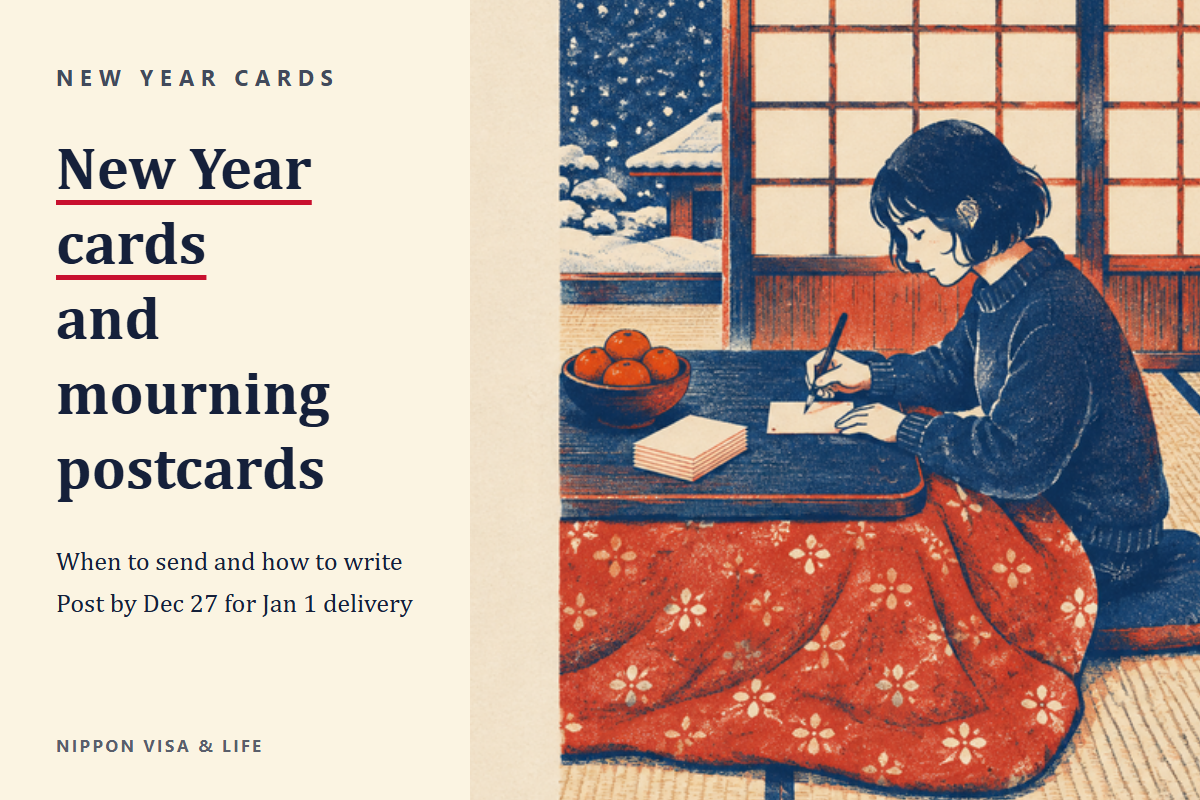
In Japan, people have a custom of sending “nengajo” (年賀状, ねんがじょう: New Year’s greeting postcards) for the New Year holidays. For the 2027 New Year, Japan Post starts accepting New Year’s cards on December 20, 2026, and the guideline is to post them by December 27 so that they are delivered on New Year’s Day (January 1). In a year when a family member has died, instead of New Year’s cards you send “mochu hagaki” (喪中はがき, もちゅうはがき: mourning postcards) between November and early December.
The Short Answer: When to Send New Year’s Cards and Mourning Postcards (End of 2026 to 2027)
| What to do | When |
|---|---|
| Buy New Year’s postcards (at post offices, etc.) | November 2, 2026 to January 15, 2027 |
| Send mourning postcards (in a year when a family member has died) | So that they reach the recipient between November and early December |
| Post New Year’s cards in a mailbox or at a post office (acceptance of New Year’s cards) | From December 20, 2026 |
| Guideline date for posting New Year’s cards so that they arrive on New Year’s Day | By December 27, 2026 |
| Send “kanchu mimai” (寒中見舞い, かんちゅうみまい: midwinter greeting postcards) | From January 8 (January 16 in some areas such as Kansai) until the day before Risshun (the start of spring, around February 4) |
(Source: Japan Post “Overview of the Issue of New Year’s Postcards, etc. for 2027 (Reiwa 9)”, Post Office Print Service “When Is the Right Time to Send Mourning Postcards?”)
Starting with the cards for 2027, Japan Post changed the day it starts accepting New Year’s cards from December 15 to December 20, and the guideline date for posting them so that they arrive on New Year’s Day from December 25 to December 27. Please be careful, as this is different from the information for previous years.
What Are New Year’s Cards (Nengajo)? Postcards with New Year’s Greetings
New Year’s cards are postcards that celebrate the new year and thank people for their help during the previous year. People send them to family, friends, people at work, teachers and others. Japan Post introduces New Year’s cards as a traditional part of Japanese culture.
At the same time, Japan Post’s own announcement says that sending New Year’s greetings on social media has become common, and that the custom of sending New Year’s cards is changing. New Year’s cards are not a religious event; they are a Japanese New Year custom.
(Source: Japan Post “Overview of the Issue of New Year’s Postcards, etc. for 2027 (Reiwa 9)”, Post Office Print Service “Useful Facts About Mourning (Mochu)”)
Types and Prices of New Year’s Postcards (for 2027)
New Year’s postcards (nenga hagaki) are sold at post offices and other places from November 2, 2026 to January 15, 2027. You can post them as they are, without putting a stamp on them.
| Type of New Year’s postcard | Price per card | Description |
|---|---|---|
| Plain | 85 yen | An ordinary New Year’s postcard with no picture |
| Plain (inkjet paper) | 85 yen | Paper suited to printing with a home inkjet printer |
| With picture and donation | 90 yen | A New Year’s postcard with a picture. 5 yen per card goes to donations |
| With advertisement | 80 yen | Contains an advertisement from a company, etc. Sold only in some areas |
(Source: Japan Post “List of Types of New Year’s Postcards for 2027 (Reiwa 9)”)
- Buying online: You can also buy them at the post office online shop. Orders are accepted until January 13, 2027.
- Using an ordinary postcard as a New Year’s card: Write “年賀” (nenga: New Year’s greeting) in red below the place where the stamp goes (the postage area). If you do not write “年賀”, the card will be delivered within the year (in December).
- Using a New Year’s postcard for something other than a New Year’s card: When it does not need to be delivered on New Year’s Day, cross out the word “年賀” on the postcard with a double line or similar before posting it.
(Source: Japan Post “Overview of the Issue of New Year’s Postcards, etc. for 2027 (Reiwa 9)”, Post Office Print Service “Complete Guide to Writing New Year’s Cards”)
How to Send New Year’s Cards: Dates for Delivery on New Year’s Day
- Post them from December 20, 2026: From this day, they are accepted as New Year’s cards.
- Post them by December 27: This is the guideline for delivery on New Year’s Day.
- Do not post them on or before December 19: New Year’s cards posted before acceptance starts (up to December 19) are treated as ordinary mail and will be delivered within the year.
During “sanganichi” (三が日, the first three days of the New Year, January 1 to 3), New Year’s cards are delivered on New Year’s Day and on January 3.
(Source: Japan Post “Overview of the Issue of New Year’s Postcards, etc. for 2027 (Reiwa 9)”)
How to Write New Year’s Cards: The Basics of the Address Side and the Message Side
The address side (where you write the address and name)
- Write the postal code, address and name of both the recipient and yourself accurately and clearly (a request from Japan Post).
- It is considered polite to write the full address without abbreviations: prefecture, city/ward/town/village, block and lot number, building name and room number.
- After the recipient’s name, add “様” (sama) for an individual, or “御中” (onchu) for a company or department.
The message side (where you write the greeting)
- Start with a “gashi” (賀詞, がし: words celebrating the New Year). Examples: “あけましておめでとうございます” (akemashite omedetou gozaimasu: Happy New Year) and “謹賀新年” (kinga shinnen: Respectful New Year’s greetings).
- For people senior to you, such as your boss or teacher, it is said to be better to avoid two-character gashi such as “賀正” (gasho) and “迎春” (geishun), because they are casual expressions.
- “新年あけましておめでとうございます” repeats words with the same meaning, so write “あけましておめでとうございます” instead.
- To refer to the previous year, write “昨年” (sakunen) or “旧年” (kyunen) instead of “去年” (kyonen). This is because “去る” (saru: to leave) is considered an unlucky word.
- It is said to be polite not to use punctuation marks (“、” and “。”) in New Year’s cards.
- If you make a mistake, it is considered polite to rewrite the card on a new postcard rather than correcting it with correction tape or similar. If you take spoiled New Year’s postcards to a post office, you can exchange them for new postcards.
(Source: Japan Post “Overview of the Issue of New Year’s Postcards, etc. for 2027 (Reiwa 9)”, Post Office Print Service “Complete Guide to Writing New Year’s Cards”)
These are points of etiquette based on Japanese custom, not rules set by law.
What Are Mourning Postcards (Mochu Hagaki)? Postcards Telling People You Will Not Send New Year’s Cards in a Year When a Family Member Has Died
“Mochu” (喪中, もちゅう: mourning) is the period after a family member or relative has died, during which people refrain from celebrations. People in mourning generally do not send New Year’s cards for the New Year. Instead, they send “mourning postcards”.
- Formal name: They are called “nenga ketsureijo” (年賀欠礼状, ねんがけつれいじょう). They are postcards that apologize in advance for refraining from New Year’s greetings.
- Their purpose is not to announce the death: Their original purpose is to tell people that you will refrain from New Year’s greetings.
- They do not mean “please do not send me New Year’s cards”: A mourning postcard does not ask the recipient not to send New Year’s cards.
- Who is in mourning: There is no clear rule. Today, family members up to the “second degree of kinship” (二親等, にしんとう: nishinto), such as parents, children, brothers and sisters, grandparents and grandchildren, are often used as a guideline. This differs depending on the region and on people’s views.
- Who to send them to: Send them to the people you usually exchange New Year’s cards with.
(Source: Post Office Print Service “When Is the Right Time to Send Mourning Postcards?”, Post Office Print Service “Useful Facts About Mourning (Mochu)”, Post Office Print Service “What to Do About ‘New Year’s Cards to People in Mourning’ and ‘New Year’s Cards Received While in Mourning'”)
When to send mourning postcards, and what to write on them
It is common to send them so that they arrive between November and early December, before the recipients start preparing their New Year’s cards.
A mourning postcard usually contains the following, in this order. Do not use words of celebration such as “おめでとう” (omedetou: congratulations) or the word “年賀” (nenga); use words such as “年始” (nenshi: beginning of the year) and “新年” (shinnen: New Year) instead.
- Greeting (saying that because you are in mourning, you will refrain from New Year’s greetings)
- About the person who died (their relationship to you, name, the month they died and their age)
- Thanks for the help the recipient has given you
- Closing words
- Date (example: 令和8年11月, November of Reiwa 8)
(Source: Post Office Print Service “What to Do About ‘New Year’s Cards to People in Mourning’ and ‘New Year’s Cards Received While in Mourning'”, Post Office Print Service “Useful Facts About Mourning (Mochu)”)
When a family member dies after mid-December
After mid-December, it is likely that the recipients have already prepared or posted their New Year’s cards, so it is said to be better not to send mourning postcards. After the New Year begins, use a midwinter greeting card (kanchu mimai) to apologize for not sending New Year’s greetings and to tell people about the death.
When You Receive a Mourning Postcard, and When You Receive New Year’s Cards While in Mourning
If you receive a mourning postcard, what should you do about New Year’s cards?
It is common to refrain from sending New Year’s cards to people who have sent you a mourning postcard. If you want to send a greeting, send it as a midwinter greeting card (kanchu mimai) on or after January 8 (January 16 in some areas such as Kansai).
What if you sent a New Year’s card before the mourning postcard arrived?
A mourning postcard does not mean “please do not send me New Year’s cards”, so this is generally considered no particular problem. If it worries you, it is more polite to send a midwinter greeting card (kanchu mimai) and apologize in it. If you really want to get back a New Year’s card you have already posted, you can make a “request for retrieval of mail” (取戻し請求, torimodoshi seikyu; a fee is charged) at a post office, so please ask a post office.
What if you receive New Year’s cards while you are in mourning?
Reply with a midwinter greeting card (kanchu mimai) on or after January 8 (January 16 in some areas such as Kansai). In a midwinter greeting card, do not use the “賀” (ga) of “年賀状” (nengajo), because it is a word of celebration; instead, say “年始状” (nenshijo: beginning-of-the-year card) or “年始のごあいさつ” (nenshi no goaisatsu: beginning-of-the-year greeting).
(Source: Post Office Print Service “What to Do About ‘New Year’s Cards to People in Mourning’ and ‘New Year’s Cards Received While in Mourning'”, Post Office Print Service “When Is the Right Time to Send Mourning Postcards?”)
If You Are Unsure: Frequently Asked Questions
What do Christians and Muslims do about mourning postcards?
A column by Japan Post explains that Christianity and Islam do not have a concept of “mochu” like the one in Japan. At the same time, it says that some Christians living in Japan follow the Japanese custom of exchanging New Year’s cards and send mourning postcards in a year when a family member has died. It also says it is easier to understand mourning postcards as a custom of daily life in Japan rather than a religious rule. Please decide according to your own views and those of your family.
(Source: Post Office Print Service “Useful Facts About Mourning (Mochu)”)
What if you receive a New Year’s card from someone you did not send one to?
You can send a New Year’s card in reply. New Year’s cards are said to be sent during “matsu no uchi” (松の内, まつのうち: the New Year period, January 1 to 7, or until January 15 in some areas such as Kansai). If it will be later than that, send a midwinter greeting card (kanchu mimai) instead. New Year’s postcards are sold at post offices until January 15, 2027.
(Source: Post Office Print Service “Complete Guide to Writing New Year’s Cards”, Japan Post “Overview of the Issue of New Year’s Postcards, etc. for 2027 (Reiwa 9)”)
Are post offices open during the year-end and New Year holidays?
For the days when government offices, banks and the postal service are closed during the year-end and New Year holidays, see Public Holidays and Year-End and New Year Holidays in Japan | List of Public Holidays in 2026 and 2027, and Days When Government Offices, Banks and the Postal Service Are Closed.
After moving, how can you receive New Year’s cards sent to your old address at your new address?
If you submit a change-of-address notification (転居届, tenkyo todoke; also called a mail forwarding request) to the post office, mail sent to your old address will be forwarded to your new address. For how to submit it, see Mail Forwarding Request (Change-of-Address Notification) When You Move in Japan | Free for 1 Year, 3 Ways to Submit, Identity Verification, and Mail That Is Not Forwarded.
Where to Ask About New Year’s Cards
If you have questions about New Year’s postcards or the delivery of New Year’s cards, you can ask Japan Post’s “Customer Service Consultation Center”.
| Contact | Phone number | Hours |
|---|---|---|
| Customer Service Consultation Center (toll-free number) | 0120-23-28-86 | Every day 8:00-21:00 |
| When calling from a mobile phone | 0570-046-666 (call charges apply) | Every day 8:00-21:00 |
When the call connects, a recorded voice guide plays. Select “*” and then “1”. You can also ask at the counter of a nearby post office.
(Source: Japan Post “Overview of the Issue of New Year’s Postcards, etc. for 2027 (Reiwa 9)”)
Primary Sources Referred to in Writing This Article
- Japan Post “Overview of the Issue of New Year’s Postcards, etc. for 2027 (Reiwa 9)” (August 31, 2026)
- Japan Post “Attachment 1: List of Types of New Year’s Postcards for 2027 (Reiwa 9)”
- Post Office Print Service (Japan Post) “Complete Guide to Writing New Year’s Cards: Etiquette and Points to Note for the Front and Back”
- Post Office Print Service (Japan Post) “When Is the Right Time to Send Mourning Postcards? Guideline Posting Period and Points to Note”
- Post Office Print Service (Japan Post) “What to Do About ‘New Year’s Cards to People in Mourning’ and ‘New Year’s Cards Received While in Mourning'”
- Post Office Print Service (Japan Post) “Useful Facts About Mourning (Mochu)”
This article is a translation of the original Japanese version.