This article was written by the NIPPON VISA & LIFE editorial team based on information from public organizations such as the national government and local governments. Rules and fees may differ depending on the city, ward, town or village where you live.
In apartments and condominiums in Japan, everyday sounds such as footsteps, washing machines and voices can cause trouble with neighbors. The basics for preventing trouble are to keep sounds especially low late at night and early in the morning, and to greet your neighbors in daily life. When noise bothers you, first talk calmly with the other person. If that is difficult, talk to the landlord or management company, and if the problem is still not solved, consult your municipal office or a legal consultation service.
Manners for daily life in Japan in general are summarized in Manners and Rules to Know When Living in Japan: At Home, on Trains and Buses, at Hot Springs, with Neighbors, Alcohol and Tobacco, and Holidays.
The Short Answer: Basics of Everyday Noise
- Sounds that come from daily life are called everyday living noise (seikatsu sōon in Japanese). This means the ordinary sounds of daily life made inside and around a home.
- There is no law that regulates everyday noise (some municipalities have ordinances or other rules about being considerate of everyday noise). It is solved by neighbors talking with each other, consulting the municipal office and similar methods. Many local governments say that, as a rule, it should be solved by the people involved talking with each other (examples: Sakura City and Kagoshima City).
- Everyone makes everyday noise. Anyone can be the one causing trouble, and anyone can be the one who is bothered.
- A sound you do not notice yourself may sound loud to other people.
(Sources: Ministry of the Environment “Everyday Noise” pamphlet, Sakura City “For Those Troubled by Noise from the Neighborhood”, Kagoshima City “Trouble with Neighbors Caused by Everyday Noise”)
Sounds to Be Careful About and Ways to Reduce Them
The Ministry of the Environment lists the following “5 considerations” for eliminating noise.
- Be considerate of the time of day
- Take steps so sound does not leak out
- Take steps to make sounds quieter
- Choose quieter appliances and equipment
- Value your relationships with your neighbors
Here are tips for each type of sound.
| Sound | What to be careful about and tips |
|---|---|
| Washing machines, vacuum cleaners, refrigerators | Do not use them late at night or early in the morning. Place washing machines and refrigerators so that sound and vibration do not travel, for example by using anti-vibration mats or noise-reducing mats |
| Footsteps (inside your room and on stairs) | Walk quietly. Put mats or similar items on the floor. Do not run up or down the stairs |
| Opening and closing doors | Do not slam doors. Attach cushioning material (something that softens sound), such as weatherstripping tape |
| Water from the bath or toilet | Avoid using them early in the morning or late at night |
| TV, music, games | Keep the volume low. Use headphones or earphones at night |
| Musical instruments (piano, guitar, etc.) | Close the windows. If you play seriously, take soundproofing measures |
| Talking and laughing | Do not raise your voice (especially at night). Do not talk with the windows open |
| Pets barking or crying | Learn about the animal’s habits before getting one. Train your pet. Be careful about where you keep it |
| Outdoor units of air conditioners | Be careful about where they are placed and which way they face (keep them away from the house next door) |
| Cars and motorcycles | Do not idle (keep the engine running while stopped) or rev the engine needlessly |
For example, of the 195 consultations about everyday noise received by Yokohama City in fiscal Reiwa 3, about 1/4 were about sounds between upper and lower floors in apartment buildings such as condominiums.
(Sources: Ministry of the Environment “Everyday Noise” pamphlet, Sakura City “For Those Troubled by Noise from the Neighborhood”, Katsushika City “About Everyday Noise”, Yokohama City “What Is Everyday Noise?”)
What Hours Count as “Late at Night” and “Early in the Morning”?
The national and local government information referred to in this article says to “avoid late at night and early in the morning,” but does not say which hours. If you want to know the rules of your building, ask your landlord or management company.
What Rental Housing Contracts Say
The contract you sign when renting a room may also include rules related to noise and neighbors. The Standard Rental Housing Contract (a model contract) made by the Ministry of Land, Infrastructure, Transport and Tourism includes rules such as the following.
| Rule in the model contract | Examples |
|---|---|
| Things you must not do | Using a TV or stereo at a loud volume, or playing a piano or other instrument. Keeping animals that would clearly bother neighbors, such as dangerous wild animals or venomous snakes. Saying or doing violent things in the room or around it in a way that makes neighbors uneasy |
| Things you must not do without the landlord’s written consent | Leaving things in common areas (places other residents also use) such as stairs and hallways. Keeping animals such as dogs and cats (except animals that clearly pose no risk of bothering neighbors, such as small birds or fish kept for viewing) |
| Things you must tell the landlord | Adding a new person to live with you besides the household members written in the contract (except when a child is born). Leaving the room empty for 1 month or more in a row |
This is a model contract shown by the national government. The actual content of contracts differs from property to property. Read your own contract, and ask your landlord or management company about anything you do not understand. For the process of renting a room, see How to Rent an Apartment and Move in Japan: Finding a Home, Contracts, Move-in Costs, Moving In, House Rules and Moving Out, and for pets, see Rules for Keeping a Dog or Cat in Japan: Dog Registration, Rabies Vaccinations, Microchips, and Manners in Apartments and on Walks.
(Sources: Ministry of Land, Infrastructure, Transport and Tourism “Standard Rental Housing Contract” (Article 8, Appended Tables 1 to 3))
Getting Along with Your Neighbors Day to Day
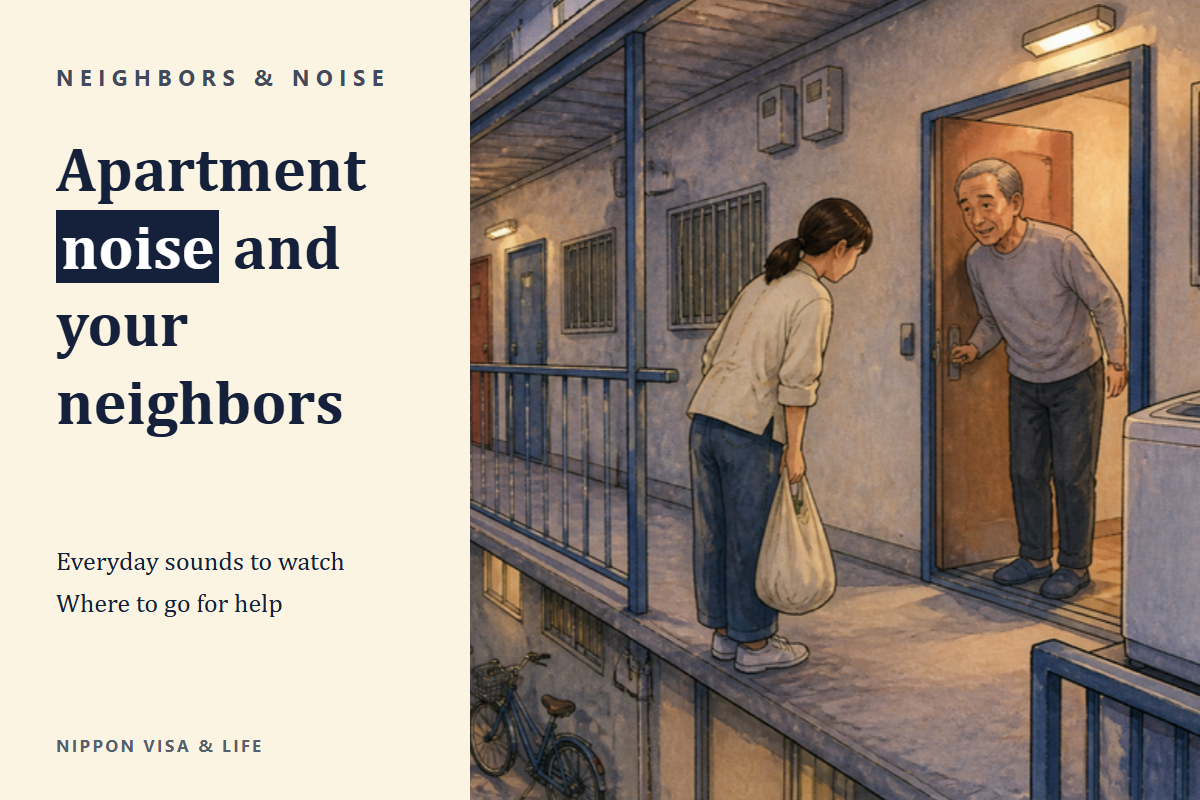
Local governments say that to prevent trouble over everyday noise, it is important to build good relationships with your neighbors, for example by greeting them regularly. Thinking about each other’s feelings is the first step to preventing trouble.
(Sources: Katsushika City “About Everyday Noise”, Sakura City “For Those Troubled by Noise from the Neighborhood”)
When Noise from Neighbors Bothers You
Based on local government information, here is an example of the order in which to seek help.
- First, tell the other person directly: The other person may not realize they are causing trouble. After giving your name and room number, explain clearly what is bothering you, calmly and without getting emotional. If possible, check the sound together with the other person.
- Talk to the landlord, management company or management association: If talking directly is difficult, or nothing changes after you talk, consult the landlord, management company or management association (the association of owners in a condominium) if you live in an apartment or condominium. Some local governments also suggest consulting together with neighbors who have the same problem, or consulting the neighborhood association (jichikai / chonaikai, a group of local residents).
- Consult your municipal office: Some local governments have a consultation desk for everyday noise and similar issues. Some local governments lend out sound level meters (devices that measure how loud a sound is) (examples: Sakura City and Yokohama City). Checking the loudness of a sound in numbers can help in discussions.
- Use a legal consultation service: If talking does not solve the problem, you can also consult a lawyer. There are free legal consultations offered by municipalities (examples: Sakura City and Kagoshima City), and Houterasu (Japan Legal Support Center), set up by the national government.
(Sources: Sakura City “For Those Troubled by Noise from the Neighborhood”, Kagoshima City “Trouble with Neighbors Caused by Everyday Noise”, Yokohama City “What Is Everyday Noise?”, Ministry of the Environment “Everyday Noise” pamphlet)
If You Feel Scared or Feel Your Safety Is in Danger
- For an emergency incident or accident where you need the police to come right away, call 110.
- If it is not an emergency but you want to consult the police (for example, you are not sure whether something is a crime), call the police consultation line “#9110”. You will be connected to a consultation desk at the police headquarters or similar office for the area you are calling from. Hours are weekdays from 8:30 a.m. to 5:15 p.m., and differ by prefecture.
When Someone Complains to You
- Do not get emotional. Accept the fact that the other person is having trouble, and listen to them.
- If possible, check together with the other person which sound is heard and when.
- If there is something you can do, do it (see “Sounds to Be Careful About and Ways to Reduce Them” above).
- If it is difficult to talk just between yourselves, consult the people around you who are involved, such as the landlord, management company or management association.
(Sources: Yokohama City “What Is Everyday Noise?”, Sakura City “For Those Troubled by Noise from the Neighborhood”)
Frequently Asked Questions
Is there a law that regulates everyday noise?
Because these are sounds made in daily life, there is no law that regulates them. However, some municipalities have ordinances or other rules about being considerate of everyday noise (for example, Yokohama City has set “Guidelines on Considerations for Preventing Everyday Noise”). Check with the environment section of your municipal office.
Can noise lead to a court case?
The Ministry of the Environment’s pamphlet explains that there have been cases where noise that was not improved led to pollution dispute mediation, or to claims for damages in civil lawsuits. If noise bothers you or someone complains to you, talk about it early, and use the places for help listed above if necessary.
How do I find the right desk at my municipal office?
The Ministry of the Environment advises checking with the environment-related section of your municipal office. If you search the municipality’s website for words such as “生活騒音” (everyday noise) or “騒音 相談” (noise consultation), you may find information about the section in charge (examples: the Living Environment Division in Sakura City, the Environment Division in Katsushika City, and the Air and Sound Environment Division in Yokohama City).
(Sources: Ministry of the Environment “Everyday Noise” pamphlet, Yokohama City “What Is Everyday Noise?”, Sakura City “For Those Troubled by Noise from the Neighborhood”, Katsushika City “About Everyday Noise”)
Where You Can Get Help in Foreign Languages
- Houterasu Multilingual Information Service: 0570-078377 (Monday to Friday, 9:00 to 17:00. Closed on Saturdays, Sundays and national holidays). Provides information on legal troubles for foreign nationals.
- Houterasu Support Dial (Japanese): 0570-078374 (weekdays 9:00 to 21:00, Saturdays 9:00 to 17:00)
(Sources: Houterasu (Japan Legal Support Center), Houterasu “For Foreign Nationals”)
Primary Sources Used for This Article
- Ministry of the Environment “Everyday Noise” pamphlet (Toward a Society Without Noise Through Mutual Consideration)
- Ministry of Land, Infrastructure, Transport and Tourism “Standard Rental Housing Contract”
- Government Public Relations Online “For Consultations with the Police, Call the Police Consultation Line ‘#9110′”
- Houterasu (Japan Legal Support Center)
- Houterasu “For Foreign Nationals”
- Sakura City “For Those Troubled by Noise from the Neighborhood”
- Kagoshima City “Trouble with Neighbors Caused by Everyday Noise”
- Katsushika City “About Everyday Noise”
- Yokohama City “What Is Everyday Noise?”
This article is a translation of the original Japanese version.