This article was written by the NIPPON VISA & LIFE editorial team based on information from public organizations such as the national government and local governments. Rules and fees may differ depending on the city, ward, town or village where you live.
In Japan, a tax certificate (kazei shomeisho, 課税証明書) is a document in which the city, ward, town or village certifies your resident tax amount and the income it was based on. You get it from the city, ward, town or village where you lived on January 1 of that fiscal year. Besides the counter and mail, some cities, wards, towns and villages also let you get it at a convenience store or with your smartphone.
For how resident tax works, see How Resident Tax Works in Japan: When, How Much and How to Pay, Deduction from Salary vs. Paying Yourself, and What to Do When You Quit Your Job or Leave Japan.
The Short Answer: Steps to Get One
- Ask the place you are submitting it to which certificate (tax certificate, tax exemption certificate or tax payment certificate) and which fiscal year they need.
- Check the city, ward, town or village where you lived on January 1 of that fiscal year. If you have moved, it may not be your current city, ward, town or village.
- Decide whether to get it at the counter, by mail, at a convenience store or online.
- Prepare an identity document (such as your residence card) and the fee, and make the request.
The Differences Between the 3 Certificates
| Certificate | What it certifies |
|---|---|
| Tax certificate (kazei shomeisho, 課税証明書; some cities call it an income certificate (shotoku shomeisho, 所得証明書)) | Your resident tax amount, and the amounts of income and deductions it was based on |
| Tax exemption certificate (hikazei shomeisho, 非課税証明書) | That you are not charged resident tax |
| Tax payment certificate (nozei shomeisho, 納税証明書) | The amount of resident tax you were supposed to pay and the amount you actually paid |
- Some cities, wards, towns and villages combine the tax certificate and the tax exemption certificate into one certificate (for example, a “tax (exemption) certificate”).
- People who are not charged resident tax are not issued a resident tax payment certificate (example: Yokohama City).
- You may be asked to submit these certificates for things like scholarships, loan contracts, nursery school admission screening, and extending your period of stay (example: Yokohama City’s information).
(Source: Yokohama City, “Tax Certificates”, Saitama City, “Application guide for income certificates, tax certificates and tax exemption certificates”)
Certificates with All Items and Certificates with Only Some Items
In some cities, wards, towns and villages, you can choose between a certificate that shows everything down to the deduction amounts and one that shows only your income and tax amount. Ask the place you are submitting it to which one they need (example: Saitama City).
The “Fiscal Year” and the “Income Year” Are Different
A tax certificate shows your income for the year before that fiscal year (January 1 to December 31).
| Fiscal year of the certificate | Income shown |
|---|---|
| FY Reiwa 8 (FY2026) | Income for Reiwa 7 (January to December 2025) |
| FY Reiwa 7 (FY2025) | Income for Reiwa 6 (January to December 2024) |
- If you need “proof of your 2025 income,” get the FY Reiwa 8 certificate. Check carefully whether the document from the place you are submitting it to says “fiscal year (〇年度)” or “for the year (〇年分).”
- Certificates for the new fiscal year are issued from around June. Example: Osaka City issues them from June 1 (or the next business day if it falls on a weekend). People who only have resident tax deducted from their salary can get them from May 20, but at convenience stores they are available from June 1.
(Source: Yokohama City, “Tax Certificates”, Osaka City, “Frequently asked questions (Q&A on requesting certificates)”)
Which City, Ward, Town or Village Do You Get It From?
Certificates are issued by the city, ward, town or village where you lived on January 1 of that fiscal year.
Example: A person who moved from City A to City B in February 2026
- FY Reiwa 8 certificate (2025 income) → request it from City A (because they lived in City A on January 1, 2026).
- FY Reiwa 9 certificate → if they live in City B on January 1, 2027, request it from City B.
If the city, ward, town or village where you used to live is far away, check its website to see whether you can request the certificate by mail or online.
(Source: Osaka City, “Frequently asked questions (Q&A on requesting certificates)”, Osaka City, “Tax (income) certificate”)
4 Ways to Get It
1. At the Counter
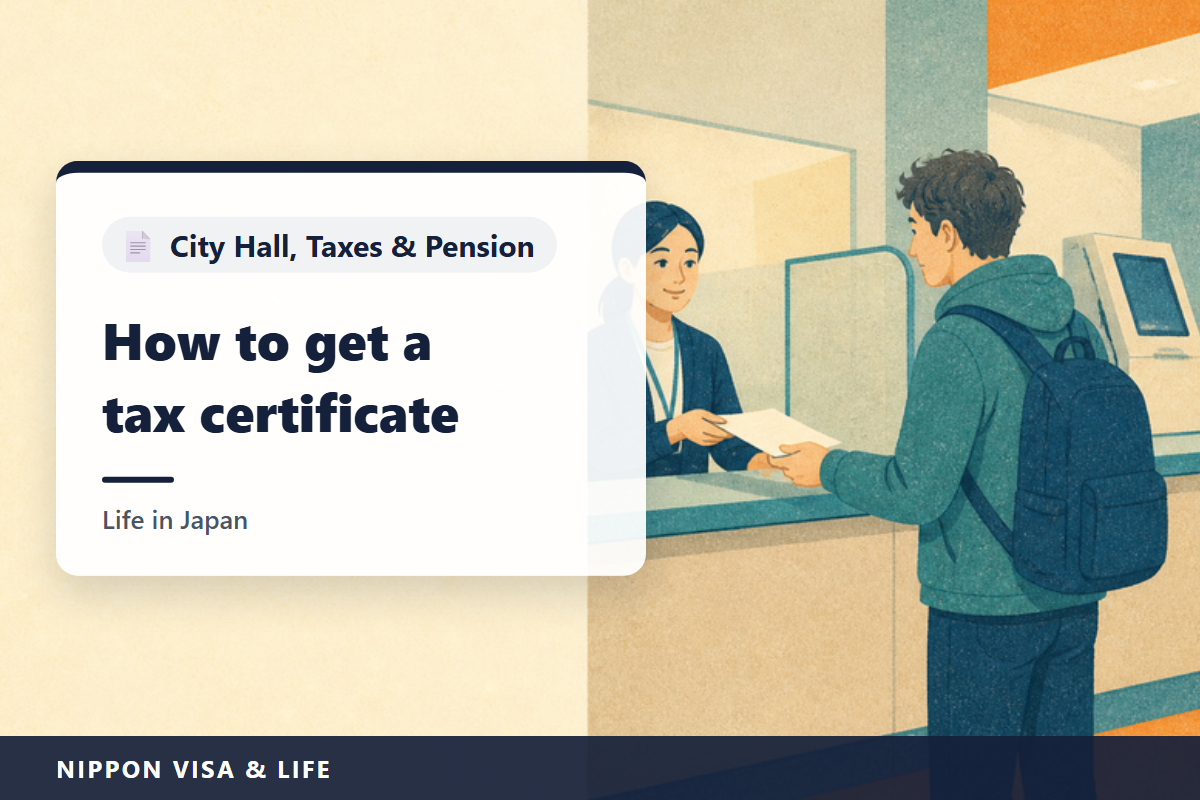
- Request it at the tax counter of the city, ward, town or village office, or at a ward office, branch office, etc. Where you can get it differs depending on the city, ward, town or village.
- What to bring (example: Osaka City)
- Identity document: your residence card, My Number Card, driver’s license, etc. It must show your address, name and date of birth and be within its validity period. Depending on what you bring, you may need 2 documents.
- The fee
- For example, the fee at the counters in Osaka City, Yokohama City and Saitama City is 300 yen per copy. In Osaka City, one copy covers one fiscal year.
(Source: Osaka City, “Tax (income) certificate”, Yokohama City, “Tax Certificates”, Saitama City, “If you want to get municipal tax certificates”)
2. By Mail
- Send the application form, the fee and a return envelope with stamps attached to the tax section of the city, ward, town or village, and the certificate will be mailed to you.
- Example: In Yokohama City, you send the fee as a “fixed-amount postal money order (teigaku kogawase, 定額小為替; a certificate you can mail instead of cash)” bought at a post office. As a rule, only the person themselves can request by mail, and the certificate is sent to that person’s address.
- It takes time to arrive. Example: In Osaka City, it takes about 1 week until it is sent, and it may take longer around the New Year holidays and from April to June.
- To check how and where to send it and what you need, search for “(name of the city, ward, town or village) 課税証明書 郵送” and look at the city, ward, town or village’s website.
(Source: Osaka City, “Frequently asked questions (Q&A on requesting certificates)”, Aoba Ward, Yokohama City, “Can I have a tax (exemption) certificate sent to me by mail?”)
3. At a Convenience Store (If You Have a My Number Card)
In some cities, wards, towns and villages, you can use your My Number Card to get certificates from a multi-function copy machine (a machine that can print and issue certificates) at convenience stores and similar places.
Example: Saitama City
- Conditions: you have a My Number Card or similar, you are registered as a resident of Saitama City on the day you get it, and Saitama City decided your resident tax for that fiscal year
- Only the latest fiscal year certificate is available
- The fee is 100 yen cheaper than at the counter (200 yen per copy)
- People who have moved out of the city, and people whose My Number Card electronic certificate has expired, cannot use it
Note:
- Some cities, wards, towns and villages do not issue tax certificates at convenience stores (example: Yokohama City).
- People who did not live in that city, ward, town or village on January 1 cannot use it (example: Shinjuku City).
- Certificates for people who are dependents and did not file a tax return may not be available at convenience stores (example: Osaka City).
(Source: Saitama City, “Application guide for income certificates, tax certificates and tax exemption certificates”, Saitama City, “If you want to get municipal tax certificates”, Yokohama City, “How to apply for tax certificates”, Shinjuku City, “Getting special ward resident tax, metropolitan resident tax and forest environment tax certificates at convenience stores, etc.”, Osaka City, “Frequently asked questions (Q&A on requesting certificates)”)
4. Requesting Online (with Your Smartphone)
Some cities, wards, towns and villages let you request a certificate with your smartphone and My Number Card and receive it by mail.
Example: Shinjuku City
- You can request a tax (exemption) certificate and a tax payment certificate for the current fiscal year and up to 3 past fiscal years.
- Only the person themselves can request.
- The fee is 300 yen per copy plus postage, paid with PayPay (a smartphone payment service) or a credit card.
(Source: Yokohama City, “How to apply for tax certificates”, Yokohama City, “Tax Certificates”, Shinjuku City, “Electronic applications for tax certificates”)
Can a Family Member or Friend Get It for You?
- If you have a letter of authorization (ininjo, 委任状) written by you and an identity document of the person you asked (the proxy), the proxy can make the request.
- In some cities, wards, towns and villages, family members in the same household can make the request without a letter of authorization (example: Osaka City; however, a letter of authorization is required if they live outside the city and it cannot be confirmed that they are in the same household).
(Source: Osaka City, “Tax (income) certificate”, Yokohama City, “Tax Certificates”)
Problems and Common Mistakes
Is the Certificate Not Issued If You Did Not File a Tax Return?
Yes, it may not be issued.
- Some cities, wards, towns and villages do not issue certificates to people who have not filed a tax return (example: Yokohama City).
- Even people who had no income can get a certificate if they have submitted a resident tax return (example: Osaka City).
- People who are dependents of a family member may be able to get a certificate showing a tax amount of 0 yen (not charged resident tax) even if they have not filed a return. However, the amount of income is not shown. If you need a certificate showing your income, you need to file a return (example: Nagoya City, Osaka City).
If you are told a certificate cannot be issued, ask the tax counter of that city, ward, town or village how to file a return.
(Source: Yokohama City, “Tax Certificates”, Osaka City, “Frequently asked questions (Q&A on requesting certificates)”, Nagoya City, “I did not file a return because I had no income. Can I get an income certificate?”)
You Just Came to Japan and Cannot Get a Certificate?
Because a tax certificate is based on your address on January 1 and your income for the previous year, you may not be able to get a certificate for that fiscal year in the year you came to Japan. Ask the place you are submitting it to what you should do.
(Source: Yokohama City, “Tax Certificates”)
You Were Asked for an Income Tax Payment Certificate
Income tax is a national tax. You request an income tax payment certificate not from the city, ward, town or village but from the tax office (National Tax Agency). It is different from a resident tax payment certificate, so check with the place you are submitting it to which one they need.
(Source: National Tax Agency, “How to request a tax payment certificate”)
Where to Ask If You Have Questions
- For questions about certificates, ask the tax section of the city, ward, town or village office where you lived on January 1 of that fiscal year (called “Shiminzei-ka (municipal tax section),” “Zeimu-ka (tax affairs section),” etc.; the name differs depending on the city, ward, town or village).
- If you search for “(name of the city, ward, town or village) 課税証明書,” you can find the page explaining how to get it, the fee and what to bring.
- For an overview of all the procedures you do at the city office soon after arriving in Japan, see Procedures at the City Office After You Arrive in Japan: The Basics of the Moving-in Notification, My Number, National Health Insurance, National Pension and Resident Tax.
Primary Sources Referenced in This Article
- Yokohama City, “Tax Certificates” (Living guide for foreign residents)
- Yokohama City, “How to apply for tax certificates”
- Aoba Ward, Yokohama City, “Can I have a tax (exemption) certificate sent to me by mail?”
- Osaka City, “Tax (income) certificate”
- Osaka City, “Frequently asked questions (Q&A on requesting certificates)”
- Saitama City, “Application guide for income certificates, tax certificates and tax exemption certificates”
- Saitama City, “If you want to get municipal tax certificates”
- Shinjuku City, “Getting special ward resident tax, metropolitan resident tax and forest environment tax certificates at convenience stores, etc.”
- Shinjuku City, “Electronic applications for tax certificates”
- Nagoya City, “I did not file a return because I had no income. Can I get an income certificate?”
- National Tax Agency, “How to request a tax payment certificate”
This article is a translation of the original Japanese version.