This article was written by the NIPPON VISA & LIFE editorial team based on information from public organizations such as the national government and local governments. Rules and fees may differ depending on the city, ward, town or village where you live.
In Japan, when a company hires someone, it must show the worker the conditions of the job (the working conditions), such as pay and working hours. The law requires that the important items be given in writing. Before you start working, get the document, check what it says, and keep it in a safe place.
The Short Answer: What to Do Before You Start Working
- Get a written document that sets out your working conditions (such as a Notice of Working Conditions) from your company
- Check that the items in the table below (contract period, workplace and job, hours, days off, wages and leaving the job) are written in it
- Ask your company about any words or numbers you do not understand before you start working
- Keep the document while you are working and also after you leave the job
- If you cannot get a written document, or if the actual conditions are different from the document, consult the Labour Standards Inspection Office or a consultation service in foreign languages
An overview of finding a job and working is available in The Basics of Finding a Job and Working in Japan: Hello Work, Working Conditions, Wages and Overtime, Paid Leave, Quitting and Where to Get Help.
What Is a Notice of Working Conditions?
A law called the Labor Standards Act says that when a company (the employer) makes an employment contract with a worker, it must show the working conditions, such as wages (pay) and working hours. The important items among them must be shown by giving a written document.
An example of this document is the “Notice of Working Conditions” (roudou jouken tsuuchisho), for which the Ministry of Health, Labour and Welfare provides a sample (model form). The document your company gives you may have a different name, such as “employment contract” (koyou keiyakusho). What matters is not the name, but whether the items in the table below are written in it.
- As a rule, the document is given on paper
- If the worker wishes, it can also be received by fax, email or similar means. In the case of email and similar means, it is limited to a form that the worker can print out as a paper document
(Sources: e-Gov Law Search “Labor Standards Act” Article 15, e-Gov Law Search “Ordinance for Enforcement of the Labor Standards Act” Article 5)
Items You Must Receive in Writing
The following items must be shown in writing to everyone. This applies not only to full-time regular employees but also to part-time workers, “arubaito” workers and others.
| Item | What to check in the document |
|---|---|
| Contract period | Whether the contract has no fixed period, or has a fixed period (for example, 1 year) |
| Contract renewal | For a fixed-period contract that may be renewed: what the decision to renew is based on, and whether there is a limit on renewals (how many times, or up to how many years in total) |
| Workplace and job | Your workplace and job right after you are hired, and how far they may change in the future (the scope of change) |
| Hours | The time work starts and ends, whether you may work beyond the set hours (overtime), break times, and the rules if you work in shifts |
| Days off and leave | Your days off, and leave (such as annual paid leave) |
| Wages | How your pay is decided, calculated and paid, the closing date (the day the pay calculation period ends) and the payday |
| Leaving the job | The rules for leaving the job (including the reasons for dismissal) |
(Source: e-Gov Law Search “Ordinance for Enforcement of the Labor Standards Act” Article 5)
In addition, pay raises (increases in your pay) must also be shown. If the company has rules on them, the following must also be shown: retirement allowance, bonuses, costs paid by the worker such as meals and work supplies, safety and health, job training, compensation for injuries at work, awards and penalties, and leave of absence. The Labor Standards Act does not go as far as requiring these to be shown in writing (if there is such a system, it is shown orally, in writing or by other means).
However, for part-time workers and workers on fixed-period contracts, a separate law called the Part-Time and Fixed-Term Employment Act requires that whether there are pay raises, bonuses and a retirement allowance, and the company’s consultation contact, also be shown in writing or by similar means.
Items Added from April 2024
From April 2024, the rules for showing working conditions changed, and the following items were added.
| Who it applies to | Items added |
|---|---|
| Everyone (when making a contract, and when renewing a fixed-period contract) | The scope of change of the workplace and job (how far they may change in the future, such as through transfers) |
| People on fixed-period contracts (when making a contract, and when renewing) | Whether there is a limit on renewals, and what it is (a limit on the total contract period or on the number of renewals) |
| People who become able to apply to change to a contract with no fixed period after their fixed-period contracts with the same company have been renewed for more than 5 years in total (an application for conversion to indefinite-term employment) (at the time of that renewal) | That you can apply for conversion to indefinite-term employment, and the working conditions after the conversion |
If the company newly sets a limit on renewals after the first contract, or shortens the limit, it is now required to explain the reason in advance.
(Sources: Ministry of Health, Labour and Welfare “The Rules for Showing Working Conditions Change from April 2024”, Ministry of Health, Labour and Welfare leaflet “The Rules for Showing Working Conditions Changed from April 2024”)
Where to Look in the Document (Checking with the Sample)
In the Ministry of Health, Labour and Welfare’s sample Notice of Working Conditions, the items are arranged as shown below. The document your company gives you may look different. Find where the same items are written and check them.
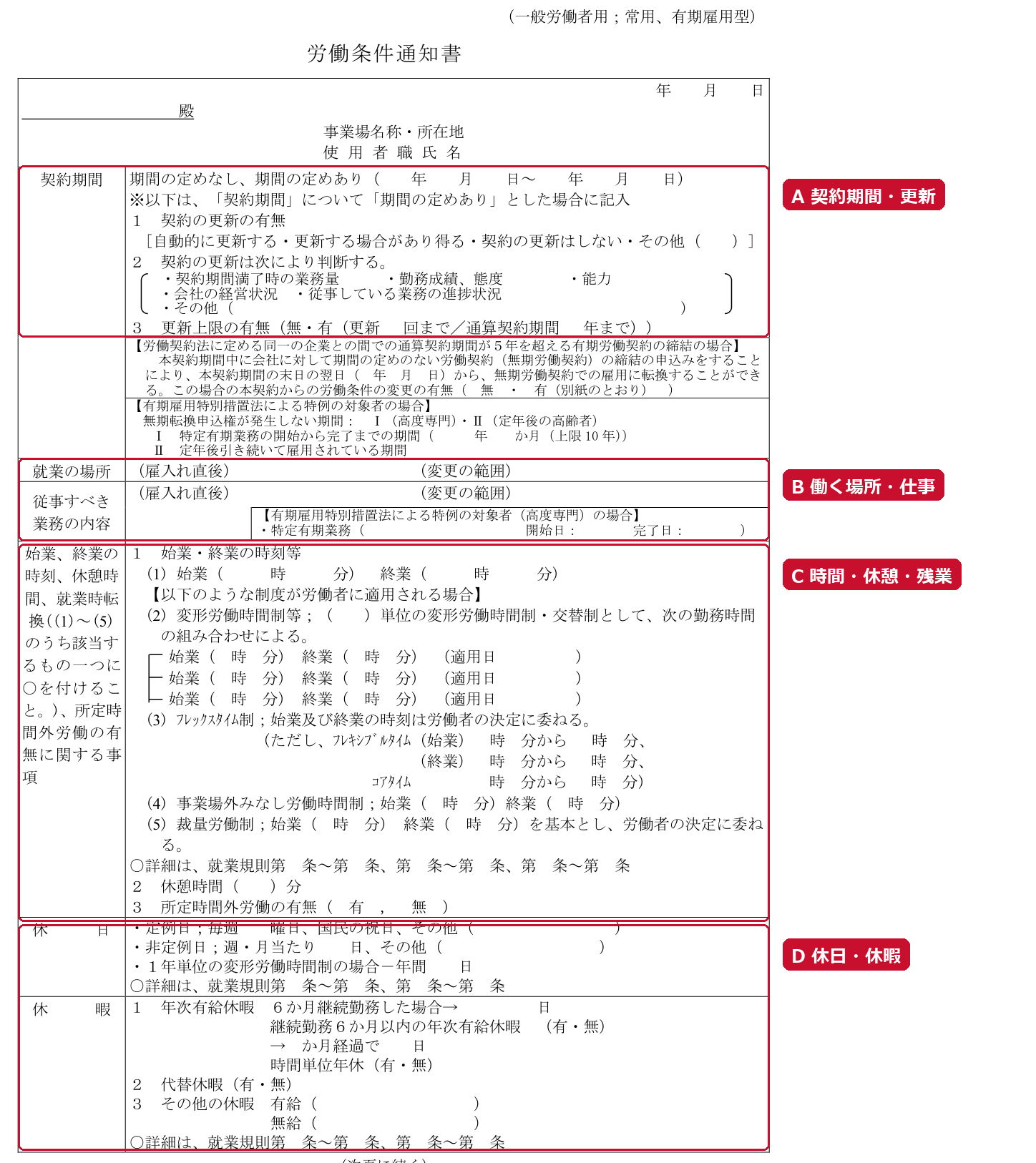
Sources: Ministry of Health, Labour and Welfare “Notice of Working Conditions (for general workers: regular and fixed-term employment)”
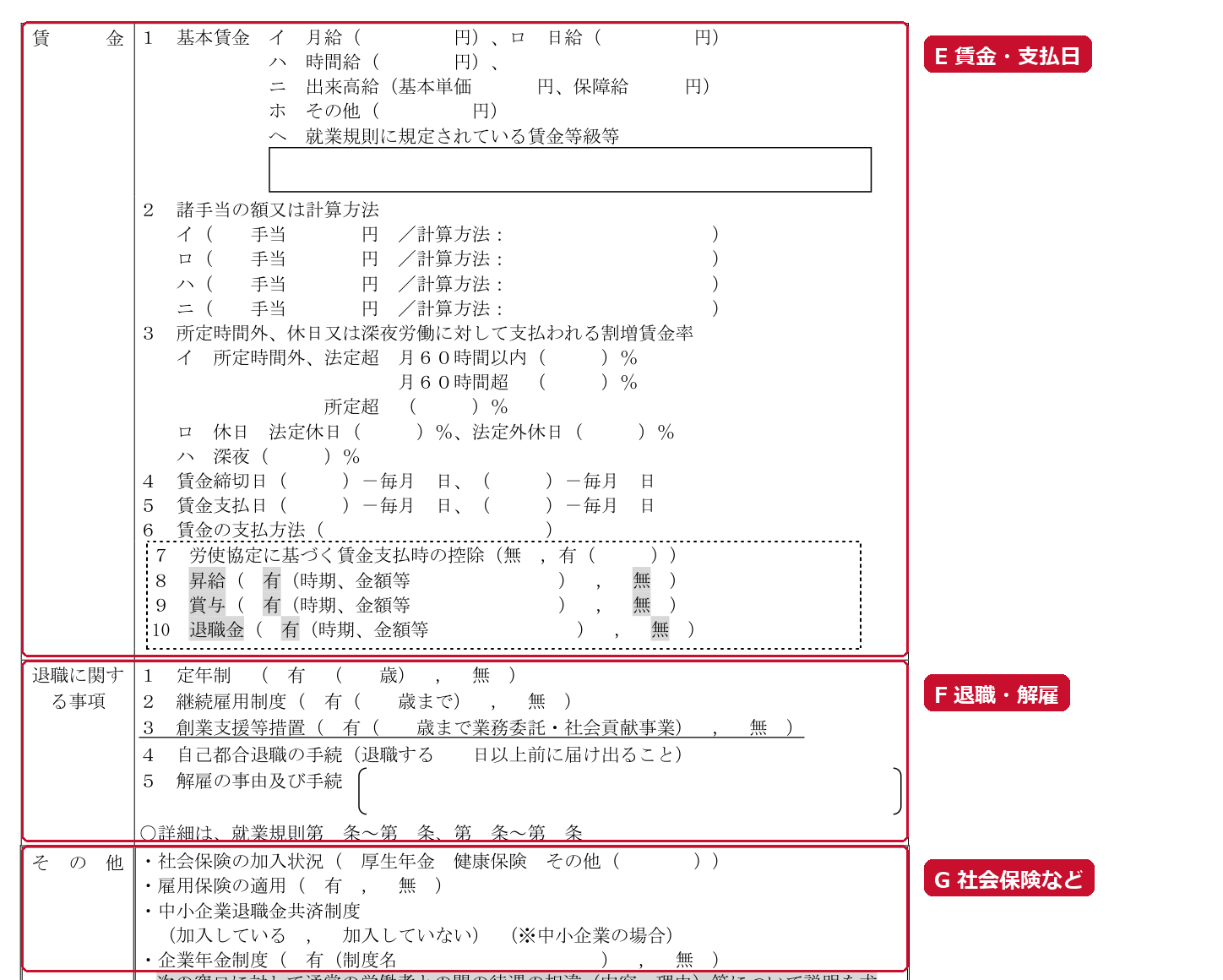
Sources: Ministry of Health, Labour and Welfare “Notice of Working Conditions (for general workers: regular and fixed-term employment)”
Points to Check in Particular
- A Contract period and renewal: If the contract has a fixed period, check the end date, whether it may be renewed, and the limit on renewals
- B Workplace and job: Check both “right after hiring” and “scope of change”
- C Hours: Check the start and end times, break times, and whether overtime is marked “有” (yes) or “無” (no). How overtime pay works is explained in Overtime and Overtime Pay Rules in Japan: The Basics of Working Hours, Breaks, Holidays and Premium Wages (25%, 35% and 50%)
- D Days off and leave: Check which days of the week you have off and how many, and the number of days of annual paid leave
- E Wages: Check the amount of your hourly, daily or monthly pay, allowances, the closing date and payday, and how you are paid (such as bank transfer). If there are “deductions” (amounts taken out of your pay), also check what is deducted. You can check whether the amount is below the minimum wage in How to Check the Minimum Wage in Japan: Amounts by Prefecture (FY Reiwa 8) and How to Calculate Whether Your Pay Is Below It
- F Leaving the job: Check how many days in advance you must give notice if you decide to quit, and in what cases you may be dismissed
- G Social insurance and similar systems: Check whether you will be enrolled in Employees’ Pension Insurance, Health Insurance and Employment Insurance
Samples and Explanations in Foreign Languages
On the Ministry of Health, Labour and Welfare’s “Check Working Conditions” (Tashikameyou Roudou Jouken) website, a sample Notice of Working Conditions and the “Working Conditions Handbook”, which summarizes the rules for working, are published for foreign workers in Japanese and 13 foreign languages (English, Chinese, Portuguese, Spanish, Tagalog, Vietnamese, Myanmar, Nepali, Korean, Thai, Indonesian, Khmer and Mongolian). Comparing them with your Japanese document makes it easier to understand what each item means.
(Source: Ministry of Health, Labour and Welfare “Check Working Conditions” FOR FOREIGN WORKERS)
When You Have a Problem: Common Concerns
What if I cannot get a written document?
The important items must be shown in writing. First, ask your company, “Please give me my working conditions in writing.” If you cannot get it, you can consult the Labour Standards Inspection Office in charge of your workplace, or one of the consultation services in foreign languages below.
What if the actual conditions are different from the document?
A company must not show working conditions that are different from the facts. The Labor Standards Act says that if the working conditions shown are different from the facts, the worker may end (cancel) the employment contract immediately. If a worker who moved to a new place to live in order to work returns home within 14 days from the day the contract was ended, the company must pay the necessary travel costs.
However, whether to actually end the contract is a big decision that also affects your daily life and your stay in Japan. Before deciding on your own, consult the Labour Standards Inspection Office or a consultation service.
(Sources: e-Gov Law Search “Labor Standards Act” Article 15, e-Gov Law Search “Ordinance for Enforcement of the Labor Standards Act” Article 5)
What if it says “You will be fined if you quit”?
The Labor Standards Act prohibits companies from making contracts like the following. If your document contains something like this, consult a consultation service.
- Setting in advance a penalty (fine) for breaking the contract, or the amount of compensation for damages
- Offsetting your pay against money lent to you in advance on the condition that you work (advance loans)
- Making you sign a contract to save money together with the employment contract, or a contract for the company to manage the worker’s savings
(Source: e-Gov Law Search “Labor Standards Act” Articles 16, 17 and 18)
How long should I keep the document?
The Ministry of Health, Labour and Welfare’s sample says that it is recommended to keep the Notice of Working Conditions to prevent trouble between the worker and the company. Keep it somewhere you can take it out quickly, not only while you are working but also after you leave the job. Taking a photo of it with your smartphone is also a good idea.
Consultation Services Available in Foreign Languages
You can consult by telephone in foreign languages about working conditions (as of October 2026. The days and hours of service may change temporarily. The year-end and New Year holidays 〈December 29 to January 3〉 are excluded).
Consultation Dial for Foreign Workers (weekdays 10:00 a.m. to 3:00 p.m., except noon to 1:00 p.m. Call charges apply: 9.35 yen per 180 seconds from a landline, 22 yen per 30 seconds from a mobile phone 〈tax included〉)
| Language | Days | Phone number |
|---|---|---|
| English | Mon–Fri | 0570-001-701 |
| Chinese | Mon–Fri | 0570-001-702 |
| Portuguese | Mon–Fri | 0570-001-703 |
| Tagalog | Mon–Fri | 0570-001-705 |
| Vietnamese | Mon–Fri | 0570-001-706 |
| Myanmar | Tue, Wed, Fri | 0570-001-707 |
| Nepali | Mon–Fri | 0570-001-708 |
| Korean | Tue–Fri | 0570-001-709 |
| Thai | Tue, Thu | 0570-001-712 |
| Indonesian | Tue, Thu | 0570-001-715 |
Working Conditions Consultation Hotline (free of charge. Weekdays 5:00 p.m. to 10:00 p.m., Saturdays, Sundays and national holidays 9:00 a.m. to 9:00 p.m. You can consult during hours when the Labour Bureaus and Labour Standards Inspection Offices are closed)
| Language | Days | Phone number |
|---|---|---|
| Japanese | Every day | 0120-811-610 |
| English | Every day | 0120-531-401 |
| Chinese | Every day | 0120-531-402 |
| Portuguese | Mon–Sat | 0120-531-403 |
| Tagalog | Tue, Wed, Sat | 0120-531-405 |
| Vietnamese | Tue, Wed, Fri–Sun | 0120-531-406 |
| Myanmar | Wed, Sun | 0120-531-407 |
| Nepali | Wed, Sun | 0120-531-408 |
| Korean | Thu, Sun | 0120-613-801 |
| Thai | Thu, Sun | 0120-613-802 |
| Indonesian | Thu, Sun | 0120-613-803 |
In addition, some prefectural Labour Bureaus and Labour Standards Inspection Offices have a “Consultation Corner for Foreign Workers” where you can consult in person in foreign languages. You can search for the locations and languages by prefecture on the Ministry of Health, Labour and Welfare page below.
Primary Sources Used for This Article
- e-Gov Law Search “Labor Standards Act” (Articles 15 to 18)
- e-Gov Law Search “Ordinance for Enforcement of the Labor Standards Act” (Article 5)
- Ministry of Health, Labour and Welfare “The Rules for Showing Working Conditions Change from April 2024”
- Ministry of Health, Labour and Welfare leaflet “The Rules for Showing Working Conditions Changed from April 2024”
- Ministry of Health, Labour and Welfare “Notice of Working Conditions (for general workers: regular and fixed-term employment)”
- Ministry of Health, Labour and Welfare “Check Working Conditions” FOR FOREIGN WORKERS
- Ministry of Health, Labour and Welfare “Check Working Conditions” Consultation Services for Foreign Workers
This article is a translation of the original Japanese version.