This article was written by the NIPPON VISA & LIFE editorial team based on information from public organizations such as the national government and local governments. Rules and fees may differ depending on the city, ward, town or village where you live.
In Japan, packaged food sold in bags or boxes (processed food) has a label showing its name, ingredients, date, storage method and more. There are 2 kinds of dates: the “use-by date” (shohi kigen, 消費期限) and the “best-before date” (shomi kigen, 賞味期限), and they mean different things. If you have an allergy, look at the ingredients section.
For the overall flow of shopping, see The Basics of Money and Shopping in Japan.
The Short Answer: What to Check on the Label
- Date: Check whether it is a “use-by date” (消費期限) or a “best-before date” (賞味期限). Dates are written in the order “year, month, day.”
- Storage method: For example, “keep refrigerated” (要冷蔵), “keep frozen” (要冷凍) or “room temperature” (常温). Store the food the way it says.
- Ingredients (原材料名): Foods that can cause allergies are written in the ingredients section, for example inside the parentheses ( ).
- Nutrition facts (栄養成分表示): If you are concerned about calories (熱量) or salt (食塩相当量, salt equivalent), look here.
(Source: Consumer Affairs Agency, “Food Labeling System in Japan (For Visitors to Japan)”)
An Example Label
Packaged processed food shows the name (the common name of the food), ingredients, additives, net quantity, date, storage method, manufacturer and more. The image below is an example label (potato salad) from a pamphlet the Consumer Affairs Agency made for foreign nationals.
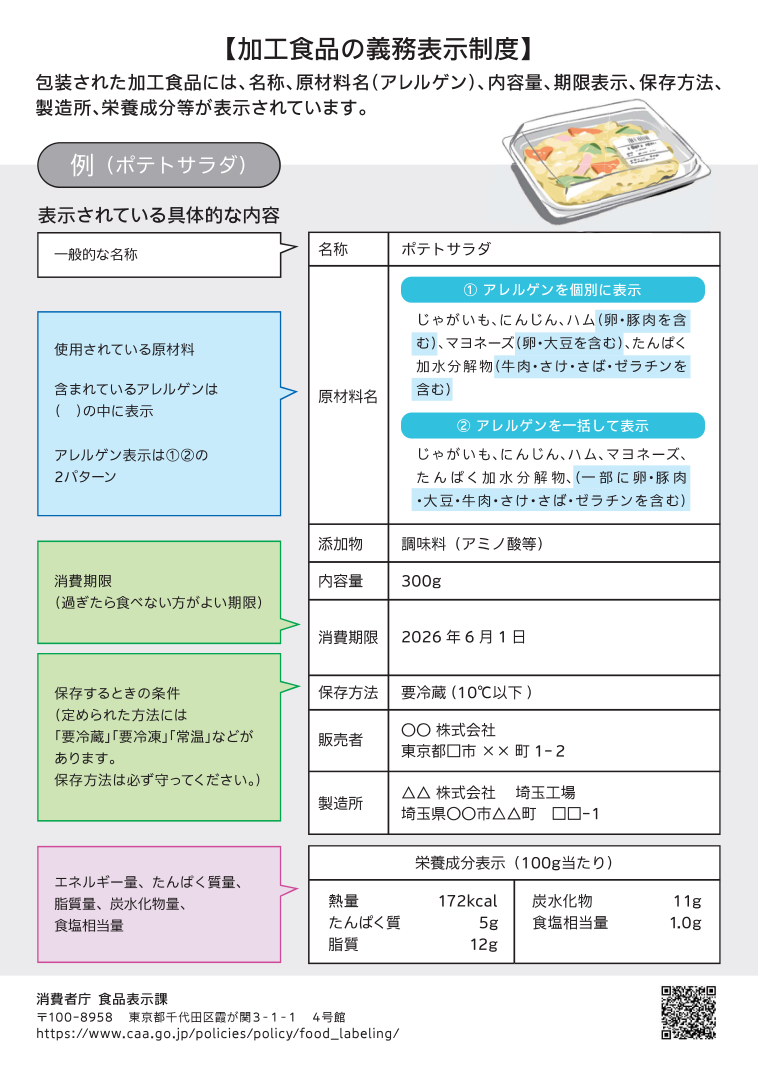
Sources: Consumer Affairs Agency, “Food Labeling System in Japan (For Visitors to Japan)”
The Consumer Affairs Agency’s pamphlet is available in English, Chinese and Korean as well as Japanese (Consumer Affairs Agency, “Pamphlets”).
The Difference Between the Use-by Date and the Best-before Date
| Date | Meaning | Examples of food |
|---|---|---|
| Use-by date (消費期限) | The date after which you should not eat the food | Boxed meals (bento), sandwiches, rice balls (onigiri), sozai (prepared side dishes) |
| Best-before date (賞味期限) | The date until which the food can be enjoyed at its best taste | Snacks, cup noodles, canned food |
- The use-by date is shown on food that spoils easily. It is the date until which the food is safe to eat when stored in the specified way.
- The best-before date is shown on food that can be stored for a relatively long time. It is the date until which the quality is maintained when stored in the specified way. It is said that the quality may still be maintained after this date has passed.
- Both dates apply when you follow the storage method written on the label.
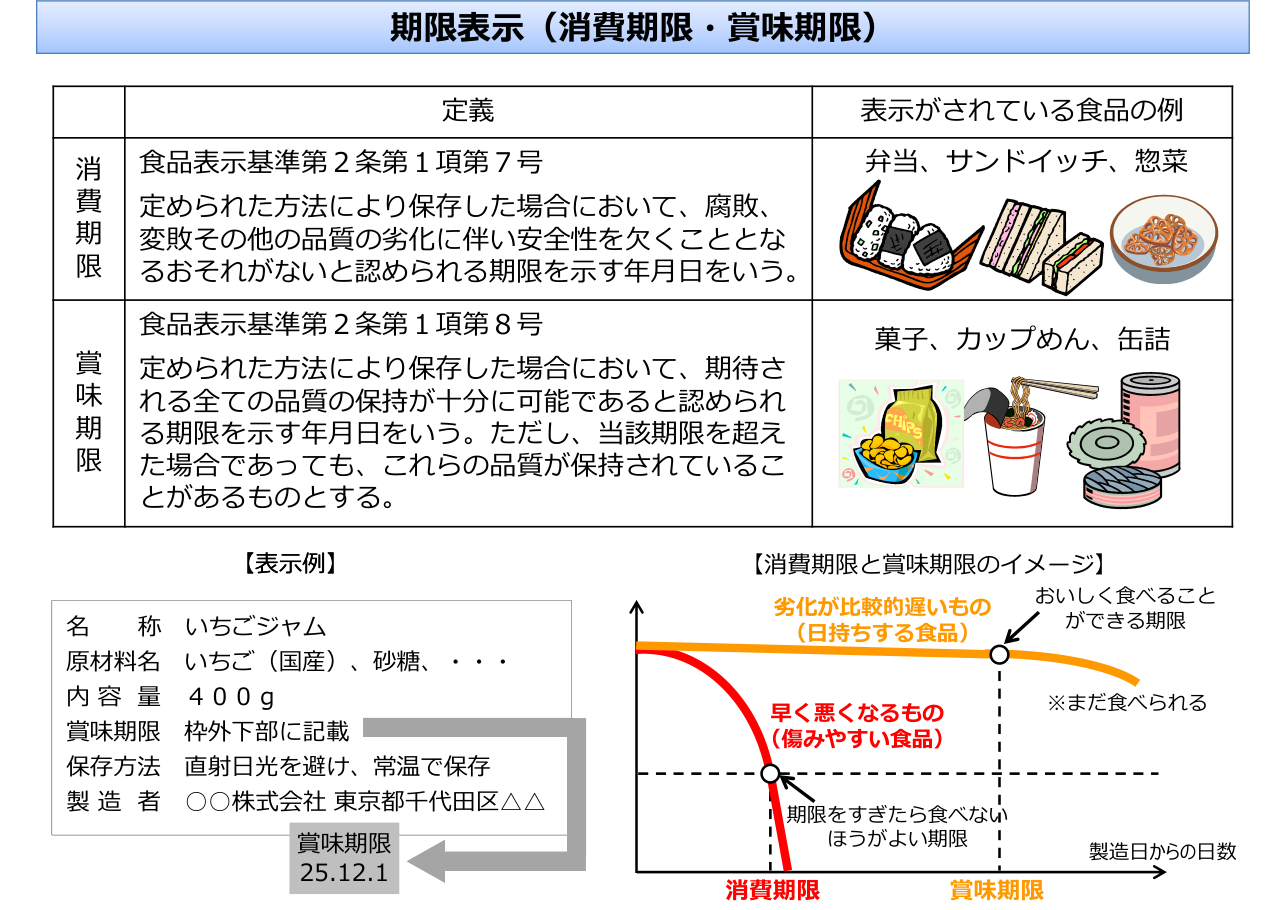
Sources: Consumer Affairs Agency, “Date Labeling (Use-by Date and Best-before Date)”
(Source: Consumer Affairs Agency, “Date Labeling (Use-by Date and Best-before Date)”, Consumer Affairs Agency, “Food Labeling System in Japan (For Visitors to Japan)”)
How Dates Are Written
Dates are written in the order year, month, day. The same date can be written in several ways, as shown below.
| How it is written | Meaning |
|---|---|
| 2026.12.31 | December 31, 2026 |
| 26.12.31 | December 31, 2026 (only the last 2 digits of the year) |
| 令和8年12月31日 | December 31, 2026 (Japanese era name; Reiwa 8 = 2026) |
Reiwa 8 may also be written as “08.”
Where the Date Is Written
The date is sometimes written outside the frame of the label, not inside it. In that case, the “best-before date” (賞味期限) field on the label says something like “枠外下部に記載” (meaning “written below, outside the frame”).
How to Read Allergen Labeling
The 9 Items That Must Be Labeled (Specified Ingredients)
When packaged processed food contains any of the following 9 items, they must be labeled.
Shrimp, cashew nuts, crab, walnuts, wheat, buckwheat (soba), egg, milk, peanuts
Cashew nuts were added to the mandatory items on April 1, 2026. Because there is a 2-year transition period (a grace period for changing labels), for a while some products may not show cashew nuts even if they contain them.
(Source: Consumer Affairs Agency, “Information on Food Allergy Labeling”, Consumer Affairs Agency, “On the Labeling of Foods Containing Allergens” (administrative notice of April 1, Reiwa 8))
The 20 Items Recommended for Labeling (Equivalent to Specified Ingredients)
Labeling is recommended for the following 20 items (meaning companies are encouraged to label them as much as possible). Because it is not mandatory, they may not be labeled even if the food contains them.
Almonds, abalone, squid, salmon roe (ikura), oranges, kiwi fruit, beef, sesame, salmon, mackerel, soybeans, chicken, bananas, pistachios, pork, macadamia nuts, peaches, yam (yamaimo), apples, gelatin
(Source: Consumer Affairs Agency, “About Allergen Labeling” (as of April, Reiwa 8))
How Allergens Are Written in the Ingredients Section
Foods that cause allergies (allergens) are written in the ingredients section in one of the following 2 ways.
- Written individually: Written in parentheses ( ) after each ingredient. Examples: “ハム(卵・豚肉を含む)” (ham (contains egg and pork)), “マヨネーズ(卵・大豆を含む)” (mayonnaise (contains egg and soybeans))
- Written all together: Written together at the end. Example: “(一部に卵・豚肉・大豆・牛肉・さけ・さば・ゼラチンを含む)” (contains in part egg, pork, soybeans, beef, salmon, mackerel and gelatin)
Egg may be written in a different way, such as “玉子” or “たまご” instead of “卵.”
There may also be a caution such as “本品製造工場では○○を含む製品を生産しています。” (products containing ○○ are produced in the factory where this product is made), telling you that products are made in the same factory. This caution is recommended, not mandatory.
(Source: Consumer Affairs Agency, “About Allergen Labeling”)
Food With No Label or Items That Are Not Labeled
- Food that is not packaged: Restaurant dishes, bread at bakeries, cakes in display cases and similar foods may not have labels. Ask a staff member.
- Alcoholic drinks: Allergen labeling is not mandatory.
- Differences between countries: The allergens that are labeled in Japan and in other countries are not always the same. An item that was labeled in your home country may not be labeled in Japan.
(Source: Consumer Affairs Agency, “Food Labeling System in Japan (For Visitors to Japan)”)
When You Ask Store Staff
The Consumer Affairs Agency has made a “Food Allergy Communication Sheet” for people with allergies to show to store staff. You point to pictures of foods (pictograms) or put check marks and show it. Besides Japanese, it is available in English, Chinese and Korean (Consumer Affairs Agency, “Pamphlets”).
If you have allergy symptoms after eating, consult a medical institution. For how to see a doctor, see When You Are Sick or Injured in Japan.
Storage Methods and Nutrition Facts
Storage Methods
Labels show storage methods such as “要冷蔵(10℃以下)” (keep refrigerated at 10℃ or below), “要冷凍” (keep frozen), “常温” (room temperature) and “直射日光を避け、常温で保存” (store at room temperature away from direct sunlight). Follow the storage method written on the label. If you store food the wrong way, it may go bad sooner.
(Source: Consumer Affairs Agency, “Food Labeling System in Japan (For Visitors to Japan)”, Government of Japan Public Relations Online, “Let’s Reduce Food Loss! Things You Can Do at Home Starting Today”)
Nutrition Facts
Nutrients are listed in the order energy (calories), protein, fat, carbohydrates, salt equivalent. Salt is shown not as “sodium” but as salt equivalent (食塩相当量, the amount converted into salt). Also check what amount the numbers refer to, such as “per 100g” (100g当たり).
(Source: Consumer Affairs Agency, “Food Labeling System in Japan (For Visitors to Japan)”)
When You Have Trouble / Frequently Asked Questions
Do I have to throw away food right away once the best-before date has passed?
The best-before date is “the date until which the food can be enjoyed at its best taste.” The Consumer Affairs Agency’s materials say the quality may still be maintained after the date has passed. On the other hand, the use-by date is “the date after which you should not eat the food.” It is said that you should not eat food whose use-by date has passed.
Is it bad to take items with later dates from the back of the shelf?
Government of Japan Public Relations Online recommends that, for food you will use soon, you take items from the front of the shelf. This is because products with dates that are close and remain unsold end up being thrown away by stores (food loss: food that is thrown away even though it can still be eaten).
If the label seems wrong or you have a problem with food you bought
If you have a problem with a product, call the Consumer Hotline (188) and you will be directed to a nearby consultation service such as a Consumer Affairs Center. Consultation is free, but you pay the call charge. For details on how to use these consultation services, see Where to Get Help With Shopping and Contract Problems in Japan: Consumer Hotline 188, Consumer Affairs Centers and Cooling-off.
(Source: Consumer Affairs Agency, “Consumer Hotline”)
Primary Sources Referred to in Writing This Article
- Consumer Affairs Agency, “Food Labeling System in Japan (For Visitors to Japan)”
- Consumer Affairs Agency, “Pamphlets” (food labeling)
- Consumer Affairs Agency, “Information on Food Date Labeling”
- Consumer Affairs Agency, “Date Labeling (Use-by Date and Best-before Date)”
- Consumer Affairs Agency, “Information on Food Allergy Labeling”
- Consumer Affairs Agency, “About Allergen Labeling” (as of April, Reiwa 8)
- Consumer Affairs Agency, “On the Labeling of Foods Containing Allergens” (administrative notice of April 1, Reiwa 8)
- Government of Japan Public Relations Online, “Let’s Reduce Food Loss! Things You Can Do at Home Starting Today”
- Consumer Affairs Agency, “Consumer Hotline”
This article is a translation of the original Japanese version.