This article was written by the NIPPON VISA & LIFE editorial team based on information from public organizations such as the national government and local governments. Rules and fees may differ depending on the city, ward, town or village where you live.
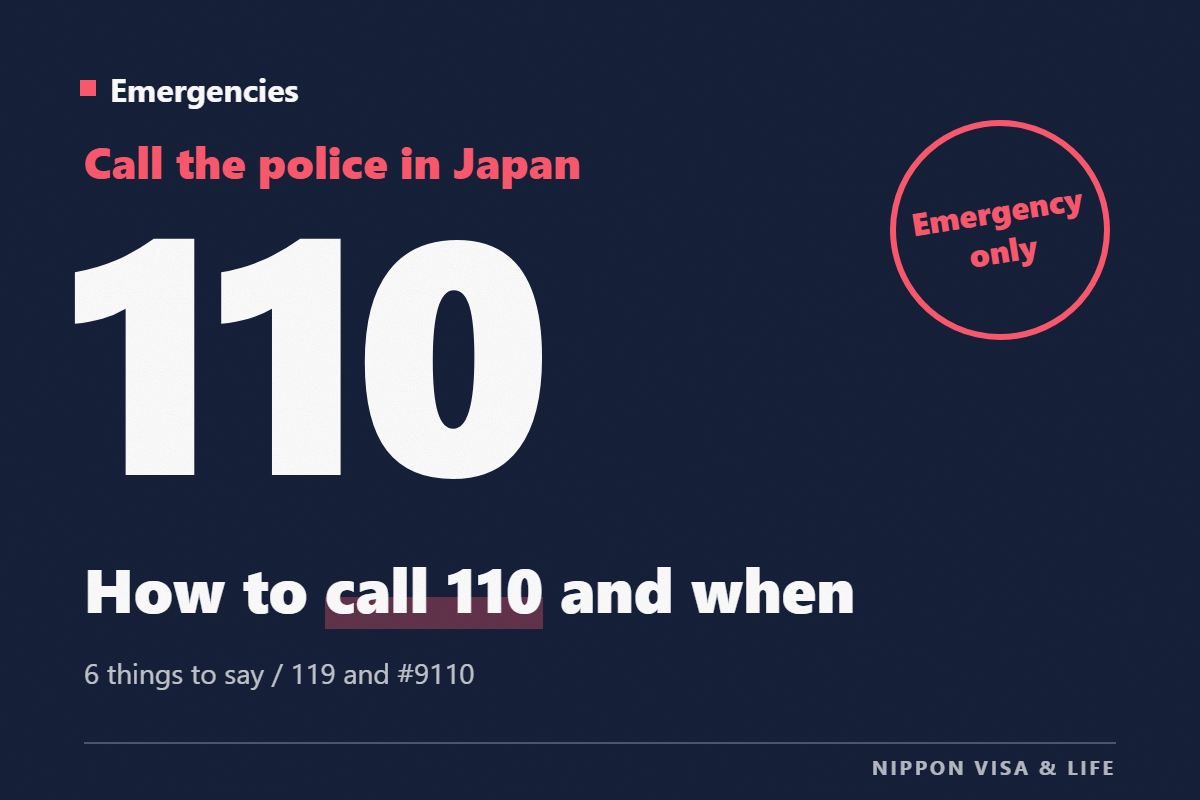
If you are involved in a crime or a traffic accident in Japan, call 110 right away. You can call 110 even if you cannot speak Japanese. The police respond through officers who can speak foreign languages and through three-way calls with an interpreter. For consultations that are not urgent, do not use 110. Use #9110 or contact a nearby police station.
Disasters and emergencies as a whole are summarized in Disasters and Emergencies in Japan: The Basics | Calling 119 and 110, Earthquakes, Tsunami, Heavy Rain, Volcanoes, Evacuation and Multilingual Information.
When to Use 110, 119 and #9110
Choose where to call according to your problem.
| Your problem | Where to call |
|---|---|
| You were the victim of a crime, or you saw a crime or similar incident | 110 (police) |
| You were in a traffic accident, or you saw one | 110 (police) |
| There is a fire | 119 (fire department) |
| You need an ambulance because of a sudden illness or injury | 119 (fire department) |
| Someone was injured in a traffic accident | Both 119 and 110 |
| It is not urgent, but you want to consult the police | #9110, or a nearby police station |
| You lost something, or you found something | A nearby koban (交番: a small police office in the neighborhood) or police station |
(Sources: National Police Agency “Opinions, Consultations and Providing Information”, Metropolitan Police Department “How Do I Report or Notify the Police?”, Immigration Services Agency (ISA) “Guidebook on Living and Working” Chapter 9: Transportation (4-2) and Chapter 10: Emergencies and Disasters)
For how to call an ambulance, read How to Call an Ambulance in Japan: How to Dial 119, What to Say, and Where to Get Advice When You Are Unsure (#7119). What to do after a traffic accident is summarized in If You Are in or Cause a Traffic Accident in Japan: What to Do on the Spot, Reporting to the Police, the Traffic Accident Certificate and Claiming Compulsory Automobile Liability Insurance.
The 6 Things to Tell the Police on a 110 Call
When the call connects, the person in charge asks you what they need to know, one question at a time. Stay calm and answer. The Osaka Prefectural Police ask callers to give the following 6 things.
- Crime or accident: Whether it is a crime or a traffic accident
- Where: The place where it happened
- When: The time it happened
- Features of the offender: What the offender is like, if you know
- The current situation: What is happening now
- Your name and other details: The name and other details of the person calling
The Immigration Services Agency’s “Guidebook on Living and Working” says you will also be asked whether anyone is injured. Stay calm and answer as accurately as you can.
After the call, wait for the police officers in a safe place.
(Sources: Minoh Police Station, Osaka Prefecture “About 110 Day”, Osaka Prefectural Police “110” EMERGENCY CALLS, Immigration Services Agency “Guidebook on Living and Working” Chapter 10: Emergencies and Disasters)
How to Call 110 If You Cannot Speak Japanese
You can call 110 even if you cannot speak Japanese. According to the National Police Agency, the police assign officers who can speak foreign languages and also respond through three-way calls that include staff of an interpretation center or a similar service.
The Osaka Prefectural Police say that if you do not understand the language, they will connect you to an interpreter, so please wait without hanging up.
When the call connects, first say one of the following.
| What you want to say | How to say it in Japanese |
|---|---|
| When you have been the victim of a crime or there is a crime or similar incident | 「事件です」(じけんです / jiken desu): “This is a crime or incident.” |
| When there is a traffic accident | 「事故です」(じこです / jiko desu): “This is an accident.” |
| When you cannot speak Japanese | 「日本語が話せません」(にほんごが はなせません / nihongo ga hanasemasen): “I cannot speak Japanese.” |
According to the Osaka Prefectural Police, there is no charge for a call to 110.
(Sources: National Police Agency “White Paper on Police, Reiwa 6 Edition”: Immediate Response to Crimes and Accidents, Osaka Prefectural Police “110” EMERGENCY CALLS)
How to Explain Your Location on a 110 Call When You Do Not Know Where You Are
When you call 110 from a mobile phone, there is a system that sends your location information to the police. According to the Osaka Prefectural Police, if your smartphone is on a contract made in Japan, its GPS information reaches the police.
However, if you are inside a building or GPS cannot show where you are, a police officer will ask you for your location. The Osaka Prefectural Police give the following examples.
- The name of the apartment building and your room number
- A nearby shop, intersection or station
- The number on a blue sticker on the pole of a traffic sign in Osaka Prefecture (the sticker with “OPP” written on it; signs in other areas do not necessarily have one)
A smartphone that is still on a foreign phone company’s contract and is used through international roaming (a service for using a foreign mobile phone in Japan) may not be able to call 110.
(Sources: Osaka Prefectural Police “110” EMERGENCY CALLS, National Police Agency “White Paper on Police, Reiwa 6 Edition”: Immediate Response to Crimes and Accidents)
Common Questions When You Are Unsure About Calling 110
May I Call 110 for a Consultation That Is Not Urgent?
110 is the number for emergency reports. For problems and worries that are not urgent, consult #9110, the dedicated police consultation number, or a nearby police station or koban.
#9110 connects you to the police consultation desk of the area you are calling from.
- You pay the call charge (in the case of Tokyo)
- You cannot call it from rotary-dial lines or some IP phones
- Near a prefectural border, you may be connected to the police of the neighboring prefecture
On Saturdays, Sundays, national holidays and at night, the service is handled by staff on duty, by recorded voice guidance or in similar ways. For details, search online for “#9110 ○○県警察” (put the name of the prefecture in place of ○○) or ask a police station.
For where to get help with false phone calls and emails, read What to Do About Scam Emails, Text Messages and Phone Calls in Japan: Tricks Pretending to Be Delivery Companies, the Police or Immigration, and Where to Get Help (#9110 and 188).
(Sources: Osaka Prefectural Police “Q10: Can I Call 110 for a Consultation That Is Not Urgent?”, Metropolitan Police Department “Guide to Consultation Hotlines”, Kanagawa Prefectural Police “Consulting the Police”, National Police Agency “Dedicated Police Consultation Number #9110”)
How Can I Call 110 If I Do Not Have a Smartphone?
You can call 110 from a public phone. You do not need money or a telephone card. On a public phone with a red button, lift the receiver, press the button and then press 110. On a public phone without a red button, lift the receiver and press 110 directly.
(Source: Immigration Services Agency “Guidebook on Living and Working” Chapter 10: Emergencies and Disasters)
Can I Also Use an Interpreter When I Call 119?
The Fire and Disaster Management Agency is promoting a system of three-way conversations through a telephone interpretation center. However, 673 of the 720 fire departments across Japan have introduced it (as of January 1, 2025). Some areas have not introduced it.
How Can I Report to 110 If I Cannot Speak Out Loud?
For people who have difficulty speaking by voice, such as those who have trouble hearing, there is the “110 App System” (110番アプリシステム). You can report to the police using text and images. Foreign-language support covers only reporting by button operation, and the chat screen does not support foreign languages.
You need to register in advance to use it. You also need a contract with a Japanese mobile phone company that includes SMS and data communication. If you can report by voice, call 110 and speak.
(Source: National Police Agency “110 App System”)
Primary Sources Used for This Article
- National Police Agency “Opinions, Consultations and Providing Information”
- National Police Agency “White Paper on Police, Reiwa 6 Edition”: Immediate Response to Crimes and Accidents
- National Police Agency “110 App System”
- Metropolitan Police Department “How Do I Report or Notify the Police?”
- Metropolitan Police Department “Guide to Consultation Hotlines”
- Osaka Prefectural Police “110” EMERGENCY CALLS
- Minoh Police Station, Osaka Prefecture “About 110 Day”
- Osaka Prefectural Police “Q10: Can I Call 110 for a Consultation That Is Not Urgent?”
- Kanagawa Prefectural Police “Consulting the Police”
- National Police Agency “Dedicated Police Consultation Number #9110”
- Fire and Disaster Management Agency “Simultaneous Three-Way Interpretation Through a Telephone Interpretation Center”
- Immigration Services Agency “Guidebook on Living and Working” Chapter 9: Transportation (4-2) and Chapter 10: Emergencies and Disasters
This article is a translation of the original Japanese version.