This article was written by the NIPPON VISA & LIFE editorial team based on information from public organizations such as the national government and local governments. Rules and fees may differ depending on the city, ward, town or village where you live.
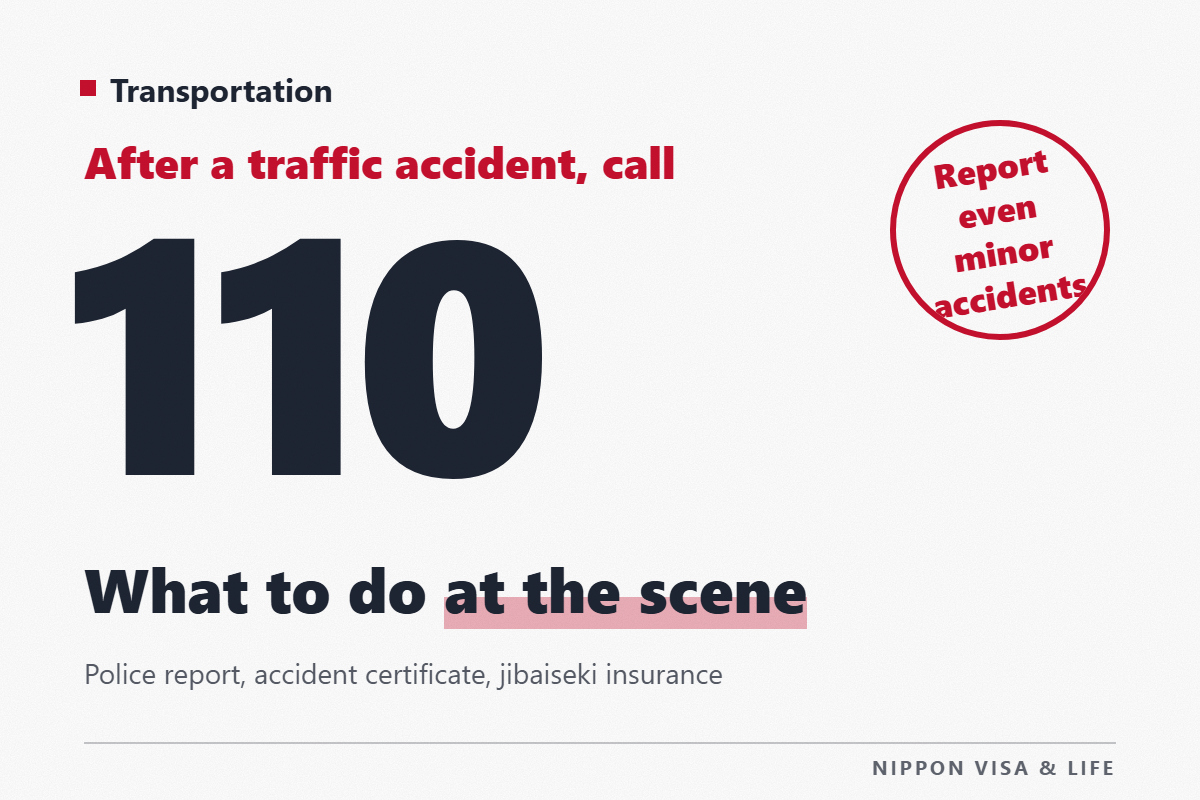
If a traffic accident happens in Japan, first stop driving, help anyone who is injured, and tell the police (dial 110). You must report to the police even if the accident is small and even if you are the victim. If an accident was not reported, you cannot get a “Traffic Accident Certificate” for it later.
The Short Answer: What to Do When an Accident Happens
- Stop your car or bicycle right away. Move to a safe place so that cars coming from behind do not hit you
- If anyone is injured, help them, and call 119 (ambulance) if needed
- Tell the police by dialing 110. Do not leave the scene until a police officer arrives
- Check the other party’s name, contact details, car number plate and insurance, and record what the scene looks like
- Even if you do not seem to be injured, see a doctor at a hospital as soon as possible
- Later, get a Traffic Accident Certificate and use it for insurance claims and other procedures
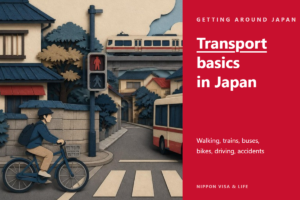
The traffic rules in general are explained in Getting Around in Japan: The Basics of Walking, Trains, Buses, Bicycles, Driving, and Traffic Accidents, and how to call an ambulance is explained in How to Call an Ambulance in Japan: How to Dial 119, What to Say, and Where to Get Advice When You Are Unsure (#7119).
What to Do on the Spot (Rules of the Road Traffic Act)
Article 72 of the Road Traffic Act requires drivers of vehicles and others to do the following when a traffic accident happens.
- Stop driving immediately
- Help injured people (rescue)
- Prevent danger on the road (for example, make sure other cars do not crash into the scene)
- Report to a police officer
Report the following to the police officer.
| What to report | Example |
|---|---|
| The date, time and place of the accident | “I am now at the intersection in front of ○○ Station” |
| The number of people killed or injured, and how badly they are injured | “One person has hurt their leg” |
| What was damaged, and how badly | “The car door has a dent” |
| What the vehicle was carrying (its load) | When you were carrying goods |
| What you did after the accident | “I called an ambulance” |
If there is no police officer at the scene, tell a police officer at a nearby police station, koban (police box) or chuzaisho (residential police box). Usually, you call 110.
(Source: e-Gov Law Search “Road Traffic Act” Article 72)
The Immigration Services Agency’s “Guidebook on Living and Working” also says that if an accident happens, you should call 119 if anyone is injured, call 110 whether or not anyone is injured, and not leave until a police officer arrives.
(Source: Immigration Services Agency “Guidebook on Living and Working”)
What You Will Be Asked When You Call 110
When you call 110, you will mainly be asked the following. If it is difficult for you to speak Japanese, ask someone nearby for help.
- When, where and what happened
- Your name and contact details
- Information about the other party in the accident (gender, number of people, age, clothing, etc.)
- Whether anyone is injured
(Source: Immigration Services Agency “Guidebook on Living and Working”)
Record the Other Party and the Scene
The Ministry of Land, Infrastructure, Transport and Tourism advises you to do the following if you are in a traffic accident.
- Check the other party: Write down the registration number (number plate) of the other party’s car, the other party’s address, name and contact details, and the company names and certificate numbers of the other party’s compulsory automobile liability insurance (or mutual aid) and automobile insurance. If the other party was working at the time, also check their workplace and employer
- Find witnesses: If anyone saw the accident, write down what they say and ask for their name and contact details
- Keep the dashcam (drive recorder) video: If the car has a dashcam, save the video
- Make your own record: While you still remember, keep a drawing of the scene, how the accident happened, photos and so on. It is safer to keep them until the talks (compensation negotiations) are finished
According to the Ministry of Land, Infrastructure, Transport and Tourism, in an accident caused by someone who was working, not only the driver but also the employer may be responsible for compensation.
Go to a Hospital Even If You Are Not Injured
According to the Ministry of Land, Infrastructure, Transport and Tourism, an injury that looks minor may later turn out to be serious. See a doctor and get a diagnosis as soon as possible.
The Ministry also says that if you do not see a doctor soon after the accident, the injury may not be recognized as caused by the traffic accident. If you are injured, it is important to report it to the police as an “accident with injuries” (jinshin jiko: an accident in which a person was injured).
How to see a doctor is explained in How to See a Doctor in Japan: Choosing Between Hospitals and Clinics, What to Show at Reception, the Medical Questionnaire, Payment and Medicine.
How to Get a Traffic Accident Certificate
The Traffic Accident Certificate (kotsu jiko shomeisho) is an official document that proves a traffic accident happened. It is issued by the Japan Safe Driving Center. You may need it for procedures after the accident, such as insurance claims.
| Item | Details |
|---|---|
| Who can apply | The person who caused the accident or the victim, family members who can claim compensation for damages, people who receive insurance money, etc. (a representative needs a letter of authorization) |
| Fee | 1,000 yen per copy (if you apply at a post office or online, there is also a payment fee) |
| How to apply | (1) At the counter of a Japan Safe Driving Center office (2) By payment at Japan Post Bank or a post office (takes about 10 days to arrive) (3) Online |
| Application period | In principle, it is not issued after 5 years from the accident for an accident with injuries, or after 3 years for a property-damage-only accident (an accident in which only things were damaged) |
| Condition | The accident must have been reported to the police (no certificate is issued for an accident that was not reported) |
- Application forms are available at Japan Safe Driving Center offices, as well as at police stations, koban, chuzaisho, non-life insurance companies and other places.
- Only a person directly involved in the accident who still lives at the address reported to the police can apply online.
(Source: Japan Safe Driving Center “Traffic Accident Certificate”, Ministry of Land, Infrastructure, Transport and Tourism “What should you do first if you are in a traffic accident?”)
Compulsory Automobile Liability Insurance and How to Claim
What Is Compulsory Automobile Liability Insurance?
Compulsory automobile liability insurance (jibaiseki hoken; jidosha songai baisho sekinin hoken. There is also a mutual aid version) is insurance that every motor vehicle must have. Motorized bicycles (gentsuki), electric kick scooters and mopeds (motorized bicycles with pedals) must also have it. Driving without it can lead to imprisonment of up to 1 year or a fine of up to 500,000 yen, and 6 violation points (license suspension).
Compulsory automobile liability insurance pays only for damage from accidents in which people are injured or killed. Accidents in which only things are damaged (property damage accidents) are not covered.
The maximum payment per victim is as follows.
| Damage | Maximum payment |
|---|---|
| Death | 30,000,000 yen |
| Permanent disability (after-effects) | 750,000 yen to 40,000,000 yen depending on the grade |
| Injury | 1,200,000 yen |
How to Claim and the Deadline
You make the claim to the insurance company (mutual aid association) of the person who caused the accident. There are 2 ways to claim.
- Claim by the person who caused the accident: The person who caused the accident first pays compensation to the victim, and then claims from the insurance company
- Claim by the victim: If the victim cannot get compensation from the person who caused the accident, the victim claims directly from that person’s insurance company
If you want to receive money for medical costs and other expenses right away, there is also a system called “provisional payment” (karitokin). For injuries, it is 50,000 yen, 200,000 yen or 400,000 yen depending on how serious the injury is, and for death, it is 2,900,000 yen.
There is a deadline for claims. After 3 years, you can no longer claim (statute of limitations).
| Claim | Counted from | Deadline |
|---|---|---|
| Claim by the victim (injury) | The day after the accident | 3 years |
| Claim by the victim (permanent disability) | The day after the symptoms became fixed (the day a doctor judged that continued treatment will not improve them) | 3 years |
| Claim by the victim (death) | The day after the date of death | 3 years |
| Claim by the person who caused the accident | The day after paying compensation | 3 years |
If there is a reason your claim will be delayed, talk to the insurance company (mutual aid association).
(Source: Ministry of Land, Infrastructure, Transport and Tourism “Flow until payment and how to claim”)
If You Do Not Know Who the Other Party Is or They Had No Insurance
If you cannot identify the other party because of a hit-and-run, or if the other party did not have compulsory automobile liability insurance, you may be able to receive compensation equal to compulsory automobile liability insurance through the national “Government Guarantee Program“. Claims are accepted at branches of non-life insurance companies, mutual aid associations and similar places (insurance agencies do not accept them).
(Source: Ministry of Land, Infrastructure, Transport and Tourism “Government Guarantee Program”)
Frequently Asked Questions
Do I Have to Report Even a Small Accident to the Police?
Under the Road Traffic Act, you must report a traffic accident to a police officer. Also, no Traffic Accident Certificate is issued for an accident that was not reported to the police. Even if the accident is small, call 110.
What If It Is a Bicycle Accident?
A bicycle is also a “vehicle” under the Road Traffic Act. If you cause an accident, stop, help anyone who is injured and tell the police, just as with a car. For bicycle rules and bicycle insurance, read Rules for Riding a Bicycle in Japan: Keep Left, Helmets, Bicycle Crime Prevention Registration, and Blue Tickets (Fines).
Where Can I Get Advice If I Am the Victim?
According to the Ministry of Land, Infrastructure, Transport and Tourism, the police station that handled the accident has a consultation desk and support for victims. You can also get advice at the victim support center in each prefecture. When the support center is closed, you can also get advice from the “Crime Victims Telephone Support Center” (0570-783-554).
Where You Can Get Advice in Foreign Languages
If you want to know about the legal system or where to get advice about compensation or insurance, you can call the “Multilingual Information Service” of Houterasu (Japan Legal Support Center). It gives free information about the Japanese legal system and where to get advice, such as bar associations (call charges apply).
| Item | Details |
|---|---|
| Phone number | 0570-078377 (from IP phones and others: 050-3754-5430) |
| Hours | Monday to Friday, 9:00 to 17:00 (closed on Saturdays, Sundays and national holidays) |
| Languages | English, Chinese, Korean, Spanish, Portuguese, Vietnamese, Tagalog, Nepali, Thai, Indonesian, Easy Japanese |
(Source: Houterasu “For Foreign Nationals”)
Primary Sources Referenced for This Article
- e-Gov Law Search “Road Traffic Act”
- Immigration Services Agency “Guidebook on Living and Working”
- Ministry of Land, Infrastructure, Transport and Tourism “What should you do first if you are in a traffic accident?”
- Ministry of Land, Infrastructure, Transport and Tourism “What is compulsory automobile liability insurance / mutual aid?”
- Ministry of Land, Infrastructure, Transport and Tourism “Flow until payment and how to claim”
- Ministry of Land, Infrastructure, Transport and Tourism “Government Guarantee Program”
- Japan Safe Driving Center “Traffic Accident Certificate”
- Houterasu (Japan Legal Support Center) “For Foreign Nationals”
This article is a translation of the original Japanese version.