This article was written by the NIPPON VISA & LIFE editorial team based on information from public organizations such as the national government and local governments. Rules and fees may differ depending on the city, ward, town or village where you live.
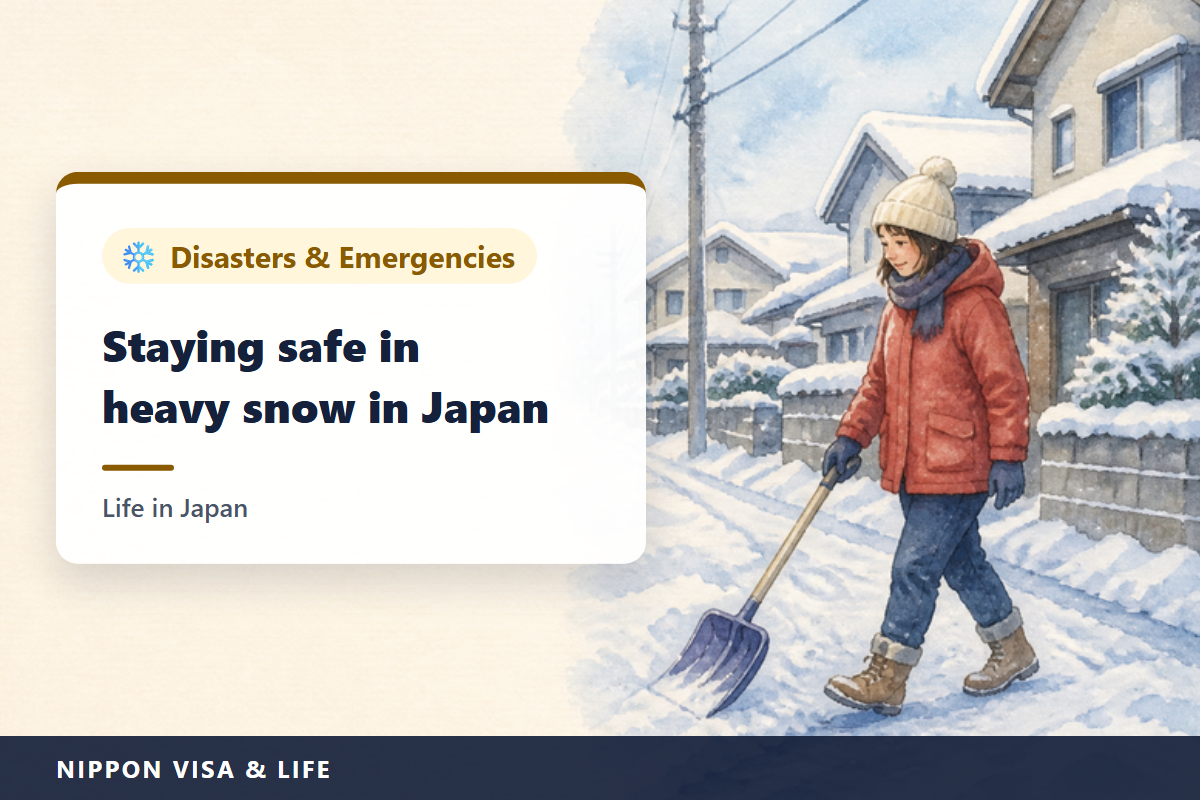
When heavy snow is forecast in Japan, first check the Japan Meteorological Agency’s information to find out when, where and how much snow will fall. While it is snowing and after it has snowed, avoid going out unless it is necessary and urgent. When you do go outside, walk in a way that keeps you from falling on icy roads. If you have no choice but to drive, people are advised to put on winter tires, carry tire chains and put the chains on early.
The Short Answer: What to Do When Heavy Snow Comes
- A few days to the day before: Check the Japan Meteorological Agency’s “Early Warning Information (possibility of warning-level weather)” and its weather information on heavy snow.
- Before the snow starts: Check the latest weather and traffic information. Think about whether you can change your plans to go out.
- When a heavy snow warning or similar information is issued: Avoid going out unless it is necessary and urgent. If you can work remotely (telework), do so.
- When you go outside: Leave plenty of time. Walk with small steps and watch out for snow falling from roofs.
- Cars: If you have no choice but to drive, put on winter tires, carry tire chains and put them on early. If your car gets stuck, clear the snow from around the muffler (exhaust pipe) and let fresh air in.
- Clearing snow and removing snow from roofs: Do not work alone. Use a safety rope and a helmet, and carry your mobile phone.
(Source: Prime Minister’s Office of Japan, “Snow Disasters”, Ministry of Land, Infrastructure, Transport and Tourism and Japan Meteorological Agency, “Announcement by the Ministry of Land, Infrastructure, Transport and Tourism on Heavy Snow” (December 2, 2025, PDF), Ministry of Land, Infrastructure, Transport and Tourism, Hokuriku Snow Disaster Countermeasure Technology Center, “Tell Me! Snow Navi: When You Have Trouble on Snowy Roads”)
Weather Information on Heavy Snow: When and What Is Issued
The Japan Meteorological Agency issues information step by step, depending on how likely heavy snow is.
| Name of the information | When it is issued | What it means |
|---|---|---|
| Early Warning Information (possibility of warning-level weather) | When warning-level heavy snow is forecast within the next 5 days | Heavy snow may come, so be careful early |
| Weather information on heavy snow (weather commentary information) | For example, about a few days to 1 day before heavy snow | Lets people know, before warnings and advisories, that heavy snow is likely |
| Heavy snow warning | When there is a risk of a disaster with a large impact on society. Usually about 3 to 6 hours before | Be on alert for heavy snow |
| Meteorological disaster prevention bulletin (heavy snow in a short time) | When strong snow is forecast to fall in a short time in some areas, and warning-level snow is expected to continue after that | Large-scale traffic disruption is likely. Avoid going out, and do not head to that area |
The “meteorological disaster prevention bulletin (heavy snow in a short time)” is issued only in certain areas, such as some prefectures in the Hokuriku, Tohoku, Kinki, Chugoku and Tokai regions. It has had this name since May 2026.
Even in areas that usually get little snow, when snow above the heavy snow warning criteria is forecast and is likely to keep falling, information calling for even stronger alert may be issued. The Japan Meteorological Agency explains that in areas with little snow, many cars do not have winter tires and many people are not used to snowy roads, so cars getting stuck (unable to move) and slipping accidents happen easily even when there is not much snow.
(Source: Japan Meteorological Agency, “About Information on Heavy Snow”)
Check the Amount of Snow on a Map: “Snow Forecast”
On the Japan Meteorological Agency’s website, the “Snow Forecast (short-range snowfall forecast)” page lets you see snow depth (how deep the snow on the ground is) and snowfall (the amount of newly fallen snow) on a map. You can check the conditions from 24 hours ago up to now, and the forecast up to 6 hours ahead, hour by hour. It is useful to look at the snow conditions for where you are going and for your way back before you leave.
- Japan Meteorological Agency, “Snow Forecast (short-range snowfall forecast)”
- Japan Meteorological Agency, “Warnings and Advisories”
How to receive weather information in your own language is explained in How to Receive Disaster Information in Japan in Your Own Language: The Safety tips App, the Japan Meteorological Agency’s Multilingual Pages, and Multilingual Guides That Help in a Disaster.
(Source: Prime Minister’s Office of Japan, “Snow Disasters”, Japan Meteorological Agency, “Analyzed Snow Depth, Analyzed Snowfall and Short-Range Snowfall Forecast”)
Trains, Buses and Roads May Stop
In areas where heavy snow is forecast, public transportation such as trains and buses may have large-scale, long delays or cancellations (trains and buses not running). Expressways and the national roads that run alongside them may also be closed at the same time.
The Ministry of Land, Infrastructure, Transport and Tourism asks people in areas where heavy snow is forecast to avoid going out unless it is necessary and urgent, including by making use of telework. When you go out, leave plenty of extra time. Check information on train and bus services on the website of the railway or bus company you use.
How to Walk on Snowy Roads Without Falling
Many accidents in which people fall on snowy or icy roads happen not only in areas with a lot of snow, but also in areas with little snow.
Slippery Places
| Place | Why it is slippery |
|---|---|
| On the white lines of pedestrian crossings | Even if they look dry, a thin layer of ice may have formed |
| Sidewalks where cars go in and out, such as at parking lot entrances and in front of gas stations | Car tires polish the ice, making it very slippery |
| Bus stops and taxi stands | The snow is packed down and slippery. Also watch out for the step between the sidewalk and the road |
| Slopes | You are more likely to fall when going down than when going up |
| Where road heating (equipment that warms the road to melt snow) ends | Snow and ice that have not melted create a step |
Tips for Walking
- Take small steps and walk slowly (this is called “penguin walking”)
- Lean your body’s center of gravity slightly forward, and walk so that the whole sole of your shoe touches the ground
- Choose shoes with soles that do not slip easily (such as rubber boots)
- Wear a hat and gloves in case you fall
- Do not walk with both hands in your pockets. It is also dangerous after drinking alcohol, because it is harder to keep your balance
- Snow and ice on roofs may fall, so also pay attention to roofs. Be especially careful on warm days
(Source: Prime Minister’s Office of Japan, “Snow Disasters”)
When You Drive a Car: Winter Tires and Tire Chains
The Ministry of Land, Infrastructure, Transport and Tourism asks people who have no choice but to drive to put on winter tires, to check in advance how to put on tire chains, carry them in the car and put them on early, and to carry winter tools such as a shovel and sand.
What Is a Chain Regulation?
During unusually heavy snow, such as when a heavy snow emergency warning or an urgent national announcement about heavy snow is issued, a “chain regulation” may be put in place on designated sections such as mountain passes. During a chain regulation, cars without tire chains cannot pass, even if they have studless tires (winter tires). The same applies to 4WD (four-wheel drive) cars. As a rule, chains are put on the drive wheels (the tires that the engine’s power goes to). Spray-on products that coat the tires with a chemical cannot be used to pass through chain regulation sections.
(Source: Ministry of Land, Infrastructure, Transport and Tourism, “About Chain Regulations”)
Driving on Icy Roads
- Places that freeze easily: intersections with traffic lights, bridges, and tunnel entrances and exits
- On cold nights and mornings, and in the shade, the road may be frozen even if it does not look frozen (black ice)
- Start braking earlier than usual and press the brake gently. If you brake suddenly, the tires slip and you cannot stop
- Slow down enough before curves
- In a snowstorm, turn on your lights, slow down and keep a longer distance from the car in front
- If you feel tired or feel it is dangerous, do not stop on the road. Rest at a roadside station (michi-no-eki) or a parking area
(Source: Prime Minister’s Office of Japan, “Snow Disasters”)
Things to Keep in the Car (Examples)
The Prime Minister’s Office of Japan page lists items such as tire chains, a shovel, a tow rope, booster cables, sand to prevent slipping, a snow brush, warm clothing, boots, gloves, blankets, disposable heat packs (kairo), emergency water and food, a flashlight and a radio.
(Source: Prime Minister’s Office of Japan, “Snow Disasters”)
If Your Car Gets Stuck in Snow: Watch Out for Carbon Monoxide Poisoning
Do Not Leave Your Car
Unless you know for sure that there is a place you can evacuate to or someone who can help you, do not leave your car carelessly. In a snowstorm, you may lose track of where you are and get lost. Cars may come from behind, so do not step out onto the road side.
When You Call for Help
- Turn on your hazard lights and put out a warning triangle or a flag to let other cars know you have stopped
- When you call the police, the fire department or a roadside assistance service, tell them where you are as accurately as possible. On national roads, the kilometer posts that stand beside the road every 1 km show the national road number and the location
How to call 110 and 119 is explained in How to Call 110 for the Police in Japan and When to Use 119 Instead: What to Say on the Phone, Reporting in a Foreign Language, and #9110 for Non-Urgent Consultations.
Things to Be Careful About While Waiting for Rescue
- If the exhaust pipe (muffler) is buried in snow, exhaust gas can get inside the car and cause carbon monoxide poisoning. Clear the snow from time to time so that the area around the muffler does not get buried, and open a window slightly to let fresh air in
- Use the heater while being careful not to run out of fuel or drain the battery
- Change out of wet clothes, cover yourself with a blanket and have warm drinks to keep your body from getting cold
- If there are other people in the car at night, take turns sleeping, and make sure one person always stays awake to check whether rescue has come
Preventing Accidents While Clearing Snow and Removing Snow from Roofs
Many of the people who die in snow-related accidents die in accidents while removing snow, such as removing snow from roofs or clearing snow. These include falling from roofs, being buried by snow falling from roofs, falling into waterways, getting caught in snow blowers, and heart attacks or other illnesses brought on by heavy work in the cold.
10 Rules to Protect Your Life and Prevent Accidents While Removing Snow
- Work with 2 or more people, and also tell your family and neighbors
- Leave snow around the building when removing snow from the roof
- Be especially careful on sunny days. The snow on the roof has loosened
- Secure the ladder
- Turn off the engine before clearing snow stuck in a snow blower
- Do not let your guard down even on low roofs
- Be especially careful right after you start working and when you get tired
- Even if it is a bother, use a safety rope and a helmet
- Take care of and check tools such as safety ropes and snow blowers regularly
- Carry your mobile phone when you work
If you are in trouble, for example when snow on a nearby empty house has not been removed and has become dangerous, contact your city, ward, town or village office.
(Source: Prime Minister’s Office of Japan, “Snow Disasters”)
When You Have Trouble: Frequently Asked Questions
What if the power goes out because of heavy snow?
Power outages can also happen during heavy snow. What to do during a power outage is summarized in What to Do During a Power Outage or Water Outage in Japan: Checking the Breaker, Finding Outage Information, Electrical Fires When Power Returns, Food in the Refrigerator, Toilets and Water Supply Points. For stocking food and water, see Preparing for Disasters in Japan: Stockpiling Food and Water (3 Days to 1 Week) and What to Put in an Emergency Grab Bag.
What should I do when I go skiing or to snowy mountains?
The Prime Minister’s Office of Japan page asks people to check the weather forecast before going out, not to go outside the ski resort’s courses, to act in a group rather than alone, and to submit a climbing plan (tozan todoke) when climbing mountains. After a lot of new snow has piled up, avoid places where avalanches (nadare) happen easily, such as steep slopes.
(Source: Prime Minister’s Office of Japan, “Snow Disasters”)
Where can I find road information for my area?
The Ministry of Land, Infrastructure, Transport and Tourism’s “Winter Road Information” page collects links to information on snow on roads and road closures for each region.
(Source: Ministry of Land, Infrastructure, Transport and Tourism, “Winter Road Information”)
Primary Sources Referenced in This Article
- Prime Minister’s Office of Japan, “Snow Disasters”
- Japan Meteorological Agency, “About Information on Heavy Snow”
- Japan Meteorological Agency, “Analyzed Snow Depth, Analyzed Snowfall and Short-Range Snowfall Forecast”
- Ministry of Land, Infrastructure, Transport and Tourism and Japan Meteorological Agency, “Announcement by the Ministry of Land, Infrastructure, Transport and Tourism on Heavy Snow” (December 2, 2025, PDF)
- Ministry of Land, Infrastructure, Transport and Tourism, “About Chain Regulations”
- Ministry of Land, Infrastructure, Transport and Tourism, “Winter Road Information”
- Ministry of Land, Infrastructure, Transport and Tourism, Hokuriku Snow Disaster Countermeasure Technology Center, “Tell Me! Snow Navi: When You Have Trouble on Snowy Roads”
This article is a translation of the original Japanese version.