This article was written by the NIPPON VISA & LIFE editorial team based on information from public organizations such as the national government and local governments. Rules and fees may differ depending on the city, ward, town or village where you live.
In Japan, fluorescent lamps (long tube-shaped or ring-shaped lights) and mercury thermometers contain mercury. Do not put them in burnable garbage. Put them out separately, so that they do not break, in the way your city, ward, town or village has decided. The way to put them out differs greatly from one municipality to another, so please check the information from the municipality where you live.
The overall rules for sorting garbage are summarized in How to Sort and Put Out Garbage in Japan: Basic Rules for Burnable, Recyclable and Oversized Garbage. For batteries and spray cans, see How to Throw Away Spray Cans, Batteries and Lighters in Japan: Disposing of Dangerous Waste Such as Lithium-Ion Batteries and Gas Canisters.
The Short Answer: What to Throw Away and How
| What you are throwing away | Mercury | Basic way to put it out |
|---|---|---|
| Fluorescent lamps (straight tube, ring-shaped, bulb-shaped, etc.) | Contains mercury | Do not put it in burnable garbage. Wrap it in its paper case or in newspaper and put it out in the way your municipality has decided |
| Mercury thermometers (for body temperature), mercury blood pressure monitors and mercury thermometers (for temperature) | Contains mercury | Do not put it in burnable garbage. Keep it separate from other garbage and put it out for your municipality’s collection (a counter, a collection box, etc.) |
| LED bulbs and incandescent bulbs (ordinary light bulbs) | No mercury | Follow your municipality’s sorting rules (some treat them as a kind of “non-burnable garbage,” others as “ordinary garbage” (futsu gomi), etc.) |
| Electronic thermometers (for body temperature) and alcohol thermometers | No mercury | Follow your municipality’s sorting rules (some municipalities collect electronic thermometers with small electronics) |
How items are collected differs by municipality. A Ministry of the Environment document introduces the following collection methods.
- Station collection: Put the items out separately at your usual garbage collection point, for example on the day for recyclable garbage
- Drop-off point collection: Take the items yourself to a collection point set up at a municipal facility (such as the city office)
- Collection at stores and other places: The municipality places collection boxes at electronics retailers (large electronics stores), pharmacies and other places
- Collection on set days: Take the items to the place on the day announced by the municipality
Some municipalities combine several of these methods.
How to Tell Whether an Item Contains Mercury
You Can Tell Whether a Lamp Contains Mercury from the First Letters of Its Product Code
The lamp itself and its box show a “product code” (hinban, a code for the product). Many fluorescent lamp product codes begin with “F” or “EF.” Products made outside Japan may be labeled differently.
A Ministry of the Environment document shows the relationship between the first letters of the product code and mercury as follows.
| First letters of the product code | Type of lamp | Mercury |
|---|---|---|
| F | Straight tube, ring-shaped (circular) and compact fluorescent lamps | Contains mercury |
| EF | Bulb-shaped fluorescent lamps | Contains mercury |
| LD | LED lamps | No mercury |
| L, LW, G, etc. | Incandescent bulbs | No mercury |
| J | Halogen lamps | No mercury |
If you are not sure whether a lamp is fluorescent, the guidance suggests taking a photo of the lamp or the light fixture and asking the store where you bought it or the manufacturer.
(Sources: Ministry of the Environment “Regulations on Fluorescent Lamps for General Lighting”, Ministry of the Environment “Guidelines for the Separate Collection of Waste Products Containing Mercury Discharged from Households”)
You Can Tell Whether a Thermometer Contains Mercury from Its Type
Thermometers for body temperature, thermometers for measuring temperature and blood pressure monitors come in mercury types and other types. For example, Yokohama City does not accept alcohol thermometers with red liquid or electronic devices in its collection of mercury-type items. If you are not sure, ask the garbage department of your municipality.
Why Must Fluorescent Lamps and Mercury Thermometers Not Be Put in Burnable Garbage?
Fluorescent lamps and mercury thermometers break easily, and when they break, the mercury inside may scatter or leak out. If they are burned as burnable garbage, the mercury is released into the air. For this reason, the Ministry of the Environment asks municipalities to collect these items separately without mixing them with other garbage, and not to let people put them out as burnable garbage.
One mercury thermometer for body temperature contains about 1.2 g of mercury. This is equal to about 200 fluorescent lamps (as of 2013). Even though it is small, it is important to put it out separately so that it does not get mixed in with other garbage.
(Sources: Ministry of the Environment “Proper Separate Collection of Waste Products Containing Mercury” (leaflet), Ministry of the Environment “Guidelines for the Separate Collection of Waste Products Containing Mercury Discharged from Households”)
Examples of How Municipalities Collect Fluorescent Lamps and Mercury Thermometers
The way to put out the same fluorescent lamp differs by municipality. Here are three examples.
Example: Shinjuku City (Put Them Out at the Garbage Collection Point)
- Fluorescent lamps and light bulbs go out as “metal, ceramic and glass garbage” (kinzoku, toki, garasu gomi; collected twice a month). Put them out in their paper case.
- Mercury thermometers and mercury blood pressure monitors are also “metal, ceramic and glass garbage.” Put them out in a separate bag that you can see through.
- Put them out at the garbage collection point by 8 a.m. on the collection day.
(Sources: Shinjuku City “How to Put Out Metal, Ceramic and Glass Garbage”)
Example: Osaka City (Collection Boxes, Counters and Collection by Request)
- Take fluorescent tubes to a collection box or to the counter of an Environmental Project Center (kankyo jigyo center, the city’s garbage office). You can also apply by phone and have them picked up at your home.
- To keep them from breaking, put them in a paper box or a paper tube, or wrap them in newspaper or similar. The city advises that children should not take them there alone.
- Long fluorescent lamps (such as rod-shaped lamps longer than 1 meter) are picked up at your home by request.
- Light bulbs, glow starters (small parts used to turn on fluorescent lamps) and LEDs do not contain mercury, so put them out as “ordinary garbage” (futsu gomi).
- Take mercury thermometers for body temperature to a collection box or to the counter of an Environmental Project Center. Take mercury blood pressure monitors and mercury thermometers for measuring temperature to the counter of an Environmental Project Center.
- Put electronic thermometers (digital thermometers) in a collection box for small electronics.
Example: Yokohama City (Take Them to a Ward Office or Similar)
- Mercury thermometers for body temperature, blood pressure monitors and thermometers for measuring temperature are collected at each ward office and at the city’s collection offices.
- Take them in the case they came in when you bought them, or in a plastic bag.
- Put mercury thermometers for body temperature in the dedicated collection box, and hand mercury blood pressure monitors and mercury thermometers for measuring temperature to the reception counter.
- Broken items are not accepted in this collection. Items you have handed in will not be returned.
How to Find Out How Your Municipality Collects Fluorescent Lamps and Thermometers
- On your municipality’s website, search for “(name of your municipality) 蛍光灯 捨て方” (how to throw away fluorescent lamps) or “(name of your municipality) 水銀体温計” (mercury thermometer)
- Look at the “how to sort garbage” pamphlet, the garbage collection calendar or the garbage sorting app provided by your municipality
- If you are still not sure, call the garbage department of your municipality (such as the sanitation office)
Tips for Putting Out Fluorescent Lamps and Thermometers Without Breaking Them
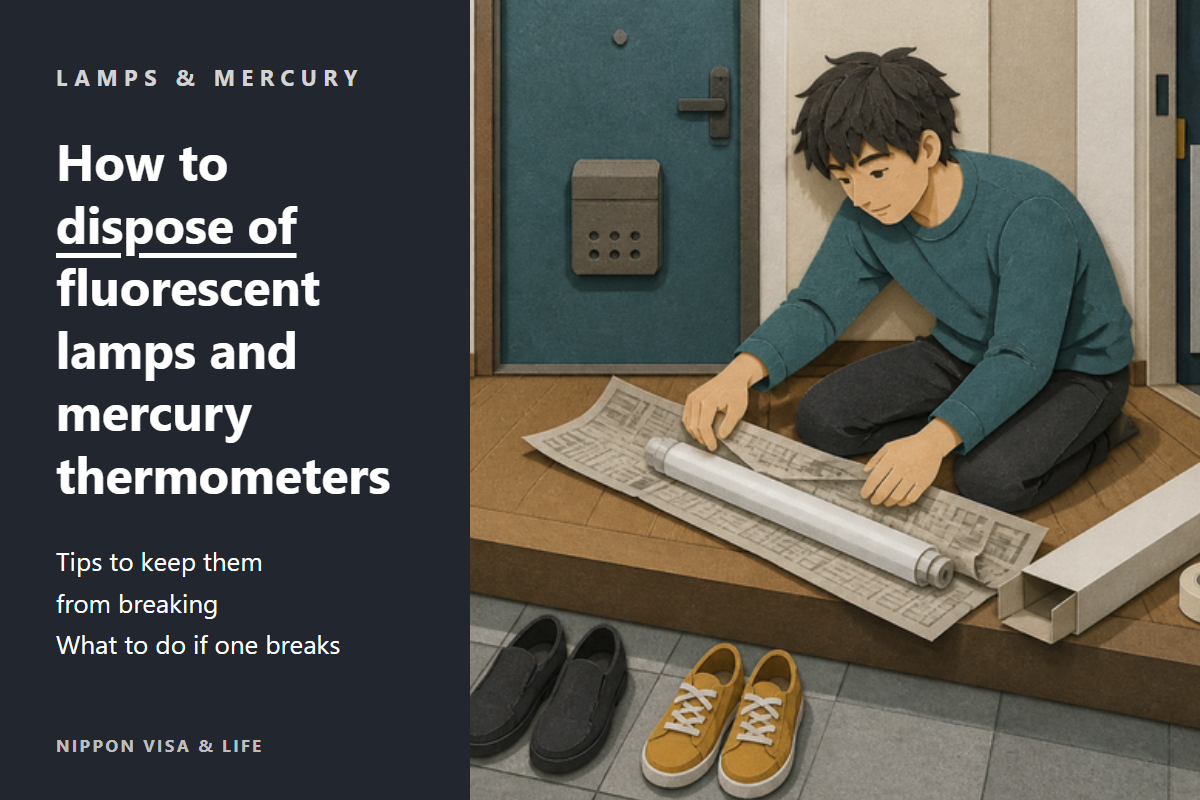
- Put fluorescent lamps out in the paper case they came in or in a paper box, or wrapped in newspaper.
- Put thermometers out in the case they came in.
- Do not mix them with other garbage (burnable garbage, recyclable garbage, etc.).
- Put anything that has broken in a plastic bag or a container with a lid that can be closed. Check with your municipality how to put it out.
How to Clean Up If a Fluorescent Lamp or Mercury Thermometer Breaks
The Ministry of the Environment’s guidelines introduce the following steps, based on methods such as those of the U.S. Environmental Protection Agency (EPA).
If a Fluorescent Lamp Breaks
Before cleaning up
- Have people and pets leave the room
- Turn off the air conditioner and similar devices
- Close the doors to other rooms and the hallway
- Open the windows and outside doors and air out the room for 5 to 10 minutes
- Prepare things to use for cleaning up (thick paper or cardboard, sticky tape, wet paper towels, plastic bags, etc.)
When cleaning up (on a hard floor)
- Scoop up the pieces of glass and powder with thick paper and put them in a glass jar with a lid that can be closed or in a plastic bag
- Pick up the remaining small pieces and powder with sticky tape and put them in the same way
- Wipe the area with wet paper towels or similar and put them in the same way
On carpet, also pick things up with thick paper and sticky tape. It is said to be better not to use a vacuum cleaner, because it may spread mercury vapor. If you must use one, use it only after removing everything you can see, and air out the room well.
After cleaning up
- Keep the bag closed and put what you collected outside the room (outside the building) right away. Put it out at the garbage collection point on the day and in the way your municipality has decided (do not put it in burnable garbage)
- Wash your hands
- Check with your municipality how to put it out
- If possible, keep airing out the room for several hours
For example, Osaka City collects broken fluorescent tubes by picking them up at your home on request. Wrap them in thick paper or similar, write “キケン” (danger) on it and put them out.
If a Mercury Thermometer Breaks
What not to do
- Use a vacuum cleaner (it spreads the mercury)
- Sweep with a broom (the mercury breaks into small drops and spreads)
- Pour the mercury down a drain (sink, toilet, etc.)
- Walk around in slippers or other footwear with mercury on them
- Clean up while wearing metal items such as accessories or a watch
How to clean up
- Have people and pets leave the room. Open all the windows and close the doors to other rooms
- Put on rubber gloves
- Carefully pick up the pieces of glass, place them on a paper towel, put them in a strong plastic bag together with the paper towel and close it
- Slowly gather the drops of mercury on the floor with thick paper or similar. Shining a flashlight at floor level makes the shiny drops easier to find. The drops scatter far, so be careful not to miss any
- Collect the mercury with a dropper, place it on a wet paper towel and put it in a plastic bag together with the paper towel
- Pick up the remaining small drops by sticking them to packing tape or similar, and put them in a plastic bag
- If mercury has spread onto a carpet, curtains or similar, put the item itself in a plastic bag that can be closed
After cleaning up
- Wash your hands, and check with your municipality how to put out the glass and mercury
- Keep airing out the room for at least 24 hours
(Sources: Ministry of the Environment “Guidelines for the Separate Collection of Waste Products Containing Mercury Discharged from Households”, Osaka City “Collection of Fluorescent Tubes, Mercury Thermometers, Mercury Blood Pressure Monitors and Mercury Temperature Thermometers That Use Mercury”)
The Manufacture, Import and Export of Fluorescent Lamps for General Lighting Will End by the End of 2027 (Using Them Is Not Prohibited)
Following a decision under the international convention on mercury (the Minamata Convention), Japan will prohibit the manufacture, import and export of fluorescent lamps for general lighting, type by type.
| Type of fluorescent lamp | Date when manufacture, import and export are prohibited |
|---|---|
| Bulb-shaped | January 1, 2026 (January 1, 2027 for those over 30 W) |
| Compact | January 1, 2027 |
| Straight tube | January 1, 2028 (January 1, 2027 for those using halophosphate phosphors) |
| Ring-shaped (circular) | January 1, 2028 (January 1, 2027 for those using halophosphate phosphors) |
However, using, selling and buying fluorescent lamps are not prohibited. You can continue to use the fluorescent lamps you have now. The Ministry of the Environment encourages people to switch to LED lighting in a planned way. Replacing the whole light fixture may require installation work, so consult an electronics retailer or an electrical shop.
Put out used fluorescent lamps according to your municipality’s rules, as before.
Be Careful of Phone Calls from People Claiming to Be the Ministry of the Environment
The Ministry of the Environment is warning people to be careful of suspicious phone calls from callers claiming to be the Ministry of the Environment. If you cannot confirm that a call is really connected with the Ministry of the Environment, do not give your personal information, sign a contract or pay money. You can consult the Consumer Hotline (188) about trouble with sales calls or contracts.
(Sources: Ministry of the Environment “Regulations on Fluorescent Lamps for General Lighting”)
When You Are Not Sure: Frequently Asked Questions
How Do I Put Out LED Bulbs and Ordinary Light Bulbs?
They do not contain mercury, but how to put them out differs by municipality. For example, Shinjuku City treats them as “metal, ceramic and glass garbage,” and Osaka City as “ordinary garbage” (futsu gomi). Please check the sorting rules of the municipality where you live.
Can Fluorescent Lamps Used at a Company or Shop Be Put Out with Household Garbage?
Garbage from businesses such as companies and shops must be treated as business waste, separately from household garbage (Waste Management and Public Cleansing Act). For example, Osaka City does not accept fluorescent lamps and similar items from businesses in its household collection. Ask the person in charge at your workplace.
Can I Put Out an Electronic Thermometer Together with Mercury Thermometers?
Electronic thermometers do not contain mercury. For example, Yokohama City does not accept electronic devices in its collection of mercury-type items. Osaka City collects electronic thermometers in its collection boxes for small electronics. For how to put out small electronics, see How to Throw Away a Computer, Smartphone or Small Electronics in Japan: Manufacturer Collection, Mobile Phone Shops, Municipal Collection Boxes and How to Erase Your Data.
What Should I Do When a Light Fixture Gets Old or Breaks?
Who to contact when equipment in your rental room breaks is summarized in When Something Breaks in Your Rental Apartment in Japan: Who to Contact About the Air Conditioner, Water Heater or Leaks, and Who Pays for Repairs.
(Sources: Osaka City “Collection of Fluorescent Tubes, Mercury Thermometers, Mercury Blood Pressure Monitors and Mercury Temperature Thermometers That Use Mercury”, Ministry of the Environment “Regulations on Fluorescent Lamps for General Lighting”)
Where to Ask
- How to put out fluorescent lamps and thermometers: The garbage department of the municipality where you live (such as the sanitation office)
- Trouble with sales calls or contracts: Consumer Hotline (188)
Primary Sources Used for This Article
- Ministry of the Environment “Regulations on Fluorescent Lamps for General Lighting”
- Ministry of the Environment “Mercury Waste”
- Ministry of the Environment “Proper Separate Collection of Waste Products Containing Mercury” (leaflet, prepared in fiscal Reiwa 5)
- Ministry of the Environment “Guidelines for the Separate Collection of Waste Products Containing Mercury Discharged from Households” (December, Heisei 27)
- Shinjuku City “How to Put Out Metal, Ceramic and Glass Garbage”
- Osaka City “Collection of Fluorescent Tubes, Mercury Thermometers, Mercury Blood Pressure Monitors and Mercury Temperature Thermometers That Use Mercury”
- Yokohama City “Drop-Off Collection of Mercury Thermometers, Blood Pressure Monitors and Temperature Thermometers”
This article is a translation of the original Japanese version.