This article was written by the NIPPON VISA & LIFE editorial team based on information from public organizations such as the national government and local governments. Rules and fees may differ depending on the city, ward, town or village where you live.
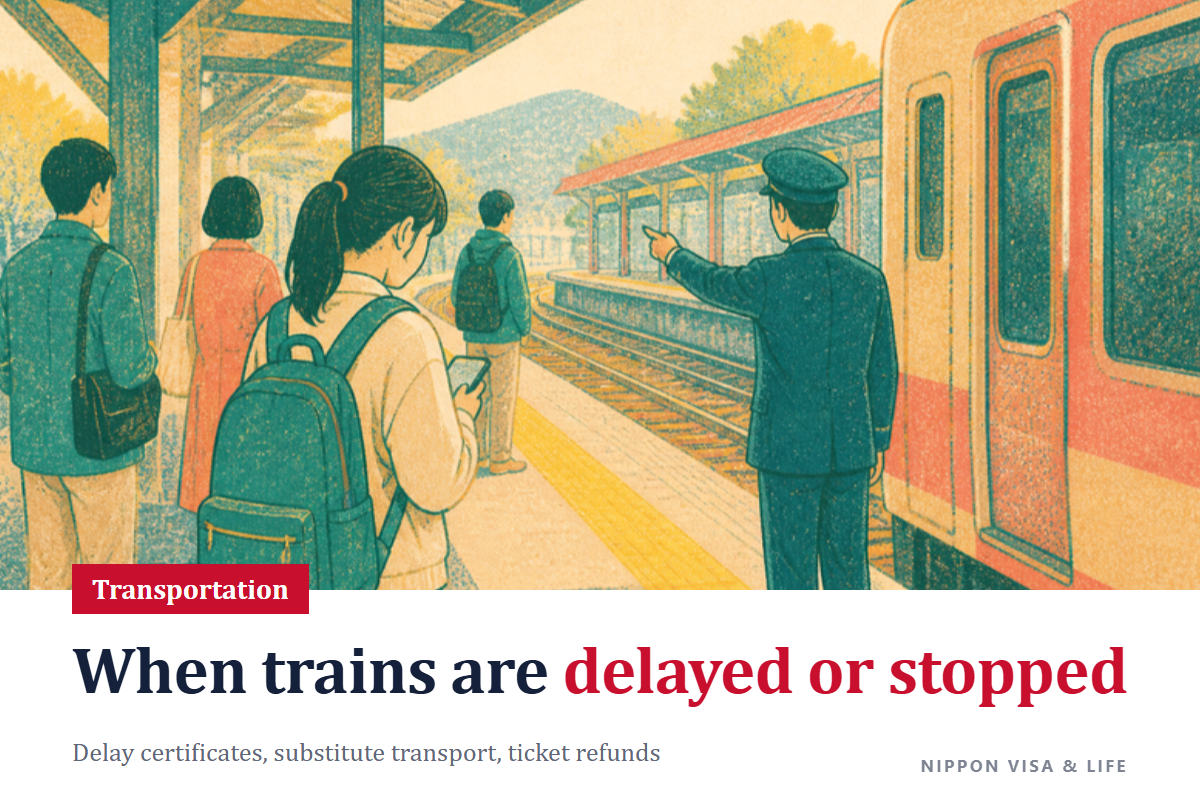
When a train in Japan is delayed or stopped, first check the train service information on the railway company’s app or website. Sometimes “substitute transportation” (furikae yuso) is provided, which lets you travel on another line instead of the line that has stopped. If you need proof that the train was late, check on the website of the railway company you rode how it issues delay certificates (chien shomeisho, a document showing that a train was late).
This article is based on official information from JR East and Tokyo Metro. Other railway companies may have different rules or different names for their services. Please check the website of the railway company you are using or ask station staff.
The basics of riding trains and using transit IC cards are summarized in How to Ride Trains in Japan and Use Transit IC Cards: Buying Tickets, Going Through Ticket Gates, Charging Your Card, and What to Do If You Lose It.
The Short Answer: What to Do When a Train Is Delayed or Stopped
- On the railway company’s app or website, check which lines are delayed, by how much, and when service is likely to resume.
- Check the announcements and information displays at the station and on the train to see whether substitute transportation is being provided.
- When you use substitute transportation, go through a ticket gate with staff, not an automatic ticket gate.
- If your workplace or school needs proof that you were late, get a delay certificate (JR East issues them on its website).
- If a Shinkansen or limited express train is greatly delayed, or your train is canceled, ask for a ticket refund at the ticket office in the station.
How to Check Train Service Information
For JR East, you can check train service information in the following ways.
| Method | Details |
|---|---|
| JR East App | A smartphone app. You can see train service information |
| The “Dokotore” website | Mainly for regional lines: service status, cancellation information, timetables and delay certificates |
| “Dokotore Dial” | An automated phone service where you can hear service information for all Dokotore lines. Phone number 050-3355-6421 |
| The “Train Service Information” on the website | From 4:00 to 2:00 the next morning, gives service information when a delay of 30 minutes or more has occurred or is expected |
JR East advises that information from any of these methods may differ from the actual service status, so it should be used only as a guide.
Other railway companies also provide train service information on their websites and apps. To find it, search for “(name of the railway company) train service information” (運行情報).
(Sources: JR East “I would like to know the current train service status.”)
How to Get a Delay Certificate (a Document Showing That a Train Was Late)
A delay certificate is a document showing that a train was late. Your workplace or school may ask you to submit one as the reason you were late. Please check with your workplace or school whether you need to submit one and in what form.
JR East’s Rules for Delay Certificates
JR East issues delay certificates on its website.
| Item | Details |
|---|---|
| Delays that are listed | Delays of about 5 minutes or more on the line concerned |
| Trains covered | Ordinary trains (futsu ressha) on conventional lines (lines other than the Shinkansen). Limited express trains, extra trains and similar trains are not covered |
| When delays are posted | After 7:00, after 10:00, after 16:00 and after 21:00 on the same day, and after 2:00 a.m. the next day. Delays for each time period are posted after they have been finalized |
| Period you can view | The past 45 days |
(Sources: JR East “Delay Certificate”)
What a JR East Delay Certificate Proves and What It Does Not Prove
A JR East delay certificate shows the longest delay that occurred on that line. It does not prove how late the train you rode was, or that you rode that train.
If you rode a train that runs across several lines, such as the Shonan-Shinjuku Line or the Ueno-Tokyo Line, choose the line that matches the section you rode. For the Sagami Line and the Ome Line (Ome to Okutama), get the certificate using the delay certificate function of “Dokotore” (PC version only).
(Sources: JR East “Delay Certificate”)
How to Use Substitute Transportation (a System That Lets You Reach Your Destination on Another Line)
Substitute transportation is a system that, when a train is likely to be stopped for a long time, lets you use your ticket or commuter pass to reach your destination on another line or on another railway company’s trains. When substitute transportation is provided, it is announced at the station and on the train.
Tickets That Are Covered and Not Covered by Substitute Transportation
At JR East, tickets, commuter passes, discount tickets and coupon tickets that include the section where substitute transportation is provided are covered.
Be careful about how transit IC cards are treated.
- When you ride within the section of your Suica commuter pass: you are covered by substitute transportation.
- When you ride using the stored balance (the money loaded onto the card) on a transit IC card such as Suica: you are not covered by substitute transportation.
If you use another line while riding with your stored balance, you will have to pay the fare for that line.
(Sources: JR East “When train service is disrupted, which tickets are covered by substitute transportation?”)
Steps for Using Substitute Transportation (Example: Tokyo Metro)
Tokyo Metro explains how to use substitute transportation as follows.
At Tokyo Metro, tickets that show a section or an amount are covered by substitute transportation. Some tickets are not covered. Please ask station staff whether your ticket is covered.
- At a station on the line that has stopped, show your ticket or commuter pass to staff and receive a “substitute transportation ticket” (furikae josha hyo).
- Travel to your destination on the line you are directed to. Do not put your ticket through an automatic ticket gate or touch your IC card; go through a ticket gate with staff.
- At your destination station, show your ticket or commuter pass and hand over the substitute transportation ticket.
In some cases, you may be able to use substitute transportation without a substitute transportation ticket, just by showing your ticket or commuter pass to the staff at the ticket gate.
Points to Watch Out for When Using Substitute Transportation
- The sections covered by substitute transportation change depending on which line has stopped and how it has stopped. Check the announcements each time.
- You pay yourself for any travel outside the substitute transportation section, and for transport that is not covered, such as taxis and late-night buses.
- If you leave the station partway through the substitute transportation section, you will have to pay the fare for the section you rode.
(Sources: Tokyo Metro “Substitute Transportation When Service Is Disrupted”)
Refunds for Tickets and Commuter Passes (JR East)
Refund of the Limited Express Fee When a Shinkansen or Limited Express Train Is 2 Hours or More Late
If a Shinkansen or limited express train arrives 2 hours or more later than its scheduled arrival time, the full limited express fee is refunded. Green Car fees and GranClass fees are not refunded.
Apply at the ticket office in the station within 1 year counting from the day after the day of the delay.
(Sources: JR East “Is there a refund when a Shinkansen or limited express train arrives later than scheduled?”)
For how Shinkansen and limited express tickets work, see How to Ride the Shinkansen and Limited Express Trains in Japan: Basic Fare Tickets and Limited Express Tickets, Reserved and Non-Reserved Seats, Buying Tickets, and Rules for Large Luggage.
Ticket Refunds and Changes When the Train You Planned to Take Is Canceled
| Situation | Refund or change |
|---|---|
| You cancel your trip because of a cancellation or similar reason | The full fare and fees are refunded |
| You stop your trip partway | The fare for the section you did not ride is refunded |
| You return to your departure station partway through your trip | You can return to your departure station. The full fare is refunded (if you had made a stopover, the fare from the station where you made the stopover to the destination station on the ticket) |
| A train with reserved seats is canceled | You can change to another train |
Apply at the ticket office in the station within 1 year counting from the day after the day of the cancellation.
(Sources: JR East “If the train I planned to take is canceled, can I get a refund or make a change?”)
Refunds and Extended Validity When Train Cancellations Make Your Commuter Pass or Coupon Tickets Unusable
For commuter passes and ordinary coupon tickets, only if train cancellations have made them unusable for 5 or more days in a row, you can get a refund or have the validity period extended.
However, please note the following.
- If replacement transportation such as buses starts on the canceled section, that section is treated as if service has resumed.
- Days during the cancellation on which you used substitute transportation or replacement transportation are treated as days you used your commuter pass or coupon tickets.
(Sources: JR East “If trains are canceled, can I get a refund on my commuter pass or coupon tickets?”)
When You Are Not Sure: Frequently Asked Questions About Train Delays
Can I Get a Delay Certificate for a Delay from Several Days Ago?
At JR East, you can view delay certificates for the past 45 days on the website. For how other railway companies issue delay certificates, check that company’s website. When you submit one to your workplace or school, check with them what form to submit it in (a printout of the screen, a saved screenshot, etc.).
Can I Get a Refund on Discount Tickets or Tickets Bought from a Travel Agency?
JR East says that discount tickets and tickets issued by travel agencies may be handled differently. Ask at the ticket office in the station or at the travel agency where you bought the ticket.
What If I Cannot Understand the Announcements in Japanese?
Show station staff your destination and the ticket or commuter pass you have, and ask which lines you can use for substitute transportation. You can also see train service information on apps and websites.
The general traffic rules are summarized in Traffic Basics in Japan: Walking, Trains, Buses, Bicycles, Driving a Car, and What to Do in a Traffic Accident.
Primary Sources Used for This Article
- JR East “Delay Certificate”
- JR East “I would like to know the current train service status.”
- JR East “When train service is disrupted, which tickets are covered by substitute transportation?”
- JR East “Is there a refund when a Shinkansen or limited express train arrives later than scheduled?”
- JR East “If the train I planned to take is canceled, can I get a refund or make a change?”
- JR East “If trains are canceled, can I get a refund on my commuter pass or coupon tickets?”
- Tokyo Metro “Substitute Transportation When Service Is Disrupted”
This article is a translation of the original Japanese version.