This article was written by the NIPPON VISA & LIFE editorial team based on information from public organizations such as the national government and local governments. Rules and fees may differ depending on the city, ward, town or village where you live.
In Japan, many municipalities (cities, wards, towns and villages) collect paper such as newspapers, cardboard and magazines as waste paper (古紙, koshi: paper to be recycled), separately from burnable garbage. The basic rule is to sort it by type, tie it up with string, and put it out by the morning of the set day. However, whether you can put out receipts and shredded paper as waste paper differs by municipality.
The overall rules for sorting garbage are summarized in How to Sort and Put Out Garbage in Japan: Basic Rules for Burnable, Recyclable and Oversized Garbage.
4 Steps for Putting Out Waste Paper
- Check the sorting rules of the municipality where you live: Check what can be put out as waste paper and what should be burnable garbage.
- Sort it by type: Separate it into newspapers, cardboard, magazines, paper cartons, miscellaneous paper (small pieces of paper) and so on. The names of the categories differ slightly by municipality.
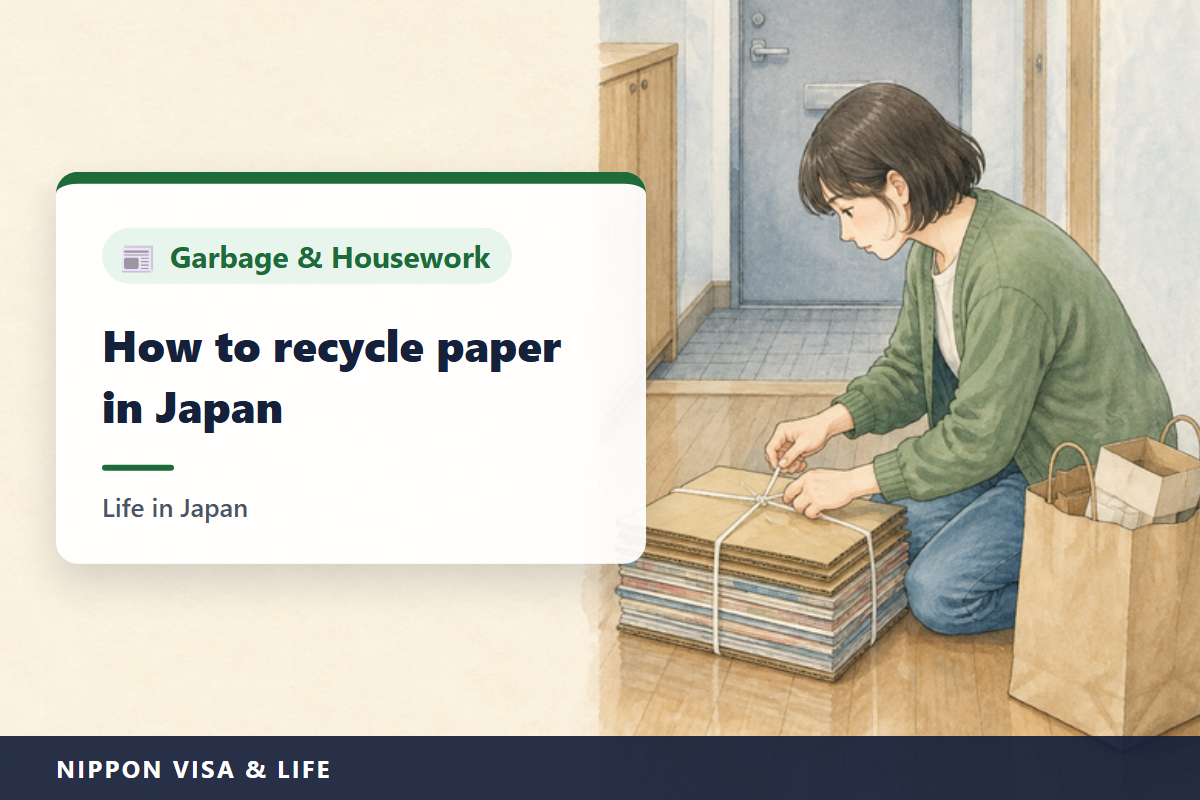
- Tie it up with string or put it in a paper bag: Make sure it does not come apart.
- Put it out at the set place by the set time on the set day: For example, in Shinjuku Ward and Setagaya Ward, it is by 8:00 a.m. on the collection day, which is once a week.
(Source: Shinjuku Ward “How to Put Out Waste Paper”, Setagaya Ward “How to Put Out Waste Paper”)
How to Put Out Each Type of Waste Paper
The following table shows general examples of how to put out waste paper, based on the guidance of Yokohama City, Shinjuku Ward, Setagaya Ward and Kagoshima City. The names of the categories and the detailed rules differ by municipality, so check the guidance of the municipality where you live.
| Type | Examples of items included | How to put it out |
|---|---|---|
| Newspapers | Newspapers, flyers inserted in newspapers (advertisements that come inside the newspaper) | Fold them, put them together and tie them up with string |
| Cardboard | Delivery boxes, moving boxes | Fold them flat, put them together and tie them up with string. Remove packing tape (gum tape) and delivery slips |
| Magazines and books | Magazines, manga, books, textbooks, catalogs | Put them together and tie them up with string |
| Paper cartons | Paper cartons for milk and other drinks | Rinse them with water, cut them open, dry them and tie them together |
| Miscellaneous paper (other paper) | Snack boxes, tissue boxes, wrapping paper, envelopes, brochures, memo paper, paper bags | Put it in a paper bag, or put it between the pages of a magazine |
(Source: Yokohama City “Waste Paper”, Shinjuku Ward, Setagaya Ward, Kagoshima City “Please Tell Me How to Put Out Waste Paper.”)
How to Put Out Newspapers
Newspapers can be put out together with the flyers inserted in them. Yokohama City and Shinjuku Ward advise folding them into quarters before tying them up with string. Setagaya Ward advises tying them crosswise with string and not using adhesive tape.
How to Put Out Cardboard
Fold cardboard flat, then tie it up with string. Remove any adhesive tape stuck on the boxes and put the tape out as burnable garbage (Yokohama City). Setagaya Ward advises also removing delivery slips and putting them out as burnable garbage.
The following cardboard cannot be put out as waste paper and is burnable garbage.
- Cardboard soaked with oil (example: delivery pizza boxes)
- Cardboard processed with aluminum, or processed with wax
(Source: Shinjuku Ward, Yokohama City)
How to Put Out Magazines and Books
Put magazines and books together and tie them up with string. Yokohama City advises removing supplements that are not made of paper, as well as covers made of leather, cloth, vinyl and similar materials, and putting them out as burnable garbage.
How to Put Out Paper Cartons
Put out paper cartons for milk and other drinks separately from other waste paper.
- Rinse the inside lightly with water
- Cut them open with scissors or similar
- Dry them
- Make them the same size, then tie them up with string or put them in a paper bag
Paper cartons that are silver (aluminum) on the inside cannot be put out as waste paper. In many municipalities they are burnable garbage. Setagaya Ward explains that only cartons that are white on the inside, 500ml or larger and marked with the “paper carton” (紙パック) mark are accepted. Kagoshima City also treats paper cartons of less than 500 milliliters as burnable garbage. Remove plastic spouts and caps.
You may also be able to put paper cartons in collection boxes at ward facilities or at stores such as supermarkets (example of Shinjuku Ward).
(Source: Shinjuku Ward, Setagaya Ward, Kagoshima City)
How to Put Out Miscellaneous Paper (Other Paper)
“Miscellaneous paper” (雑がみ, zatsugami) is paper that does not belong to any of the categories of newspapers, cardboard, magazines or paper cartons. Examples are empty snack and tissue boxes, wrapping paper, envelopes, brochures and memo paper.
- Small pieces of paper: They cannot be tied up with string, so put them in a paper bag (Shinjuku Ward and Setagaya Ward). Shinjuku Ward explains that you may also put them between the pages of a magazine.
- Tissue boxes: Remove the plastic film from the opening (Shinjuku Ward).
- If you do not have a paper bag: Yokohama City advises putting the paper in a clear or semi-transparent bag so that the contents can be clearly seen.
Paper That Cannot Be Put Out as Waste Paper (Paper That Is Burnable Garbage)
The following paper gets in the way of recycling, so in many municipalities it cannot be put out as waste paper. Put it out as burnable garbage. Shinjuku Ward gives the following reasons, for example: thermal paper changes color from the heat used when drying recycled paper, and paper cups do not absorb water and cannot be broken down into paper fibers.
| Paper that cannot be put out as waste paper | Examples |
|---|---|
| Dirty paper, paper with oil on it, paper with a smell | Used tissues, delivery pizza boxes |
| Paper processed to repel water | Paper cups, paper plates, paper cups for yogurt or ice cream |
| Paper with aluminum on the inside, gold or silver paper | Paper cartons that are silver on the inside, silver foil paper from snacks |
| Paper coated with vinyl | Paper that leaves vinyl when torn by hand, such as book covers |
| Carbon paper | Copy-type delivery slips for parcel delivery services |
| Paper that swells with heat, paper with raised surfaces | Paper for braille |
| Iron-on transfer paper | Paper used to transfer prints onto cloth with an iron |
(Source: Shinjuku Ward, Setagaya Ward, Yokohama City, Kagoshima City)
How Receipts and Shredded Paper Are Handled Differs by Municipality
How thermal paper (paper on which text appears with heat), such as receipts, and shredded paper are handled differs by municipality.
| Example municipality | Receipts (thermal paper) | Shredded paper |
|---|---|---|
| Yokohama City | Waste paper (other paper) | Waste paper (other paper) |
| Shinjuku Ward | Burnable garbage | Burnable garbage |
| Setagaya Ward | Burnable garbage (可燃ごみ) | Burnable garbage (可燃ごみ) |
| Kagoshima City | Burnable garbage (もやせるごみ) | Not mentioned on this page |
Do not put it out following the rules of the town where you used to live. Check the guidance of the municipality where you live now.
(Source: Yokohama City, Shinjuku Ward, Setagaya Ward, Kagoshima City)
Dangerous Items You Must Not Put Among Waste Paper
Shinjuku Ward advises not putting anything that can cause a fire in waste paper, noting that there was a case where a large number of matches were put out with waste paper. Do not put matches, lighters, spray cans, or rechargeable batteries such as lithium-ion batteries together with waste paper. For how to put them out, read How to Throw Away Spray Cans, Batteries and Lighters in Japan: Disposing of Dangerous Waste Such as Lithium-Ion Batteries and Gas Canisters.
(Source: Shinjuku Ward)
Common Questions About Putting Out Waste Paper
Is It Okay to Put Out Waste Paper on a Rainy Day?
It differs by municipality. Yokohama City and Shinjuku Ward explain that waste paper can be put out and is collected even on rainy days. Kagoshima City advises refraining from putting it out on rainy days, or, after tying each type up with string, putting it in a clear bag before putting it out.
Is It Okay to Use Vinyl String or Adhesive Tape to Tie Up Waste Paper?
Some municipalities advise using paper string as much as possible (Yokohama City and Shinjuku Ward). Yokohama City advises that if you do not have paper string or paper bags at hand, you should tie the paper up with vinyl string and put it out. Shinjuku Ward explains that it also collects paper tied with vinyl string. Setagaya Ward explains that adhesive tape cannot be used.
Do You Have to Remove Staples from Waste Paper?
Kagoshima City explains that it is fine to leave staples in. In other municipalities, check the guidance.
What Should You Do When Moving Leaves You with a Lot of Cardboard or Books?
Setagaya Ward advises not putting out a large amount of waste paper at the collection point at one time when moving or doing a big cleaning. Because putting out a large amount at once may mean that part or all of it is charged for, the ward asks you to contact the sanitation office before putting it out. If you have a lot, ask the responsible office of your municipality before putting it out.
What If You Miss the 8:00 a.m. Deadline for Putting Out Waste Paper?
Shinjuku Ward and Setagaya Ward advise putting out waste paper by 8:00 a.m. on the collection day. Setagaya Ward explains that if you put it out after 8:00, it may not be collected. Keep it at home until the next collection day.
What Is “Group Collection” (集団回収) of Waste Paper?
It is a collection, separate from the municipality’s collection, in which waste paper and other resources are gathered by the local community. Yokohama City advises putting out waste paper in the “resource group collection” (資源集団回収) in your area. Shinjuku Ward also advises putting out household waste paper in group collection as much as possible, and putting it out in the ward’s collection if you cannot. To find out when and where it is collected, ask your municipality or your neighborhood association (自治会).
How to Find the Waste Paper Rules of the Municipality Where You Live
- Search online: Search with the name of your municipality, such as “○○市 古紙 出し方” (○○ city, waste paper, how to put out).
- Look at the municipality’s website or the garbage guide you were given: Check how to put out waste paper (resources) and the days of the week it is collected.
- Look at the signs at the collection point: For example, Yokohama City advises checking the blue sticker posted at the collection point if you do not know the collection day.
- Ask the responsible office: Ask the section in charge of garbage and recycling, or the sanitation office (in Yokohama City, the ward office of the Resources and Waste Recycling Bureau).
How to put out plastic, glass bottles and cans is summarized in How to Put Out Plastic Garbage in Japan: How to Recognize the Pura Mark (プラマーク), How to Put Out Plastic Products Without the Pura Mark, and How to Clean Containers and How to Throw Away PET Bottles, Cans and Glass Bottles in Japan: Removing Caps and Labels, Rinsing, and Whether to Crush Them.
Primary Sources Referred to in Writing This Article
- Yokohama City “Waste Paper”
- Shinjuku Ward “How to Put Out Waste Paper”
- Setagaya Ward “How to Put Out Waste Paper”
- Kagoshima City “Please Tell Me How to Put Out Waste Paper.”
This article is a translation of the original Japanese version.