This article was written by the NIPPON VISA & LIFE editorial team based on information from public organizations such as the national government and local governments. Rules and fees may differ depending on the city, ward, town or village where you live.
In Japan, you can get a taxi by raising your hand on the street, by boarding at a taxi stand, or by calling one by phone or with a smartphone app. Normally, you pay the amount shown on the meter when you get out. You do not need to tip.
Fare amounts differ from region to region. The amounts in this article are examples from Tokyo. To find the amounts for the area where you live, check the website of a taxi company or of your local taxi association.
The basics of transportation as a whole, including trains and buses, are summarized in Getting Around in Japan: The Basics of Walking, Trains, Buses, Bicycles, Driving, and Traffic Accidents.
The Short Answer: The Steps for Taking a Taxi
- Find a taxi (raise your hand on the street, go to a taxi stand, or call one by phone or app).
- Wait for the door to open, then get in. The door opens automatically, so do not touch it yourself.
- Tell the driver your destination. It is easier to get your destination across if you show it written in Japanese.
- Fasten your seatbelt. You must wear one in the back seat too.
- When you arrive, pay the amount on the meter, wait for the door to open, and get out.
How to Find and Call a Taxi
| Method | Details |
|---|---|
| Raise your hand on the street | Raise your hand to stop a vacant taxi that is driving by |
| Taxi stand | Board at a taxi stand at a station or similar place. In rural areas, taxis are easy to find in front of the station |
| Call by phone | Call a taxi company and tell them where you want the taxi to come |
| Call with a smartphone app | Call a taxi with a ride-hailing app (an app for calling taxis). Some apps can be used in English |
When you call a taxi by phone or app, there may be a pick-up charge (迎車料金, a charge for having the taxi come to get you).
How to Spot a Vacant Taxi
Look at the sign at the front of the taxi. The sign is usually in Japanese, but you can also tell by its color. According to the Japan National Tourism Organization (JNTO), red means the taxi is available and green means the taxi is in use. A red sign says “空車” (kusha, meaning a car with no passenger).
Places and Times When You Can Board a Taxi Only at a Taxi Stand
Depending on the place and time, you may be unable to board a taxi anywhere other than a taxi stand. Example: in the no-pickup zone in Ginza, Tokyo, you board from a taxi stand between 10 p.m. and 1 a.m. the next morning, except on Saturdays, Sundays, national holidays and other holidays.
Things to Be Careful About When Getting In and During the Ride
- Door: It opens and closes automatically. Do not open or close it yourself.
- Where to get in: Example: the guide from Niihama City in Ehime Prefecture explains that you should get in through the rear left door.
- Destination: In large cities, some drivers can speak foreign languages. Even so, it is reassuring to have your destination written in Japanese, especially when you are going somewhere other than a famous tourist spot or hotel.
- Seatbelt: Wear one in every seat. The same applies to the back seats.
- Smoking: You cannot smoke in a non-smoking car. If you keep smoking after the driver asks you to stop, you may be refused the ride.
- Items you cannot bring in: You cannot bring in items prohibited by the rules, such as knives and other blades.
How Taxi Fares Work
The ordinary fare is a “distance-based fare” (kyorisei unchin 距離制運賃). It is determined by the distance from where you got in to where you got out. There is also a “combined time-and-distance fare” (jikan kyori heiyosei unchin 時間距離併用制運賃), which also takes time into account. Taxis in Tokyo use this fare. Time spent at 10 km/h or slower, such as waiting at traffic lights or in traffic jams, is also converted into distance and added to the fare. For this reason, the amount is not always the same each time, even for the same route.
Example of Taxi Fares in Tokyo (Standard Vehicles)
These are example fares from April 20, 2026 for Tokyo’s 23 wards, Musashino City and Mitaka City. Some companies and conditions have different fares.
| Item | Amount |
|---|---|
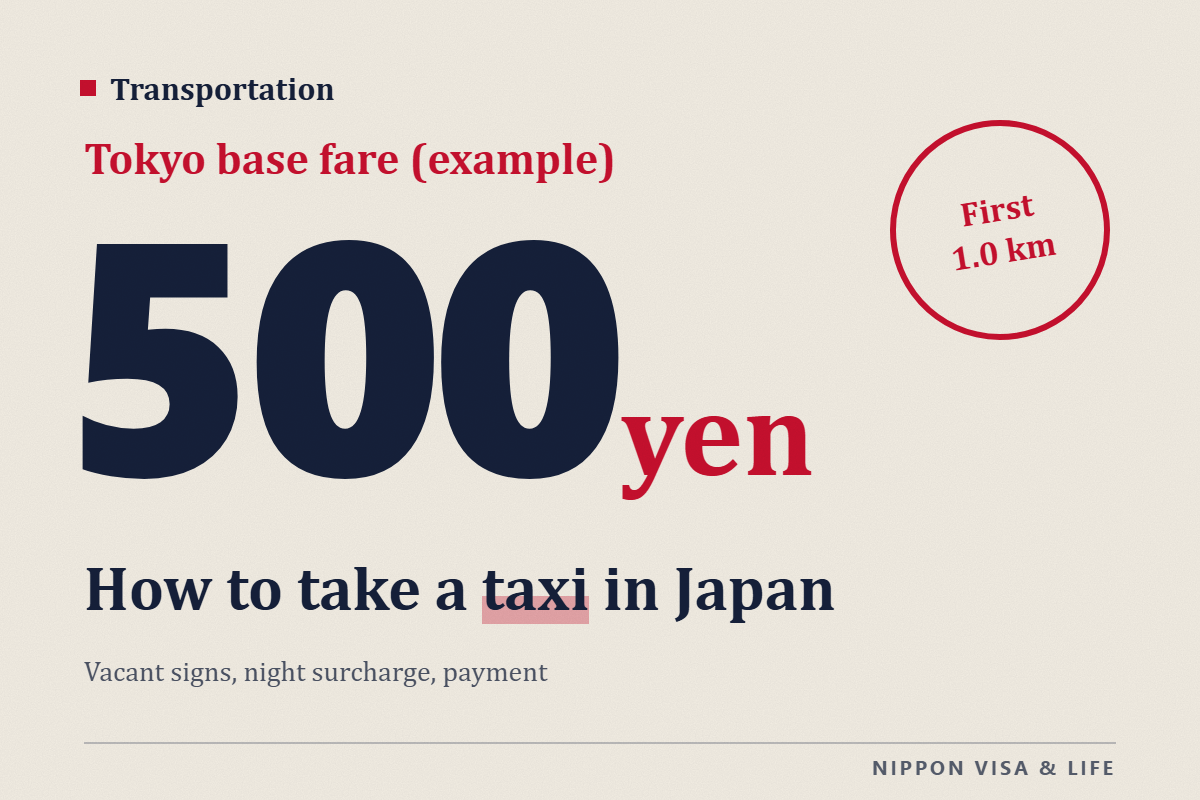
| Initial fare (初乗運賃, hatsunori unchin: the fare as soon as you start riding) | 500 yen for up to 1.0 km |
| Additional fare by distance | 100 yen for every additional 232 m |
| Additional fare at 10 km/h or slower | 100 yen for every 1 minute 25 seconds |
| Late-night and early-morning surcharge | 20% extra from 22:00 to 5:00 |
| Pick-up charge (迎車回送料金, a charge for having the taxi come to get you) | A fixed amount per pick-up. Each company decides the amount |
| Disability discount | 10% off |
| Long-distance discount | 10% off the portion over 9,000 yen |
The passenger pays actual costs such as expressway tolls.
Charges That May Be Added Besides the Fare
The following explanation is mainly based on the rules of the Kanto District Transport Bureau. For surcharges and charges in other regions, check with the taxi company.
- Late-night and early-morning surcharge: As a rule, this is a surcharge from 10 p.m. to 5 a.m. Example: under the Kanto District Transport Bureau’s rules, it is 20% extra.
- Winter surcharge: Some regions set a winter surcharge.
- Pick-up charge: This is a charge for having a taxi you called come to get you. Example: under the Kanto District Transport Bureau’s rules, some are free up to a certain distance, and some vary in amount according to demand.
- Waiting charge: This is a charge for making the car wait for the passenger’s own reasons.
- Reservation charge: This is a charge for reserving a specific time or for reserving a specific type of vehicle, such as a wagon.
Fares That Are Set Before You Ride
- Flat-rate fare (定額運賃): A fare for traveling at a set amount between a place such as an airport or station and a set area. Example: the flat-rate fare for Haneda Airport in Tokyo requires a reservation at least 1 hour in advance. At the taxi stands at each Haneda Airport terminal, you can board without a reservation. Toll road charges are paid separately.
- Pre-fixed fare (事前確定運賃): A fare whose amount is set before you ride, after you enter your pick-up and drop-off points in a ride-hailing app or similar service. Check with the taxi company or the ride-hailing app whether you can use it.
People Who Can Get a Discount on Taxi Fares
Example: under the Kanto District Transport Bureau’s rules, the discount for people with a Physical Disability Certificate (身体障害者手帳) or an Intellectual Disability Certificate (療育手帳) is 10%. In Tokyo’s 23 wards, Musashino City and Mitaka City, if you show your certificate to the driver when you get in and the photo confirms that you are the holder, you get a discount on the fare and charges for the section you ride. Discounts for the Mental Disability Certificate (精神障害者保健福祉手帳) and similar certificates are decided according to each taxi company’s application. For other regions and certificates, check with the taxi company.
How to Look Up an Estimated Taxi Fare
Look on the website of each taxi company or of your local taxi association. In Tokyo, the website of the Tokyo Hire-Taxi Association has a fare search.
How to Pay the Taxi Fare, and Whether to Tip
You pay the fare when you get out. Taxis in large cities can usually take credit cards. In rural areas, some take cash only. It is reassuring to have cash with you.
You do not need to tip. The Japan National Tourism Organization says that taxi drivers do not expect tips and do not accept them.
If you keep the receipt, you can tell which taxi company it was if you leave something behind.
Who to Contact and Where to Get Advice When You Have a Problem with a Taxi
Who Should I Contact If I Leave Something in a Taxi?
If you can tell the taxi company from the receipt or the ride-hailing app, contact that company. If you cannot tell which company it was, report it at a nearby police station or police box (koban). For how to look for lost items in general, see If You Lose Something or Leave Something Behind in Japan: How to Look for Items Lost at Stations, on Trains, Buses, Taxis or on the Street, and How to File a Lost Property Report.
The Tokyo Taxi Center does not keep lost items. It lists the contact details of Tokyo’s taxi radio groups on its website.
Can a Taxi Refuse to Take Me?
As a rule, taxi companies accept requests to carry passengers. However, the standard terms and conditions (the rules of use) set by the national government specify cases in which they may refuse. Examples:
- When you are so drunk that you cannot clearly state your destination, or cannot walk without help
- When you are wearing dirty clothes that may soil the inside of the car
- When you have items whose carriage is prohibited, such as knives and other blades
- When the passenger is a seriously ill person with no one accompanying them
- When there is an obstacle to transport because of a natural disaster or similar event
The terms and conditions may differ from company to company.
Where Can I Get Advice If I Was Refused a Ride or Am Not Satisfied with the Fare?
For taxis in Tokyo’s 23 wards, Musashino City and Mitaka City, you can consult the Complaints Investigation Office (苦情調査室) of the Tokyo Taxi Center. The phone number is 03-3648-0300. It is open Monday to Friday from 9 a.m. to 5 p.m. (except national holidays and December 29 to January 3). It also accepts inquiries through its website.
In other regions, contact that taxi company or your local taxi association. Contact points for Kanagawa, Chiba, Saitama and Yamanashi Prefectures and the Tama area of Tokyo are listed on the Tokyo Taxi Center’s website.
Do I Need a Child Seat When Riding with a Child?
In an ordinary car, a child seat is required when carrying a child under 6 years old. Taxi drivers are exempt from this obligation. If you want to use a child seat, ask the taxi company before you call the taxi.
Are There Taxis with Drivers Who Speak English?
Tokyo has a system called “ENGLISH CERTIFIED DRIVER.” These are drivers who have passed an English test for serving foreign passengers (外国人旅客接遇英語検定). A certification mark is placed on the vehicle. The list of drivers who have passed is published on the Tokyo Taxi Center’s website.
What Should I Do If I Am in an Accident While Riding in a Taxi?
What to do in a traffic accident is summarized in If You Are in or Cause a Traffic Accident in Japan: What to Do on the Spot, Reporting to the Police, the Traffic Accident Certificate and Claiming Compulsory Automobile Liability Insurance.
Primary Sources Used for This Article
- Kanto District Transport Bureau “About the System of Fares and Charges for General Passenger Car Transportation Business”
- Ministry of Land, Infrastructure, Transport and Tourism “About Taxi Fares and Charges”
- Ministry of Land, Infrastructure, Transport and Tourism “Standard Transportation Terms and Conditions for General Passenger Car Transportation Business”
- Tokyo Taxi Center “About Various Inquiries” (complaints desk and Tokyo fares)
- Tokyo Taxi Center “About Items Left Behind in a Taxi”
- Tokyo Taxi Center “Guide to the Ginza No-Pickup Zone”
- Tokyo Taxi Center “Guide to ENGLISH CERTIFIED DRIVER”
- Tokyo Hire-Taxi Association “Frequently Asked Questions”
- Tokyo Hire-Taxi Association “Haneda Airport Flat-Rate Fares: Please Read Before Use”
- Japan National Tourism Organization “Taxis in Japan”
- National Police Agency “Wear Your Seatbelt in All Seats”
- National Police Agency “Child Seats to Protect Children”
- Niigata Prefecture “The Obligation to Use a Child Seat”
- Niihama City “Taxi”
This article is a translation of the original Japanese version.