This article was written by the NIPPON VISA & LIFE editorial team based on information from public organizations such as the national government and local governments. Rules and fees may differ depending on the city, ward, town or village where you live.
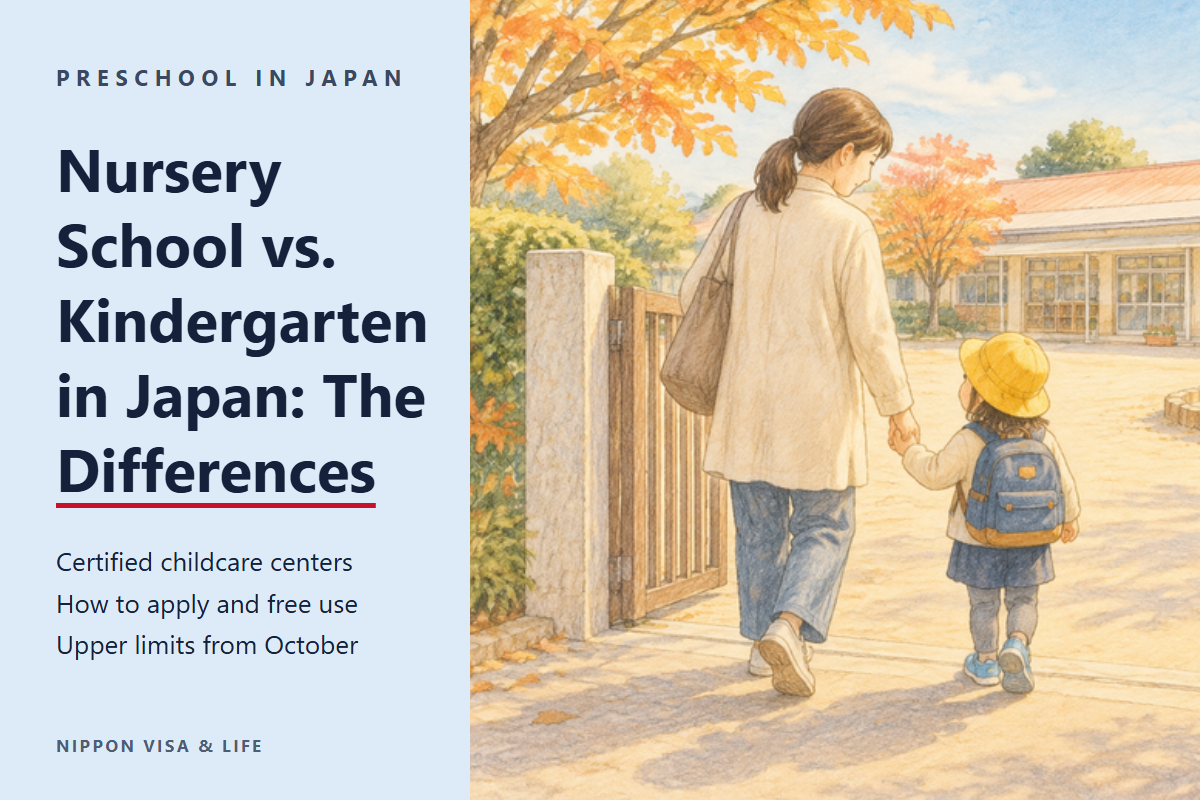
In Japan, if you cannot care for your child at home because you work or for a similar reason, you apply to your city, ward, town or village for a place at a nursery school(保育所)or a certified childcare center(認定こども園). A kindergarten(幼稚園)can be used whether or not the parents work, and you basically apply directly to the kindergarten. For classes for ages 3 to 5, use of kindergartens, nursery schools and certified childcare centers is basically free.
Raising children in Japan as a whole is summarized in The Basics of Raising Children in Japan: Pregnancy and Birth Procedures, Child Allowance, Checkups and Vaccinations, Nursery Schools and Kindergartens, Elementary and Junior High School.
The Short Answer: What to Know When Choosing Among Kindergartens, Nursery Schools and Certified Childcare Centers
- Nursery schools are for children aged 0 to 5. They are used by families who cannot care for their child at home, for example because the parents work.
- Kindergartens are schools for children aged 3 to 5. There is no condition about whether the parents work.
- Certified childcare centers are facilities that work as both a kindergarten and a nursery school. They are for children aged 0 to 5.
- For April admission to nursery schools and similar facilities, some cities, wards, towns and villages close applications in about the autumn of the previous year. Check the website of your city, ward, town or village early.
- Even in classes for ages 3 to 5, parents pay for transportation to and from the facility, food ingredients, events and similar costs.
(Sources: Children and Families Agency “Comprehensive Support System for Children and Childcare”, Children and Families Agency “About Free Early Childhood Education and Care”)
Differences Among Kindergartens, Nursery Schools, Certified Childcare Centers and Community-Based Childcare
| Type of facility | Ages covered | What kind of facility it is | Hours of use | Which parents can use it |
|---|---|---|---|---|
| Kindergarten(幼稚園) | 3 to 5 | A school that provides early childhood education to build the foundation for education from elementary school onward | Education hours until about early afternoon. Depending on the kindergarten, there is extended-hours care(預かり保育)in the afternoon, on Saturdays, during summer vacation and at similar times | No restrictions |
| Nursery school(保育所) | 0 to 5 | A facility that cares for children in place of parents who cannot care for them at home because they work or for a similar reason | Until the evening. Depending on the facility, there is extended care(延長保育) | Households where both parents work, and parents who cannot care for their child at home for reasons such as caring for a relative |
| Certified childcare center(認定こども園)(ages 0 to 2) | 0 to 2 | A facility that combines the functions and strengths of a kindergarten and a nursery school and also supports child-raising in the local community | Until the evening. Depending on the facility, there is extended care | Households where both parents work, and parents who cannot care for their child at home for reasons such as caring for a relative |
| Certified childcare center (ages 3 to 5) | 3 to 5 | Same as above | Education hours until about early afternoon. If the child needs childcare, until the evening. Depending on the facility, there is extended care | No restrictions |
| Community-based childcare(地域型保育) | 0 to 2 | A service that cares for children in smaller groups than a nursery school (in principle, 20 or more children) | Until the evening. Depending on the facility, there is extended care | Households where both parents work, and parents who cannot care for their child at home for reasons such as caring for a relative |
There are 4 types of community-based childcare: home-based childcare(家庭的保育), small-scale childcare(小規模保育), workplace childcare(事業所内保育)and in-home childcare(居宅訪問型保育).
At a certified childcare center, children aged 3 to 5 receive education and childcare together, whether or not their parents work. Even if the way the parents work changes, the child can continue at the same center.
There are also unlicensed childcare facilities(認可外保育施設), which have not received a license under the Child Welfare Act. They include unlicensed nursery schools, day-care rooms(託児所), “baby hotels”(ベビーホテル)and babysitters.
(Sources: Children and Families Agency “Comprehensive Support System for Children and Childcare”, Immigration Services Agency “Guidebook on Living and Working”)
Conditions Families Must Meet to Use Nursery Schools and Similar Facilities (Reasons Why Childcare Is Needed)
To receive childcare at a nursery school or similar facility, you get childcare certification(保育の認定)from your city, ward, town or village. To be certified, one of the following must apply.
- Work (full-time, part-time, night work, work done at home and so on)
- Pregnancy or childbirth
- Illness or disability of a parent
- Caring for or nursing a relative who lives with you, a relative who is in the hospital for a long time, or a similar relative
- Recovery from a disaster
- Looking for a job (including preparing to start a business)
- Studying (including vocational training at a vocational training school or similar place)
- A risk of child abuse or domestic violence
- During childcare leave, a child who is already using childcare needs to continue using it
- Other cases that the city, ward, town or village recognizes as close to one of the reasons above
The hours you can use are divided into standard hours(保育標準時間, up to 11 hours)and short hours(保育短時間, up to 8 hours). To use short hours because of work, there is a minimum number of working hours. The city, ward, town or village sets this minimum within the range of 48 to 64 hours per month.
(Sources: Children and Families Agency “Comprehensive Support System for Children and Childcare”)
Type 1, Type 2 and Type 3 Certification for Using Kindergartens and Childcare Facilities, and Where to Apply
The type of certification depends on the child’s age and on whether childcare is needed. Where you apply and the steps you follow differ by type.
| Type of certification | Who it is for | Facilities that can be used | Where to apply |
|---|---|---|---|
| Type 1 certification(1号認定) | Children who have turned 3 and whose parents want education for them (the parents’ work is not a condition) | Kindergartens, certified childcare centers | Apply directly to the facility |
| Type 2 certification(2号認定) | Children aged 3 to 5 who need childcare | Nursery schools, certified childcare centers | Apply to your city, ward, town or village |
| Type 3 certification(3号認定) | Children aged 0 to 2 who need childcare | Nursery schools, certified childcare centers, community-based childcare | Apply to your city, ward, town or village |
Even in a family where both parents work, the child receives Type 1 certification if the family wants kindergarten education.
Steps to Use Education at a Kindergarten or Certified Childcare Center (Type 1 Certification)
- Apply directly to the facility.
- Receive an informal decision of admission from the facility.
- Apply for certification to your city, ward, town or village through the facility.
- Receive the certificate through the facility.
- Sign a contract with the facility.
If you use a kindergarten that has not moved to the Support System for Children and Childcare(子ども・子育て支援制度), this certification is not needed.
Steps to Use Childcare at a Nursery School or Certified Childcare Center (Type 2 and Type 3 Certification)
- Apply for certification to your city, ward, town or village.
- If the need for childcare is recognized, a certificate is issued.
- Apply to your city, ward, town or village for the facility you want to use.
- The city, ward, town or village carries out placement adjustment(利用調整: deciding which child will use which facility).
- After the facility is decided, sign a contract.
(Sources: Children and Families Agency “Comprehensive Support System for Children and Childcare”)
When to Apply for April Admission to Nursery Schools and Similar Facilities (Examples)
The application period differs by city, ward, town or village. The examples below are applications for admission in April 2027.
| Example city | First application period | Second application period |
|---|---|---|
| Yokohama City | Deadline: October 28, 2026 | December 23, 2026 to February 2, 2027 |
| Saitama City | October 16, 2026 to October 30, 2026 | Check the city’s guidance |
| Tsukuba City | Deadline: November 13, 2026, 4:30 p.m. | January 6, 2027 to February 5, 2027 |
To find the schedule for where you live, search online for “(name of your city, ward, town or village) 保育所 入所 申し込み” (nursery school admission application), or ask the section in charge of childcare at your city, ward, town or village. Also check the required documents in the guidance from your city, ward, town or village.
(Sources: Yokohama City “For People Who Wish to Use Nursery Schools and Similar Facilities in Reiwa 9”, Saitama City “Applying to Use Childcare Facilities (Reiwa 9)”, Tsukuba City “Applying to Nursery Schools (April Admission, Reiwa 9)”)
How Childcare Fees Are Set and What Free Preschool Education and Childcare Covers
Each city, ward, town or village sets childcare fees within the upper limits set by the national government. The fees are calculated based on the parents’ income (such as the amount of the income-based portion of municipal resident tax).
Fees for Using Kindergartens, Nursery Schools, Certified Childcare Centers and Similar Facilities (Free Use)
| Child’s class | Fee |
|---|---|
| Classes for ages 3 to 5 | Free |
| Classes for ages 0 to 2 | Free for households exempt from resident tax(住民税非課税世帯: households that do not have to pay resident tax) |
This is the national system. Some cities, wards, towns and villages have their own programs that make childcare fees for ages 0 to 2 free or lower them (example: Minamisoma City). Check with your city, ward, town or village.
- The period covered is, in principle, the 3 years from the first April 1 after the child turns 3 until the child enters elementary school. At kindergartens, it starts from when the child turns 3, matching the time the child can enter.
- In classes for ages 0 to 2, the oldest child using a nursery school or similar facility is counted as the first child. The second child pays half, and the third and later children are free. In households equivalent to an annual income below 3,600,000 yen, the age of the first child does not matter.
- National, public and private facilities are all covered. Licensed nursery schools and similar facilities outside the city, ward, town or village where you live are also covered.
- If you are using a kindergarten, nursery school, certified childcare center or community-based childcare under the Support System for Children and Childcare, no new procedure is needed for free use.
Costs Not Covered by Free Preschool Education and Childcare
- Parents pay for transportation to and from the facility, food ingredients, events and similar costs.
- The cost of side dishes and snacks(副食費)is waived for households equivalent to an annual income below 3,600,000 yen, and for the third and later children of all households.
- Fees for extended care at licensed nursery schools and certified childcare centers are not covered by free use.
Monthly Limits on Free Preschool Education and Childcare Raised in October 2026
The following services are not completely free. They are covered up to an upper limit. The upper limits were raised on October 1, 2026.
| Service and children covered | Through use in September 2026 (per month) | From use in October 2026 (per month) |
|---|---|---|
| Kindergartens not under the Support System for Children and Childcare (classes for ages 3 to 5) | 25,700 yen | 28,000 yen |
| Extended-hours care at kindergartens (classes for ages 3 to 5) | 11,300 yen | 12,300 yen |
| Unlicensed childcare facilities and similar services (classes for ages 3 to 5) | 37,000 yen | 40,300 yen |
| Unlicensed childcare facilities and similar services (classes for ages 0 to 2, households exempt from resident tax) | 42,000 yen | 45,700 yen |
- For extended-hours care at kindergartens, the number of days used in the month multiplied by 490 yen is compared with the actual fee, and the smaller amount is free up to 12,300 yen per month. For children in households exempt from resident tax, from the day the child turns 3 until the first March 31 after that, the upper limit is 17,700 yen per month (previously 16,300 yen).
- To receive free use of extended-hours care or of unlicensed childcare facilities and similar services, you need certification of the need for childcare(保育の必要性の認定)from your city, ward, town or village.
- Unlicensed childcare facilities and similar services also include temporary childcare programs(一時預かり事業), sick child care programs(病児保育事業)and Family Support Center programs(ファミリー・サポート・センター事業). Free use of these services is for people who have not been able to use a nursery school, certified childcare center or similar facility. Only unlicensed childcare facilities that have notified the prefecture and meet the standards set by the national government are covered.
- If you use a kindergarten not under the Support System for Children and Childcare, you may need certification for free use or a procedure to receive the money later. Check with your city, ward, town or village.
(Sources: Children and Families Agency “About Free Early Childhood Education and Care”, Children and Families Agency “Frequently Asked Questions”, Tama City guidance, Yokohama City guidance, Children and Families Agency “Comprehensive Support System for Children and Childcare”)
Common Questions When You Have Trouble with Childcare
Can I Apply to a Nursery School While I Am Looking for a Job?
Looking for a job is one of the reasons why childcare is needed. However, application periods and conditions differ by city, ward, town or village. For example, Minamisoma City says that applications based on looking for a job are accepted from the second round of applications. Check with your city, ward, town or village.
What Can I Do If I Want Someone to Look After My Child Only When Something Urgent Comes Up?
Some facilities offer temporary childcare(一時預かり). They look after children for a short time when something urgent comes up, when a parent has short-term part-time work, and in similar cases. Check at the counter of your city, ward, town or village which facilities offer it. Families whose children do not go to a nursery school or kindergarten can also get advice at local child-raising support places.
What Happens After School Once My Child Enters Elementary School?
If parents are not home during the day because of work or a similar reason, the child can use an after-school children’s club(放課後児童クラブ, also called 学童保育, gakudo). This is explained in How to Apply for an After-School Children’s Club (Gakudo) in Japan: Which Children Can Use It, When to Apply, Required Documents and Fees.
(Sources: Minamisoma City “Applying for Admission to Licensed Childcare Facilities in Reiwa 9 (April Admission)”, Children and Families Agency “Comprehensive Support System for Children and Childcare”, Immigration Services Agency “Guidebook on Living and Working”)
Guidance on Free Preschool Education and Childcare in Foreign Languages, and Where to Ask About Childcare
The Children and Families Agency’s guidance on free preschool education and childcare is available in versions such as English, Simplified Chinese and Korean.
Some cities, such as Yokohama City, provide guidance on using nursery schools and similar facilities in several foreign languages. For questions about facilities or applications, ask the section in charge of childcare at your city, ward, town or village.
Primary Sources Used for This Article
- Children and Families Agency “Comprehensive Support System for Children and Childcare”
- Children and Families Agency “About Free Early Childhood Education and Care”
- Children and Families Agency “Free Early Childhood Education and Care: Frequently Asked Questions”
- Children and Families Agency “Overview of Certified Childcare Centers”
- Immigration Services Agency “Guidebook on Living and Working”
- Yokohama City “Free Early Childhood Education and Care”
- Yokohama City “For People Who Wish to Use Nursery Schools and Similar Facilities in Reiwa 9”
- Tama City “For People Whose Children Attend or Who Are Considering Facilities Covered by Free Early Childhood Education and Care”
- Saitama City “Applying to Use Childcare Facilities (Reiwa 9)”
- Tsukuba City “Applying to Nursery Schools (April Admission, Reiwa 9)”
- Minamisoma City “Applying for Admission to Licensed Childcare Facilities in Reiwa 9 (April Admission)”
This article is a translation of the original Japanese version.