This article was written by the NIPPON VISA & LIFE editorial team based on information from public organizations such as the national government and local governments. Rules and fees may differ depending on the city, ward, town or village where you live.
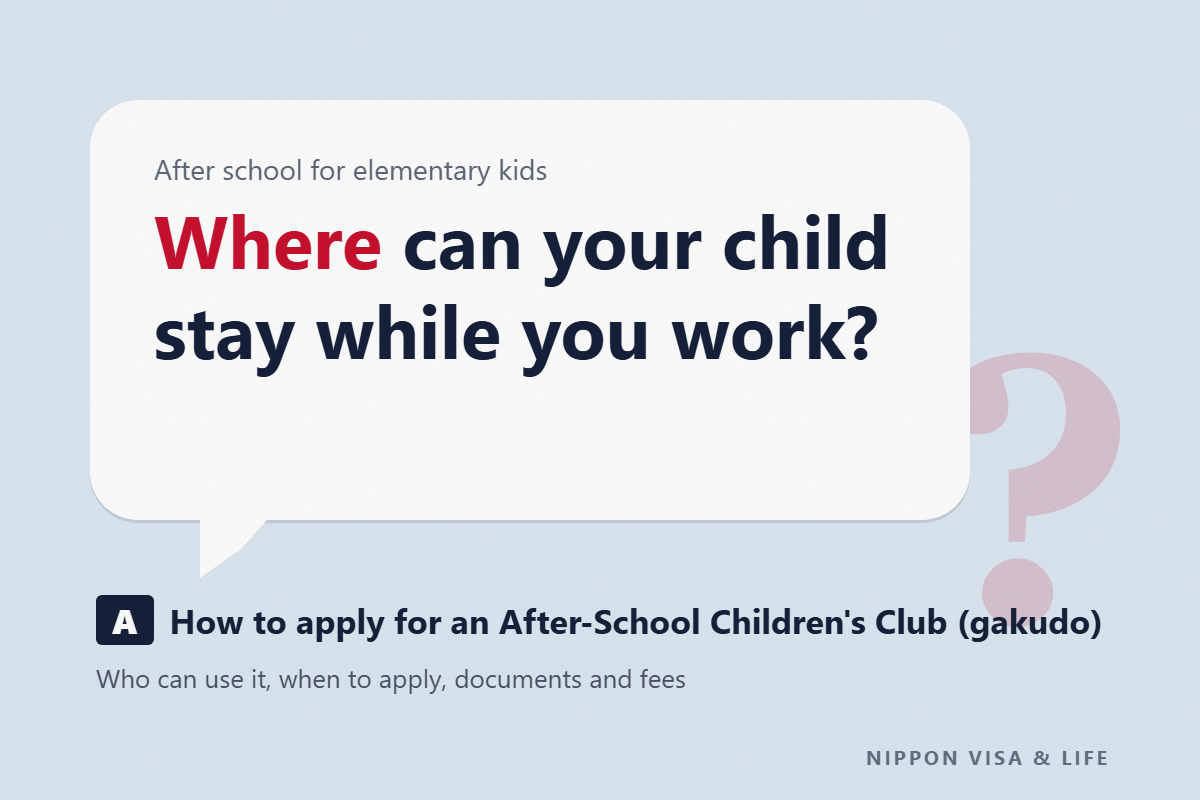
In Japan, children whose parents are not at home after elementary school classes end because of work or other reasons can use an After-School Children’s Club (放課後児童クラブ, hokago jido kurabu). It is also called “gakudo hoiku” (学童保育) or simply “gakudo” (学童). You apply by following the information from your city, ward, town or village (市区町村), and in some municipalities, applications for use from April start in the autumn to winter of the previous year.
How to apply for a nursery school is explained in How to Apply for a Nursery School (Hoikuen) in Japan: Types of Certification, When to Apply, Required Documents, Childcare Fees and If Your Child Cannot Get a Place. For an overview of child-rearing procedures, see The Basics of Raising Children in Japan: Pregnancy and Birth Procedures, Child Allowance, Checkups and Vaccinations, Nursery Schools and Kindergartens, Elementary and Junior High School.
The Short Answer: How to Apply for an After-School Children’s Club
How to apply differs depending on the municipality. Here, we show a common flow.
- Read the notice: Read the information about applications for that school year on the municipality’s website or in handouts.
- Fill in the application form: Fill in the municipality’s application form. Example: In the case of Funabashi City, when you apply for siblings, you need one application form per child.
- Submit it with the required documents: Attach documents such as an “employment certificate” (就労証明書, shuro shomeisho) showing that the parents are working. Some municipalities accept online applications.
- Wait for the result: The municipality or other organizer checks the conditions and notifies you whether your child can use the club.
- Start using the club: Complete the procedure for paying the fee (such as automatic bank transfer).
The After-School Children’s Club is a program set out in a law called the Child Welfare Act. It provides a place for play and daily life after classes for elementary school children whose parents are not at home during the day because of work or other reasons.
(Source: Children and Families Agency, “After-School Healthy Child Development Program (After-School Children’s Club)”, e-Gov Laws and Regulations Search, “Child Welfare Act”)
What an After-School Children’s Club Is Like
| Item | Details |
|---|---|
| Who can use it | Elementary school children (1st to 6th grade) whose parents are not at home during the day because of work or other reasons |
| Place | Empty classrooms in elementary schools, buildings on school grounds, children’s centers (児童館, jidokan: public facilities where children can play), etc. |
| Who runs it | Municipalities, social welfare corporations, parents’ associations, etc. |
| What it does | Provides a place for play and daily life and watches over children’s health and safety. Example: In Hiroshima City and Funabashi City, snacks are also served |
Under the national standards, the club is in principle open for at least 3 hours a day on school days and at least 8 hours a day on days when there is no school, such as summer vacation. In principle, it is open at least 250 days a year. The actual hours are set by each club. The number of children in one group is about 40 or fewer.
Example: In the case of Hiroshima City, in FY Reiwa 9, the hours are 13:00 to 18:30 from Monday to Friday, 8:30 to 17:00 on Saturday, and 8:30 to 18:30 during long school holidays such as summer vacation. The clubs are closed on Sundays, national holidays, and during the year-end and New Year holidays.
According to a survey by the Children and Families Agency, as of May 1, 2026, 1,602,037 children were registered nationwide. There were 14,713 children who applied but could not use a club (waiting children: 待機児童, taiki jido). In some areas, your child may not be able to get a place right away even if you apply.
(Source: Children and Families Agency, “About the After-School Healthy Child Development Program”, e-Gov Laws and Regulations Search, “Standards for Facilities and Operation of the After-School Healthy Child Development Program”, Children and Families Agency, “Implementation Status of After-School Children’s Clubs in FY Reiwa 8 (Preliminary Figures)”, Hiroshima City, “Using Hiroshima City After-School Children’s Clubs in FY Reiwa 9”)
Children Who Can Use an After-School Children’s Club
Children who can use a club are elementary school children living in that municipality whose parents cannot look after them at home during the day. Each municipality decides in what cases parents are recognized as “unable to look after” their children.
Municipal information lists reasons such as the following.
- The parents are working (at least a set number of days and hours)
- The parents are ill, injured or have a disability, or are caring for a family member
- The parents are in the period before or after giving birth
- The parents are attending school
- The parents are looking for a job (the period during which the club can be used may be short)
The conditions on the number of working days and hours differ greatly depending on the municipality.
- Example: In the case of Hiroshima City, the condition is that the parents are not at home until about 5 p.m. on at least 4 days a week (at least 16 days a month).
- Example: In the case of Funabashi City, the condition is that there are at least 3 days a week from Monday to Saturday (or at least 12 days a month, excluding Sundays) on which the parents’ work ends after 2 p.m.
Example: In the case of Hiroshima City and Funabashi City, when a child has two parents (father and mother), both parents must meet the conditions. Example: In the case of Funabashi City, when grandparents under 65 years old live at the same address, the grandparents also need a reason.
(Source: Hiroshima City, “Using Hiroshima City After-School Children’s Clubs in FY Reiwa 9”, Funabashi City, “Guide to Applying for After-School Rooms in FY Reiwa 9”)
When to Apply for an After-School Children’s Club
If you want your child to use a club for one year from April, some municipalities require you to apply in the autumn to winter of the previous year. Even children who are using a club now may need to apply again for the new school year.
| Example city | Application period for use from April 2027 |
|---|---|
| Example: Hiroshima City | First round for children entering 1st to 3rd grade: December 4 to December 17, 2026 |
| Example: Funabashi City | November 1 to December 9, 2026 (children currently using a club must also apply) |
If you want to start using a club in the middle of the school year, or only during summer vacation, there are separate application periods. Example: In the case of Hiroshima City, to start in the middle of the school year, you apply in the month before the month you want to start. Applications for summer vacation only are accepted as long as there is space within the capacity.
If you submit your application close to the deadline, you may not have time to resubmit if documents are missing. Please prepare early.
(Source: Hiroshima City, “Using Hiroshima City After-School Children’s Clubs in FY Reiwa 9”, Funabashi City, “Guide to Applying for After-School Rooms in FY Reiwa 9”)
Documents Required to Apply for an After-School Children’s Club
In addition to the application form, you submit documents showing the reason for using the club. Example: In the case of Hiroshima City and Funabashi City, when there are two parents, each parent needs their own documents.
| Reason for using the club | Examples of documents |
|---|---|
| Working at a company, etc. | Employment certificate (a document filled in by your employer) |
| Self-employed | Statement of employment, copy of your final tax return, etc. |
| Illness or injury | Doctor’s medical certificate |
| Before or after giving birth | Copy of the Maternal and Child Health Handbook (a handbook you receive when you become pregnant) |
| Attending school | Certificate of enrollment |
Ask your employer to fill in the employment certificate. It may take time, so ask early. The national government has issued a standard format (a form with a set way of filling it in) for the employment certificate, and some municipalities also allow you to submit it online.
Example: In the case of Funabashi City, when you apply for siblings, you need one application form and one “Survey Form on the Child’s Situation for Admission” (入所児童状況調査票) per child.
(Source: Children and Families Agency, “About the Employment Certificate in the Procedure for Using After-School Children’s Clubs (Notice)”, Hiroshima City, “Using Hiroshima City After-School Children’s Clubs in FY Reiwa 9”, Funabashi City, “Guide to Applying for After-School Rooms in FY Reiwa 9”)
Fees for an After-School Children’s Club
Fees differ depending on the municipality and the club. Snack costs and other costs may be charged separately.
| Example city | Monthly fee |
|---|---|
| Example: Hiroshima City (FY Reiwa 9) | 3,000 yen. Free for households receiving School Attendance Assistance or public assistance (welfare), households exempt from municipal resident tax, etc. Snack and lunch costs are separate |
| Example: Funabashi City (FY Reiwa 9) | Regular use 10,000 yen, short-time use (short use) 6,000 yen. Both include snack costs |
Some municipalities have a system that lowers the fee (fee reduction or exemption: 減免, genmen) for low-income households and households with siblings using a club. Example: In the case of Funabashi City, if your documents for the fee reduction are late, the reduction does not apply until all the documents are submitted.
For School Attendance Assistance (assistance with elementary and junior high school costs), see How to Apply for School Attendance Assistance (Shugaku Enjo) in Japan: Which Families Can Get Help with School Supplies, School Lunch and School Trip Costs for Elementary and Junior High School, When to Apply and What Documents to Submit.
You pay the fee by automatic bank transfer (automatic withdrawal from your bank account) or with a payment slip. Example: In Hiroshima City and Funabashi City, it takes about 1 to 2 months before automatic bank transfer starts, and until then you pay with a payment slip. If you leave the fee unpaid, a late payment charge (additional money for paying late) may be added.
(Source: Hiroshima City, “Using Hiroshima City After-School Children’s Clubs in FY Reiwa 9”, Funabashi City, “Guide to Applying for After-School Rooms in FY Reiwa 9”)
When You Have Trouble: Frequently Asked Questions
Can My Child Fail to Get a Place Even After I Apply?
Yes. If there are more applications than places, the municipality decides which children can use the club in an order it has set. Example: In the case of Hiroshima City, children in lower grades are given priority, and within the same grade, children from single-parent families, children with disabilities and others are given priority. Example: In the case of Hiroshima City, if you applied for one year of use and your child could not get a place, the application is put “on hold,” and when a place becomes available, children are admitted in order. For use only during summer vacation and other holidays, if your child cannot get a place, the application is “not approved.” Ask the municipality’s office in charge whether there is a place your child can use while waiting (such as a children’s center).
What Should I Do When My Child Stops Using the Club?
Submit the specified notification before the day your child stops. Example: In the case of Hiroshima City, if you do not submit the notification, the fee will be charged, and you cannot submit it retroactively.
Are the Snacks Safe for a Child with Allergies?
How allergies are handled differs depending on the club. Example: In the case of Funabashi City, snacks for children with allergies are prepared, and children can also bring their own snacks. Tell the club or the municipality when you apply.
Can I Apply If I Do Not Understand Japanese?
You may be able to ask how to apply at the municipality’s consultation desk for foreign residents or at the office in charge of child-rearing. On the municipality’s website, search for “放課後児童クラブ” or “学童保育” together with the name of your municipality. The name differs depending on the municipality, and some call it “放課後ルーム” (after-school room) or “児童クラブ” (children’s club).
Primary Sources Referenced in This Article
- Children and Families Agency, “After-School Healthy Child Development Program (After-School Children’s Club)”
- Children and Families Agency, “About the After-School Healthy Child Development Program”
- Children and Families Agency, “Implementation Status of After-School Children’s Clubs in FY Reiwa 8 (Preliminary Figures)”
- Children and Families Agency, “About the Employment Certificate in the Procedure for Using After-School Children’s Clubs (Notice)”
- e-Gov Laws and Regulations Search, “Child Welfare Act”
- e-Gov Laws and Regulations Search, “Standards for Facilities and Operation of the After-School Healthy Child Development Program”
- Hiroshima City, “Using Hiroshima City After-School Children’s Clubs in FY Reiwa 9”
- Funabashi City, “Guide to Applying for After-School Rooms in FY Reiwa 9”
This article is a translation of the original Japanese version.