This article was written by the NIPPON VISA & LIFE editorial team based on information from public organizations such as the national government and local governments. Rules and fees may differ depending on the city, ward, town or village where you live.
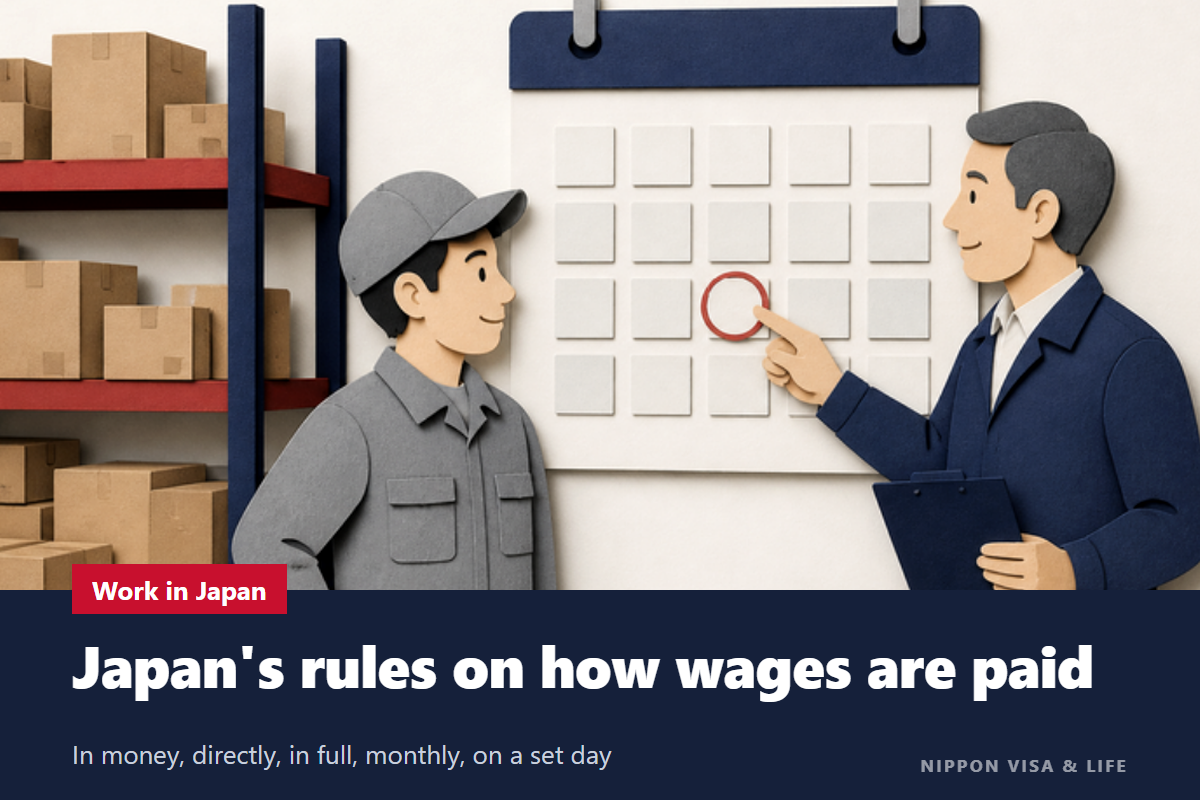
In Japan, how your pay (called “wages” in the law) is paid is set by a law called the Labor Standards Act. As a rule, pay must be paid “in money, directly to you, in full, at least once a month, on a fixed day.” If your pay is late or less than the agreed amount, you can consult the Labour Standards Inspection Office or a consultation service in foreign languages.
An overview of finding a job and working is available in The Basics of Finding a Job and Working in Japan: Hello Work, Working Conditions, Wages and Overtime, Paid Leave, Quitting and Where to Get Help.
The Short Answer: The 5 Rules for Paying Wages
Article 24 of the Labor Standards Act says that a company (the employer) must pay wages as follows. The Ministry of Health, Labour and Welfare calls these the “5 principles of wage payment.”
| Rule | What it means | Main exceptions |
|---|---|---|
| 1. Pay in money (currency) | Pay in Japanese money (currency). As a rule, pay cannot be given in goods or similar things | If the worker agrees, pay can be transferred to the worker’s own bank account or similar. If laws and regulations or a collective agreement (an agreement between the company and a labor union) provide for it, pay may be given in a form other than currency |
| 2. Pay directly to the worker | Pay the worker who did the work. Pay cannot be given to a boss, an intermediary or an agent | Pay can be handed to a messenger sent by the worker |
| 3. Pay in full | Pay the whole agreed amount. The company must not deduct money on its own | Items set by laws and regulations, such as taxes and social insurance premiums, and items set by a labor-management agreement at the workplace |
| 4. Pay at least once a month | Pay at least once every month | Bonuses, pay given on a one-off basis, and similar |
| 5. Pay on a fixed day | Set a payday, such as “the 25th of every month,” and pay on that day | Same as rule 4 |
(Sources: e-Gov Law Search “Labor Standards Act” Article 24, Ministry of Health, Labour and Welfare “Check Working Conditions” Q&A on the amount and method of wage payment)
As for the amount of pay itself, the Minimum Wage Act requires that pay be at least the minimum wage of each prefecture. For how to check it, see How to Check the Minimum Wage in Japan: Amounts by Prefecture (FY Reiwa 8) and How to Calculate Whether Your Pay Is Below It.
1. Pay in Money (Currency): Conditions for Bank Transfers and Digital Wage Payment
As a rule, pay must be paid in Japanese money (currency). As a rule, a company cannot pay you with its products or similar things (there are exceptions, such as when laws and regulations or a collective agreement provide otherwise).
Transfers to a Bank Account
In Japan, pay is often transferred to a bank account. A transfer can be made when the following conditions are met.
- The worker has agreed
- The pay is transferred to an account in the worker’s own name that the worker has chosen
- The worker can withdraw the full amount of the transferred pay on the payday
(Sources: e-Gov Law Search “Ordinance for Enforcement of the Labor Standards Act” Article 7-2, Ministry of Health, Labour and Welfare “Check Working Conditions” Q&A on the amount and method of wage payment)
When you open an account for your pay, give your company the account details (bank name, branch name, account number and account holder’s name). An account in the name of a family member or friend cannot be used to receive your pay.
Digital Wage Payment (Accounts with Fund Transfer Service Providers)
If the worker agrees, pay can also be paid into an account with a fund transfer service provider designated by the Minister of Health, Labour and Welfare (such as a company that runs a smartphone payment service) (digital wage payment).
- Digital wage payment is one option for how to receive your pay. If you do not want it, you can receive your pay as before, such as in a bank account
- The company must not force digital wage payment on workers who do not want it
- You can also receive only part of your pay by digital wage payment and the rest in a bank account
- Digital wage payment is possible only when a labor-management agreement (an agreement between the company and the representative of the workers) has been made at the workplace
- There is an upper limit on the amount the account receiving your pay can hold. The limit differs for each fund transfer service provider (under the laws and regulations, every provider must keep it at no more than 1,000,000 yen)
- Any amount over the limit is automatically moved to a bank or other account that you have registered in advance (a designated alternative account). The fee for this may have to be paid by you
- Paying wages in points that cannot be turned into cash, or in crypto assets (virtual currency), is not allowed
You can check the list of designated companies on the Ministry of Health, Labour and Welfare page.
(Sources: Ministry of Health, Labour and Welfare “For Workers – About Digital Wage Payment”, Ministry of Health, Labour and Welfare “Check Working Conditions” Q&A on digital wage payment, e-Gov Law Search “Ordinance for Enforcement of the Labor Standards Act” Article 7-2)
2. Pay Directly to the Worker: Pay Cannot Be Given to an Agent or an Intermediary
Pay must be paid to the worker who did the work. This rule is meant to prevent bosses, intermediaries, agents and others from taking part of the worker’s pay (intermediate exploitation).
- The company cannot pay wages even to an agent whom the worker has asked to receive them
- Pay can be handed to a person who comes to collect it as the worker’s messenger
- For a dispatched worker, it is considered not to break this rule if the company where the worker is dispatched receives the pay from the dispatching agency and hands it to the worker
3. Pay in Full: What May and May Not Be Deducted from Your Pay
As a rule, pay must be paid in full. However, the following can be taken out of (deducted from) your pay.
What May Be Deducted from Your Pay
| Type | Examples |
|---|---|
| Items set by laws and regulations | Income tax and resident tax, Health Insurance and Employees’ Pension Insurance premiums, Employment Insurance premiums, and similar |
| Items set by a labor-management agreement at the workplace | In-company savings, the price of goods bought from the company, labor union dues, and similar |
A labor-management agreement is a written agreement between the company and a labor union organized by a majority of the workers at the workplace (or, if there is no such union, a representative of a majority of the workers).
(Sources: e-Gov Law Search “Labor Standards Act” Article 24, Ministry of Health, Labour and Welfare “Check Working Conditions” Q&A on the amount and method of wage payment)
What is written in each section of your pay slip is explained in How to Read a Pay Slip in Japan: Payments, Deductions and Attendance Sections, and How Income Tax, Resident Tax and Social Insurance Premiums Are Deducted.
What Must Not Be Deducted from Your Pay, and Agreements the Company Must Not Make
- Compensation for damage suffered by the company: Even if the company suffered damage, for example because you broke something belonging to the company while working, the company cannot one-sidedly take the amount of the compensation out of your pay (offsetting). Even if the company asks for compensation, it must pay your wages and discuss the matter separately
- Money borrowed in advance: Money borrowed from the company in advance on the condition that you work (advance loans) cannot be offset against your pay (Labor Standards Act Article 17)
- Agreements on penalties: Contracts that set in advance a penalty or an amount of compensation for damages for breaking the contract, such as “a fine of ○ yen if you quit partway,” must not be made (Labor Standards Act Article 16)
(Sources: e-Gov Law Search “Labor Standards Act” Articles 16, 17 and 24, Ministry of Health, Labour and Welfare “Check Working Conditions” Q&A on the amount and method of wage payment)
Upper Limits When the Company Reduces Your Pay as a Penalty (Pay Reduction as a Disciplinary Measure)
There are also upper limits when a company reduces your pay as a penalty (pay reduction as a disciplinary measure) based on its work rules (the company’s rulebook for working).
- The amount of a single reduction is up to half of the average wage (the average pay for one day)
- The total of the reductions is up to one tenth of the total amount of pay for one pay period
(Source: e-Gov Law Search “Labor Standards Act” Article 91)
4 and 5. Pay at Least Once a Month, on a Fixed Day
Pay must be paid at least once a month, on a fixed day. As a rule, ways of paying such as “this month we will pay when we can” or “we will pay 2 months’ pay together” are not allowed.
The exceptions are pay such as the following.
- Bonuses
- Pay given on a one-off basis, such as a retirement allowance
- Good attendance allowances paid based on attendance over a period longer than 1 month, long-service allowances paid for continuous work over a period longer than 1 month, and similar
The payday and how your pay is calculated are written in the document setting out your working conditions that you receive when you start working. At workplaces with work rules, they are also written in the work rules (workplaces that always have 10 or more workers are required to make work rules). What to check in the document is summarized in What to Check in Your Notice of Working Conditions Before Starting Work in Japan: Items You Must Receive in Writing, Items Added from April 2024, and Where to Get Help If Your Actual Conditions Differ from the Notice.
(Sources: e-Gov Law Search “Labor Standards Act” Articles 15, 24 and 89, e-Gov Law Search “Ordinance for Enforcement of the Labor Standards Act” Articles 5 and 8)
When You Can Get Your Pay Even Before Payday (Emergency Payment)
If a worker needs money in cases such as childbirth, illness or a disaster, as listed below, and asks for it, the company must pay the wages for the work already done, even before payday.
- When the worker, or a family member who lives on the worker’s income, gives birth, becomes ill or is hit by a disaster
- When the worker, or a family member who lives on the worker’s income, gets married or dies
- When the worker, or a family member who lives on the worker’s income, returns home for 1 week or more for an unavoidable reason
(Sources: e-Gov Law Search “Labor Standards Act” Article 25, e-Gov Law Search “Ordinance for Enforcement of the Labor Standards Act” Article 9)
Your Pay When You Leave the Company
When a worker leaves the job, if the worker asks for it, the company must pay the wages within 7 days. The company must also return money and goods that belong to the worker, such as reserve funds and deposits. Even if there is a dispute about the amount or other matters, the undisputed part is to be paid within 7 days.
(Source: e-Gov Law Search “Labor Standards Act” Article 23)
If you plan to return to your home country, check with your company in advance which account you will receive your last pay in, and when.
When You Have a Problem: Common Questions
What if my pay is not paid on payday, or is less than it should be?
First, check the payday and the amount on your pay slip and in the document setting out your working conditions (such as the Notice of Working Conditions). If you are still not paid after checking with your company, you can consult the Labour Standards Inspection Office in charge of the area where the company is located, or one of the consultation services in foreign languages below. Keeping records of the days and hours you worked (shift schedules or notes), your pay slips and your bankbook records will help when you consult.
How long can I claim unpaid wages?
The period during which you can claim wages (excluding a retirement allowance) is currently 3 years (counted from the payday). For a retirement allowance, it is 5 years. After the period has passed, you may no longer be able to claim, so consult early.
(Sources: e-Gov Law Search “Labor Standards Act” Article 115 and Supplementary Provisions Article 143, Ministry of Health, Labour and Welfare “Check Working Conditions” Q&A on the extinctive prescription of the right to claim wages)
What pay do I get when work is suspended for the company’s own reasons?
If work is suspended for reasons for which the company is responsible, the company must pay an allowance (a leave allowance) of at least 60/100 of the average wage for the period of the suspension.
(Source: e-Gov Law Search “Labor Standards Act” Article 26)
What if my overtime pay may not have been paid?
For the basics of overtime hours and premium wages, see Overtime and Overtime Pay Rules in Japan: The Basics of Working Hours, Breaks, Holidays and Premium Wages (25%, 35% and 50%).
Consultation Services Available in Foreign Languages
You can use the Ministry of Health, Labour and Welfare’s telephone consultation services in foreign languages about working conditions such as pay.
Consultation Dial for Foreign Workers (weekdays 10:00 a.m. to 3:00 p.m., except noon to 1:00 p.m. Call charges apply: 9.35 yen per 180 seconds from a landline, 22 yen per 30 seconds from a mobile phone 〈tax included〉)
| Language | Days | Phone number |
|---|---|---|
| English | Mon–Fri | 0570-001-701 |
| Chinese | Mon–Fri | 0570-001-702 |
| Portuguese | Mon–Fri | 0570-001-703 |
| Tagalog | Mon–Fri | 0570-001-705 |
| Vietnamese | Mon–Fri | 0570-001-706 |
| Myanmar | Tue, Wed, Fri | 0570-001-707 |
| Nepali | Mon–Fri | 0570-001-708 |
| Korean | Tue–Fri | 0570-001-709 |
| Thai | Tue, Thu | 0570-001-712 |
| Indonesian | Tue, Thu | 0570-001-715 |
Working Conditions Consultation Hotline (free of charge. Weekdays 5:00 p.m. to 10:00 p.m., Saturdays, Sundays and national holidays 9:00 a.m. to 9:00 p.m. You can consult during hours when the Labour Bureaus and Labour Standards Inspection Offices are closed)
| Language | Days | Phone number |
|---|---|---|
| Japanese | Every day | 0120-811-610 |
| English | Every day | 0120-531-401 |
| Chinese | Every day | 0120-531-402 |
| Portuguese | Mon–Sat | 0120-531-403 |
| Tagalog | Tue, Wed, Sat | 0120-531-405 |
| Vietnamese | Tue, Wed, Fri–Sun | 0120-531-406 |
| Myanmar | Wed, Sun | 0120-531-407 |
| Nepali | Wed, Sun | 0120-531-408 |
| Korean | Thu, Sun | 0120-613-801 |
| Thai | Thu, Sun | 0120-613-802 |
| Indonesian | Thu, Sun | 0120-613-803 |
Both services are closed during the year-end and New Year holidays (December 29 to January 3). The days and hours of service may change temporarily. In addition, some prefectural Labour Bureaus and Labour Standards Inspection Offices have a “Consultation Corner for Foreign Workers” where you can consult in person in foreign languages. You can search for the locations and languages by prefecture on the Ministry of Health, Labour and Welfare page below.
Primary Sources Used for This Article
- e-Gov Law Search “Labor Standards Act” (Articles 15, 16, 17, 23 to 26, 89, 91 and 115, and Supplementary Provisions Article 143)
- e-Gov Law Search “Ordinance for Enforcement of the Labor Standards Act” (Articles 5, 7-2, 8 and 9)
- Ministry of Health, Labour and Welfare “Check Working Conditions” Q&A: Are the amount and method of wage payment regulated by the Labor Standards Act and other laws?
- Ministry of Health, Labour and Welfare “Check Working Conditions” Q&A: I heard that the extinctive prescription of the right to claim wages has changed
- Ministry of Health, Labour and Welfare “Check Working Conditions” Q&A: Digital wage payment
- Ministry of Health, Labour and Welfare “For Workers – About Digital Wage Payment”
- Ministry of Health, Labour and Welfare “About Wage Payment into Accounts with Fund Transfer Service Providers (Digital Wage Payment)”
- Ministry of Health, Labour and Welfare “Check Working Conditions” Consultation Services for Foreign Workers
This article is a translation of the original Japanese version.