This article was written by the NIPPON VISA & LIFE editorial team based on information from public organizations such as the national government and local governments. Rules and fees may differ depending on the city, ward, town or village where you live.
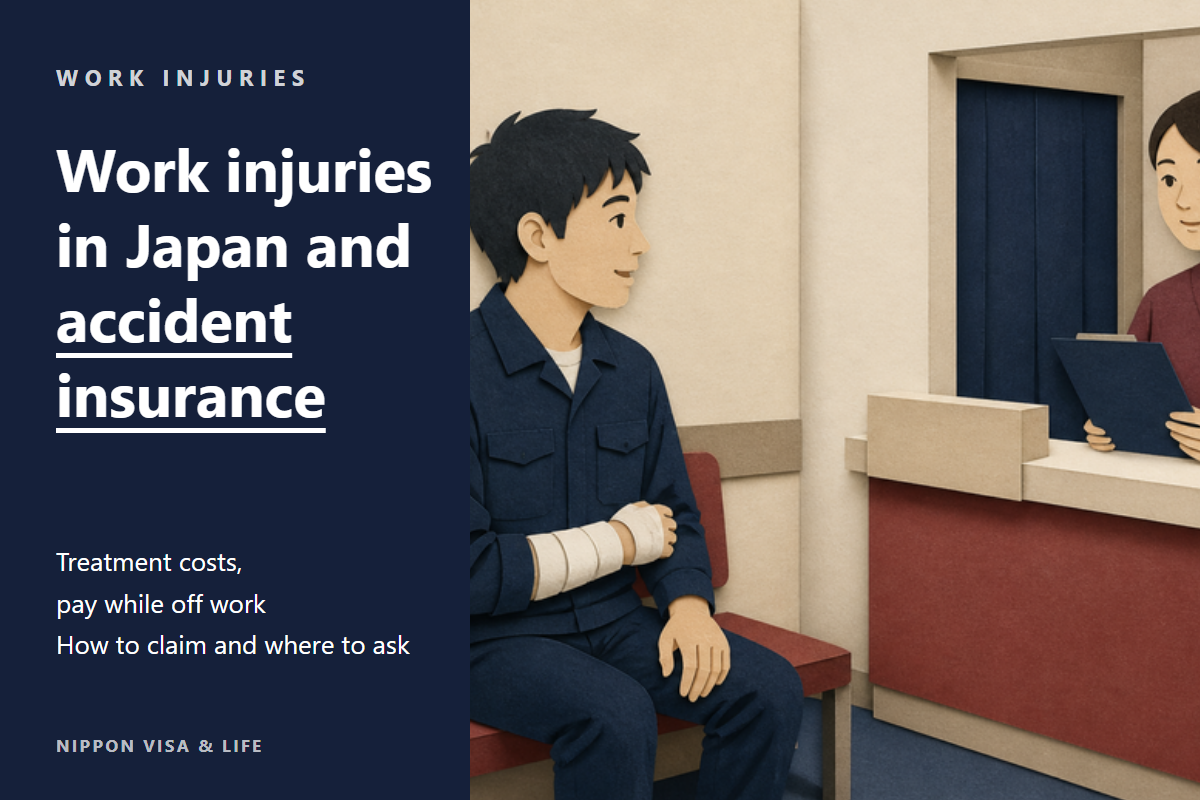
In Japan, for injuries and illnesses that happen at work or while commuting, you use Workers’ Accident Compensation Insurance (労災保険, a national insurance for injuries and illnesses caused by work or commuting), not health insurance. At the hospital reception, say “This is an injury from work” or “This is an injury from commuting.” At a designated hospital, you can receive treatment for free. If you take time off work and receive no wages, money is also paid from the 4th day off.
The Short Answer: What to Do When You Are Injured at Work or While Commuting
- Tell your company that you were injured.
- At the hospital, say that this is an injury from work (or from commuting). If possible, go to a designated medical institution for Workers’ Accident Compensation Insurance (労災保険指定医療機関, a designated hospital where this insurance can be used).
- Do not use your health insurance.
- Get the claim form, ask your company to fill in the certification section, and submit the form. (See the “Medical costs” and “Money while you are off work” sections below.)
- If you do not understand something, or if your company will not cooperate, consult a Labour Standards Inspection Office (労働基準監督署).
For an overview of work and working styles, see The Basics of Finding a Job and Working in Japan: Hello Work, Working Conditions, Wages and Overtime, Paid Leave, Quitting and Where to Get Help.
Who Is Covered by Workers’ Accident Compensation Insurance
Workers’ Accident Compensation Insurance applies regardless of nationality, so it also applies to foreign nationals working as employees in Japan. The Ministry of Health, Labour and Welfare’s guidebook says that a person who has an accident while working part-time during their studies in Japan is also covered.
In principle, any company or shop that employs even one worker is covered by Workers’ Accident Compensation Insurance, whatever its industry or size. Even if your company has not completed the enrollment procedure, you can, in principle, still receive benefits.
(Source: Ministry of Health, Labour and Welfare, “Guidebook on Claiming Workers’ Accident Compensation Insurance for Foreign Nationals Working in Japan,” Part 1, Ministry of Health, Labour and Welfare, “Labour Standards Information: Workers’ Accident Compensation”)
Injuries and Illnesses Covered by Workers’ Accident Compensation Insurance
| Type | When it applies | Examples |
|---|---|---|
| Work-related accident (業務災害) | An injury or illness caused by your work | An injury while working inside the company, an injury in the toilet during work, an injury on a business trip |
| Commuting accident (通勤災害) | An injury or illness caused by commuting | An injury while traveling between your home and your workplace by a usual route and method |
In the following cases, you may not be covered.
- You were doing something personal during work, and that caused the injury
- You caused the accident on purpose
- You were doing something personal during a break and were injured (you are covered if the cause was in the company’s facilities)
- You were injured after leaving your route during your commute or doing something unrelated to it (such as going into a movie theater or drinking alcohol)
Small things during a commute do not count as leaving your route. Examples are using a toilet near your route or buying a drink at a shop along the way. Some activities are listed in the law, such as shopping for daily necessities or seeing a doctor at a hospital. If you do one of these for an unavoidable reason and only to the minimum extent, your travel counts as commuting again after you return to your original route.
A Labour Standards Inspection Office investigates and decides whether a case is covered. If you are unsure, consult a Labour Standards Inspection Office.
Why You Should Not Use Health Insurance for Injuries at Work or While Commuting
The Ministry of Health, Labour and Welfare explains that health insurance cannot be used for injuries at work or while commuting. If you use health insurance by mistake, you may have to pay the full medical cost yourself for a time.
If you have already used health insurance, follow these steps in order.
- Ask the hospital where you were treated whether it can switch from health insurance to Workers’ Accident Compensation Insurance.
- If it can switch: Give the hospital the Workers’ Accident Compensation Insurance claim form (Form No. 5 / 様式第5号 for injuries from work, Form No. 16-3 / 様式第16号の3 for injuries from commuting). The money you paid at the reception will be returned to you.
- If it cannot switch: Tell your health insurance office (such as the Japan Health Insurance Association, 全国健康保険協会) that the injury was from work or commuting. Pay the amount on the notice you receive. Then attach that receipt and the hospital’s receipt, and claim from a Labour Standards Inspection Office (Form No. 7 / 様式第7号, or Form No. 16-5 / 様式第16号の5). You also need a copy of the medical fee statement (レセプト, 診療報酬明細書), so ask your health insurance office for it.
If your case has already been recognized as a workers’ accident and paying the full amount is difficult, there is also a way to claim without paying the full amount. Ask a Labour Standards Inspection Office.
What You Can Receive from Workers’ Accident Compensation Insurance
| Name of the benefit | When it applies | What you receive |
|---|---|---|
| Medical (compensation) benefits (療養〈補償〉等給付) | When you receive treatment for an injury or illness | The treatment itself, or the cost of the treatment. Under certain conditions, also travel costs for hospital visits |
| Absence from work (compensation) benefits (休業〈補償〉等給付) | When you cannot work because of treatment and receive no wages | From the 4th day off, 80% of the basic daily benefit amount (給付基礎日額, your average wage per day) per day (60% insurance benefit + 20% special payment) |
| Injury and disease (compensation) pension (傷病〈補償〉等年金) | When you have not recovered 1 year and 6 months after treatment began, and you have a disability of a set degree | A pension based on the degree of disability |
| Disability (compensation) benefits (障害〈補償〉等給付) | When a disability of a set degree remains after treatment has ended | A pension or lump sum based on the degree of disability |
| Nursing care (compensation) benefits (介護〈補償〉等給付) | When a person receiving a disability or injury and disease pension has a certain disability and is receiving nursing care | The costs of nursing care |
| Survivors (compensation) benefits (遺族〈補償〉等給付), funeral expenses, etc. | When a person dies because of work or commuting | A pension or lump sum for the surviving family, and a benefit for funeral costs |
Medical Costs: Free at Hospitals Designated for Workers’ Accident Compensation Insurance
- Rosai hospitals (労災病院) and designated medical institutions for Workers’ Accident Compensation Insurance: You can receive treatment for free. Submit the claim form to the Labour Standards Inspection Office through the hospital (Form No. 5 for injuries from work, Form No. 16-3 for injuries from commuting).
- Other hospitals: First pay yourself. If you later claim from a Labour Standards Inspection Office, the full amount you paid is paid to you (Form No. 7 or Form No. 16-5). Keep your receipts. For injuries from commuting, also submit the attachment to Form No. 16 (様式第16号の別紙, items about the commuting accident).
- Travel costs for hospital visits: These are paid if certain conditions are met (in principle, for example, a one-way trip of 2 km or more).
You can search for designated hospitals by name, location or medical department on the Ministry of Health, Labour and Welfare’s “Search for Designated Medical Institutions for Workers’ Accident Compensation Insurance” page. To change the designated hospital where you are being treated, submit a notification (Form No. 6 / 様式第6号, or Form No. 16-4 / 様式第16号の4) through the new hospital. You do not need to do anything at the previous hospital.
You can get the claim forms on the Ministry of Health, Labour and Welfare’s “Download Page for Workers’ Accident Compensation Insurance Benefit Claim Forms.”
(Source: Ministry of Health, Labour and Welfare, “Guidebook on Claiming Workers’ Accident Compensation Insurance for Foreign Nationals Working in Japan,” Part 1, Ministry of Health, Labour and Welfare, “Q&A on Workers’ Accident Compensation Insurance,” 2-4)
Money While You Are Off Work Because of an Injury: From Workers’ Accident Compensation Insurance, Starting on the 4th Day Off
You can receive absence from work (compensation) benefits when all 3 of the following apply.
- You are receiving treatment for an injury or illness caused by work or commuting
- You cannot work because of it
- You are not receiving wages
| Days off | Who pays and how much |
|---|---|
| Days 1 to 3 (injury from work) | Your company provides absence compensation (60% of your average wage per day). You claim it from your company |
| Days 1 to 3 (injury from commuting) | No law requires your company to pay compensation. Workers’ Accident Compensation Insurance does not pay either |
| From day 4 | Workers’ Accident Compensation Insurance pays 80% of the basic daily benefit amount per day (60% insurance benefit + 20% special payment) |
The basic daily benefit amount is your wages for the 3 months just before the accident, divided by the number of days in that period (calendar days).
Example calculation (from the Ministry of Health, Labour and Welfare’s guidebook): Wages of 200,000 yen per month (closed on the last day of each month), with an accident in October
- Basic daily benefit amount: 200,000 yen × 3 months ÷ 92 days (the days in July, August and September) ≒ 6,522 yen
- Per day off: 6,522 yen × 80% ≒ 5,217 yen
Days when your company is closed are also covered if the 3 conditions are met. A person who works only 2 days a week can also receive the benefit if the conditions are met. For injuries from commuting, 200 yen is deducted from the first payment as a partial contribution.
The claim form is Form No. 8 (様式第8号) for injuries from work and Form No. 16-6 (様式第16号の6) for injuries from commuting. Ask your doctor and your company to fill in their certification sections, and submit the form yourself to a Labour Standards Inspection Office. A decision takes about 1 month after the claim is accepted (it may take longer than 1 month). Once it is decided, the money is transferred to the bank account you specified.
(Source: Ministry of Health, Labour and Welfare, “Guidebook on Claiming Workers’ Accident Compensation Insurance for Foreign Nationals Working in Japan,” Part 1, Ministry of Health, Labour and Welfare, “Q&A on Workers’ Accident Compensation Insurance,” 3-2, 3-4)
Deadlines for Claiming Workers’ Accident Compensation Insurance Benefits
| Benefit | Deadline |
|---|---|
| Free treatment at a designated hospital | No time limit |
| Medical costs you paid yourself, travel costs for hospital visits | 2 years from the day after you paid the cost |
| Money while you are off work | For each day you received no wages, 2 years from the following day |
After the deadline, you cannot receive the benefit. For the deadlines for other benefits, such as disability and survivors benefits, check the foreign-language guidebooks below.
A law was revised in 2026. From April 1, 2027, the claim deadline (time limit) for medical compensation benefits and similar benefits will change from 2 years to 5 years. This applies to certain illnesses, set by Cabinet Order, for which it is difficult to decide whether work was the cause.
(Source: Ministry of Health, Labour and Welfare, “Guidebook on Claiming Workers’ Accident Compensation Insurance for Foreign Nationals Working in Japan,” Part 1, Ministry of Health, Labour and Welfare, “Labour Standards Information: Workers’ Accident Compensation”)
When You Have Trouble Claiming Workers’ Accident Compensation Insurance / Common Worries
What If Your Company Says “This Is Not a Workers’ Accident” and Will Not Sign the Certification?
In principle, the injured person carries out the Workers’ Accident Compensation Insurance procedures. Even if your company refuses to sign the certification, you can still claim. Consult a nearby Prefectural Labour Bureau (都道府県労働局) or Labour Standards Inspection Office.
What If Your Company Says “We Are Not Enrolled in Workers’ Accident Compensation Insurance” or “We Have a Different Insurance”?
Even if your company has not completed the enrollment procedure, you can, in principle, still receive benefits. Even if a different insurance that your company or an organization joined voluntarily is used, you can still receive Workers’ Accident Compensation Insurance benefits. However, if you receive compensation from your company for things like medical costs or time off, you may not receive the Workers’ Accident Compensation Insurance benefits, or they may be reduced.
The Ministry of Health, Labour and Welfare states that “rosai kakushi” (労災かくし, deliberately not submitting a report of workers’ death or injury, or submitting one with false content) is a crime and will be dealt with strictly.
(Source: Ministry of Health, Labour and Welfare, “Guidebook on Claiming Workers’ Accident Compensation Insurance for Foreign Nationals Working in Japan,” Part 1, Ministry of Health, Labour and Welfare, “Labour Standards Information: Workers’ Accident Compensation”)
Can You Claim Workers’ Accident Compensation Insurance After Quitting Your Job or After Your Company Has Closed?
Yes, you can. In that case, you may be asked for the addresses and names of the company and your coworkers. If you make a 2nd or later claim after quitting, you do not need your company’s certification (for absence from work benefits and for medical costs you paid yourself). However, for absence from work benefits, you do need your company’s certification if the period of absence in that claim includes days before you quit.
(Source: Ministry of Health, Labour and Welfare, “Guidebook on Claiming Workers’ Accident Compensation Insurance for Foreign Nationals Working in Japan,” Part 1, Ministry of Health, Labour and Welfare, “Overview of Workers’ Accident Compensation Insurance Benefits”)
Can You Be Dismissed While You Are Off Work Because of an Injury?
Under the Labor Standards Act, a company must not dismiss you while you are off work to receive treatment for an injury or illness caused by work, or for 30 days afterward. There are exceptions (when the company pays a lump-sum compensation called uchikiri hosho, 打切補償, or when it cannot continue business because of a natural disaster or similar event). This rule does not apply to injuries from commuting. If dismissal is mentioned, consult a Labour Standards Inspection Office.
(Source: e-Gov Laws and Regulations Search, “Labor Standards Act,” Article 19)
Can You Use Workers’ Accident Compensation Insurance If You Have a Traffic Accident While Commuting?
Yes. You can receive Workers’ Accident Compensation Insurance benefits even for a traffic accident. Submit a “Notification of Accident Caused by a Third Party” (第三者行為災害届) together with the claim form. If you do not submit it without a valid reason, your benefits may be stopped for a time. For a traffic accident, also attach documents such as the accident certificate. If you receive money from the other party’s compulsory automobile liability insurance (jibaiseki) (自賠責保険, a type of car insurance) or a similar source, that amount is deducted from the Workers’ Accident Compensation Insurance payment for the same reason. You can choose which one to receive first. Special payments are paid even if you have received money from compulsory automobile liability insurance (jibaiseki) or a similar source.
You can also receive Workers’ Accident Compensation Insurance benefits for a bicycle accident when you do not know who the other party is.
(Source: Ministry of Health, Labour and Welfare, “Overview of Workers’ Accident Compensation Insurance Benefits”, Ministry of Health, Labour and Welfare, “Guidebook on Claiming Workers’ Accident Compensation Insurance for Foreign Nationals Working in Japan,” Part 1)
Can You Claim Workers’ Accident Compensation Insurance After Returning to Your Home Country?
Some benefits can be claimed after you return to your home country. The amount paid is converted at the exchange rate on the day the payment is decided. The costs of treatment received overseas are also paid if the treatment is recognized as reasonable. However, some support is limited to Japan, such as payment for the cost of artificial limbs and aftercare. Consult a Labour Standards Inspection Office before returning to your home country.
Foreign-Language Materials and Consultation Services for Workers’ Accident Compensation Insurance
- Foreign-language guidebooks: On the Ministry of Health, Labour and Welfare’s “Workers’ Accident Compensation Insurance Benefit Pamphlets for Foreign Workers” page, you can read versions in Japanese and 13 foreign languages (English, Portuguese, Korean, Chinese, Vietnamese, Thai, Indonesian, Persian, Spanish, Tagalog, Cambodian, Nepali and Burmese).
- Labour Standards Inspection Offices and Prefectural Labour Bureaus: These are the consultation offices for Workers’ Accident Compensation Insurance.
- Workers’ Accident Compensation Insurance Consultation Dial (労災保険相談ダイヤル): 0570-006031 (closed on Saturdays, Sundays, national holidays and over the New Year period. Call charges apply. It cannot be used from some phones, such as IP phones.) (Source: Ministry of Health, Labour and Welfare leaflet, “For Injuries and Other Harm from Work, Use Workers’ Accident Compensation Insurance!”, Ministry of Health, Labour and Welfare, “Workers’ Accident Compensation Insurance Consultation Dial”)
- Consultation dials for foreign workers: You can get advice by phone in foreign languages about working conditions and other matters. For the phone numbers, languages and days, see the Ministry of Health, Labour and Welfare’s “Consultation Services for Foreign Workers” page and What to Check in Your Notice of Working Conditions Before Starting Work in Japan: Items You Must Receive in Writing, Items Added from April 2024, and Where to Get Help If Your Actual Conditions Differ from the Notice.
Primary Sources Referred to in Writing This Article
- Ministry of Health, Labour and Welfare, “Guidebook on Claiming Workers’ Accident Compensation Insurance for Foreign Nationals Working in Japan,” Part 1 (Japanese version)
- Ministry of Health, Labour and Welfare, “Workers’ Accident Compensation Insurance Benefit Pamphlets for Foreign Workers”
- Ministry of Health, Labour and Welfare, “Overview of Workers’ Accident Compensation Insurance Benefits”
- Ministry of Health, Labour and Welfare leaflet, “For Injuries and Other Harm from Work, Use Workers’ Accident Compensation Insurance!”
- Ministry of Health, Labour and Welfare, “Workers’ Accident Compensation Insurance Consultation Dial”
- Ministry of Health, Labour and Welfare, “Labour Standards Information: Workers’ Accident Compensation”
- Ministry of Health, Labour and Welfare, “Search for Designated Medical Institutions for Workers’ Accident Compensation Insurance”
- Ministry of Health, Labour and Welfare, “Q&A on Workers’ Accident Compensation Insurance,” 2-4, 3-2, 3-4
- e-Gov Laws and Regulations Search, “Labor Standards Act” (Article 19)
- Ministry of Health, Labour and Welfare, “Consultation Services for Foreign Workers”
This article is a translation of the original Japanese version.