This article was written by the NIPPON VISA & LIFE editorial team based on information from public organizations such as the national government and local governments. Rules and fees may differ depending on the city, ward, town or village where you live.
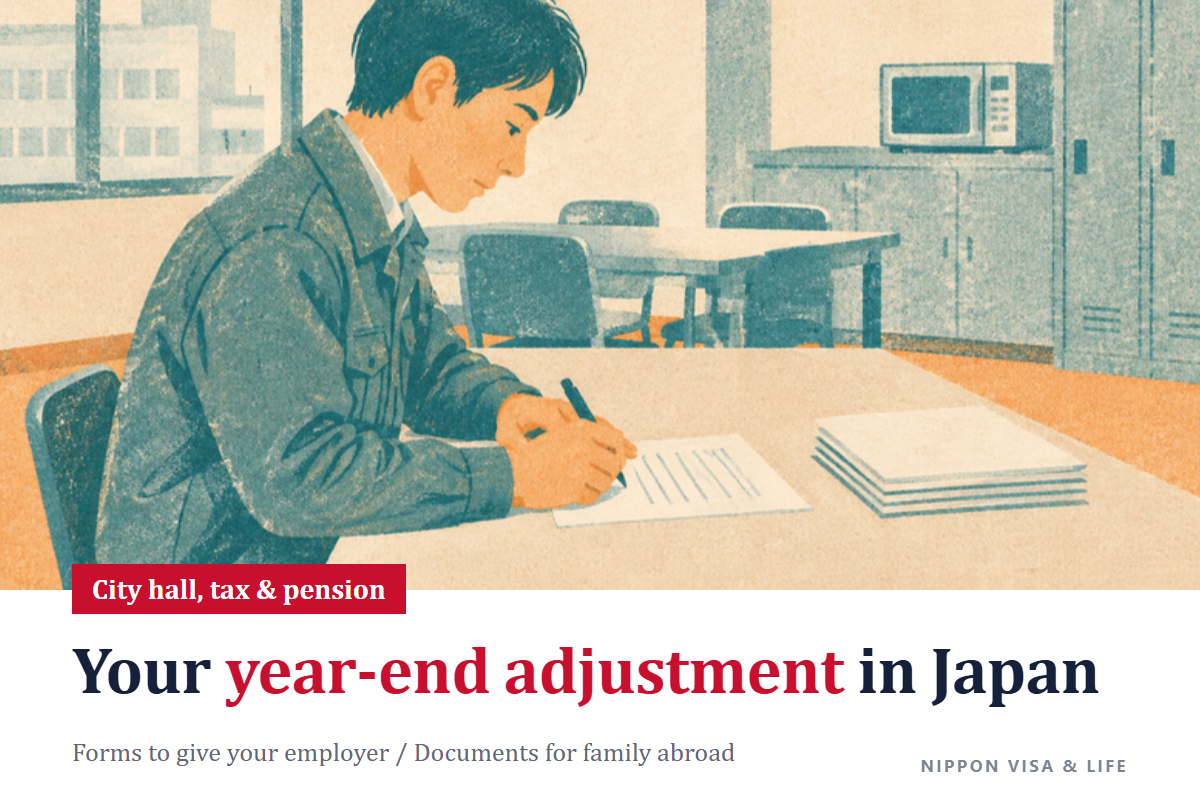
The year-end adjustment in Japan (年末調整, nenmatsu chosei) is a procedure in which your company recalculates your income tax (所得税) for the full year and settles the difference between that amount and the tax taken from your salary. When your employer gives you information about the declaration forms, please submit them by the deadline your employer sets. In many cases, this completes your income tax payment for that year, and you do not need to file a final tax return (確定申告, kakutei shinkoku: a return you file yourself with the tax office, 税務署).
This article explains income tax. For your individual tax amount and whether you can receive a deduction, please check with the person in charge at your employer or with the tax office. The procedures to do at the municipal office when you arrive in Japan are explained in Procedures at the City Office After You Arrive in Japan: The Basics of the Moving-in Notification, My Number, National Health Insurance, National Pension and Resident Tax.
The Short Answer: What Employees Need to Do for the Year-End Adjustment
- Check whether you are covered by the year-end adjustment (see the table in “Who Is Covered by the Year-End Adjustment and Who Is Not” below).
- Fill in the declaration forms by following your employer’s instructions. Even people with no family submit the Declaration Form for Dependent Deduction, etc. (扶養控除等申告書, fuyo kojo to shinkokusho).
- If you are claiming a deduction for life insurance or similar, submit the certificates together with the form.
- If you are claiming family in your home country as dependents, submit documents showing that they are your relatives and that you sent them money.
- Your employer calculates the tax amount. If too much tax was taken, your employer returns the difference, and if too little was taken, your employer collects it.
- By January 31 of the following year, receive your withholding tax statement (源泉徴収票, gensen choshu hyo) and keep it.
What the Year-End Adjustment Is: A Procedure to Settle the Difference Between the Tax Taken Each Month and the Tax for the Full Year
Your company takes income tax from your salary every month. This is called withholding (源泉徴収, gensen choshu). However, the total tax taken during the year and the correct tax amount for the full year usually do not match. This is because your salary may change during the year, or the number of your family members may change.
So, when your employer pays the last salary of the year, it calculates the tax amount for the full year. It then settles the difference from the tax already taken by either collecting the shortfall or making a refund (還付, kanpu: returning the amount you overpaid). This is usually done in December. Please check with your employer when and how you will receive the difference.
Who Is Covered by the Year-End Adjustment and Who Is Not
Foreign employees who are “residents” (居住者, kyojusha) are judged by the same standards as Japanese employees. A resident is a person who has a domicile (住所, jusho) in Japan, or who has continuously had a place of residence (居所, kyosho: the place where you actually live) in Japan for one year or more. Part-time workers such as international students are also judged using the table below.
| Category | Who applies |
|---|---|
| Covered | People who have worked for the entire year |
| Covered | People who started a job during the year and work until the end of the year |
| Covered | People who left their job after receiving their December salary |
| Covered | People such as part-time workers who left their job and whose total salary for that year is 1,360,000 yen or less (excluding people who expect to receive salary from another source in the same year after leaving) |
| Covered | People who left their job because of death |
| Covered | People who left their job because of a serious physical or mental disability and are not expected to find another job in that year |
| Covered | People who became non-residents during the year, for example because of a transfer to an overseas branch |
| Not covered | People whose main salary income for that year exceeds 20,000,000 yen |
| Not covered | People who suffered a disaster and received a postponement of collection or a refund of income tax on that year’s salary under the Act on tax reduction, exemption and deferred collection for disaster victims (災害減免法) |
| Not covered | People who work at two or more places and have submitted the Declaration Form for Dependent Deduction, etc. to their other employer |
| Not covered | People who have not submitted the Declaration Form for Dependent Deduction, etc. by the time of the year-end adjustment |
| Not covered | People who left their job during the year and do not fall under the “Covered” rows above |
| Not covered | Non-residents (非居住者: people who are not residents, excluding the “people who became non-residents during the year” above) |
| Not covered | Day laborers who are not continuously employed by the same employer |
People who are not covered settle their tax amount by filing a final tax return themselves. The conditions and deadlines are explained in Who Needs to File a Final Tax Return in Japan and Who Does Not: Conditions for Company Employees, People with Multiple Part-time Jobs, Side Jobs and Sole Proprietors, Plus the Deadline and How to File.
If you moved from another company during the year, submit the withholding tax statement from your previous company to your current employer. This is because the salary from your previous company is also included in the calculation. If your current employer cannot confirm this salary, you cannot receive the year-end adjustment and will settle your tax by filing a final tax return.
(Sources: National Tax Agency “How to Do the Year-End Adjustment for Reiwa 8 (2026)” Part II What Is the Year-End Adjustment (PDF), National Tax Agency Tax Answer “People Covered by the Year-End Adjustment”, National Tax Agency Tax Answer “Classification of Residents and Non-residents”, National Tax Agency No.2674 Year-End Adjustment for People Who Started a Job During the Year)
Types of Declaration Forms to Submit to Your Employer for the Year-End Adjustment
A deduction (控除, kojo) is an amount that can be subtracted from your income or tax amount when your tax is calculated. To receive a deduction, you need to submit the applicable declaration form to your employer.
| Declaration form | Who submits it | Deduction you can receive |
|---|---|---|
| Declaration Form for Dependent Deduction, etc. (扶養控除等申告書) | People who receive a salary (including people with no family). People who work at two or more places submit it only to their main employer | Dependent deduction (扶養控除), disability deduction (障害者控除), widow deduction (寡婦控除), single parent deduction (ひとり親控除), working student deduction (勤労学生控除) |
| Basic Deduction Declaration Form (基礎控除申告書) | People who receive the basic deduction | 1,040,000 yen if your total income (合計所得金額) is 4,890,000 yen or less (the amount goes down for people with higher income) |
| Declaration Form for Spouse Deduction, etc. (配偶者控除等申告書) | People who receive a deduction for their spouse (your own total income must be 10,000,000 yen or less) | Spouse deduction (配偶者控除) if your spouse’s total income is 620,000 yen or less; special spouse deduction (配偶者特別控除) if it is more than 620,000 yen and 1,330,000 yen or less |
| Declaration Form for Special Deduction for Specified Relatives (特定親族特別控除申告書) | People who have a relative aged 19 or older and under 23 whose total income is more than 620,000 yen and 1,230,000 yen or less | Up to 630,000 yen per such relative |
| Declaration Form for Income Amount Adjustment Deduction (所得金額調整控除申告書) | People whose salary covered by the year-end adjustment exceeds 8,500,000 yen and who meet certain requirements | Up to 150,000 yen |
| Insurance Premium Deduction Declaration Form (保険料控除申告書) | People who paid life insurance or earthquake insurance premiums. People who paid social insurance premiums themselves that were not taken from their salary, such as National Pension (国民年金) premiums | A deduction for each type of premium |
| Declaration Form for Special Deduction for Housing Loans, etc. (住宅借入金等特別控除申告書) | People who received the housing loan deduction through a final tax return in a previous year (from the second year onward) | A deduction based on the year-end balance of the housing loan |
On the National Tax Agency’s form, the declaration forms for the basic deduction, spouse deduction, etc., special deduction for specified relatives, and income amount adjustment deduction are combined on one sheet. Attach certificates from your insurance company or similar to the Insurance Premium Deduction Declaration Form (there are exceptions, such as older contracts with small premiums).
If you do not submit the Declaration Form for Dependent Deduction, etc., your monthly tax is calculated using “Column Otsu” (乙欄, otsuran), at a higher rate than if you had submitted it. If you have not submitted it yet, please submit it to your employer soon. If your family situation changes during the year, submit a “Change Declaration Form” (異動申告書, ido shinkokusho).
(Sources: National Tax Agency “For Salary Earners (Employees) (Reiwa 8 (2026))”, National Tax Agency “How to Do the Year-End Adjustment for Reiwa 8 (2026)”)
Basic Deduction and Dependent Conditions That Changed from the Previous Year in the 2026 Year-End Adjustment
Starting with the year-end adjustment in December 2026, the amounts below are used for the calculation. Monthly withholding through November does not change, and the difference is settled all at once in the December year-end adjustment.
- Basic deduction: 1,040,000 yen for people whose total income is 4,890,000 yen or less.
- Income condition for dependents and spouses who share the same livelihood as you (同一生計配偶者): total income (合計所得金額) of 620,000 yen or less. For people who only have a salary, gross salary before deductions (給与収入) of 1,360,000 yen or less is the guideline for 2026 and 2027.
If you have a family member who newly counts as a dependent because of this revision, you need to submit a “Change Declaration Form.”
Family Members Eligible for the Dependent Deduction and the Deduction Amounts
The dependent deduction covers relatives who share the same livelihood as you (生計を一にする親族: relatives who live together with you financially) and who are 16 or older on December 31. Children under 16 are not covered by the income tax dependent deduction. However, you still write them in the “Matters Concerning Resident Tax” (住民税に関する事項) section of the declaration form.
| Category of family member | Age on December 31 | Deduction amount |
|---|---|---|
| General dependent eligible for deduction (一般の控除対象扶養親族) | 16 or older and not in the categories below | 380,000 yen |
| Specified dependent (特定扶養親族) | 19 or older and under 23 | 630,000 yen |
| Elderly dependent (老人扶養親族), not an elderly parent, etc. living with you | 70 or older | 480,000 yen |
| Elderly parent, etc. living with you (同居老親等: a parent, grandparent, etc. who normally lives with you) | 70 or older | 580,000 yen |
(Sources: National Tax Agency No.1180 Dependent Deduction, National Tax Agency “Points to Note When Receiving the Year-End Adjustment” (PDF))
Conditions and Documents for Claiming Family in Your Home Country as Dependents
To claim family members living outside Japan (国外居住親族, kokugai kyoju shinzoku) for the dependent deduction, they must meet the age conditions and you must submit documents. At any age, they must share the same livelihood as you and have a total income of 620,000 yen or less. If a document is in a foreign language, also submit a translation.
| Age on December 31 | Condition required in addition to age | Documents to submit |
|---|---|---|
| 16 or older and under 30 | No additional condition | Relationship documents, remittance documents |
| 70 or older | No additional condition | Relationship documents, remittance documents |
| 30 or older and under 70 | People who no longer have a domicile or place of residence in Japan because they are studying abroad | Relationship documents, student visa documents, remittance documents |
| 30 or older and under 70 | People with a disability | Relationship documents, remittance documents |
| 30 or older and under 70 | People who received 380,000 yen or more from you in that year for living or education expenses | Relationship documents, 380,000-yen remittance documents |
Family members aged 30 or older and under 70 who do not fall under any of the above are not eligible for the dependent deduction.
- Relationship documents (親族関係書類, shinzoku kankei shorui): Either of the following. (1) A document issued by the Japanese national or a local government, such as a copy of the family register supplement (戸籍の附票), together with a copy of that family member’s passport (旅券). (2) A document issued by a foreign government or local government that shows the family member’s name, date of birth, and domicile or place of residence.
- Remittance documents (送金関係書類, sokin kankei shorui): Documents showing that you paid living or education expenses to each family member in that year when they were needed. These are documents from a financial institution, a credit card company, or an electronic payment instruments exchange service provider (電子決済手段等取引業者), or copies of these.
- 380,000-yen remittance documents (38万円送金書類): Remittance documents showing that the total you paid to each family member in that year is 380,000 yen or more.
- Student visa documents (留学ビザ等書類): A copy of a document equivalent to a foreign visa (査証), or a copy of a document equivalent to a foreign residence card (在留カード).
Attach or show the relationship documents and student visa documents when you submit the Declaration Form for Dependent Deduction, etc. Attach or show the remittance documents and 380,000-yen remittance documents at the time of the year-end adjustment. Also write the amount you sent in that year in the “Fact of Sharing the Same Livelihood” (生計を一にする事実) section of the declaration form. When you include a spouse living outside Japan for the spouse deduction or similar, relationship documents and remittance documents are also required.
(Sources: National Tax Agency No.1180 Dependent Deduction, National Tax Agency Tax Answer Q&A “When Claiming Relatives Living Outside Japan for the Dependent Deduction”, National Tax Agency “How to Do the Year-End Adjustment for Reiwa 8 (2026)” Confirming Each Deduction Amount (PDF))
When You Receive Your Withholding Tax Statement and What It Is Used For
The withholding tax statement (源泉徴収票, gensen choshu hyo) is a document showing your salary for the year and the amount of income tax taken. Employers are required to give it to all employees. This includes foreign employees who are residents living in Japan.
| Situation | Deadline for receiving it |
|---|---|
| You worked until the end of the year | By January 31 of the following year |
| You left your job during the year | Within 1 month from the day you left |
You may receive it as electronic data instead of on paper. Even if it is provided as electronic data, your employer is required to give it to you on paper if you ask.
The withholding tax statement is used for the year-end adjustment at a new employer and for a final tax return. Please keep it so that you do not lose it. The withholding tax statement given to employees does not show your My Number (Individual Number). Your employer also submits your salary information (給与支払報告書) to your city, ward, town or village. How resident tax works is explained in How Resident Tax Works in Japan: When, How Much and How to Pay, Deduction from Salary vs. Paying Yourself, and What to Do When You Quit Your Job or Leave Japan.
(Sources: National Tax Agency No.7411 Scope and Number of Copies for Submitting the “Withholding Tax Statement for Employment Income”, National Tax Agency No.2674 Year-End Adjustment for People Who Started a Job During the Year)
Frequently Asked Questions When You Have Trouble with the Year-End Adjustment
Can I receive the medical expense deduction through the year-end adjustment?
No, you cannot. People who paid a large amount of medical expenses, or who bought a home with a loan in that year, need to file a final tax return to receive a tax refund. The filing period for the 2026 final tax return is from February 16 to March 15, 2027. A return filed to receive a refund can also be submitted on or before February 15.
If I quit my job during the year and return to my home country, is there a year-end adjustment?
If you do not fall under the “Covered” rows of the table, you are not covered by the year-end adjustment. For what to do before you return home, see Checklist of Procedures When You Leave Japan and Return Home.
Where should I look for income tax on my pay slip?
How to read the tax taken from your salary is explained in How to Read a Pay Slip in Japan: Payments, Deductions and Attendance Sections, and How Income Tax, Resident Tax and Social Insurance Premiums Are Deducted.
Are there deductions that international students with part-time jobs can receive?
Students who meet certain requirements may be able to receive the working student deduction (勤労学生控除, 270,000 yen). There are conditions, such as a total income (合計所得金額) of 890,000 yen or less (gross salary before deductions of 1,630,000 yen or less if you only have a salary). To find out whether your school qualifies, please check with your employer or the tax office.
Where You Can Get Advice About the Year-End Adjustment
- The person in charge at your employer: For how to submit the declaration forms and the deadline, ask your employer first.
- The National Tax Agency’s guidance in English: Various Deductions for Reiwa 8 (2026) (English version, PDF) is available.
- Telephone Consultation Center (電話相談センター): Call the National Tax Consultation Dedicated Line (国税相談専用ダイヤル) at 0570-00-5901 and follow the voice guidance. Hours are 8:30 to 17:00 (excluding Saturdays, Sundays, national holidays, and December 29 through January 3).
- The National Tax Agency’s chatbot: You can use it from the Tax Consultation Services page.
(Sources: National Tax Agency “Points to Note When Filing a Tax Refund Return: For Salary Earners” (PDF), National Tax Agency “Various Deductions for Reiwa 8 (2026) (For Salary Earners)” (PDF), National Tax Agency Tax Consultation Services)
Primary Sources Used for This Article
- National Tax Agency “How to Do the Year-End Adjustment for Reiwa 8 (2026)”
- National Tax Agency “For Salary Earners (Employees) (Reiwa 8 (2026))”
- National Tax Agency Tax Answer “People Covered by the Year-End Adjustment”
- National Tax Agency No.2674 Year-End Adjustment for People Who Started a Job During the Year
- National Tax Agency Tax Answer “Classification of Residents and Non-residents”
- National Tax Agency No.1180 Dependent Deduction
- National Tax Agency Tax Answer Q&A (Dependent Deduction)
- National Tax Agency No.7411 Scope and Number of Copies for Submitting the “Withholding Tax Statement for Employment Income”
- National Tax Agency Tax Consultation Services
This article is a translation of the original Japanese version.