This article was written by the NIPPON VISA & LIFE editorial team based on information from public organizations such as the national government and local governments. Rules and fees may differ depending on the city, ward, town or village where you live.
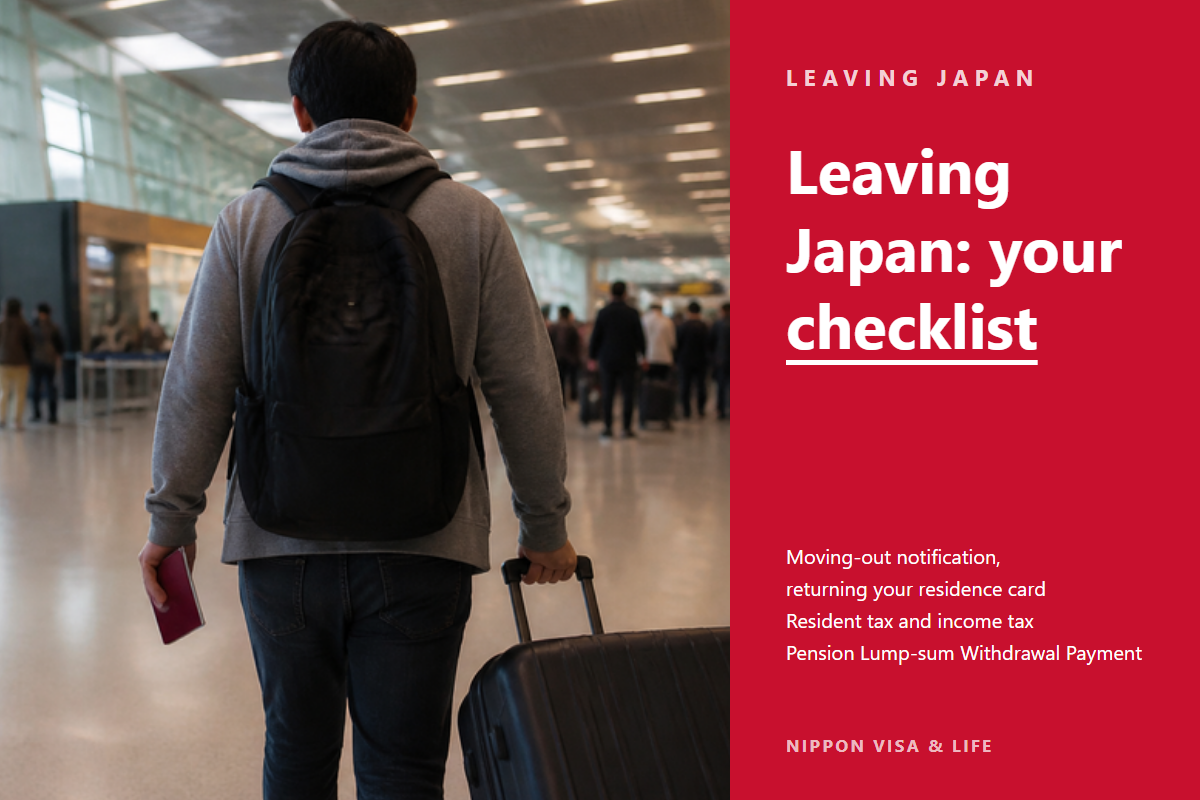
When you finish living in Japan and return home, complete the moving-out notification at your city, ward, town or village (municipality), your tax procedures, and the procedures for your bank account and mobile phone before you leave Japan. On the day you leave Japan, return your residence card at the airport or seaport. Claim the pension Lump-sum Withdrawal Payment after you no longer have an address in Japan.
This article covers the procedures for people who are leaving Japan for good. If you are going home temporarily or traveling and will come back to Japan, see “How to Leave Japan If You Plan to Come Back” below.
The Conclusion First: List of Procedures When You Return Home
| When | What to do | Where |
|---|---|---|
| Before you leave Japan | Submit the moving-out notification. Complete the procedure to leave National Health Insurance | The office of the municipality where you live |
| Before you leave Japan | Pay your resident tax. If you cannot pay it, notify the municipality of your tax agent | The office of the municipality where you live |
| Before you leave Japan | Complete the year-end adjustment or final tax return for income tax. If procedures will remain after you leave Japan, notify the tax office of your tax agent | Your company or the tax office |
| Before you leave Japan | Close your bank account | A branch of the bank where you opened the account |
| Before you leave Japan | Cancel your mobile phone contract | Your mobile phone company |
| Before you leave Japan | Contact the companies to stop electricity, gas and water, submit a change-of-address notification for your mail, and tell your landlord that you are moving out | The electricity company, gas company and waterworks bureau; the post office; your landlord or management company |
| The day you leave Japan | Return your residence card | The immigration inspector at the airport or seaport |
| After you leave Japan (within 2 years) | Claim the pension Lump-sum Withdrawal Payment (if you meet the conditions) | Japan Pension Service (by mail or online application) |
Each procedure is explained in order below. The overall procedures at the city office when you arrive in Japan are summarized in Procedures at the City Office After You Arrive in Japan: The Basics of the Moving-in Notification, My Number, National Health Insurance, National Pension and Resident Tax.
(Source: Immigration Services Agency “Guidebook on Living and Working” (PDF))
1. Procedures at the Municipal Office (Moving-out Notification and National Health Insurance)
Moving-out Notification
When you leave Japan and move to another country, submit a moving-out notification (転出届, tenshutsu todoke; a notification that you are leaving that municipality) to the office of the municipality where you live before you move.
The moving-out notification also matters when you claim the pension Lump-sum Withdrawal Payment. For details, see “4. The Pension Lump-sum Withdrawal Payment” below.
(Sources: Ministry of Internal Affairs and Communications “Move in / Move out”, Basic Resident Registration Act, Article 24)
How the moving-out notification and the moving-in notification work is explained in Moving-in Notification and Resident Record: Go to Your City Office Within 14 Days After Your Address in Japan Is Decided (What to Bring, Steps, and When You Move).
Procedure to Leave National Health Insurance
If you are enrolled in National Health Insurance (国民健康保険), when you leave Japan and no longer have an address in Japan, complete the procedure to leave National Health Insurance at the municipality where you live (the withdrawal procedure). Check at the municipal counter how to pay your last premiums. If you are enrolled in your company’s health insurance, check with your company.
(Sources: Immigration Services Agency “Guidebook on Living and Working” Chapter 6, 2-2 National Health Insurance (PDF), National Health Insurance Act, Articles 8 and 9)
How to leave National Health Insurance is summarized in How to Join and Leave National Health Insurance in Japan: Who Must Join, the 14-Day Notification, What to Bring, Premiums and Reductions.
2. Tax Procedures (Resident Tax and Income Tax)
Resident Tax
- Resident tax (住民税) is paid to the municipality where you have your address on January 1. Even if you leave Japan on or after January 2, you still need to pay that year’s resident tax.
- When you quit your job, pay any resident tax that has not yet been paid yourself. Another option is to ask your company to deduct the full amount from your last salary or retirement allowance and pay it to the municipality for you.
- If you cannot pay your resident tax before you leave Japan, before you leave Japan, choose a person living in Japan to handle tax procedures on your behalf (a tax agent, 納税管理人, nozei kanrinin) and notify the municipality where you live.
(Sources: Immigration Services Agency “Guidebook on Living and Working” Chapter 8, 2-3 (PDF), Ministry of Internal Affairs and Communications “Individual Inhabitant Tax for Foreign Residents” (外国人の方の個人住民税について))
How resident tax works is explained in How Resident Tax Works in Japan: When, How Much and How to Pay, Deduction from Salary vs. Paying Yourself, and What to Do When You Quit Your Job or Leave Japan.
Income Tax
- If you work for a company and will no longer have either an address or a place of residence (居所, kyosho; the place where you are staying) in Japan, as a rule you receive the year-end adjustment (年末調整; the company recalculates your tax for the year) for that year’s salary before you leave Japan.
- If you need to file a final tax return (確定申告), file the return and pay the tax before you leave Japan.
- If procedures such as a final tax return or tax payment will remain after you leave Japan, choose a tax agent living in Japan and submit the “Notification of Tax Agent” (納税管理人の届出書) to the tax office. After you leave Japan, the tax agent handles the procedures on your behalf.
- Submit the notification when you choose your tax agent, or by the day you leave Japan. Submit it to the tax office for your place of tax payment (usually the place where you live). You can submit it through e-Tax or on paper (in person or by mail).
(Sources: Immigration Services Agency “Guidebook on Living and Working” Chapter 8, 1-2 (4) When leaving Japan (PDF), National Tax Agency “A1-7 Procedures for Notification of Appointment or Dismissal of a Tax Agent for Income Tax and Consumption Tax” (所得税・消費税の納税管理人の選任届出又は解任届出手続))
Who needs to file a final tax return, and what to be careful about when filing as you return home, are summarized in Who Needs to File a Final Tax Return in Japan and Who Does Not: Conditions for Company Employees, People with Multiple Part-time Jobs, Side Jobs and Sole Proprietors, Plus the Deadline and How to File.
3. The Day You Leave Japan: Return Your Residence Card at the Airport or Seaport
If you have finished living in Japan and will not come back (you leave Japan without re-entry procedures), return your residence card (在留カード) to the immigration inspector at the airport or seaport when you leave Japan. When you leave Japan, your residence card loses its effect (expires), so you are required to return it right there.
(Sources: Immigration Services Agency “Return of Residence Card, etc.” (在留カード等の返納), Immigration Services Agency “Guidebook on Living and Working” Chapter 1, 1-4 Returning the residence card (PDF))
How the residence card works is explained in What Is a Japanese Residence Card? How to Read the New-Style Card and the Specified Residence Card, and Procedures for Renewal, Address Changes, and Loss.
How to Leave Japan If You Plan to Come Back
If you are going home temporarily or traveling and will come back to Japan, you can use the re-entry system to return to Japan with your current status of residence and period of stay.
- Special Re-entry Permit (みなし再入国許可): If you have a residence card and a valid passport and will return within 1 year after leaving Japan (or by your period-of-stay expiration date, if it comes earlier than 1 year), you do not need to get a re-entry permit in advance. When you leave Japan, fill out the ED card for re-entry (the departure record form) and show it to the immigration inspector together with your passport and residence card. People whose period of stay is “3 months” or less and people with “Temporary Visitor” (短期滞在) status cannot use it.
- Re-entry Permit (再入国許可): If you will be away from Japan for longer than 1 year, apply for and get a re-entry permit at a Regional Immigration Services Bureau (地方出入国在留管理官署) before you leave Japan.
If you left Japan with re-entry permission but did not come back to Japan within its period of validity, your residence card loses its effect. In that case, return your residence card within 14 days from the day it lost its effect. If you return it by mail, send it to the Odaiba Branch Office of the Tokyo Regional Immigration Services Bureau and write “在留カード等返納” (return of residence card, etc.) on the front of the envelope.
(Sources: Immigration Services Agency “Guidebook on Living and Working” Chapter 1, 3 Re-entry permit (PDF), Immigration Services Agency “Application for Re-entry Permit” (再入国許可申請), Immigration Services Agency “Return of Residence Card, etc.” (在留カード等の返納))
The steps for leaving Japan when you go home temporarily are summarized in Can You Leave Japan Without Your Residence Card for a Trip Home? How to Get a Re-entry Permit and the Steps Before and After Departure.
4. The Pension Lump-sum Withdrawal Payment (Claim It After You Leave Japan)
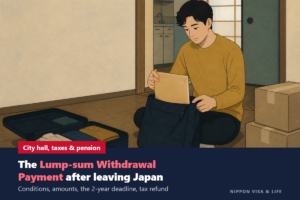
Foreign nationals who were enrolled in Japan’s pension system can claim the Lump-sum Withdrawal Payment (脱退一時金, dattai ichijikin) after leaving Japan, if they meet the conditions.
- The main conditions include having 6 months or more of enrollment in Employees’ Pension Insurance (厚生年金保険) or of paid National Pension (国民年金) premiums, and no longer having an address in Japan.
- The deadline for claiming is within 2 years from the day you no longer have an address in Japan.
- If you still have an address in Japan on the day the Japan Pension Service receives your claim form, you cannot receive the Lump-sum Withdrawal Payment. For this reason, claim it after you have submitted the moving-out notification.
- If you mail the claim form from Japan before you leave Japan, send it so that it reaches the Japan Pension Service after the day you leave Japan.
- If you receive the Lump-sum Withdrawal Payment, all of your records of the periods you were enrolled in Japan’s pension system up to that point will be erased. Decide whether to claim it after also considering the possibility of receiving a Japanese pension in the future.
(Sources: Immigration Services Agency “Guidebook on Living and Working” Chapter 7, 1-3 Lump-sum Withdrawal Payment (PDF), Japan Pension Service “The Lump-sum Withdrawal Payment system” (脱退一時金の制度))
All of the conditions for claiming, the amounts, and how to fill out the claim form are explained in The Lump-sum Withdrawal Payment from Japan’s Pension: Who Can Claim It After Returning Home, How Much, and How to Claim It (National Pension and Employees’ Pension Insurance, the 2-Year Deadline After Leaving Japan, and the Tax Refund).
5. Closing Your Bank Account and Cancelling Your Mobile Phone Contract
Bank Account
- If you will no longer use a bank account, for example because you are returning home, close it. You can close it at a branch of the bank.
- Selling or giving your account (cash card, bankbook, login ID, password, etc.) to someone else is a crime. Even if someone asks, “Let me use your account after you go home,” do not give it to them.
(Source: Immigration Services Agency “Guidebook on Living and Working” Chapter 12, 3-5 Bank accounts (PDF))
What to check before closing your account and what to do with your remaining money are summarized in Closing Your Bank Account When You Leave Japan: What to Do with Your Remaining Money, and Why Giving Your Account to Someone Else Is a Crime.
Mobile Phone
- If you will no longer use your mobile phone, for example because you are returning home, contact your mobile phone company and complete procedures such as cancelling the contract.
- Giving a mobile phone you signed a contract for to someone else without the mobile phone company’s consent is a violation of the law and is punished.
(Source: Immigration Services Agency “Guidebook on Living and Working” Chapter 12, 3-4 Mobile phones (PDF))
6. Procedures for Your Home, Electricity, Gas, Water and Mail
- Moving out of your room: If you live in a rental home, check your contract for how and by when to give notice that you are moving out, and contact your landlord or management company. For repair costs and the security deposit when you move out, see Restoration and Security Deposits When Moving Out of a Rental Home in Japan: Who Pays for Repairs? Examples from the National Government’s Guidelines.
- Electricity, gas and water: Tell the electricity company, gas company and waterworks bureau the day you want service stopped. How to find who to contact is summarized in How to Start and Stop Electricity, Gas and Water in Japan: Who to Contact When You Move, Being Present When Your Gas Is Stopped, and Where to Get Help with Electricity and Gas Sales Trouble.
- Throwing away furniture and home appliances: Put them out according to your municipality’s rules. For large furniture, see How to Put Out Oversized Garbage in Japan: Basics of Applying, Disposal Tickets (Stickers), and the Day and Place to Put It Out. For TVs, refrigerators, washing machines and air conditioners, see How to Throw Away a TV, Refrigerator, Washing Machine or Air Conditioner in Japan: Disposal Methods and Fees for the 4 Items Covered by the Home Appliance Recycling Act.
- Mail: Mail in Japan cannot be forwarded to an address in another country. If you want to stop delivery in Japan, submit a change-of-address notification (転居届) with everything filled in except the new address field at a post office counter or by putting it in a mailbox. Only the person who is moving can submit it. The online change-of-address notification (e-Tenkyo) cannot be used.
(Source: Japan Post “I am moving abroad. Can my mail be forwarded?” (海外へ引越しするが、転送できますか?))
How to submit a change-of-address notification for your mail is summarized in Mail Forwarding When You Move in Japan (Japan Post Change-of-Address Notification): Free for 1 Year, 3 Ways to Apply, ID Checks and Mail That Is Not Forwarded.
Problems and Frequently Asked Questions
What If I Returned Home Without Submitting the Moving-out Notification?
Ask the office of the municipality where you lived what to do. You cannot receive the Lump-sum Withdrawal Payment if you still have an address in Japan on the day the Japan Pension Service receives your claim form, so also check with the Japan Pension Service.
What If I Returned Home Before Finishing Paying My Resident Tax?
If you notified the municipality of a tax agent before leaving Japan, the tax agent will handle the procedures on your behalf. If you did not, ask the resident tax section of the municipality where you lived.
What Should I Do If I Return Home Right After Quitting My Job?
For resident tax, one option is to have the full amount deducted from your last salary or retirement allowance, so talk to your company early. As a rule, you also receive the year-end adjustment for income tax at your company before you leave Japan.
What If I Am Worried About Doing the Procedures in Japanese?
You may be able to get advice in a foreign language at the international exchange association in your area or at your municipality’s consultation counter for foreign residents. For pension matters, the Japan Pension Service offers consultations in foreign languages (Japan Pension Service “You can consult about pensions in various languages” (いろいろな国の言葉で年金の相談ができます)).
Primary Sources Referred to in Writing This Article
- Immigration Services Agency “Guidebook on Living and Working” (生活・就労ガイドブック) (PDF)
- Immigration Services Agency “Return of Residence Card, etc.” (在留カード等の返納)
- Immigration Services Agency “Application for Re-entry Permit” (再入国許可申請)
- Ministry of Internal Affairs and Communications “Move in / Move out”
- Ministry of Internal Affairs and Communications “Individual Inhabitant Tax for Foreign Residents” (外国人の方の個人住民税について)
- National Tax Agency “A1-7 Procedures for Notification of Appointment or Dismissal of a Tax Agent for Income Tax and Consumption Tax” (所得税・消費税の納税管理人の選任届出又は解任届出手続)
- Japan Pension Service “The Lump-sum Withdrawal Payment system” (脱退一時金の制度)
- Japan Pension Service “You can consult about pensions in various languages” (いろいろな国の言葉で年金の相談ができます)
- Japan Post “I am moving abroad. Can my mail be forwarded?” (海外へ引越しするが、転送できますか?)
- Basic Resident Registration Act (e-Gov Laws and Regulations Search)
- National Health Insurance Act (e-Gov Laws and Regulations Search)
This article is a translation of the original Japanese version.