This article was written by the NIPPON VISA & LIFE editorial team based on information from public organizations such as the national government and local governments. Rules and fees may differ depending on the city, ward, town or village where you live.
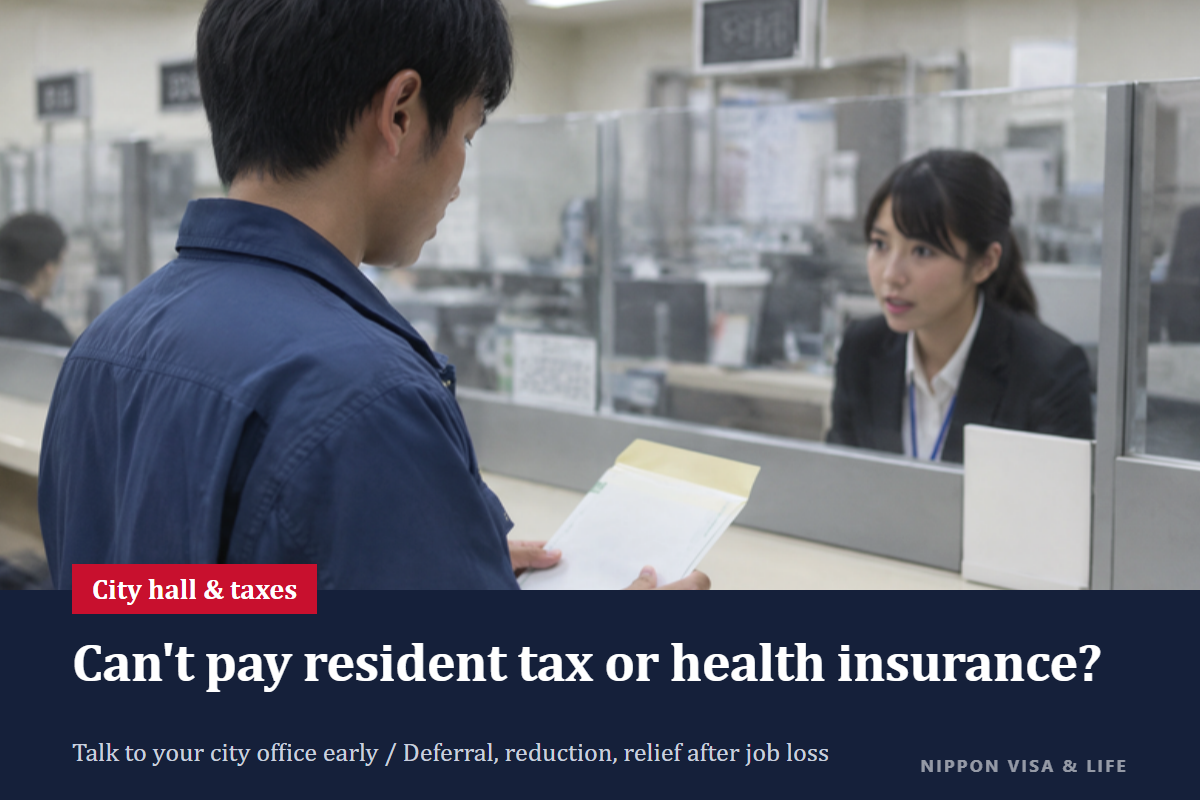
If you cannot pay your resident tax (住民税, jūminzei) or National Health Insurance premiums by the due date in Japan, do not just leave them unpaid. Talk early to the office of the city, ward, town or village that sent you the payment slip. Depending on your situation, you may be able to have payment postponed (猶予, yūyo) or have the amount reduced or exempted (減免, genmen). The law says that postponement of resident tax is granted based on the taxpayer’s own application (the procedure for reduction or exemption is set by each municipality’s ordinance).
The procedures you do at your city office as a whole are summarized in Procedures at the City Office After You Arrive in Japan: The Basics of the Moving-in Notification, My Number, National Health Insurance, National Pension and Resident Tax.
Summary: What to Do When You Cannot Pay Resident Tax or National Health Insurance Premiums (4 Steps)
- Gather your payment slips and notices: Have ready the “tax payment notice” (納税通知書) for resident tax, the “payment notice” (納入通知書) for National Health Insurance premiums, and, if you have received one, the “reminder notice” (督促状, tokusokujō: a document telling you that payment has not been made by the due date).
- Contact the office of the municipality that sent you the notice: For resident tax, contact the section in charge of taxes. For National Health Insurance premiums, contact the section in charge of National Health Insurance. The contact information is written on the notice.
- Explain why you cannot pay and your current income and living situation: Tell them about your circumstances, such as losing your job, becoming ill or injured, or being hit by a disaster.
- Ask which systems you can use, and apply: At the counter, check which systems you can use, such as postponement, reduction or exemption, or paying in installments, and what documents you need. Then apply.
Yokohama City advises that if it is difficult to pay city taxes (such as resident tax) because of your circumstances, you should talk to the tax collection staff of the taxation section at your ward office. For National Health Insurance premiums as well, it advises that if it is difficult to pay because of circumstances such as a disaster or losing your job, you should talk to the insurance and pension section at your ward office. As a rule, you must apply yourself to use the city’s systems for postponing, reducing or exempting city taxes.
(Source: Yokohama City “If You Have Difficulty Paying Your Taxes”, Yokohama City “Do People with No Income Also Have to Pay National Health Insurance Premiums?”)
What Happens If You Leave Resident Tax or National Health Insurance Premiums Unpaid
If you do not pay resident tax by the due date, the law sets out the following.
| Stage | What the law says |
|---|---|
| A reminder notice arrives | If you do not pay by the due date, the municipality is to send a reminder notice within 20 days after the due date (a municipality’s ordinance may set a different period). |
| Late payment charges are added | Late payment charges (延滞金, entaikin: money added for late payment) are added according to the number of days from the day after the due date until the day you pay. |
| Your property is seized | If you still have not paid 10 days after the day the reminder notice was sent, the municipality must seize the property of the person who has not paid. |
(Source: Local Tax Act, Articles 326, 329 and 331 (e-Gov Law Search))
The rate of late payment charges is set each year by a special rule that is separate from the main provisions of the law. Please ask your municipality how much it will be.
If you leave National Health Insurance premiums unpaid for a long time, you may be switched to a method where you first pay the full medical cost at the hospital counter and later get back the part covered by insurance (special medical care costs, 特別療養費). However, children up to the first March 31 after they turn 18 are not covered by this. Also, this switch is not made if it is recognized that there are special circumstances such as a disaster.
(Source: National Health Insurance Act, Article 54-3 (e-Gov Law Search))
You can still ask for advice even after a reminder notice has arrived. Please contact the office early, before it moves on to seizure.
Systems You Can Use When You Cannot Pay Resident Tax
For resident tax (municipal inhabitants’ tax and prefectural inhabitants’ tax), the law provides the following systems. In each case, you can receive it only when the municipality recognizes that you meet the requirements. Applying does not mean you will always receive it.
Postponement of Collection of Resident Tax (徴収猶予, chōshū yūyo): Having Payment Postponed
If it is recognized that you cannot pay the tax all at once because of circumstances like the following, you may be able to have payment postponed for a period of up to 1 year by applying.
- Your property was damaged by a disaster or theft
- You, or a family member who shares your household budget, became ill or injured
- You closed or suspended your business
- Your business suffered a large loss
- You had circumstances similar to these
Tax whose payment has been postponed may have to be paid in installments within the postponement period.
(Source: Local Tax Act, Article 15 (e-Gov Law Search))
Postponement of Conversion of Resident Tax (換価の猶予, kanka no yūyo): Having the Sale of Seized Property Postponed
If paying the tax all at once may make it difficult to continue your life or your business, and it is recognized that you are willing to pay, you may be able to have the sale of seized property for money (conversion, 換価) postponed for a period of up to 1 year by applying.
Example: In Yokohama City, you apply to the taxation section at your ward office within 6 months of the tax payment deadline. It is not granted in cases such as when you have other unpaid city taxes. If it is granted, part of the late payment charges is exempted.
(Source: Local Tax Act, Article 15-6 (e-Gov Law Search), Yokohama City “Postponement of Conversion System”)
Reduction or Exemption of Resident Tax (減免, genmen): Having the Amount Reduced or Removed
For people with special circumstances such as a disaster, or people who receive public or private assistance (扶助, fujo: help to support daily living) for their livelihood because of poverty, the municipality can reduce or remove resident tax as set by the municipality’s ordinance. The cases in which reduction or exemption is granted differ according to each municipality’s ordinance.
Example: Yokohama City advises that reduction or exemption may be granted on application in cases such as being damaged by a disaster or losing your job for reasons that were not your own choice.
(Source: Local Tax Act, Article 323 (e-Gov Law Search), Yokohama City “What Should I Do If It Is Difficult to Pay City Taxes?”)
How resident tax works (when, how much and how to pay, and how the payment method changes when you quit your job) is explained in How Resident Tax Works in Japan: When, How Much and How to Pay, Deduction from Salary vs. Paying Yourself, and What to Do When You Quit Your Job or Leave Japan.
Systems You Can Use When You Cannot Pay National Health Insurance Premiums
Depending on the municipality, National Health Insurance premiums are called either “National Health Insurance premiums” (国民健康保険料) or “National Health Insurance tax” (国民健康保険税). In either case, if you cannot pay, talk to the counter in charge of National Health Insurance.
Lower National Health Insurance Premiums for Low-Income Households (70%, 50% or 20%)
For households whose income is below the standard set by law, the part of the premium decided by the number of members and so on (the per-capita and per-household amounts, 均等割・平等割) is reduced by 70%, 50% or 20%. Because this requires that the previous year’s income be known, it is important that even people who had no income file an income declaration with their municipality.
(Source: Ministry of Health, Labour and Welfare “About National Health Insurance Premiums and National Health Insurance Tax”, Yokohama City “Do People with No Income Also Have to Pay National Health Insurance Premiums?”)
Lower National Health Insurance Premiums for People Who Were Dismissed, Whose Contract Was Not Renewed, or Who Quit for a Justifiable Reason
For people who lost their job because of bankruptcy, dismissal and so on (an “eligible recipient for specified reasons” (特定受給資格者) under employment insurance), and people who left because their contract was not renewed, because of illness or for another justifiable reason (a “person who left a job for specified reasons” (特定理由離職者) under employment insurance), premiums are calculated by treating the previous year’s employment income as 30/100 (30%), from the time they lost their job until the end of the following fiscal year.
Example: In Yokohama City, you must submit a notification to receive this reduction. You submit it to the insurance and pension section at your ward office, bringing the original of your Employment Insurance Eligibility Card (雇用保険受給資格者証: a document you receive at Hello Work) and so on, plus an identity document. A separation notice (離職票) or a certificate of employment termination is not accepted. There are also conditions such as your separation date being no later than 2 days before your 65th birthday.
(Source: Ministry of Health, Labour and Welfare “About National Health Insurance Premiums and National Health Insurance Tax”, Yokohama City “Notice from National Health Insurance” (PDF))
Reduction, Exemption or Postponement of National Health Insurance Premiums: People with Special Reasons
As set by its ordinance, a municipality can reduce, remove or postpone the premiums of people who have special reasons. Which reasons qualify differs by municipality.
Example: Yokohama City advises that if it is difficult to pay because of a disaster, losing your job or other circumstances, you should talk to the insurance and pension section at your ward office.
(Source: National Health Insurance Act, Article 77 (e-Gov Law Search), Yokohama City “Do People with No Income Also Have to Pay National Health Insurance Premiums?”)
How to join and leave National Health Insurance and the basics of premiums are covered in How to Join and Leave National Health Insurance in Japan: Who Must Join, the 14-Day Notification, What to Bring, Premiums and Reductions.
What to Bring and What to Tell the Office When You Ask for Advice About Unpaid Tax or Premiums
What you need differs by municipality, but having the following will make things go faster.
- The tax payment notice, payment notice and reminder notice you received
- An identity document such as your residence card or My Number Card
- Documents showing your income (pay slips, withholding tax statement, etc.)
- If you lost your job, your separation notice or Employment Insurance Eligibility Card (a document you receive at Hello Work)
- Documents showing why you cannot pay, such as illness, injury or a disaster (if you have them)
At the counter, you may be asked “how much can you pay, and by when?” Writing down your monthly income and necessary expenses such as rent will make it easier to answer. If it is difficult to explain in Japanese, you can ask whether your municipality has a consultation counter for foreign residents, or ask a family member or friend who speaks Japanese to come with you.
Frequently Asked Questions
Can I Still Ask for Advice After a Reminder Notice Has Arrived?
Yes, you can. A reminder notice is a document telling you that payment has not been made by the due date. When you receive one, contact the office written on it right away. If you leave it, it may move on to seizure as set by law.
What If I Cannot Pay Resident Tax or National Health Insurance Premiums All at Once and Want to Pay in Installments?
Please talk to the counter at your municipality. If postponement is granted, you may pay in installments within the postponement period. How you can pay differs depending on the municipality and your situation.
What If I Also Cannot Pay National Pension Premiums?
National Pension premiums are a separate system from resident tax and National Health Insurance premiums, and you can apply for an exemption or payment postponement. See When You Cannot Pay National Pension Premiums in Japan: How to Apply for Exemption or Payment Postponement (Income Criteria, Where to Apply, What to Bring, Making Up Payments Later).
What If I Cannot Pay Not Only Taxes but Also Rent and Living Expenses?
The national government has set up “independence consultation support organizations” (自立相談支援機関) throughout the country to give advice to people who are having difficulty making a living. Depending on your situation, they guide you to support such as help with finding a job, the Housing Security Benefit (住居確保給付金), which provides money equivalent to rent, and help with rebuilding your household finances. If you do not know where your nearest counter is, ask the municipality where you live. Rent is also explained in When You Cannot Pay Your Rent in Japan: The Basics of Paying Rent, the Housing Security Benefit and Where to Get Help.
(Source: Ministry of Health, Labour and Welfare “Support System for Self-Reliance of Needy Persons”)
Primary Sources Referred to in Writing This Article
- Local Tax Act (e-Gov Law Search): Article 15 (postponement of collection), Article 15-6 (postponement of conversion on application), Article 323 (reduction or exemption of municipal inhabitants’ tax), Article 326 (late payment charges), Article 329 (reminder), Article 331 (disposition for delinquency)
- National Health Insurance Act (e-Gov Law Search): Article 54-3 (special medical care costs), Article 77 (reduction or exemption of premiums, etc.)
- Ministry of Health, Labour and Welfare “About National Health Insurance Premiums and National Health Insurance Tax”
- Ministry of Health, Labour and Welfare “Support System for Self-Reliance of Needy Persons”
- Yokohama City “If You Have Difficulty Paying Your Taxes”
- Yokohama City “Postponement of Conversion System”
- Yokohama City “What Should I Do If It Is Difficult to Pay City Taxes?”
- Yokohama City “Do People with No Income Also Have to Pay National Health Insurance Premiums?”
- Yokohama City “Notice from National Health Insurance” (PDF)
This article is a translation of the original Japanese version.