This article was written by the NIPPON VISA & LIFE editorial team based on information from public organizations such as the national government and local governments. Rules and fees may differ depending on the city, ward, town or village where you live.
Online shopping in Japan does not have cooling-off (a system that lets you cancel a contract without giving a reason). Whether you can return an item depends on the return rules the store displays. This article explains what to check before you order and where to get help when you have a problem.
An overview of money and shopping is available in The Basics of Money and Shopping in Japan: Bank Accounts, Ways to Pay, Consumption Tax, Smartphone Contracts, Sending Money Abroad and Where to Get Help.
Summary: The Basics of Returning Items Bought Online
- Purchases you apply for via the internet, TV, catalogs and so on (mail order) do not have cooling-off.
- If the store displays return rules (called a “return policy”) in its advertisement, you must follow those rules. If it says “Returns not accepted”, in principle you cannot return the item.
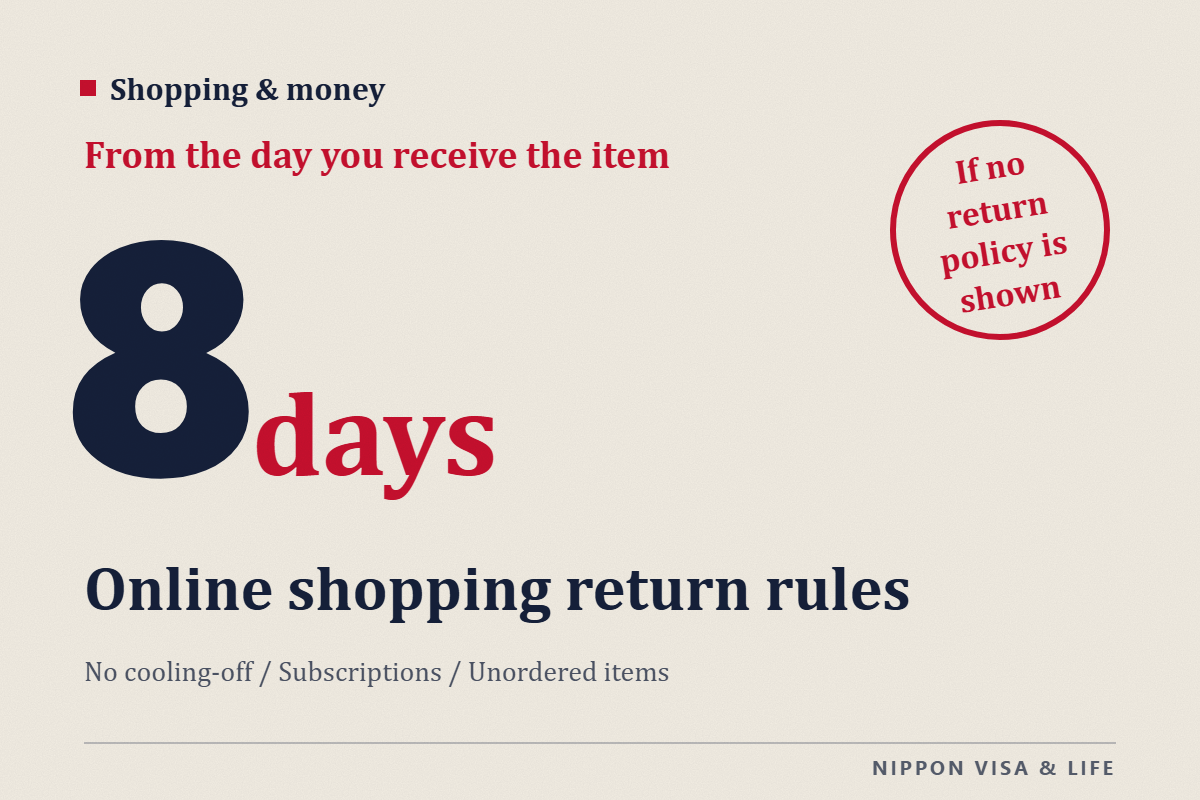
- If no return rules are displayed, you can withdraw your application or cancel the contract within 8 days counting from the day you received the item. The buyer pays the shipping cost for the return.
- The screen shown before you confirm your order (the final confirmation screen) is required to display the price, shipping cost, when and how to pay, when the item will arrive, the return rules and so on. Always read it before you order.
- If an item you did not order is sent to you one-sidedly, you do not need to pay for it.
- If you have a problem, you can call the Consumer Hotline (188) for advice.
(Source: Consumer Affairs Agency “Guide to the Act on Specified Commercial Transactions” Mail Order Sales, National Consumer Affairs Center of Japan (NCAC) “Cooling-off”)
1. What Mail Order Sales Are
Mail order sales are transactions in which a store advertises in newspapers, magazines, on TV, on the internet and so on, and the buyer applies by post, phone, fax, the internet and so on. Transactions on internet auction sites are also included.
The rules for mail order sales are set by a law called the “Act on Specified Commercial Transactions”. Even if the seller is an individual rather than a company, these rules apply if the person sells repeatedly to make a profit.
(Source: Consumer Affairs Agency “Guide to the Act on Specified Commercial Transactions” Mail Order Sales)
2. How It Is Decided Whether You Can Return an Item
| What the store displays | Can you return the item? | Shipping cost for the return |
|---|---|---|
| The store displays return rules (a return policy) | Follow the displayed rules (for example “No returns”, “Unopened items only”, “Within ○ days”) | Follow the displayed rules |
| The store does not display return rules (including internet orders where the return rules are not shown on the final confirmation screen) | You can withdraw your application or cancel the contract within 8 days counting from the day you received the item | The buyer pays |
- When you apply on the internet, the store must display its return rules on the final confirmation screen as well, not only in its advertisement.
- The return rules (whether returns are accepted, conditions such as the period in which you can return the item, and who pays the shipping cost for returns) are items that must not be left out of an advertisement.
- This 8-day rule applies to contracts for buying goods (and some rights).
Steps When You Want to Return an Item
- Check the return rules on pages of the website where you ordered, such as “About returns” or “Notation based on the Act on Specified Commercial Transactions”.
- Check the period and conditions for returns (for example, whether the item must be unopened).
- Following the rules, contact the store to return the item.
- If the store does not refund your money or does not respond, consult the Consumer Hotline (188) (see “6. Where to Get Help When You Have a Problem” below).
Stores are prohibited from giving false explanations to stop you from returning an item. Stores are also prohibited from refusing or delaying the refund when the contract has been cancelled.
(Source: Consumer Affairs Agency “Guide to the Act on Specified Commercial Transactions” Mail Order Sales, e-Gov Laws and Regulations Search “Act on Specified Commercial Transactions” Article 15-3)
3. What to Check on the Final Confirmation Screen Before You Order
When you order on the internet, the screen shown before you confirm your order (the final confirmation screen) is required to display the following.
- Quantity (number of items, number of deliveries, period and so on)
- Selling price (the shipping cost is also shown)
- When and how to pay
- When the item will arrive
- If there is a set period for applying, that fact
- Withdrawal of the application and cancellation of the contract (if there are return rules, what they say)
The store must also make it easy for the buyer to check and correct the contents of the order.
Before you press a button such as “Confirm order”, check the quantity, price, shipping cost and return rules.
(Source: Consumer Affairs Agency “Guide to the Act on Specified Commercial Transactions” Mail Order Sales)
4. Subscription Purchases (Contracts Where Items Keep Arriving When You Thought It Was a “Trial”)
There are cases where people applied after seeing advertisements such as “Cheap for the first time only” or “Trial”, and then items kept arriving from the second time onward and they were charged for them.
In mail order sales, when a contract must continue for two or more times, the store must display that fact and the sales conditions in its advertisement. The final confirmation screen is also required to show the quantity (how many times the deliveries continue), the price and so on.
When You Can Cancel Your Application
If the final confirmation screen displayed something like the following, and you applied because it misled you, you can cancel that application.
- Something the store must display was shown in a way that differed from the facts, and you believed it was true
- Something the store must display was not shown, and you thought there was no such condition
- There was a display that made you think pressing the button would not complete an application
- There was a display that misled you about the quantity, price, payment timing and so on
There is a limit to the period in which you can cancel. You can no longer cancel once 1 year has passed from the time you noticed the misunderstanding and became able to cancel, or 5 years have passed from the time you made the contract.
If you are not sure whether you can cancel in your case, consult the Consumer Hotline (188) as soon as possible.
(Source: Consumer Affairs Agency “Guide to the Act on Specified Commercial Transactions” Mail Order Sales, e-Gov Laws and Regulations Search “Act on Specified Commercial Transactions” Articles 15-4 and 9-3)
5. When Items You Did Not Order Arrive
Sometimes items you did not order are sent to you one-sidedly (this is called “negative option” or unsolicited goods).
- Because no sales contract has been made, you do not need to pay for them.
- You may dispose of items sent to you one-sidedly right away. Opening or disposing of them does not create any obligation to pay.
- Even if you are told “We have sent the item you ordered”, no contract has been made, so you do not need to pay.
- If you paid by mistake, you can ask the store to return the money. If you have a problem, consult the Consumer Hotline (188).
- The same rules also apply to items sent from overseas.
To be safe, check that a family member did not order the item before you dispose of it.
For scam emails and text messages, see What to Do About Scam Emails, Text Messages and Phone Calls in Japan: Tricks Pretending to Be Delivery Companies, the Police or Immigration, and Where to Get Help (#9110 and 188).
6. Where to Get Help When You Have a Problem
Consumer Hotline (188)
If you dial “188”, you will be connected to a consultation office near you, such as the Consumer Affairs Center of your city, ward, town or village, or of your prefecture.
- The consultation is free. However, call charges apply from the time you are connected to the consultation office.
- On Saturdays, Sundays and national holidays when the city, ward, town, village or prefectural offices are closed, the National Consumer Affairs Center of Japan (NCAC) provides supplementary consultation (except on facility inspection days and during the New Year holidays).
How to call 188 and information about Consumer Affairs Centers are summarized in Where to Get Help With Shopping and Contract Problems in Japan: Consumer Hotline 188, Consumer Affairs Centers and Cooling-off.
(Source: Consumer Affairs Agency “Consumer Hotline”)
Problems with Overseas Stores: Cross-border Consumer Center Japan
If an overseas store sells to Japan through its website and a person living in Japan buys from it, the Japanese Act on Specified Commercial Transactions also applies.
For problems with overseas stores (buying goods on the internet, accommodation bookings, cancelling websites or services and so on), you can consult the “Cross-border Consumer Center Japan” of the National Consumer Affairs Center of Japan (NCAC).
(Source: Consumer Affairs Agency “Guide to the Act on Specified Commercial Transactions” Q&A on Internet Mail Order from Overseas, National Consumer Affairs Center of Japan (NCAC) “Cross-border Consumer Center Japan”)
When Your Card or Smartphone Payment Is Used Without Permission
If you receive charges you do not recognize, see What to Do If Your Credit Card or Smartphone Payment Is Used Without Permission in Japan: How to Check Unfamiliar Charges, and Contacting the Card Company, Mobile Carrier, Police and Consumer Hotline 188.
Frequently Asked Questions
The clothes I received do not fit. Can I return them?
It depends on the store’s return rules. Check pages on the website such as “About returns”. If no return rules are displayed, you can return the item within 8 days counting from the day you received it, and you pay the shipping cost yourself.
I bought from a store that says “Returns not accepted”. What can I do?
If the return rules were displayed in the advertisement, you must follow those rules. However, in cases such as when the display on the final confirmation screen differed from the facts and you applied because it misled you, you may be able to cancel your application (see “4. Subscription Purchases” above).
Can I use cooling-off for mail order purchases?
No. Cooling-off is a system for transactions such as door-to-door sales and telephone solicitation sales, and it does not apply to mail order sales.
(Source: National Consumer Affairs Center of Japan (NCAC) “Cooling-off”)
Primary Sources Referred to in Writing This Article
- Consumer Affairs Agency “Guide to the Act on Specified Commercial Transactions” Mail Order Sales (checked 2026-11-08)
- Consumer Affairs Agency “Guide to the Act on Specified Commercial Transactions” Q&A on Goods Sent Without a Sales Contract (checked 2026-11-08)
- Consumer Affairs Agency “Guide to the Act on Specified Commercial Transactions” Q&A on Internet Mail Order from Overseas (checked 2026-11-08)
- National Consumer Affairs Center of Japan (NCAC) “Cooling-off” (checked 2026-11-08)
- Consumer Affairs Agency “Consumer Hotline” (checked 2026-11-08)
- National Consumer Affairs Center of Japan (NCAC) “Cross-border Consumer Center Japan” (checked 2026-11-08)
- e-Gov Laws and Regulations Search “Act on Specified Commercial Transactions” (Articles 9-3, 15-3, 15-4 and 59)
This article is a translation of the original Japanese version.