This article was written by the NIPPON VISA & LIFE editorial team based on information from public organizations such as the national government and local governments. Rules and fees may differ depending on the city, ward, town or village where you live.
In Japan, when a problem is found with food that has been sold, the company that made it (or another responsible company) collects the products and takes them back. This is called a voluntary recall (jishu kaishu, 自主回収). You can look up recall information online on the Ministry of Health, Labour and Welfare’s “Food Sanitation Application System” (食品衛生申請等システム) and the Consumer Affairs Agency’s “Recall Information Site” (リコール情報サイト). If you have a food that is subject to a recall, do not eat it, and check the contact information and how the recall will be handled, as written in the recall notice.
For the overall flow of shopping, see The Basics of Money and Shopping in Japan.
The Short Answer: What to Do When You Hear About a Recall
- Search by product name: On the Food Sanitation Application System or the Recall Information Site, enter the product name or the company name and search.
- Check whether your product is subject to the recall: Compare the information in the recall notice, such as the product name, use-by or best-before date and manufacturing plant, with the label on the product you have.
- Do not eat it: If the food is subject to the recall, do not eat it.
- Check the contact information and how the recall will be handled: Follow the contact information and the method (refund, collection, exchange, etc.) written in the recall information.
What Is a Food Recall (Voluntary Recall)?
When companies that make or sell food find out that there is a problem with food they have sold, they sometimes collect and take back the products themselves. Since June 1, 2021, notifying the government (prefectures, etc.) has been mandatory for some voluntary recalls. The notified information is published together on a national system.
The voluntary recalls that must be notified are mainly the following 2 types.
| Reason for the recall | Examples | Law |
|---|---|---|
| Problems with the safety of the food itself | Contamination with E. coli, foreign objects mixed in, etc. | Food Sanitation Act |
| Problems with labeling related to safety | Labeling of allergens (substances that cause allergies), the use-by date, storage method, etc. is missing or wrong | Food Labeling Act |
(Source: Ministry of Health, Labour and Welfare and Consumer Affairs Agency, “To Consumers: Information on Voluntary Recalls of Food, etc. Can Now Be Checked Online”, Ministry of Health, Labour and Welfare, “Information on the Voluntary Recall Reporting System (Recalls)”)
For how to read food labels (use-by dates, allergen labeling, etc.), see How to Read Food Labels in Japan.
How to Look Up Recall Information
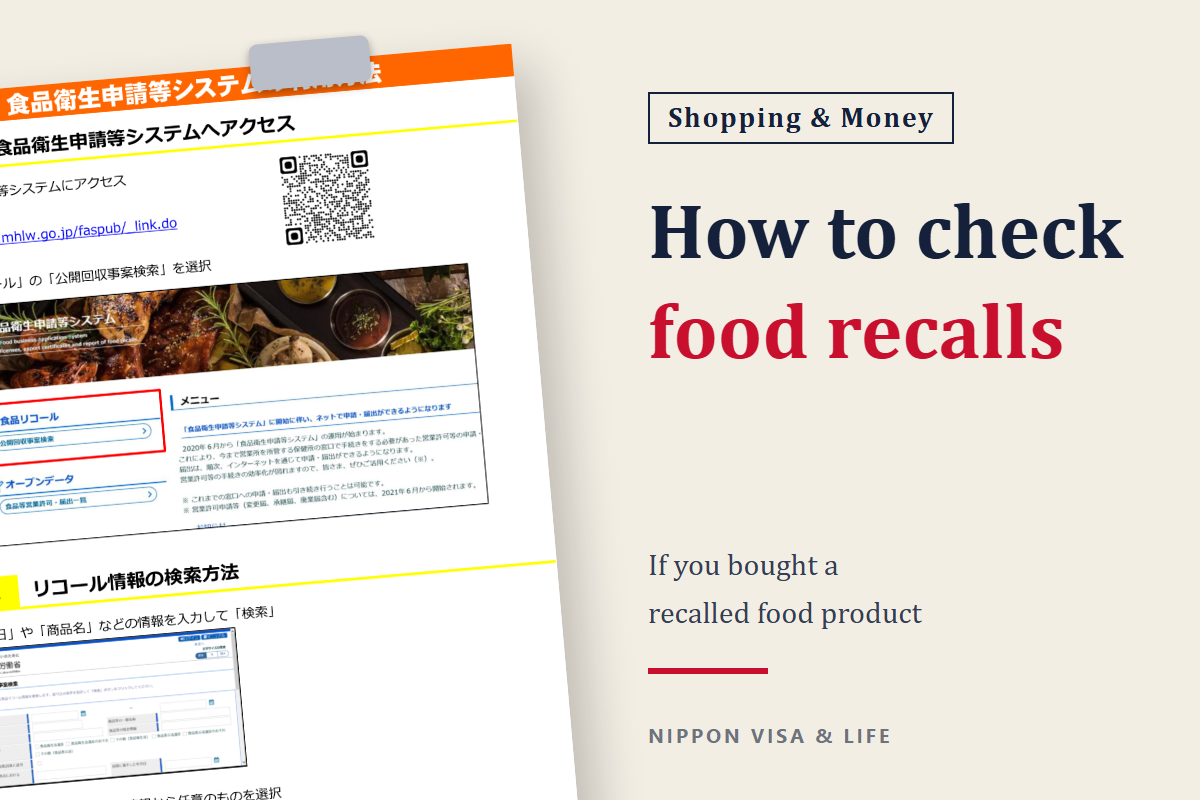
Method 1: Search on the Ministry of Health, Labour and Welfare’s “Food Sanitation Application System”
On this system, you can see voluntary food recalls that must be notified, all in one place. You can check information such as the product name, the reason for the recall and the possible health damage. It covers food as well as additives, utensils, containers and packaging, and toys.
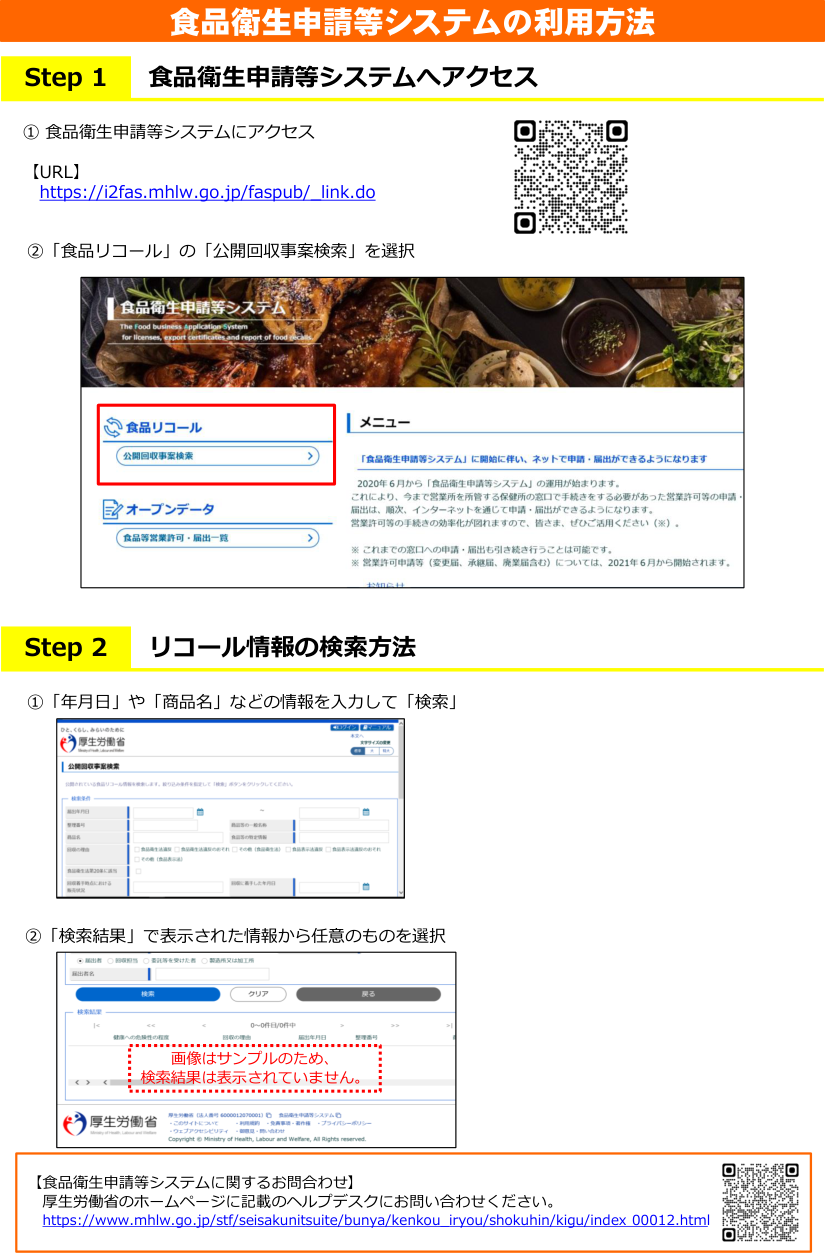
- Open the Food Sanitation Application System.
- Under “Food Recalls” (食品リコール), select “Search Published Recall Cases” (公開回収事案検索).
- Enter information such as the “date” (年月日) or the “product name” (商品名) and press “Search” (検索).
- From the search results, select the recall information you want to see.
Sources: Ministry of Health, Labour and Welfare and Consumer Affairs Agency, “To Consumers: Information on Voluntary Recalls of Food, etc. Can Now Be Checked Online”
The URL in the image (i2fas.mhlw.go.jp) and the link above (ifas.mhlw.go.jp) are written differently, but as of November 2, 2026, both could be opened. The screens are in Japanese. It is easier to find the product if you enter the product name exactly as it is written on the label of the product you have.
Method 2: Search on the Consumer Affairs Agency’s “Recall Information Site”
The Consumer Affairs Agency’s “Recall Information Site” lists information on recalls, free repairs, etc. for many kinds of products, not only food but also home appliances, cars and more. Food can be found in the “Food” (食料品) category. Newly registered information is listed under “Newly Registered Information” (新規登録情報) on the top page.
Each recall entry has sections such as the product name, the reason for the recall, the contact information, how the recall will be handled (refund, collection, exchange, etc.) and the date the response started.
How to Get Recall Information by Email
The Recall Information Site has a free email service (communication charges are separate). You can choose from 3 types: one that sends all the recall information posted on the site, one for products mainly used by elderly people, and one for products mainly used by children. The email for children’s products also includes new information about cases where the labeling of allergens in food was missing.
(Source: Consumer Affairs Agency, “Recall Information Site: Email Service”)
What the CLASS I, II and III Categories of Food Recalls Mean
Local governments classify the notified recall information by how serious the risk of health damage would be if the food were eaten. You can also narrow down your search of the published information by these categories.
| Category | Meaning (recalls under the Food Sanitation Act) | Examples |
|---|---|---|
| CLASS I | Eating it is highly likely to cause serious health damage or death | Vegetables eaten raw that are contaminated with enterohemorrhagic E. coli, etc. |
| CLASS II | Eating it is unlikely to cause serious health damage or death | Food in which the number of general bacteria, etc. does not meet the standards, etc. |
| CLASS III | Eating it is almost never likely to cause health damage | Products that violate the standards for how additives are used, etc. |
Recalls due to labeling problems (recalls under the Food Labeling Act) are classified as either CLASS I or CLASS II. Problems with allergen labeling are CLASS I.
(Source: Ministry of Health, Labour and Welfare, “If We Voluntarily Recall Food, etc., Do We Always Have to Notify?”, Consumer Affairs Agency, “Food Recall Information Notification System Based on Article 10-2 of the Food Labeling Act”)
Even if it is CLASS III, it is still a food subject to a recall. Whatever the category, follow the method written in the recall information.
If You Bought a Food Subject to a Recall
Check Whether the Product You Have Is Subject to the Recall
Even for products with the same name, the recall may cover only products with certain dates (use-by date or best-before date) or from certain manufacturing plants. Compare sections such as “information identifying the products concerned” (対象の特定情報) in the recall information with the label on the product you have (date, manufacturing plant, net quantity, etc.).
Do Not Eat the Food Subject to the Recall, and Follow the Recall Instructions
One of the purposes of publishing recall information on the national system is to prevent people from eating the food subject to the recall. If your food is subject to the recall, do not eat it, and check the contact information and how the recall will be handled (refund, collection, exchange, etc.) written in the recall information. How to return the product is written in each recall entry.
If You Have Already Eaten the Recalled Food and Feel Unwell
If you feel unwell, see a doctor at a hospital (medical institution). For how to see a doctor, see How to Go to a Hospital in Japan, and if you feel unwell at night or on a holiday, see If You Feel Unwell at Night or on a Holiday. If you have severe symptoms and it is urgent, call 119 for an ambulance.
When You Have Trouble / Frequently Asked Questions
I Cannot Read Japanese and Do Not Understand the Recall Information
The Food Sanitation Application System and the Recall Information Site are written in Japanese. Enter the product name or the company name exactly as it appears on the label you have and search. If you are worried about speaking Japanese when you call the recall contact, one option is to ask a family member or friend who understands Japanese, or someone at your workplace or school, to help you.
The Recall Contact Does Not Respond Even Though I Contacted Them
If you have trouble with a product you bought, call the Consumer Hotline (188) (消費者ホットライン「188」) and you will be directed to a nearby consultation office such as a Consumer Affairs Center. The consultation is free, but you pay the call charges. For details, see Where to Get Help with Shopping and Contract Problems in Japan: Consumer Hotline 188, Consumer Affairs Centers and Cooling-off.
(Source: Consumer Affairs Agency, “Consumer Hotline”)
Do All Recalls of Food Sold in Stores Appear on the National Websites?
Notification is mandatory for recalls due to problems related to food safety. Materials from the Ministry of Health, Labour and Welfare explain that simple cases such as putting the wrong product in a package, which have no legal problem, are not subject to notification. For that reason, some recalls are announced only by the store or company itself. Also check notices posted in stores and announcements on company websites.
Primary Sources Referred to in Writing This Article
- Ministry of Health, Labour and Welfare, “Information on the Voluntary Recall Reporting System (Recalls)”
- Ministry of Health, Labour and Welfare and Consumer Affairs Agency, “To Consumers: Information on Voluntary Recalls of Food, etc. Can Now Be Checked Online”
- Ministry of Health, Labour and Welfare, “If We Voluntarily Recall Food, etc., Do We Always Have to Notify?”
- Ministry of Health, Labour and Welfare, “Food Sanitation Application System”
- Consumer Affairs Agency, “Food Recall Information Notification System Based on Article 10-2 of the Food Labeling Act”
- Consumer Affairs Agency, “Recall Information Site”
- Consumer Affairs Agency, “Recall Information Site: Email Service”
- Consumer Affairs Agency, “Consumer Hotline”
This article is a translation of the original Japanese version.