

About the estimates in this article The timings in this article are simple estimates calculated by our editorial team from the trend in resident numbers published by the Immigration Services Agency, assuming the current pace continues. They are not the outlook of the Immigration Services Agency or the ministries in charge of each field, and they do not show when acceptance will actually stop. The conditions are as follows: the starting point is the number of residents at the end of July Reiwa 8 (2026) (preliminary figures); the deadline is the end of March Reiwa 11 (2029), when the period covered by the projected acceptance numbers ends (32 months from the starting point); and growth is calculated in three ways: A, the most recent year; B, the average of the most recent two years; and C, growth that slows by 10% every six months (the factor of 0.9 is an assumption set by our editorial team). Details are explained in “Conditions and Formulas Used in the Estimates.”
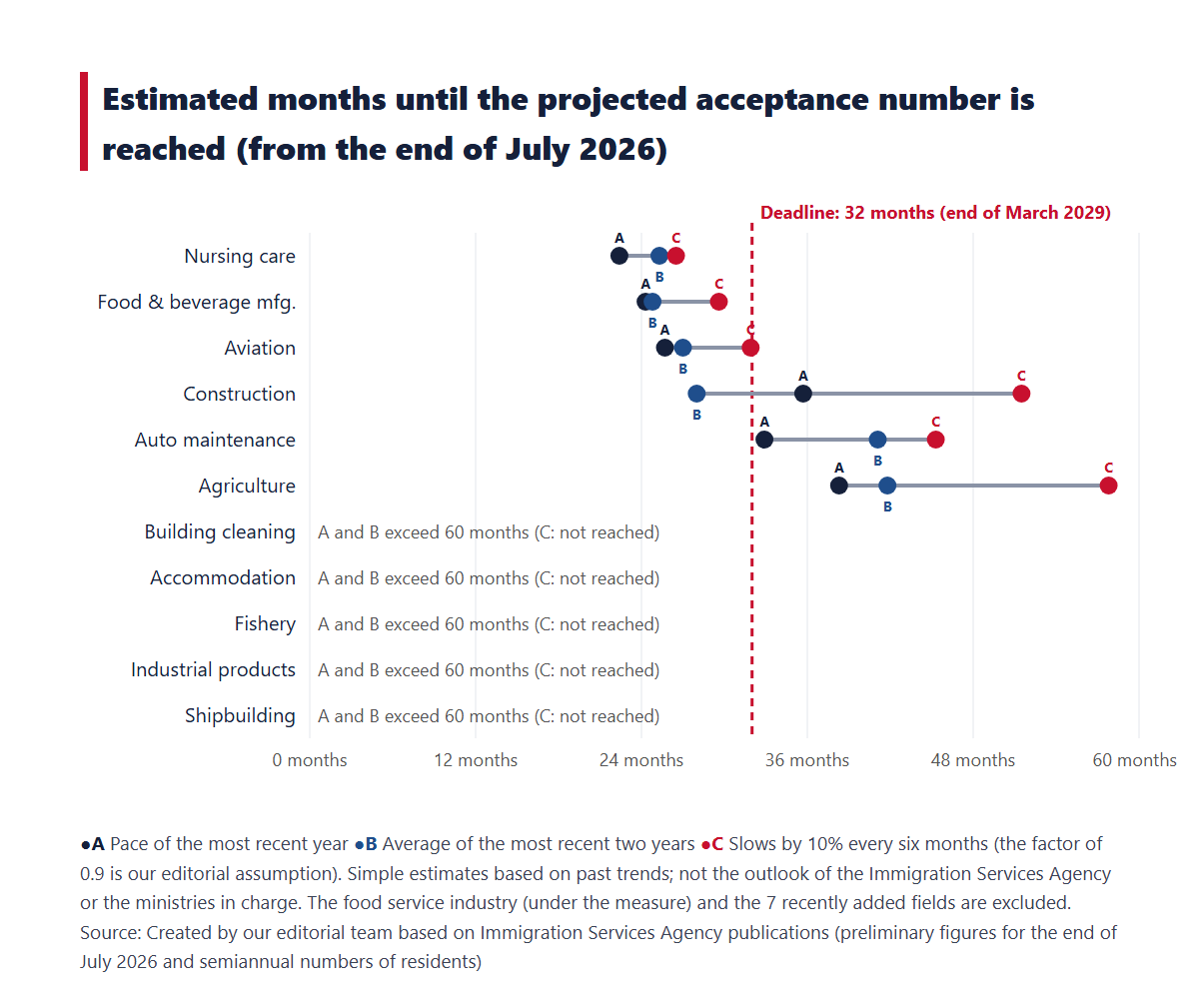
In Japan, the fields where the number of Specified Skilled Worker (i) (特定技能1号) residents is calculated to reach the projected acceptance number (受入れ見込数, the number operated as the acceptance cap) before the deadline at the end of March Reiwa 11 (2029) are three: nursing care, manufacture of food and beverages, and aviation (within the deadline in all three growth scenarios). Construction falls before or after the deadline depending on the growth assumption, automobile repair and maintenance and agriculture reach it after the deadline, and the other five fields are calculated not to reach it within the deadline. The food service industry is already under a measure that temporarily suspends the issuance of the Certificate of Eligibility (在留資格認定証明書) for this status of residence, and for the seven fields added in and after March Reiwa 6, there is not yet enough data to make an estimate.
What you will learn in this article
- How the acceptance cap (the projected acceptance number) works
- The conditions and formulas used in the estimates
- The current figures and the estimated results for each of the 19 fields
How the Acceptance Cap (Projected Acceptance Number) for Specified Skilled Worker (i) Works
The projected acceptance number is the estimated number of Specified Skilled Worker (i) foreign nationals to be accepted in each field by the end of March Reiwa 11 (2029). The current figures were set by a Cabinet decision on January 23, Reiwa 8 (2026), and the total for the 19 fields is 805,700 people.
The Immigration Services Agency operates the projected acceptance number as the acceptance cap. When the number of residents is about to exceed the projected number, a measure to temporarily suspend the issuance of Certificates of Eligibility may be taken under Article 7-2, Paragraphs 3 and 4 of the Immigration Control Act. In the food service industry field, this measure has been in place since April 13, Reiwa 8 (2026).
The projected numbers can also be revised. At the Expert Panel (15th meeting) on October 19, Reiwa 8 (2026), a revision plan for the Field-specific Operational Policies was presented that would change the projected numbers for nursing care and aviation (before Cabinet approval).
We use two publications from the Immigration Services Agency for the figures. The projected number, number of residents, and annual increase (the difference from one year earlier) for each field come from “Projected Acceptance Numbers and Numbers of Residents” (for Reiwa 8, posted on July 3 and updated on September 4 and October 6; preliminary figures). The number of residents in each field at the end of June and the end of December comes from the semiannual “Number of Specified Skilled Worker Foreign Residents.”
Sources: ISA Projected Acceptance Numbers and Numbers of Residents, Operation of the acceptance cap in the food service industry field, 15th Expert Panel
Conditions and Formulas Used in the Estimates
The starting point is the number of residents at the end of July Reiwa 8 (2026) (preliminary figures updated on October 6, Reiwa 8), and the deadline is the end of March Reiwa 11 (2029), 32 months from the starting point. The two formulas are as follows.
- Remaining = projected acceptance number − number of residents at the end of July Reiwa 8 (2026)
- Months until the cap is reached = remaining ÷ increase per year × 12
The increase per year was set in the following three ways. A and B assume that the number grows by the same amount every year.
| Estimate | Increase per year | Reason for this assumption |
|---|---|---|
| A Most recent year | The published annual increase (end of July Reiwa 7 → end of July Reiwa 8) | It is the published figure itself, and seasonal swings are evened out over one year |
| B Average of the most recent two years | Increase from the end of June Reiwa 6 to the end of June Reiwa 8 ÷ 2 (semiannual publications) | It evens out any bias that only the most recent year has |
| C Slowdown | The pace of A slows by 10% every six months (factor of 0.9) | A conservative calculation in case growth slows |
In Estimate C, the increase in the first six months is h = annual increase ÷ 2, and after that the increase in each six months is 0.9 times that of the previous six months. The total increase after n half-years is h×(1−0.9^n)÷(1−0.9), and the number of months until the cap is reached is 6×log(1−remaining×(1−0.9)÷h)÷log(0.9). With this growth pattern, even if the number keeps increasing, the total increase only goes up to h÷(1−0.9) = annual increase × 5, so fields whose remaining number is larger than that are marked “not reached by this calculation.”
The factor of 0.9 was not derived from the published figures. It is an assumption set by our editorial team to see the range of results if growth slows, based on the fact that the semiannual growth rate of the number of Specified Skilled Worker foreign residents (Specified Skilled Worker (i) and (ii) combined) has fallen from 18.2% to 16.1% to 13.8%.
We do not use a calculation that doubles the increase in a single half-year. Some fields, such as agriculture, grow very differently depending on the season, and the result would change greatly depending on which half-year is used. The timing of reaching the cap is given in months, together with an approximate half-year (for example, around the first half of 2028).
Please keep the following points in mind when reading the estimates.
- The starting point (the end-of-July publication) and the pace for B (the end-of-June publications) come from different sources. The figures for Reiwa 8 (2026) are preliminary
- Growth may change due to factors such as how the tests are being held, transitions from Technical Intern Training, transitions to Specified Skilled Worker (ii), people returning home or changing jobs, and the start of the Employment for Skill Development system (April 1, 2027)
- Reaching the projected number does not necessarily mean that acceptance will be suspended automatically. The Immigration Services Agency and the ministries in charge decide on any measure
The estimates cover 11 fields: the 12 fields with at least two years of resident number data, excluding the food service industry, which is under the measure. The “current figures” for each field are as of the end of July Reiwa 8 (2026) (preliminary figures). For the seven fields added in March Reiwa 6 or January Reiwa 8, only the current figures are shown.
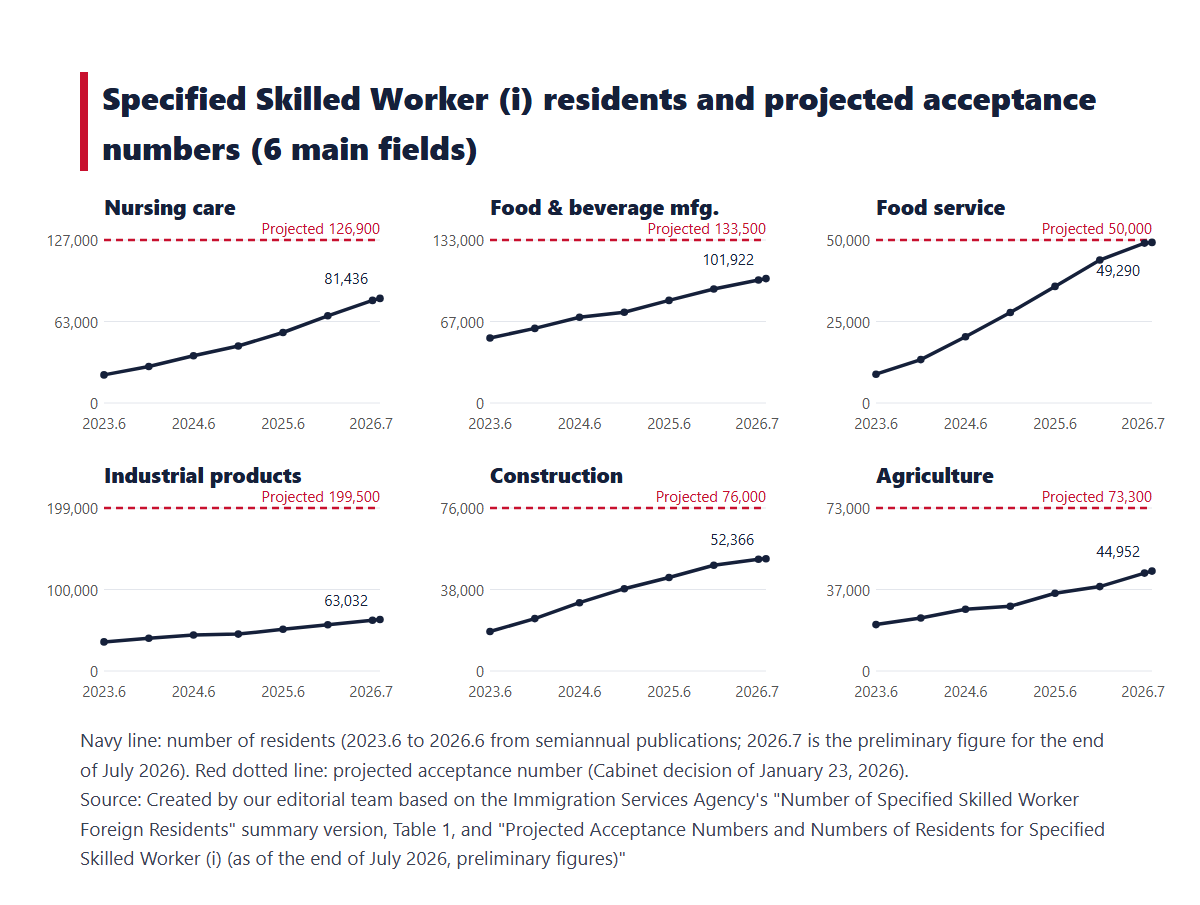
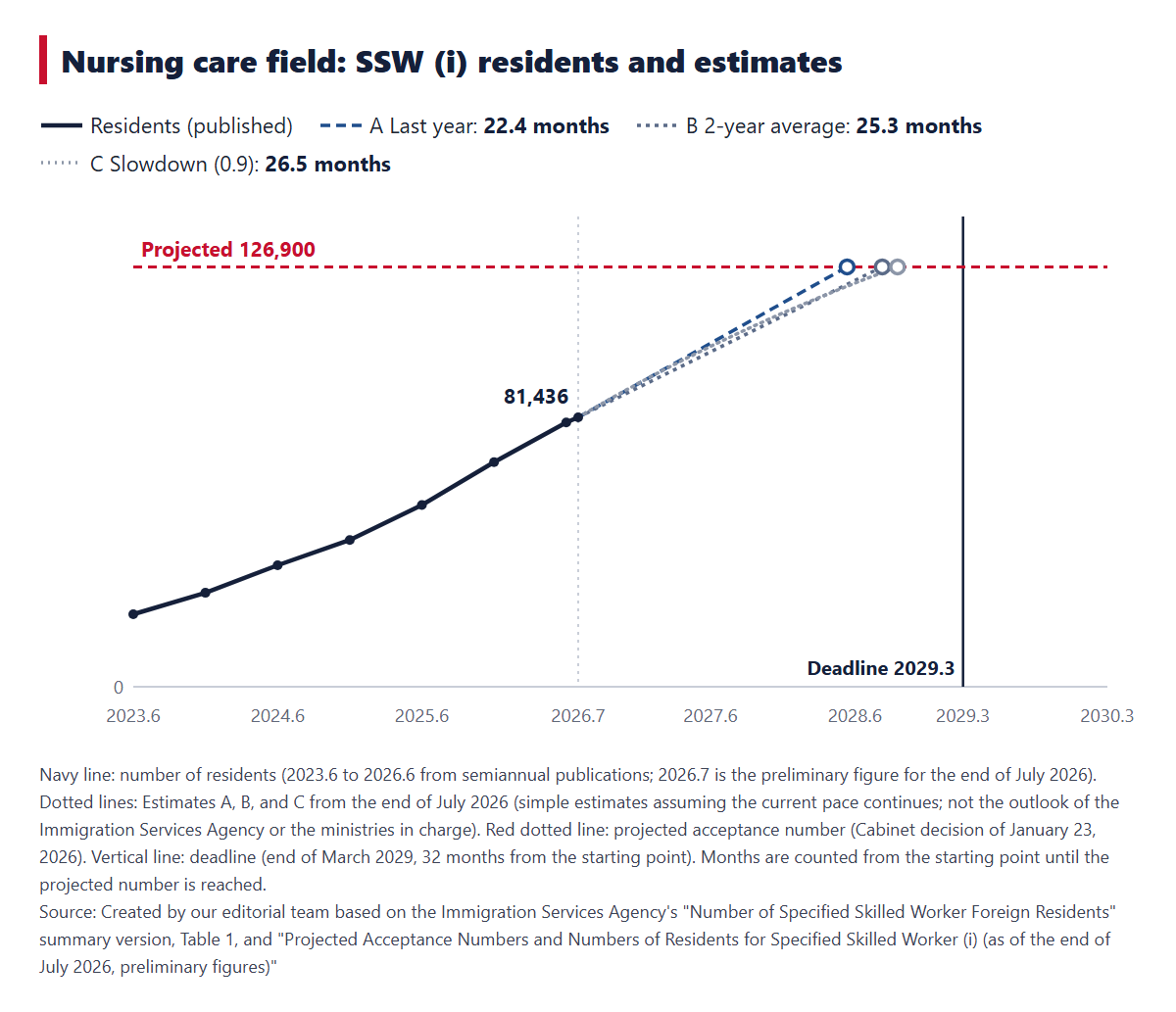
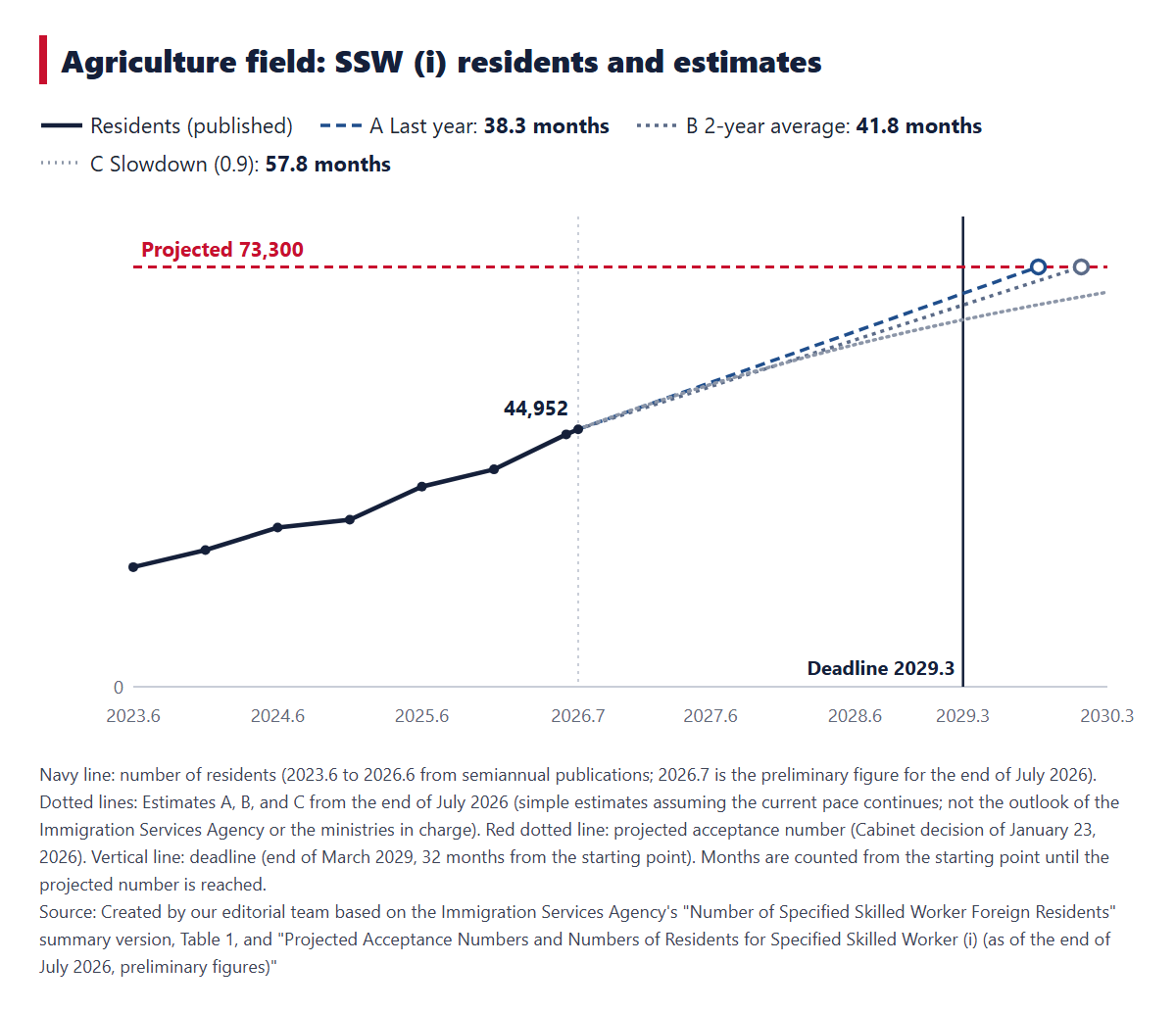
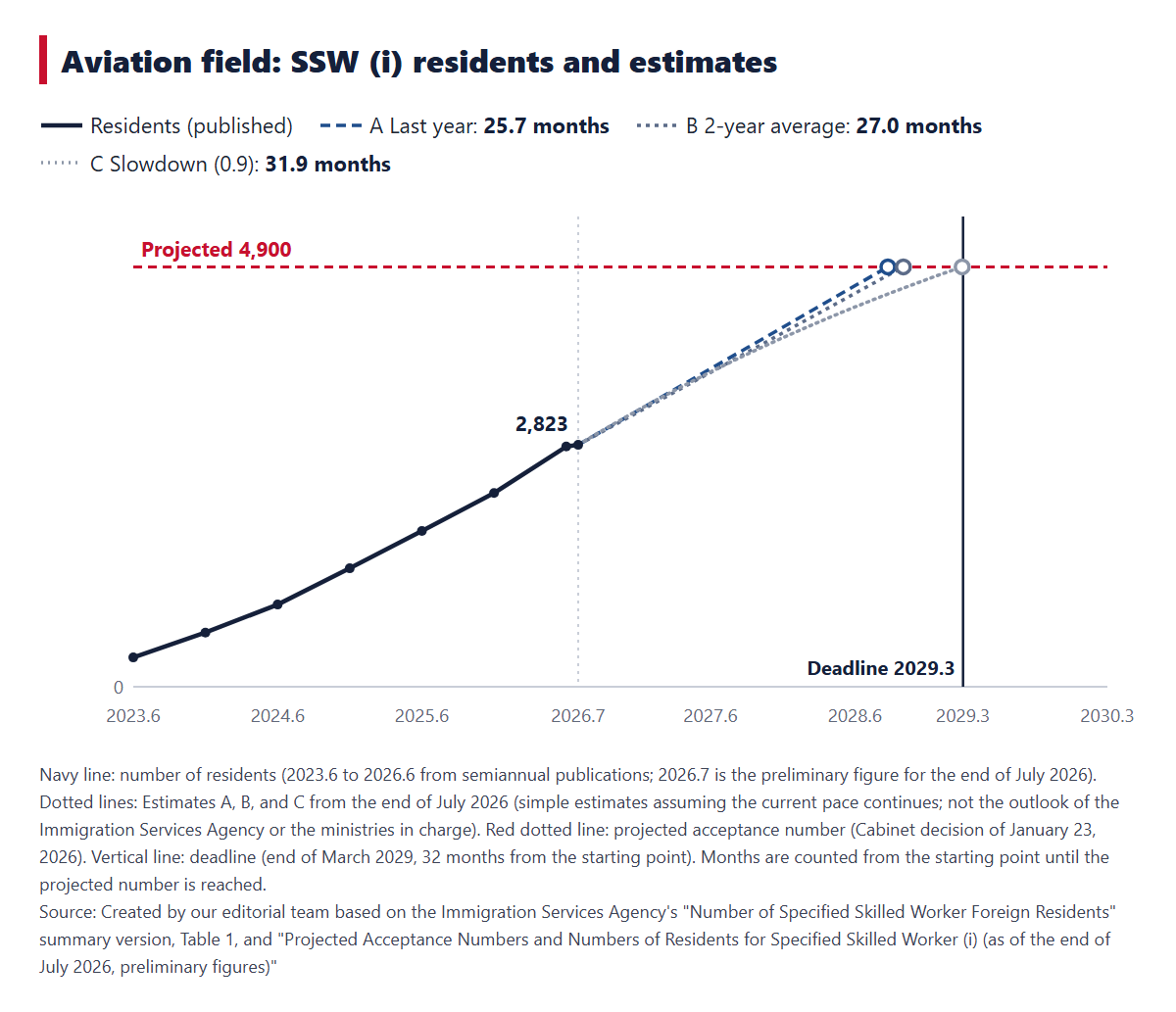
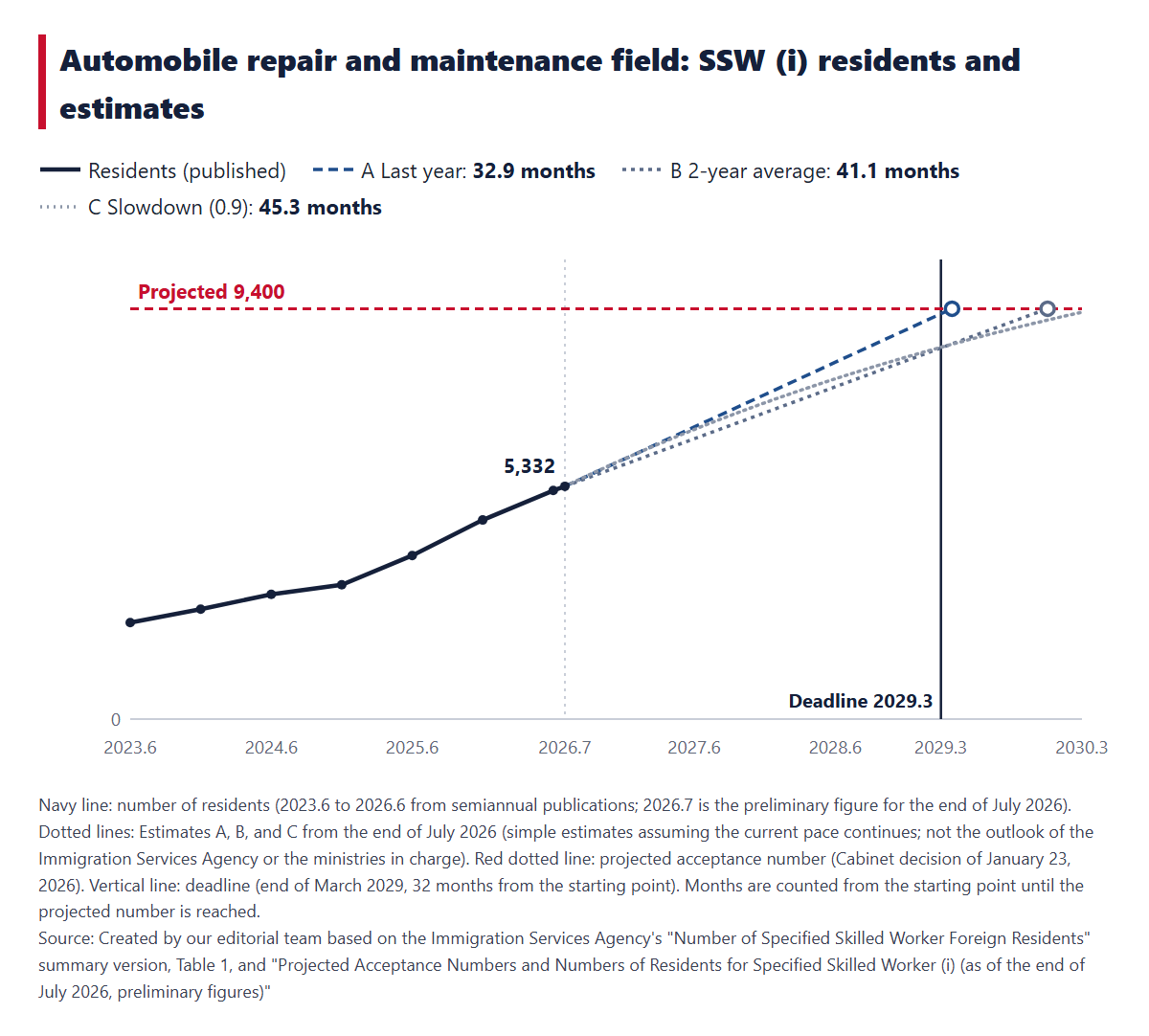
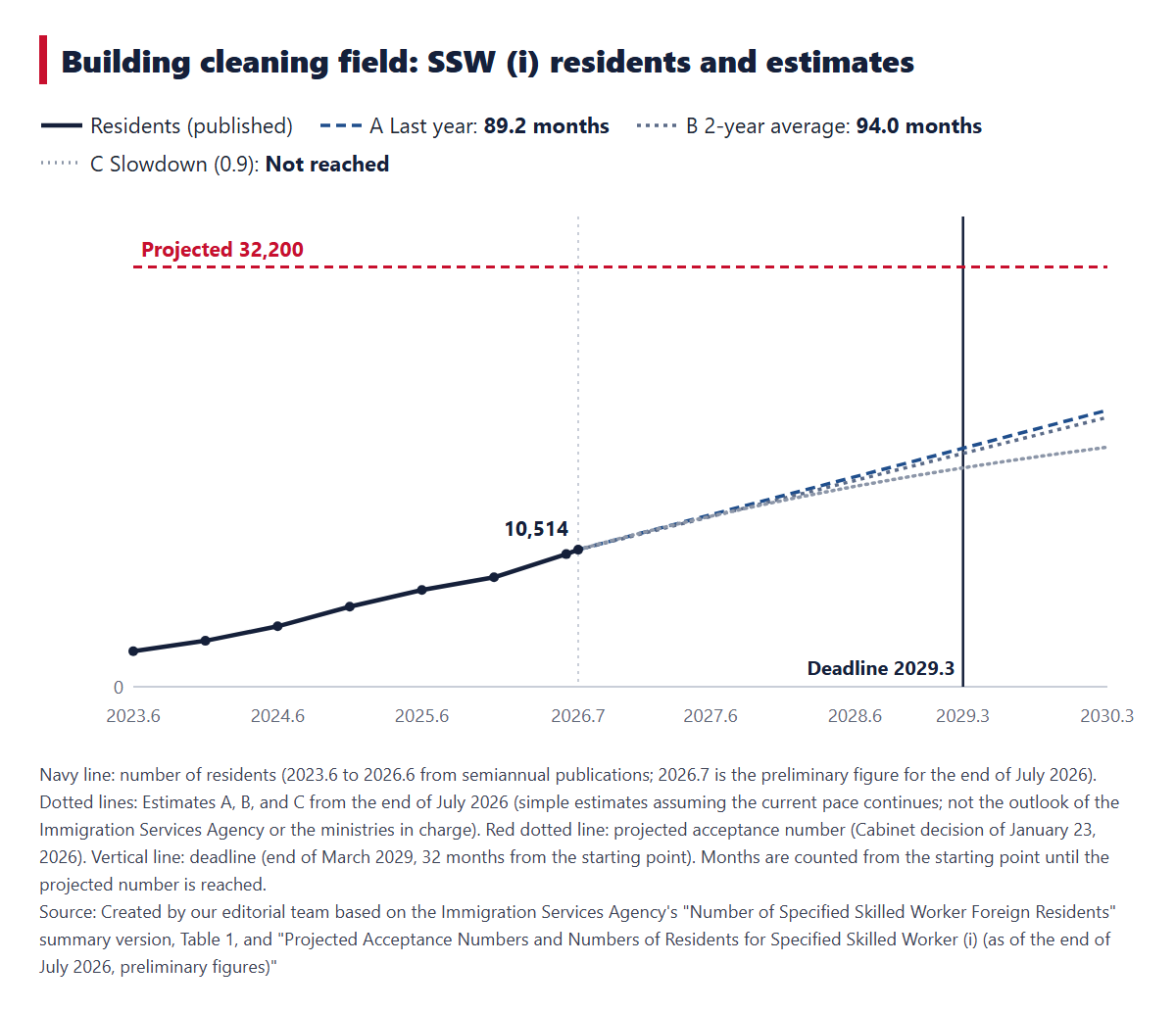
Under each field’s heading, we include a chart showing the trend in the number of residents and the lines for Estimates A, B, and C. The point where a dotted line meets the red dotted line (the projected number) is when the cap is reached, and the vertical line is the deadline.
Sources: Created by our editorial team based on ISA publications
Sources: ISA Publication of the Number of Specified Skilled Worker Foreign Residents, Key Points (end of June Reiwa 8), Employment for Skill Development System Q&A
Nursing Care Field: Estimate of When the Acceptance Cap Will Be Reached
In nursing care, all three estimates reach the projected acceptance number before the deadline (the end of March Reiwa 11).
- Current figures: projected number 126,900 people, residents 81,436 people (64.2%), annual increase 24,402 people
- Remaining: 45,464 people
- Estimates: A 22.4 months (around the first half of 2028) / B 25.3 months (around the second half of 2028) / C 26.5 months (around the second half of 2028)
Sources: Created by our editorial team based on ISA publications
The semiannual number of residents from the end of June Reiwa 5 to the end of June Reiwa 8 was 21,915 → 28,400 → 36,719 → 44,367 → 54,916 → 67,871 → 79,884 people. B is calculated by taking half of the 43,165-person increase over the two years from the end of June Reiwa 6 as one year’s increase.
The Ministry of Health, Labour and Welfare’s material for the 15th Expert Panel (Material 3-2) states that, if the current allocation continues, the number may exceed 126,900 in the second half of fiscal Reiwa 9 (FY2027). This is earlier than Estimate A (22.4 months). Please give priority to the official outlook.
At the same meeting, a revision plan (before Cabinet approval) was presented that would reduce the projected number for nursing care under Employment for Skill Development from 33,800 to 13,800 and set the number for Specified Skilled Worker (i) at 146,900. Calculated with the proposed 146,900, the results are A 32.2 months (around the first half of 2029) / B 36.4 months (around the second half of 2029) / C 43.8 months (around the first half of 2030), all three after the deadline. The plan has not yet been decided.
→ [2026 Edition Accepting Specified Skilled Workers in the “Nursing Care” Field in Japan: Conditions and Process | Tests, the Council, and Home-visit Care](https://kisaragi-office.com/immigration_journal/en/archives/2886)
Sources: 15th Expert Panel Material 3-2, Material 1-1
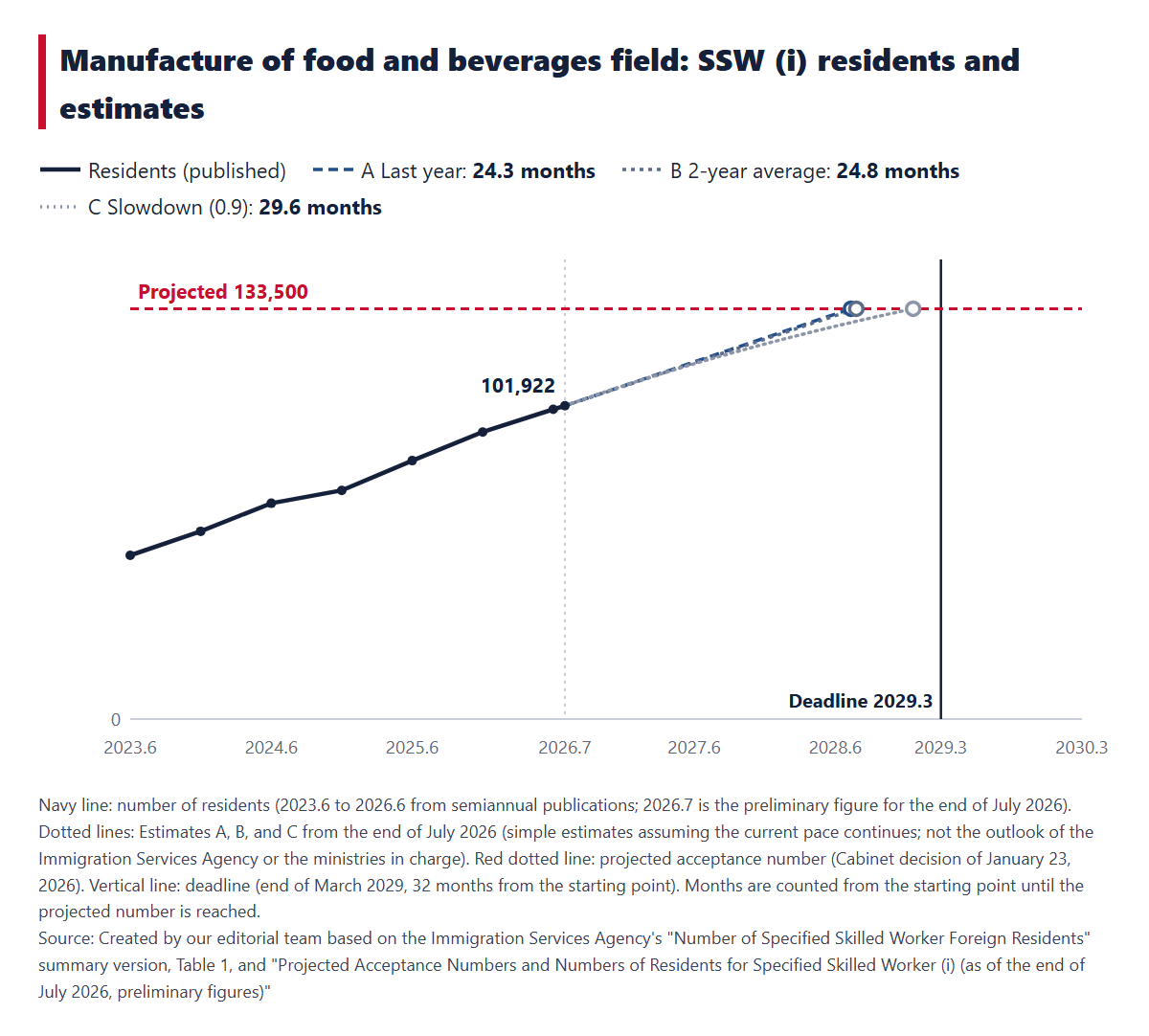
Manufacture of Food and Beverages Field: Estimate of When the Acceptance Cap Will Be Reached
In the manufacture of food and beverages, all three estimates reach the cap before the deadline. The difference between the three estimates is small, and growth in this field is stable.
- Current figures: projected number 133,500 people, residents 101,922 people (76.3%), annual increase 15,567 people
- Remaining: 31,578 people
- Estimates: A 24.3 months (around the second half of 2028) / B 24.8 months (around the second half of 2028) / C 29.6 months (around the first half of 2029)
Sources: Created by our editorial team based on ISA publications
The increase over the two years from the end of June Reiwa 6 was 30,567 people. This field has the largest number of residents of the 19 fields.
Food Service Industry Field: Why There Is No Estimate, and How the Field Approached the Acceptance Cap
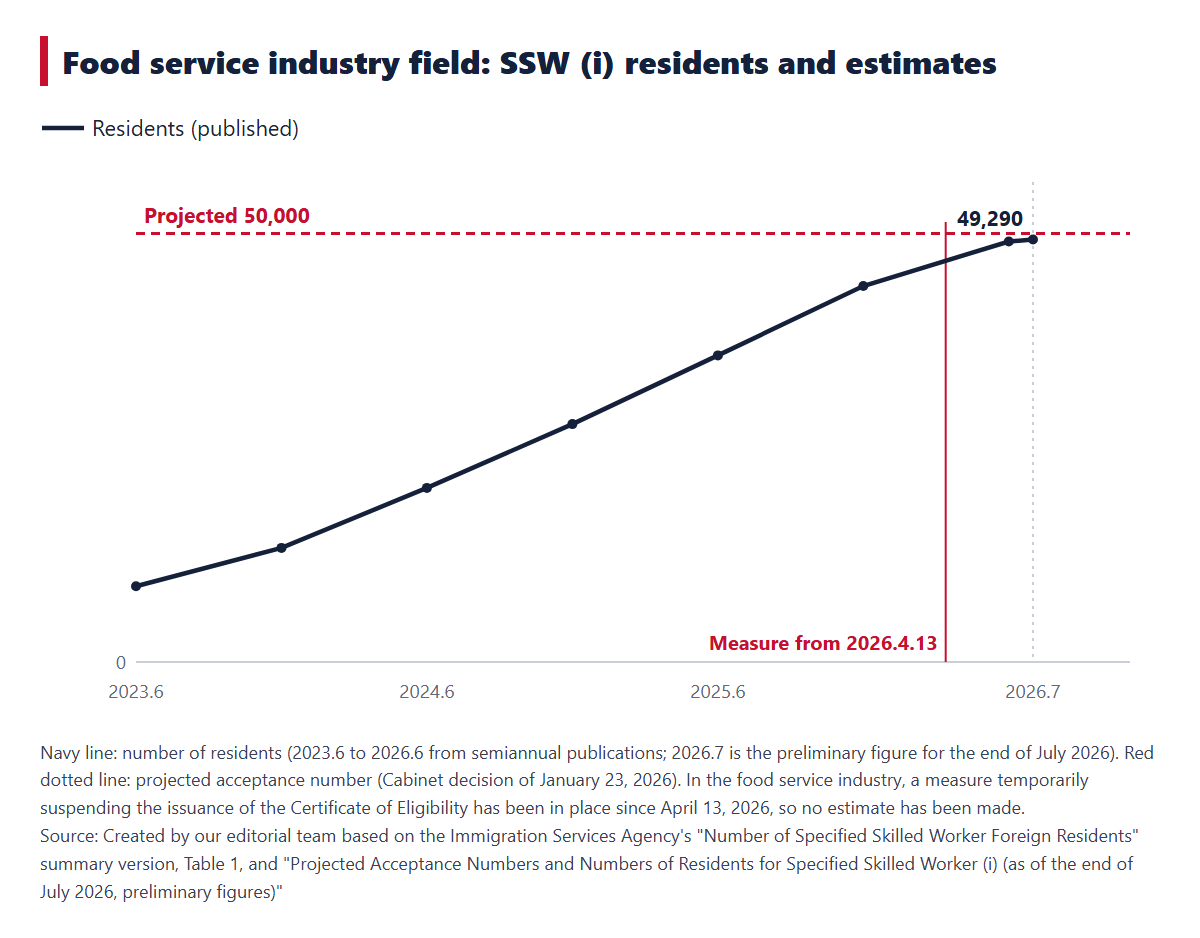
The food service industry is not covered by the estimates, because the number of residents has reached 98.6% of the projected number and the measure is already in place. As a real example of a field approaching the cap, we summarize the trend and the measure.
- Current figures: projected number 50,000 people, residents 49,290 people (98.6%), annual increase 12,107 people
- Semiannual number of residents: 8,842 → 13,312 → 20,308 → 27,759 → 35,771 → 43,869 → 49,060 people (end of June Reiwa 5 to end of June Reiwa 8)
Sources: Created by our editorial team based on ISA publications
On March 27, Reiwa 8 (2026), the Immigration Services Agency announced that, based on the number of residents at the end of February Reiwa 8 (preliminary figures), the number was expected to exceed the projected number (50,000 people) around May. Under Article 7-2, Paragraphs 3 and 4 of the Immigration Control Act, a measure to temporarily suspend the issuance of Certificates of Eligibility has been in place since April 13. The material for the 14th Expert Panel describes the timing of the resumption of acceptance as “undecided.”
The examination status and ways of hiring that are not covered by the measure are summarized in the following articles.
Sources: ISA Operation of the acceptance cap in the food service industry field, 14th Expert Panel Material 4-1
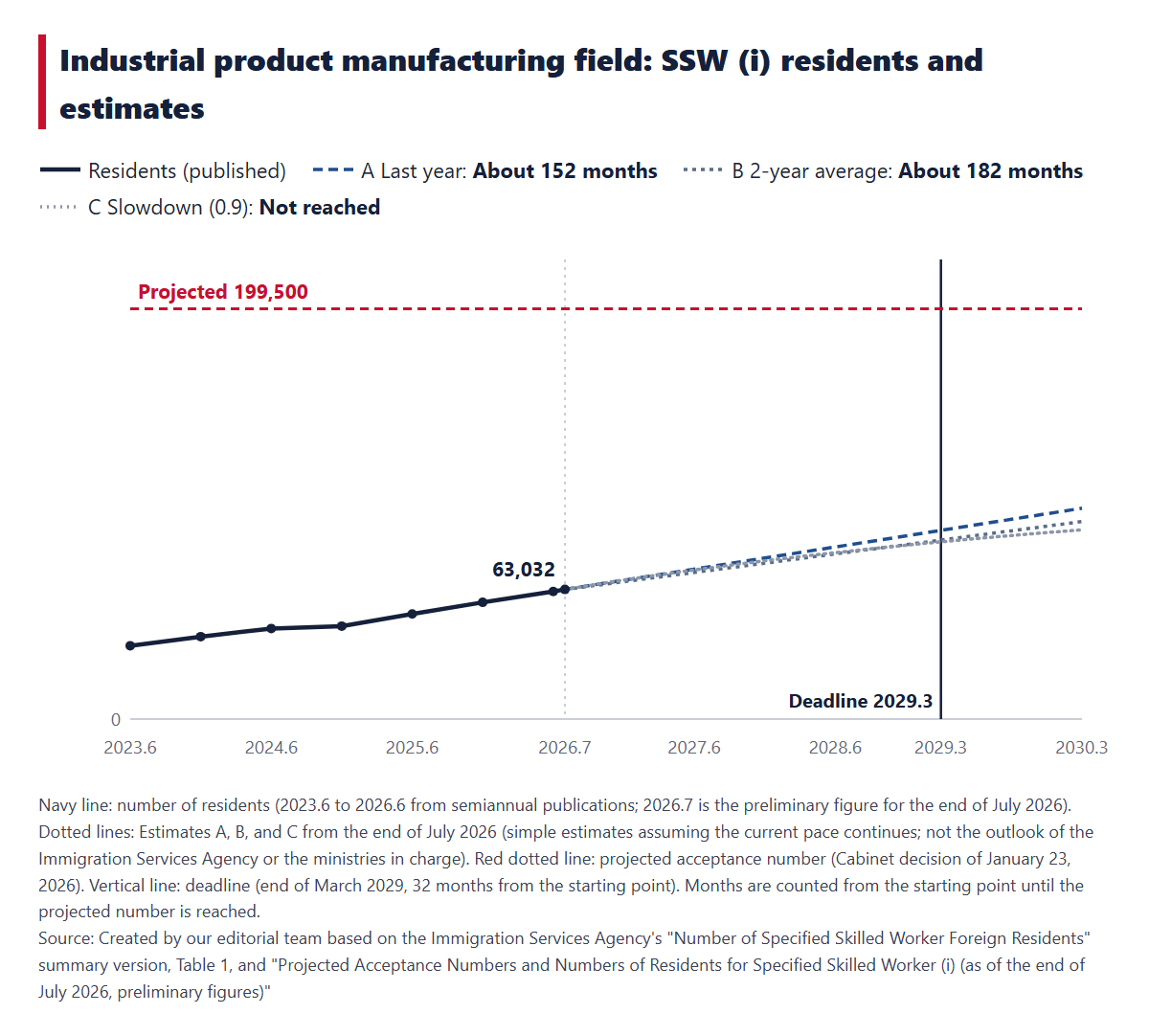
Industrial Product Manufacturing Field: Estimate of When the Acceptance Cap Will Be Reached
Industrial product manufacturing is calculated not to reach the cap within the deadline. This is because its projected number is the largest of the 19 fields (199,500 people), and the remaining number is also large.
- Current figures: projected number 199,500 people, residents 63,032 people (31.6%), annual increase 10,768 people
- Remaining: 136,468 people
- Estimates: A about 152 months (about 12.7 years) / B about 182 months (about 15.2 years) / C not reached by this calculation (even if the number keeps increasing, the total increase only goes up to 53,840 people)
Sources: Created by our editorial team based on ISA publications
The increase over two years was 17,989 people. In publications up to the end of June Reiwa 6, this field was listed as “Manufacturing of Elementary Materials, Industrial Machinery, and Electric, Electronic and Information Related Products,” and it is the same field.
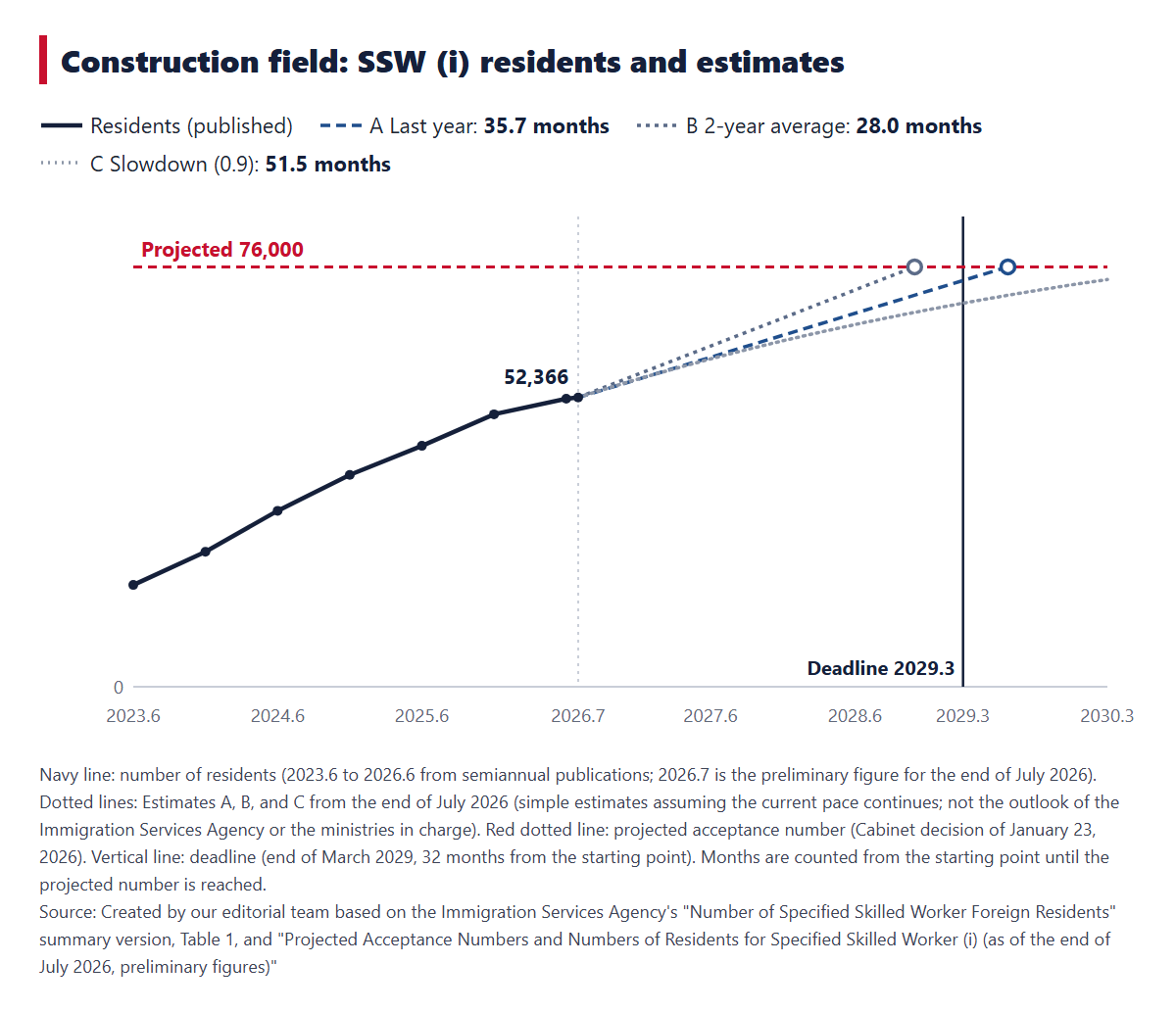
Construction Field: Estimate of When the Acceptance Cap Will Be Reached
In construction, the result falls before or after the deadline depending on the growth assumption.
- Current figures: projected number 76,000 people, residents 52,366 people (68.9%), annual increase 7,937 people
- Remaining: 23,634 people
- Estimates: A 35.7 months (around the second half of 2029) / B 28.0 months (around the second half of 2028) / C 51.5 months (around the second half of 2030)
Sources: Created by our editorial team based on ISA publications
The semiannual number of residents was 18,429 → 24,433 → 31,853 → 38,365 → 43,599 → 49,323 → 52,132 people. The increase over two years was 20,279 people, and only B falls within the deadline. The increase in the most recent half-year (end of December Reiwa 7 → end of June Reiwa 8) was 2,809 people, smaller than in the previous half-years. The result depends on whether this slowdown continues.
Agriculture Field: Estimate of When the Acceptance Cap Will Be Reached
In agriculture, all three estimates reach the cap after the deadline.
- Current figures: projected number 73,300 people, residents 44,952 people (61.3%), annual increase 8,891 people
- Remaining: 28,348 people
- Estimates: A 38.3 months (around the second half of 2029) / B 41.8 months (around the first half of 2030) / C 57.8 months (around the first half of 2031)
Sources: Created by our editorial team based on ISA publications
The semiannual number of residents was 20,882 → 23,861 → 27,786 → 29,157 → 34,935 → 37,952 → 44,050 people. The semiannual increase was 2,979 → 3,925 → 1,371 → 5,778 → 3,017 → 6,098 people, which varies greatly by season. The increase over two years was 16,264 people.
Aviation Field: Estimate of When the Acceptance Cap Will Be Reached
In aviation, all three estimates reach the cap before the deadline. However, C is 31.9 months, almost the same as the 32-month deadline.
- Current figures: projected number 4,900 people, residents 2,823 people (57.6%), annual increase 968 people
- Remaining: 2,077 people
- Estimates: A 25.7 months (around the second half of 2028) / B 27.0 months (around the second half of 2028) / C 31.9 months (around the first half of 2029)
Sources: Created by our editorial team based on ISA publications
Because the projected number is small, an increase or decrease of a few hundred people changes the result greatly.
At the 15th Expert Panel, a revision plan (before Cabinet approval) was also presented that would set the projected number for Specified Skilled Worker (i) in aviation at 4,600 people. Calculated with the proposed 4,600, the results are A 22.0 months (around the first half of 2028) / B 23.1 months (around mid-2028) / C 26.1 months (around the second half of 2028).
Automobile Repair and Maintenance Field: Estimate of When the Acceptance Cap Will Be Reached
In automobile repair and maintenance, all three estimates reach the cap after the deadline. A is 32.9 months, just after the deadline.
- Current figures: projected number 9,400 people, residents 5,332 people (56.7%), annual increase 1,482 people
- Remaining: 4,068 people
- Estimates: A 32.9 months (around the first half of 2029) / B 41.1 months (around the end of 2029 to the beginning of 2030) / C 45.3 months (around the first half of 2030)
Sources: Created by our editorial team based on ISA publications
Building Cleaning Field: Estimate of When the Acceptance Cap Will Be Reached
Building cleaning is calculated not to reach the cap within the deadline.
- Current figures: projected number 32,200 people, residents 10,514 people (32.7%), annual increase 2,918 people
- Remaining: 21,686 people
- Estimates: A 89.2 months (about 7.4 years) / B 94.0 months (about 7.8 years) / C not reached by this calculation (even if the number keeps increasing, the total increase only goes up to 14,590 people)
Sources: Created by our editorial team based on ISA publications
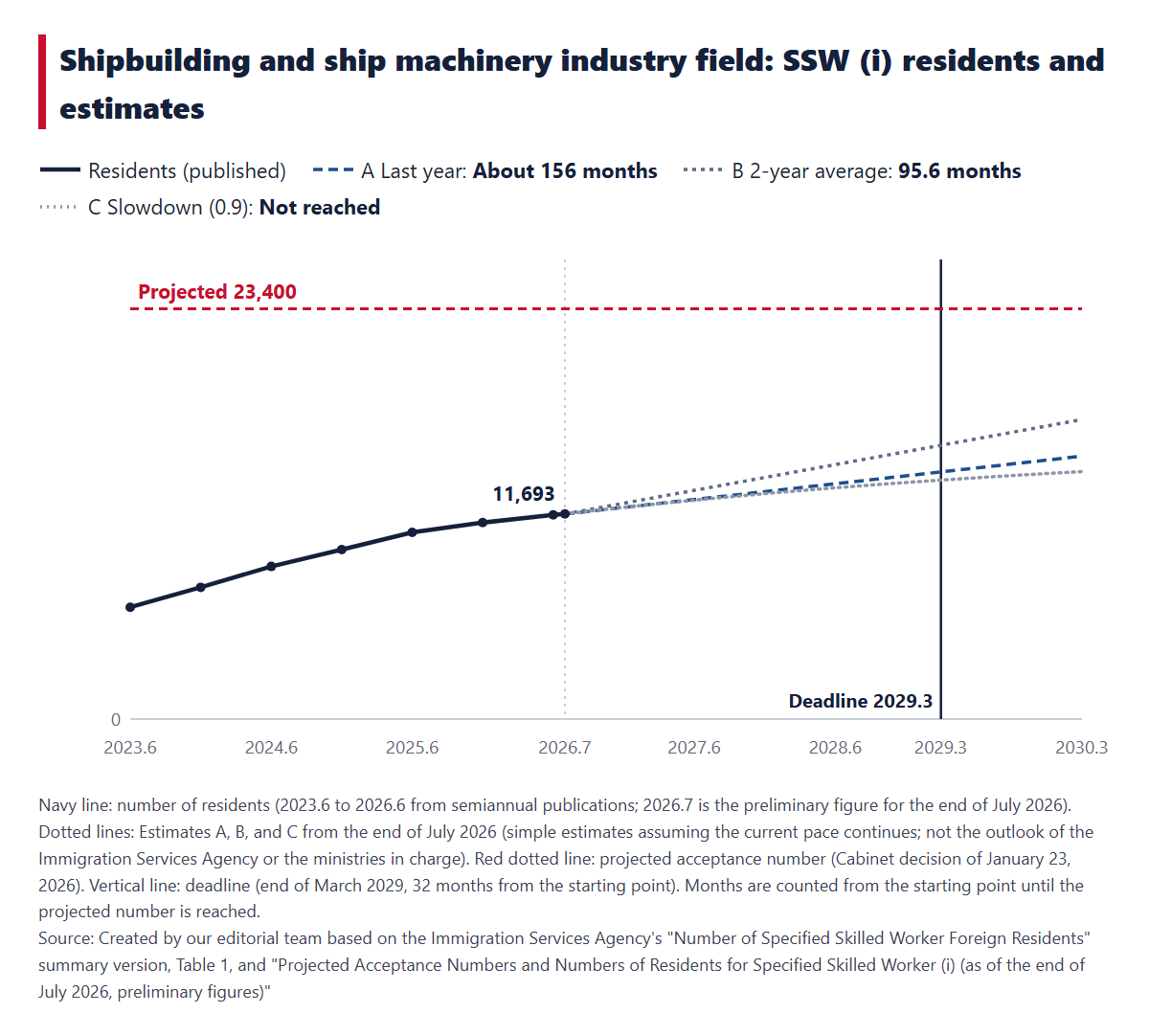
Shipbuilding and Ship Machinery Industry Field: Estimate of When the Acceptance Cap Will Be Reached
Shipbuilding and ship machinery industry is calculated not to reach the cap within the deadline.
- Current figures: projected number 23,400 people, residents 11,693 people (50.0%), annual increase 900 people
- Remaining: 11,707 people
- Estimates: A about 156 months (about 13.0 years) / B 95.6 months (about 8.0 years) / C not reached by this calculation (even if the number keeps increasing, the total increase only goes up to 4,500 people)
Sources: Created by our editorial team based on ISA publications
The increase in the most recent year (900 people) is small compared with the increase over two years (2,938 people), so the difference between A and B is large.
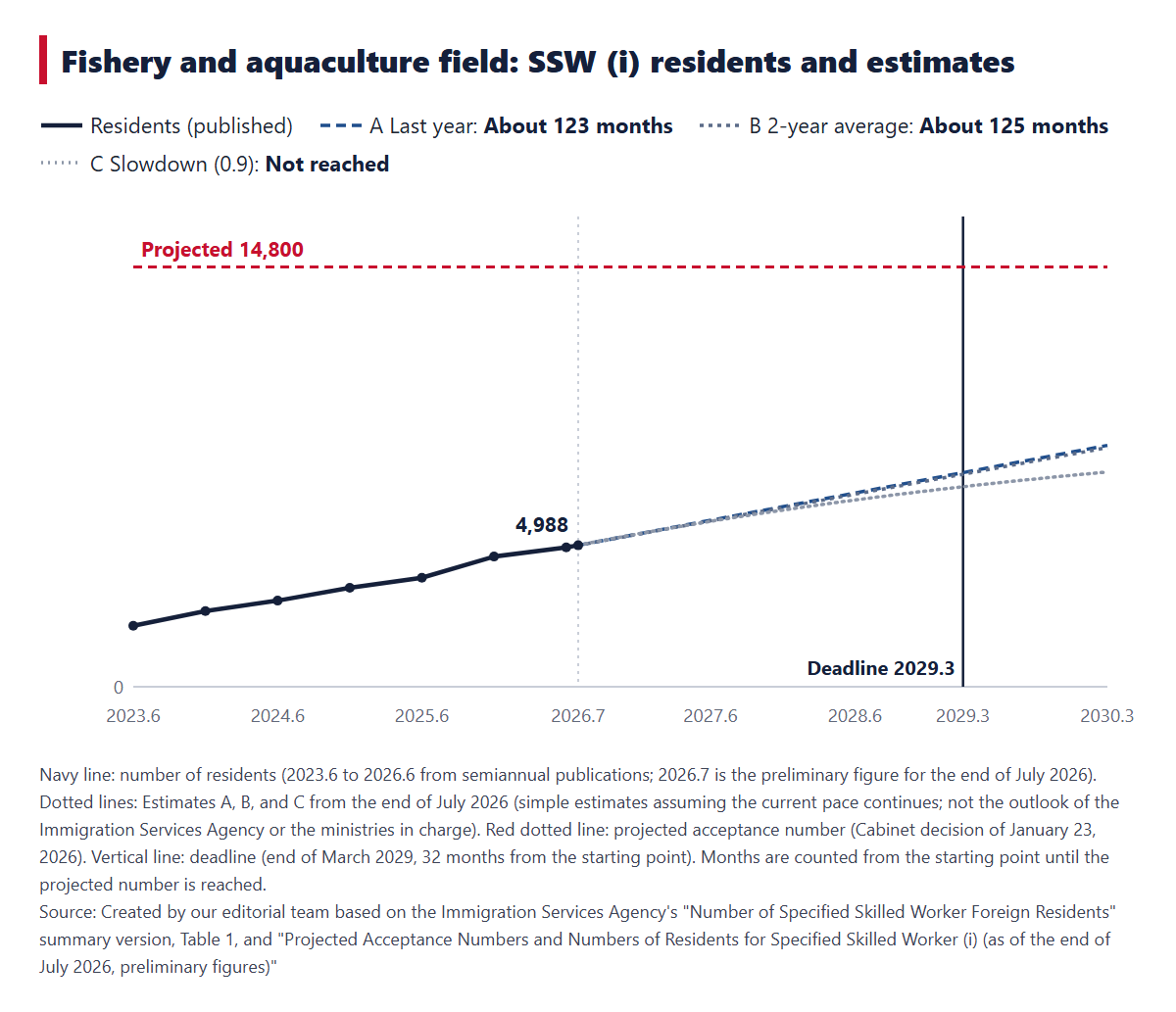
Fishery and Aquaculture Field: Estimate of When the Acceptance Cap Will Be Reached
Fishery and aquaculture is calculated not to reach the cap within the deadline.
- Current figures: projected number 14,800 people, residents 4,988 people (33.7%), annual increase 960 people
- Remaining: 9,812 people
- Estimates: A about 123 months (about 10.2 years) / B about 125 months (about 10.5 years) / C not reached by this calculation (even if the number keeps increasing, the total increase only goes up to 4,800 people)
Sources: Created by our editorial team based on ISA publications
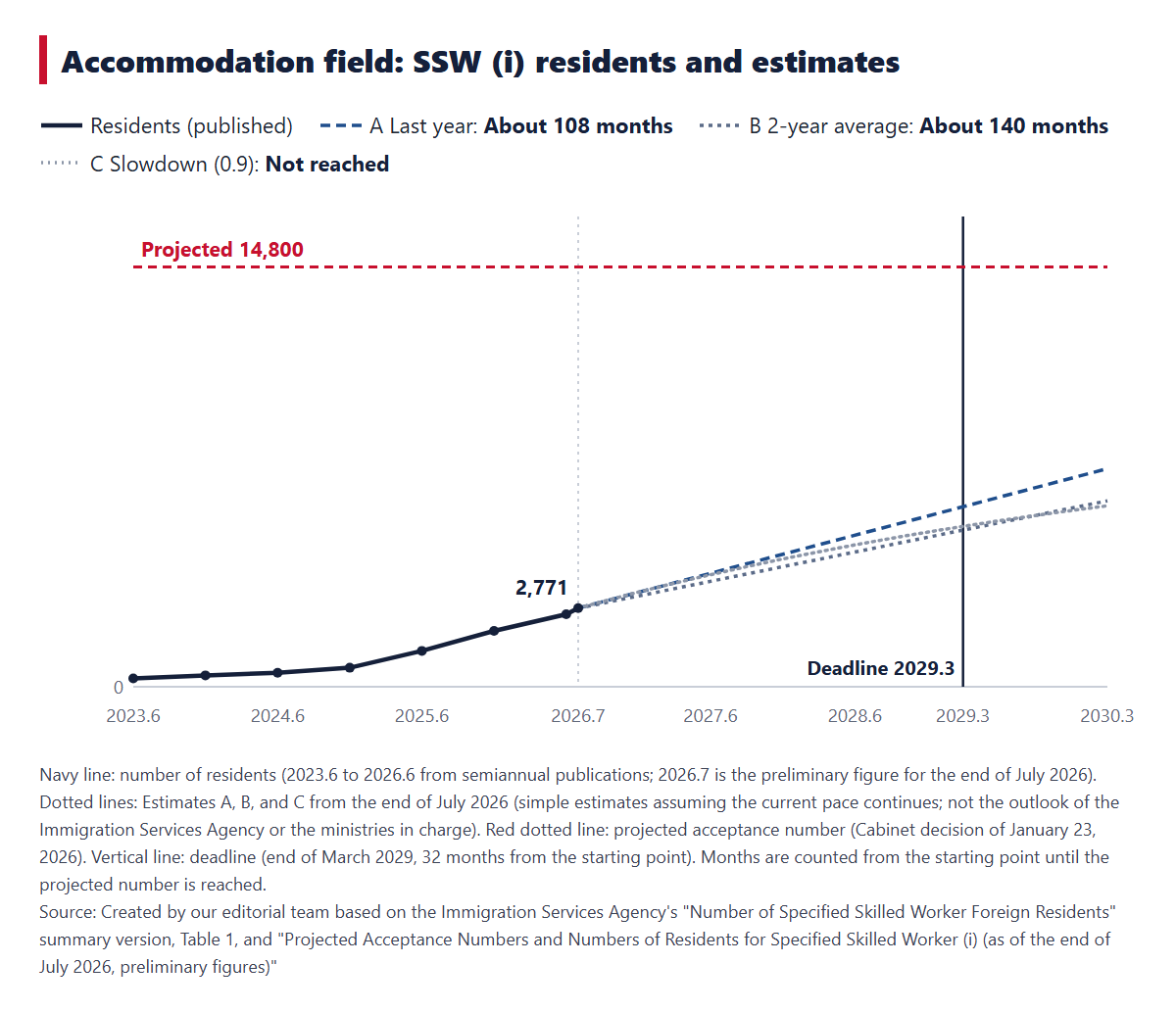
Accommodation Field: Estimate of When the Acceptance Cap Will Be Reached
Accommodation is calculated not to reach the cap within the deadline.
- Current figures: projected number 14,800 people, residents 2,771 people (18.7%), annual increase 1,341 people
- Remaining: 12,029 people
- Estimates: A about 108 months (about 9.0 years) / B about 140 months (about 11.7 years) / C not reached by this calculation (even if the number keeps increasing, the total increase only goes up to 6,705 people)
Sources: Created by our editorial team based on ISA publications
The number of residents at the end of June Reiwa 8 (2,556 people) is about 5.2 times that at the end of June Reiwa 6, but even at the end of July Reiwa 8 it is only 18.7% of the projected number.
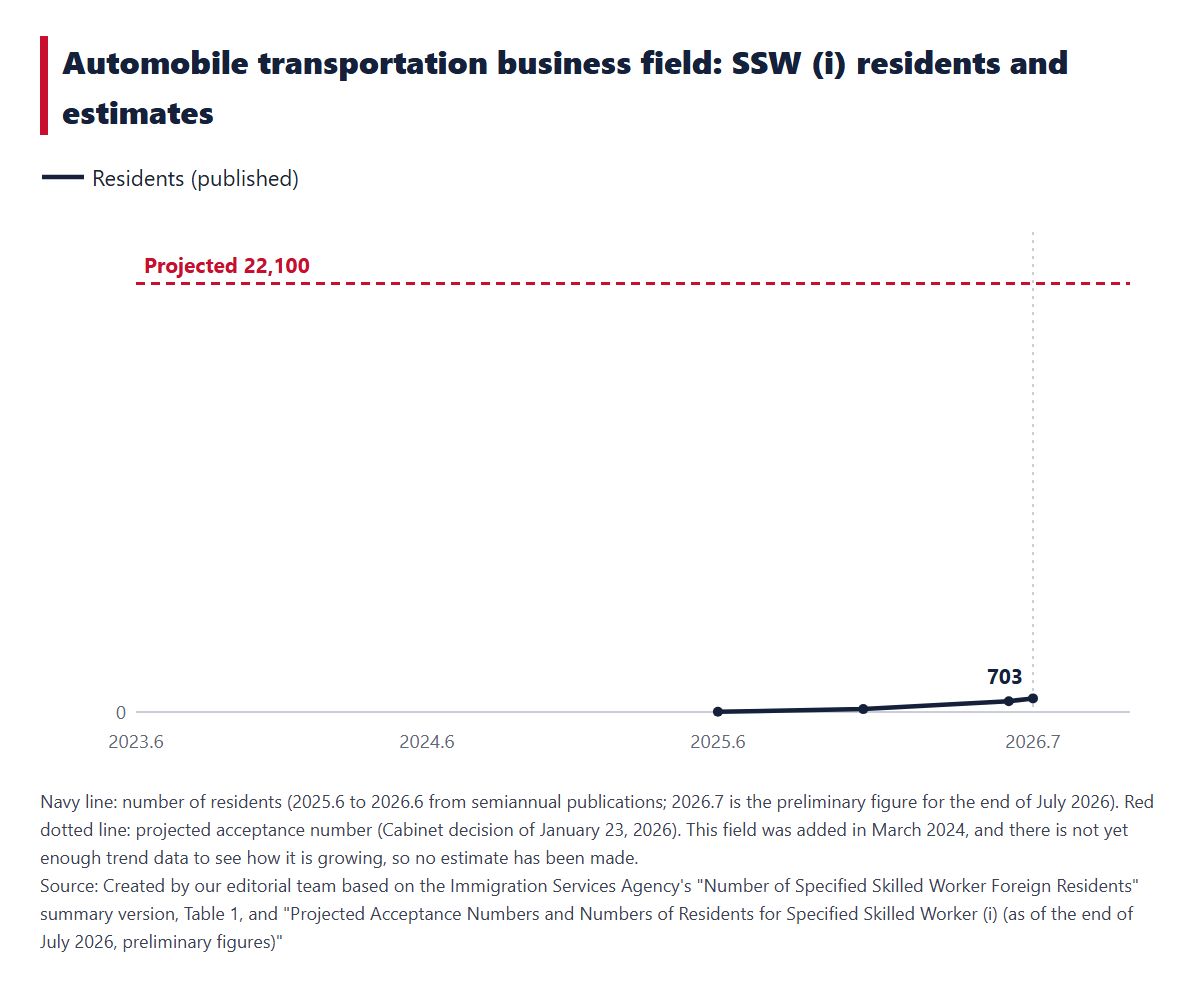
Automobile Transportation Business Field: Why There Is No Estimate Yet
The current figures are a projected number of 22,100 people and 703 residents (3.2%). This field was added in March Reiwa 6, and there is not yet enough trend data to see how it is growing, so no estimate has been made. We will add one when more data is available.
Sources: Created by our editorial team based on ISA publications
Logistics Warehousing Field: Why There Is No Estimate Yet
The current figures are a projected number of 11,400 people, and the number of residents is shown as “-” in the published table. This field was added in January Reiwa 8, and no estimate has been made. We will add one when more data is available.
Railway Field: Why There Is No Estimate Yet
The current figures are a projected number of 2,900 people and 73 residents (2.5%). This field was added in March Reiwa 6, and no estimate has been made. We will add one when more data is available.
Wood Industry Field: Why There Is No Estimate Yet
The current figures are a projected number of 4,500 people and 99 residents (2.2%). This field was added in March Reiwa 6, and no estimate has been made. We will add one when more data is available.
Forestry Field: Why There Is No Estimate Yet
The current figures are a projected number of 900 people and 19 residents (2.1%). This field was added in March Reiwa 6, and no estimate has been made. We will add one when more data is available.
Linen Supply Field: Why There Is No Estimate Yet
The current figures are a projected number of 4,300 people and 3 residents (0.1%). This field was added in January Reiwa 8, and no estimate has been made. We will add one when more data is available.
Resource Recycling Field: Why There Is No Estimate Yet
The current figures are a projected number of 900 people, and the number of residents is shown as “-” in the published table. This field was added in January Reiwa 8, and no estimate has been made. We will add one when more data is available.
Summary: Estimates for All Fields of When the Acceptance Cap Will Be Reached
The months in the estimates are counted from the end of July Reiwa 8 (2026). The deadline (the end of March Reiwa 11) is 32 months.
| Field | Projected number | Residents | Remaining | A | B | C | Result |
|---|---|---|---|---|---|---|---|
| Nursing care | 126,900 | 81,436 | 45,464 | 22.4 | 25.3 | 26.5 | Within the deadline in all three |
| Manufacture of food and beverages | 133,500 | 101,922 | 31,578 | 24.3 | 24.8 | 29.6 | Within the deadline in all three |
| Aviation | 4,900 | 2,823 | 2,077 | 25.7 | 27.0 | 31.9 | Within the deadline in all three |
| Construction | 76,000 | 52,366 | 23,634 | 35.7 | 28.0 | 51.5 | Before or after, depending on the assumption |
| Automobile repair and maintenance | 9,400 | 5,332 | 4,068 | 32.9 | 41.1 | 45.3 | After the deadline |
| Agriculture | 73,300 | 44,952 | 28,348 | 38.3 | 41.8 | 57.8 | After the deadline |
| Building cleaning | 32,200 | 10,514 | 21,686 | 89.2 | 94.0 | Not reached | Not reached within the deadline |
| Accommodation | 14,800 | 2,771 | 12,029 | about 108 | about 140 | Not reached | Not reached within the deadline |
| Fishery and aquaculture | 14,800 | 4,988 | 9,812 | about 123 | about 125 | Not reached | Not reached within the deadline |
| Industrial product manufacturing | 199,500 | 63,032 | 136,468 | about 152 | about 182 | Not reached | Not reached within the deadline |
| Shipbuilding and ship machinery industry | 23,400 | 11,693 | 11,707 | about 156 | 95.6 | Not reached | Not reached within the deadline |
| Food service industry | 50,000 | 49,290 | - | - | - | - | Under the measure |
| Automobile transportation business and others (7 fields) | - | - | - | - | - | - | Not enough data |
The projected numbers and numbers of residents are as of the end of July Reiwa 8 (2026) (preliminary figures), in people. A, B, and C are numbers of months. The results for the 15th Expert Panel’s revision plan (before Cabinet approval) are given under the nursing care and aviation headings.
Sources: Created by our editorial team based on ISA publications
- The fields calculated to reach the cap within the deadline in all three estimates are nursing care, manufacture of food and beverages, and aviation
- The results change with the assumptions. Construction in particular falls before or after the deadline depending on whether growth over the most recent year or the most recent two years is used
- For nursing care, the official outlook (the second half of fiscal Reiwa 9) is earlier than the estimates, and a revision plan for the projected number has also been presented. Please check the official materials first
We will update this article when the figures change, for example when the semiannual number of residents is published. The impact on your own company’s hiring plans depends on your individual circumstances, so please consult a specialist.
Primary Sources Referenced in Article Creation
- Immigration Services Agency, “Projected Acceptance Numbers and Numbers of Residents for Specified Skilled Worker (i) (as of the end of July Reiwa 8, preliminary figures)” (PDF)
- Immigration Services Agency, “Publication of the Number of Specified Skilled Worker Foreign Residents”
- Same agency, Number of Specified Skilled Worker Foreign Residents, summary version, Table 1 (PDF): end of June Reiwa 5, end of December Reiwa 5, end of June Reiwa 6, end of December Reiwa 6, end of June Reiwa 7, end of December Reiwa 7, end of June Reiwa 8
- Immigration Services Agency, “Key Points of the Number of Specified Skilled Worker Foreign Residents (end of June Reiwa 8)” (PDF)
- Immigration Services Agency, 15th Expert Panel on the Basic Policies and Field-specific Operational Policies for the Specified Skilled Worker System and the Employment for Skill Development System (Material 1-1, Material 3-2)
- Immigration Services Agency, “Operation of the Acceptance Cap in the Specified Skilled Worker ‘Food Service Industry’ Field”
- Immigration Services Agency, 14th Expert Panel Material 4-1 (PDF)
- Immigration Services Agency, Employment for Skill Development System Q&A
This article is a translation of the original Japanese version.