This article was written by the NIPPON VISA & LIFE editorial team based on information from public organizations such as the national government and local governments. Rules and fees may differ depending on the city, ward, town or village where you live.
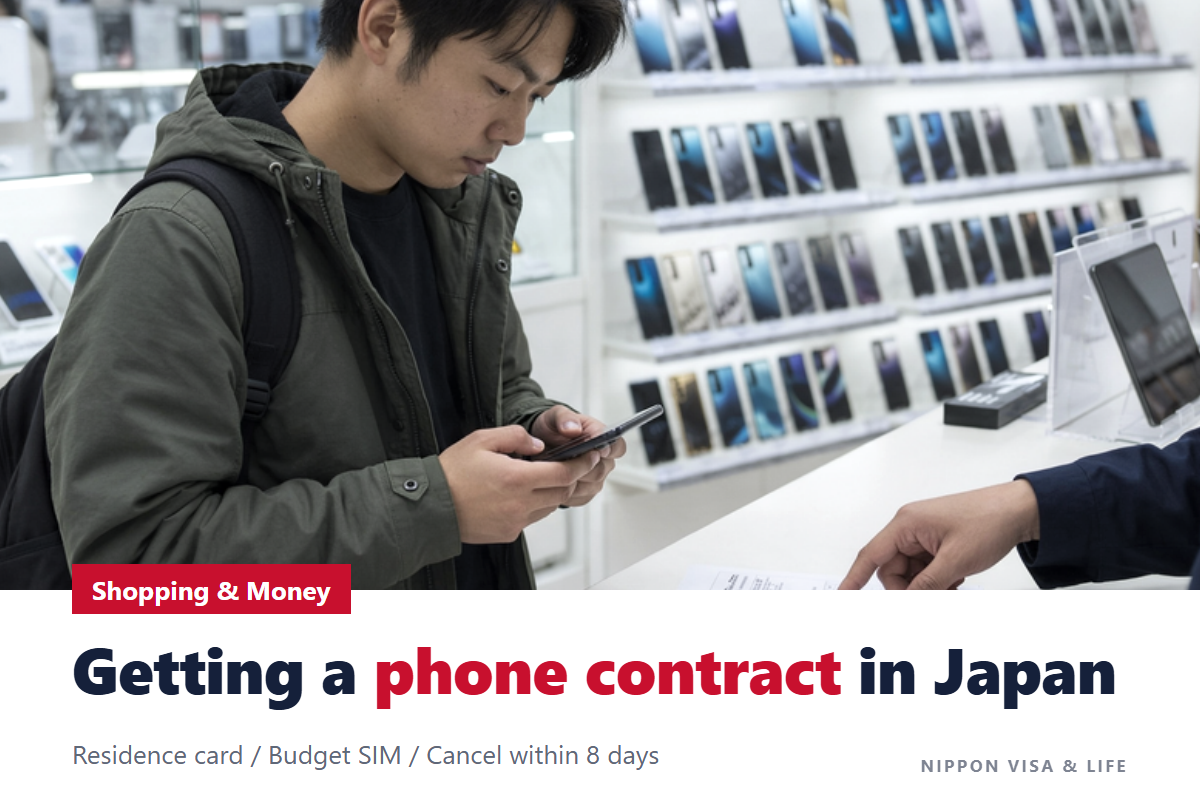
When you sign a smartphone contract in Japan, you need an identity document (such as your residence card). You can choose between the major mobile carriers and “budget SIM” (kakuyasu SIM) providers that offer lower fees. If you feel after signing that the contract does not suit you, there is a system that lets you cancel it within 8 days of receiving the contract document.
Fees and procedures differ depending on the mobile carrier and the plan. Based on the guidance of the Ministry of Internal Affairs and Communications, this article explains what you should know before signing a contract and what you must not do. For an overview of money and shopping in Japan, see The Basics of Money and Shopping in Japan: Bank Accounts, Ways to Pay, Consumption Tax, Smartphone Contracts, Sending Money Abroad and Where to Get Help.
The Short Answer: The Steps for Getting a Smartphone Contract
- Prepare an identity document: People who live in Japan on a mid- to long-term basis can use their residence card as an identity document. It must not be expired.
- Choose a mobile carrier: Choose based on whether you want support at a shop, whether you can do the procedures online, and how much data you use each month.
- Check the fees and the contract details: Check the conditions for discounts, installment payments for the device (the smartphone itself), and options (additional services).
- Sign the contract: Apply at a shop or online. If you apply online, depending on the identity check method, the SIM card or device may be delivered by registered mail to the address on your identity document.
- If it does not suit you, ask for help within 8 days: You may be able to use systems such as initial contract cancellation (shoki keiyaku kaijo).
What You Need: An Identity Document (Such as Your Residence Card)
Under the law (the Act on Prevention of Improper Use of Mobile Phones), mobile carriers must check the name, residence (address) and date of birth of the person signing a contract.
Identity documents you can use include the following.
| Document | Explanation |
|---|---|
| Residence card | Can be used by foreign nationals living in Japan on a mid- to long-term basis |
| Special Permanent Resident Certificate | Can be used by special permanent residents |
| Driver’s license | A Japanese driver’s license |
| My Number Card (Individual Number Card) | A card with your photo on it |
Your residence card or other document must be valid on the day you show it. If you have received a new card, for example after extending your period of stay, use the new card.
In 2019, the Ministry of Internal Affairs and Communications reminded mobile carriers that, for contracts with foreign nationals living in Japan on a mid- to long-term basis, the residence card can be used as an identity document.
Check That Your Residence Card Shows Your Current Address
Your address is also checked when you sign a contract. Make sure that the place of residence on your residence card (where you live; it is written on the front, and if you moved and reported it, it is written in the place of residence section on the back) is your current address. For the procedures when you move, see Checklist for Moving Within Japan: Moving-out and Moving-in Notifications, Residence Card, Electricity, Gas and Water, and Mail Forwarding.
Identity Checks When You Apply Online
If you apply without going to a shop, your identity is checked by methods such as reading the IC chip of your identity document with a smartphone app and sending it together with a photo of your face. Depending on the method, the SIM card or device is sent to the address written on the document by registered mail or another method that cannot be forwarded. In that case, you cannot receive it if you do not live at the address on the document. The methods you can use differ by mobile carrier.
Some mobile carriers also have conditions for the payment method (credit card, bank account, etc.). Before applying, check that company’s guidance. How to open a bank account is summarized in How to Open a Bank Account in Japan: What You Need, Why You May Not Be Able to Open One, and Telling Your Bank When Your Address or Period of Stay Changes.
How to Choose a Mobile Carrier: Major Carriers vs. Budget SIMs (MVNOs)
Mobile carriers in Japan are broadly divided into two types.
| Type | What kind of company | Features |
|---|---|---|
| MNO (major mobile carrier) | Companies that own their own network facilities (NTT Docomo, KDDI, SoftBank, Rakuten Mobile) | Many shops, and some brands offer extensive support. Brands with extensive support tend to have higher fees |
| MVNO (budget smartphone / budget SIM) | Companies that rent network facilities from the major carriers to provide their service | Many low-cost plans. Procedures are mainly online |
The major carriers also have online-only plans and brands that lower fees by, as a rule, not offering shop support.
Advantages of Budget SIMs (MVNOs)
- Many plans have small amounts of data, such as 1GB, 3GB or 6GB, so you can choose one that fits how you use your phone. Some companies offer 3GB or less for 1,000 yen or less per month.
- The places where you can get a signal (coverage area) are the same as the major carriers.
- Call quality is about the same as the major carriers, and call charges may be cheaper.
Things to Watch Out for with Budget SIMs (MVNOs)
- There are few shops, and procedures and inquiries are mainly online. If online procedures in Japanese are difficult for you, one option is to choose a company that lets you apply at a shop.
- Because they rent part of the major carriers’ network facilities, data speeds may slow down at times when the network is busy, such as lunchtime, commuting hours and at night.
What to Check in the Fees and the Contract Details
- Conditions for discounts: Fees may change depending on conditions, such as discounts only for the first six months or discounts only when you sign a contract together with family members. The lowest price shown in TV commercials and similar ads is often the price when all discounts are applied.
- Installment payments for the device: If you pay for the smartphone itself in installments, you will be billed every month for several months to several years until it is paid off. Even if you cancel your line, you still have to pay the remaining cost of the device.
- Options: If you do not use options that were added when you signed the contract, cancel them yourself. If you forget to cancel them, you will keep being charged.
- How much data you use: Knowing how much data you use each month makes it easier to choose a plan that suits you. After signing, you can check how much you used and the breakdown of your fees on the mobile carrier’s My Page (member page).
Whether You Can Get Explanations in a Foreign Language
In 2019, the Ministry of Internal Affairs and Communications asked mobile carriers to expand multilingual support at shops and elsewhere so that foreign nationals who do not speak Japanese do not have trouble with contracts. Examples of efforts introduced by the ministry include interpretation support by phone or video call, and catalogs and important matters explanation documents (documents that explain the important points of the contract) in foreign languages. Whether these are available differs by company and shop, so check before you go.
Within 8 Days of Receiving the Contract Document: Initial Contract Cancellation and Confirmation Measures
If you feel after signing that the contract is “different from what I expected,” you may be able to use the following systems.
- Initial contract cancellation: A system that lets you cancel the contract within 8 days of receiving the contract document, even without the mobile carrier’s consent. Because the contract is treated as if it never existed, you do not have to pay the cancellation fee that applies when you cancel in the middle of the contract period.
- Confirmation measures: Some companies, such as the three major carriers (NTT Docomo, KDDI and SoftBank), use a system called “confirmation measures” (kakunin sochi) instead of initial contract cancellation. Only in cases such as when the signal is not good enough or the explanation was not sufficient, you can also cancel the device together with the contract.
Even with initial contract cancellation, you have to pay actual costs such as the following. The maximum amounts are set by the Minister for Internal Affairs and Communications.
| Actual costs you have to pay | Approximate amount |
|---|---|
| Usage fees for the service until the cancellation | As a rule, calculated by the day |
| SIM card issuance fee | Only for MVNOs. Generally around 3,300 yen |
| Administrative fee | Generally around 3,300 yen |
| Fee for moving to another company while keeping your phone number (MNP) at the same time as the cancellation | 0 yen if done by a method other than in person or by phone. In person or by phone, a fee of 1,100 yen or less may be charged |
Note: With initial contract cancellation, you often cannot cancel the purchase of the smartphone itself. Check your contract document to see which system you can use and how the device is handled.
When Switching Carriers or Canceling
Switching Carriers While Keeping Your Phone Number (MNP)
You can switch to another mobile carrier while keeping your current phone number (MNP, mobile number portability). You need to complete a procedure with your current carrier. The fee you pay to your current carrier is free if you apply on its website. If you apply by phone or at a shop, a fee of 1,100 yen or less may be charged.
Using Your Current Smartphone as It Is (SIM Lock)
As a rule, smartphones released in or after October 2021 do not have a SIM lock (a setting that prevents you from using other companies’ SIM cards). If you have a smartphone released before then that has a SIM lock, you need to apply to have it removed. The fee is free online, and in many cases 3,300 yen by phone or at a shop.
What to Check When Canceling
- Cancellation fee: If you cancel a plan with a fixed contract period, such as a 2-year contract, partway through, you may be charged a cancellation fee.
- Bundle discounts: If you receive a discount by bundling with your family’s contracts or your home internet, switching carriers may remove the discount and raise your other fees.
- Payments and points: You will no longer be able to use payments that are charged together with your mobile phone bill (carrier billing). Your mobile carrier’s points may also be lost when you cancel.
For canceling when you leave Japan and return home, also see Checklist of Procedures When You Leave Japan and Return Home: Moving-out Notification, Returning Your Residence Card, Resident Tax and Income Tax, the Pension Lump-sum Withdrawal Payment, and Closing Your Bank Account and Mobile Phone Contract.
What You Must Not Do: Giving or Selling Your SIM Card or Mobile Phone to Others
The Act on Prevention of Improper Use of Mobile Phones is a law to prevent mobile phones from being misused for crimes such as bank transfer scams. Under this law, the following are subject to punishment.
- Giving a false name or other false information when signing a contract
- Giving a working mobile phone to another person as a business, for money, without the mobile carrier’s permission
- Giving to another person, or receiving from another person, a working mobile phone for which you are not the contract holder
SIM cards are subject to the same rules as mobile phones.
To transfer a mobile phone contract to another person’s name, you need to complete a procedure with the mobile carrier (the company checks identity). Even if a friend or a stranger asks you to “sell me your SIM card” or “sign a contract in your name for me,” do not agree. If a mobile phone contracted in your name is used for a crime, the mobile carrier may check who the contract holder is at the request of the police. When you return home, cancel the contract instead of giving the phone to someone else.
When You Have Trouble: Frequently Asked Questions
Can I Sign a Contract If My Residence Card Is About to Expire?
Identity documents must be valid on the day you show them. If you are applying to extend your period of stay and your card’s expiration date has passed, ask the mobile carrier how this is handled. When you receive a new residence card, use the new card. The detailed conditions for whether you can sign a contract differ by mobile carrier.
I Signed a Contract Just as the Shop Told Me, and the Fees Turned Out to Be High
First, look at your contract document and check which system (initial contract cancellation or confirmation measures) you can use and when the deadline is. Even if more than 8 days have passed, ask for help in cases such as when the explanation was not sufficient. The places you can ask for help are in the next section.
I Received a Bill for Something I Do Not Recognize
See What to Do If Your Credit Card or Smartphone Payment Is Used Without Permission in Japan: How to Check Unfamiliar Charges, and Contacting the Card Company, Mobile Carrier, Police and Consumer Hotline 188. Scam emails and text messages (SMS) pretending to be from a mobile carrier are covered in What to Do About Scam Emails, Text Messages and Phone Calls in Japan: Tricks Pretending to Be Delivery Companies, the Police or Immigration, and Where to Get Help (#9110 and 188).
Where You Can Get Help
- The mobile carrier you signed with: First, contact them about fees, contract details and cancellation. Some companies have multilingual call centers.
- Consumer Affairs Center: Where to get help with contract problems. You can find the nearest center on the website of the National Consumer Affairs Center of Japan (NCAC). For details, see Where to Get Help With Shopping and Contract Problems in Japan: Consumer Hotline 188, Consumer Affairs Centers and Cooling-off.
- Ministry of Internal Affairs and Communications Telecommunications Consumer Consultation Center: Phone 03-5253-5900 (consultations about telecommunications services). The regional Bureaus of Telecommunications also accept consultations.
Primary Sources Used for This Article
- Ministry of Internal Affairs and Communications “Preventing Criminal Use of Mobile Phones” (overview of the Act on Prevention of Improper Use of Mobile Phones)
- e-Gov Law Search “Ordinance for Enforcement of the Act on Identification of Subscribers by Mobile Voice Communications Carriers and Prevention of Improper Use of Mobile Voice Communications Services”
- Ministry of Internal Affairs and Communications “Measures to Facilitate Mobile Phone Contracts and Use by Foreign Nationals (Request)” (March 27, 2019, with excerpts of relevant provisions)
- Ministry of Internal Affairs and Communications Mobile Phone Portal Site “Q5. What Is ‘Initial Contract Cancellation’?”
- Ministry of Internal Affairs and Communications Mobile Phone Portal Site “4. There Are So Many Mobile Brands!”
- Ministry of Internal Affairs and Communications Mobile Phone Portal Site “5. What Are Budget Smartphones / Budget SIMs?”
- Ministry of Internal Affairs and Communications Mobile Phone Portal Site “6. Advice for Buying a Device”
- Ministry of Internal Affairs and Communications Mobile Phone Portal Site “1. Let’s Review Your Fee Plan!”
- Ministry of Internal Affairs and Communications Mobile Phone Portal Site “2. Do You Know the Basics and Costs of Switching?”
- Ministry of Internal Affairs and Communications Mobile Phone Portal Site “3. What Are the Checkpoints for Switching?”
This article is a translation of the original Japanese version.