

To move from Technical Intern Training (技能実習) to Specified Skilled Worker (i) (特定技能1号) in Japan, you need Permission to change status of residence (在留資格変更許可). If you have completed Technical Intern Training (ii) (技能実習2号) in good standing and your training occupation and work are related to the job you will do as a Specified Skilled Worker, both the skills test and the Japanese language test are waived.
The Immigration Services Agency (出入国在留管理庁) urges applicants to apply at least 2 months before the date they plan to start work as a Specified Skilled Worker. This is because once your training is completed, you cannot work until permission is granted.
If you receive permission or a similar decision on or after April 1, 2027, people who completed Technical Intern Training or similar programs before the Technical Intern Training Act took effect (November 1, 2017) will no longer be eligible for this exemption. The content of this article was checked against the Immigration Services Agency’s materials on October 19, 2026.
Conditions for the Test Exemption: Completing Technical Intern Training (ii) in Good Standing and a Link to Your Job
If you have completed Technical Intern Training (ii) in good standing and the skills you acquired in training are related to the work you will do as a Specified Skilled Worker, you do not need to prove that you passed the skills test or the Japanese language test. This is an exception written in the ministerial ordinance that sets the landing standards for Specified Skilled Worker (i) (the Landing Standards Ordinance, 上陸基準省令).
If you will do work that is not related, you need to pass the skills test. However, for Japanese, the fact that you completed Technical Intern Training (ii) in good standing is treated as proof of your ability. The Immigration Services Agency’s materials describe this as an “exemption from the N4-level test.”
The same applies to people who completed Technical Intern Training (iii), as long as they completed Technical Intern Training (ii) in good standing. It also covers people who completed Technical Intern Training (ii) before the Technical Intern Training Act took effect, and people who worked under “Designated Activities” (特定活動) (technical intern training) before July 2010 (limited to those whose combined period of training and Designated Activities was 2 years and 10 months or more).
Note that Technical Intern Training (ii) and Specified Skilled Worker (i) have different purposes, so you will not necessarily do the same work. The Immigration Services Agency explains that Technical Intern Training is a system for transferring skills to developing countries, while Specified Skilled Worker is a system for doing work that requires a certain level of skill in fields facing labor shortages. For how the scope of work is viewed, also see The difference in the scope of work between Engineer/Specialist in Humanities/International Services and Specified Skilled Worker, and work common to both statuses of residence.
Quick Reference Table of Test Exemptions
| Case | Skills test | Japanese language test |
|---|---|---|
| Completed Technical Intern Training (ii) in good standing + work is related | Waived | Waived |
| Completed Technical Intern Training (ii) in good standing + work is not related | Required | Waived (N4 level) |
| Nursing care Japanese language test in the nursing care field | — | Waived only for those who completed the nursing care occupation/work |
| Automobile transportation (taxi and bus drivers) and railways (transport staff) | — | Not waived where N3 level is required |
| People who completed training before the Technical Intern Training Act took effect (if receiving permission or similar on or after April 1, 2027) | Required | Required |
From the session held in April 2026, the nursing care Japanese language test is called the “Nursing Care Specified Skills Evaluation Test (Japanese)” (介護特定技能評価試験(日本語)) (before that, it was the Nursing Care Japanese Language Evaluation Test). How the tests are handled when moving into nursing care is summarized in Types of tests and requirements waived when moving from Technical Intern Training to Specified Skilled Worker “Nursing Care”.
(Sources: Immigration Services Agency, “Operational Guidelines for Accepting Specified Skilled Foreign Workers,” pp. 15–17 and 21; Immigration Services Agency, “Q&A on the Specified Skilled Worker System,” Q40, Q50 and Q60; Ministry of Health, Labour and Welfare, “Acceptance of Specified Skilled Foreign Workers in the Nursing Care Field”; Immigration Services Agency, “Handling of Persons Who Completed ‘Technical Intern Training’ etc. Before the Technical Intern Training Act Took Effect and Seek to Move to ‘Specified Skilled Worker (i)'”)
What “Completed in Good Standing” Means: 2 Years and 10 Months, Plus Passing the Practical Test or an Evaluation Report
“Completed Technical Intern Training (ii) in good standing” means that you completed at least 2 years and 10 months of technical intern training and meet one of the following:
- You passed the practical test of the Grade 3 Skills Test or the Technical Intern Training Evaluation Test (Specialist Level), which is the goal of the Technical Intern Training (ii) plan
- You did not pass the practical test, but an “evaluation report” (評価調書) (Reference Form No. 1-2) prepared by the implementing organization (実習実施者) recognizes that you completed the training in good standing
The evaluation report records your attendance during training, the skills you acquired, your conduct in daily life, and similar matters. If you could not take the test for an unavoidable reason such as illness, that reason is also explained in the evaluation report or similar documents.
If you will be employed by the same company If your Specified Skilled Worker accepting organization is the same as your implementing organization during Technical Intern Training, you may be able to omit the copy of the pass certificate and the evaluation report. The condition is that the accepting organization has not received an “improvement order” (改善命令) under the Technical Intern Training Act within the past 1 year. This also applies if you return home once and then sign a contract with the same accepting organization. The list of required documents also mentions “improvement guidance” (改善指導) under the old system in the same way.
If you cannot obtain an evaluation report Your former implementing organization may refuse to prepare an evaluation report. In that case, one option is to submit a statement of reasons explaining why you cannot submit it, together with a document in place of the evaluation report. An example of such a substitute document is a written explanation prepared by someone who knows how your training went, such as your technical intern training instructor at the time. Immigration makes an overall judgment based on these documents, so first consult the Regional Immigration Services Bureau (地方出入国在留管理局). Approval by this method is not guaranteed.
The internal standards for examinations (the Immigration and Residence Examination Guidelines, 入国・在留審査要領) also show the following views.
- For the 2 years and 10 months, it is enough that the date you completed training (the date you left Japan) is 2 years and 10 months or more after the start date, and periods spent outside Japan on a re-entry permit may also be included.
- The “Technical Intern Training Completion Certificate” (技能実習修了証書) issued by the Japan International Trainee & Skilled Worker Cooperation Organization (JITCO) does not show attendance and similar information, so it cannot replace an evaluation report.
- In training that combined multiple occupations/work types, if you did not pass the practical test for the secondary occupation/work, you are not assessed as having completed the training in good standing even with an evaluation report.
The examination guidelines are not laws and may be revised. If you are unsure whether your case qualifies, consult a specialist.
(Sources: Immigration Services Agency, “Operational Guidelines for Accepting Specified Skilled Foreign Workers,” pp. 19–20; Immigration Services Agency, “Q&A on the Specified Skilled Worker System,” Q48 and Q50; List of required documents, Table 3-4 (manufacturing of industrial products); Immigration and Residence Examination Guidelines, Part 12 (materials disclosed through an information disclosure request))
Checking Which Specified Skilled Worker Fields (Job Categories) Match Your Training Occupation and Work
Whether your training is related is determined by the appended tables of the operational guidelines for each field (separate volumes). The Immigration Services Agency publishes a list covering all occupations and work types: “Relationship Between Occupations Eligible for Technical Intern Training (ii) and Fields (Job Categories) of Specified Skilled Worker (i) (as of June 1, Reiwa 8 2026).”
The list reads from left to right: “occupation,” “work type,” and “field (job category).” Find your training occupation and work type, and check whether the column on the right shows a field and job category you can move to.
- Cultivation agriculture (such as greenhouse horticulture) → Agriculture (general cultivation agriculture)
- Formwork construction → Construction (civil engineering) and Construction (building)
- Metal press processing → Manufacturing of industrial products (such as machinery and metal processing), shipbuilding and ship machinery, and railways (rolling stock manufacturing)
- Many food manufacturing occupations → Manufacture of food and beverages (food and beverage manufacturing and seafood processing)
- Meal preparation for medical and welfare facilities → Food service
As these examples show, one occupation may correspond to multiple fields. On the other hand, some work types have no corresponding field. As shown by B in the image below, “household laundry” under the laundry occupation is shaded gray and has no corresponding field. The same is true of boiler maintenance. In such cases, you must pass the skills test for the field you will move to (Japanese is waived).

Sources: Immigration Services Agency, “Relationship Between Occupations Eligible for Technical Intern Training (ii) and Fields (Job Categories) of Specified Skilled Worker (i) (as of June 1, Reiwa 8 [2026)”](https://www.moj.go.jp/isa/content/001463725.pdf)
The matching table may be revised. Before applying, check the latest version from the Immigration Services Agency.
(Sources: Immigration Services Agency, “Relationship Between Occupations Eligible for Technical Intern Training (ii) and Fields (Job Categories) of Specified Skilled Worker (i) (as of June 1, Reiwa 8 [2026)”](https://www.moj.go.jp/isa/content/001463725.pdf); Immigration Services Agency, “Operational Guidelines for Accepting Specified Skilled Foreign Workers,” p. 19)
When to Apply: You Can Apply During Training, Ideally at Least 2 Months Before You Start Work
You can apply even while you are still in Technical Intern Training (ii). Apply as soon as your documents are ready; as a guide, submit your application at least 2 months before the date you plan to start work as a Specified Skilled Worker.
You cannot work once your training is completed According to the Immigration Services Agency, there have been reports of cases where the training plan ended after the change application was filed, and the person could not work and fell into financial hardship. Even during the “special period” (特例期間) while a change application is pending, once the training plan is completed you cannot work as a technical intern trainee. Processing an application takes about 1–2 months and may take even longer during busy periods. For this reason, the Immigration Services Agency asks applicants to apply at least 2 months before the planned start date.
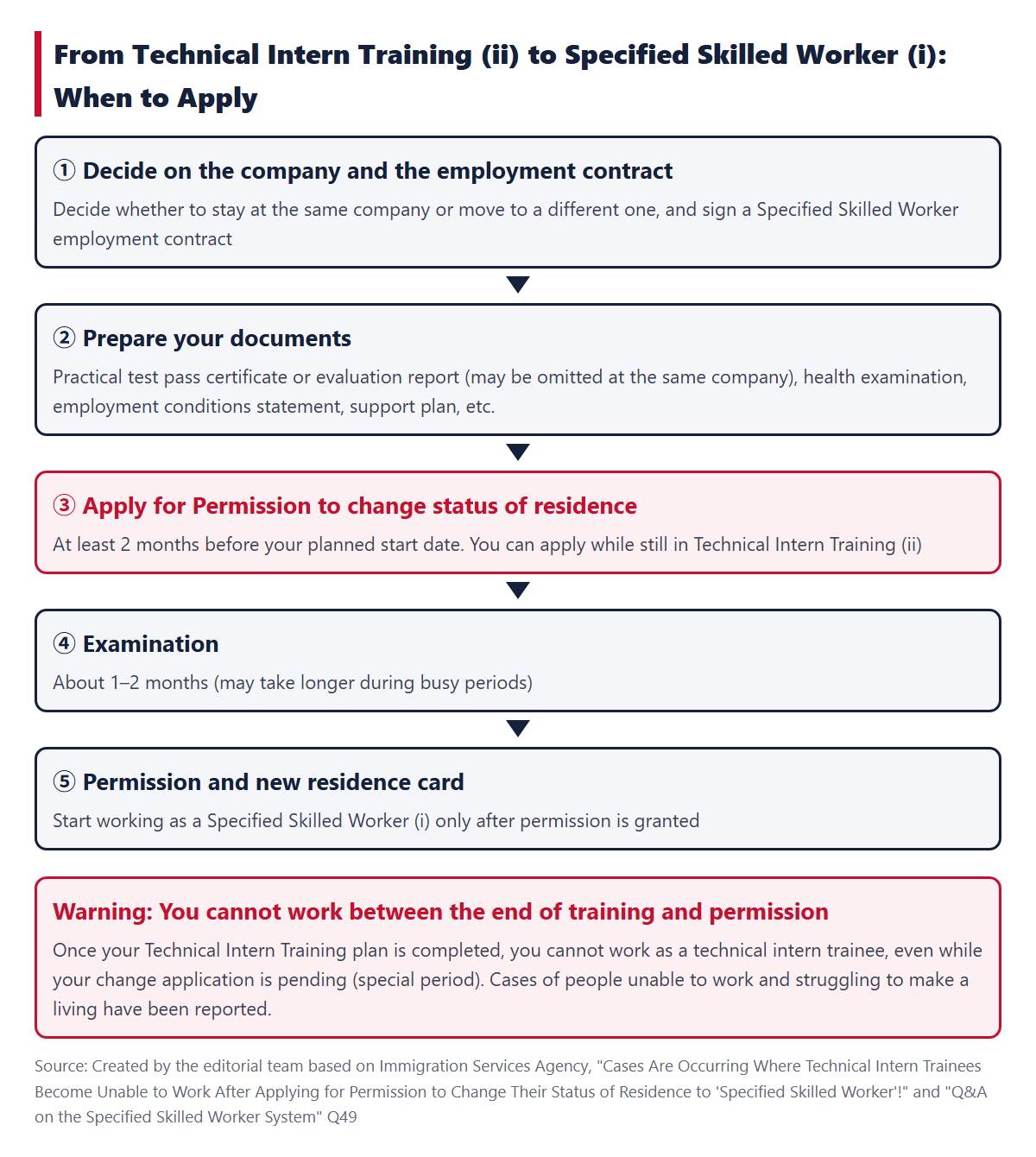
Sources: Created by the editorial team (based on Immigration Services Agency, “Cases Are Occurring Where Technical Intern Trainees Become Unable to Work After Applying for Permission to Change Their Status of Residence to ‘Specified Skilled Worker’!”(https://www.moj.go.jp/isa/content/001442736.pdf) and “Q&A on the Specified Skilled Worker System”(https://www.moj.go.jp/isa/policies/ssw/faq.html))
As shown in step (3) of the diagram, you apply before your training is completed. As the warning at the bottom of the diagram shows, you cannot work after your training is completed until permission is granted.
Points for trainees themselves It is fine to look for a Specified Skilled Worker employer on your days off during training. However, you cannot change your status of residence (在留資格) in order to look for a job. The same is true if your period of stay (在留期間) is about to end.
You cannot change in the middle of your training plan People whose Technical Intern Training plan has not ended cannot, in principle, change to Specified Skilled Worker. If there are unavoidable circumstances, first consult the Regional Immigration Services Bureau. An example given in the operational guidelines is a case where the person intended to move to Specified Skilled Worker (i) after Technical Intern Training (ii), but the hiring was canceled for business reasons of the company that planned to accept them, so they went on to Technical Intern Training (iii).
If you cannot get ready in time If preparation takes time, for example because your documents are not ready, there is “Designated Activities (6 months, work permitted),” which lets you prepare while working at the accepting organization where you plan to work as a Specified Skilled Worker. Passing the tests (including the exemption based on completing Technical Intern Training (ii) in good standing) is a condition. However, the Immigration Services Agency says that the number of these applications has grown and examinations are taking longer, and asks applicants to apply directly for a change to Specified Skilled Worker (i) whenever possible. For details, see What is Designated Activities (preparing to move to Specified Skilled Worker (i))? Eligibility, requirements, the application process, and how to use it and cautions when changing jobs.
(Sources: Immigration Services Agency, “Cases Are Occurring Where Technical Intern Trainees Become Unable to Work After Applying for Permission to Change Their Status of Residence to ‘Specified Skilled Worker’!”; Immigration Services Agency, “Q&A on the Specified Skilled Worker System,” Q47 and Q49; Immigration Services Agency, “Operational Guidelines for Accepting Specified Skilled Foreign Workers,” p. 44; Immigration Services Agency, “Designated Activities Related to Specified Skilled Worker (When Wishing to Move to ‘Specified Skilled Worker (i)’)”)
Procedures and Documents Common to All Fields: Applying for Permission to Change Status of Residence
The procedure is an application for Permission to change status of residence at the Regional Immigration Services Bureau that has jurisdiction over your place of residence (住居地). You submit the application form (with a photo attached) and present your passport and residence card (在留カード). The other documents are prepared by combining three tables from the Immigration Services Agency’s “list of required documents.”
- Table 1: Documents about the applicant (including the cover sheet)
- One of Tables 2-1 to 2-3: Documents about the accepting organization. Not required for organizations that have already accepted a Specified Skilled Worker in the same fiscal year
- One of Tables 3-1 to 3-18: Documents for each field
Table 1 for change applications was revised on October 9, Reiwa 8 (2026). To avoid using an old list, get the latest one from the Immigration Services Agency’s website.
Main documents from the applicant These include the individual health examination form and the examinee’s declaration. If you are already in Japan, results from a health examination you received at a hospital in Japan within 1 year before the application date are also acceptable. However, you must have been examined for all items on the reference form, and a doctor must have signed that you can continue working. You also need a certificate of resident tax assessment, a tax payment certificate, and a copy of your withholding tax statement. If you are enrolled in National Health Insurance or the National Pension, you also submit documents on your enrollment and payments.
Main documents from the accepting organization These include the Specified Skilled Worker employment contract, the employment conditions statement, and documents on wage payment. All of these must be written in a language you fully understand, and you sign the employment contract (雇用契約) and the employment conditions statement. A support plan is also required, and if all support is entrusted to a registered support organization (登録支援機関), an explanation of the entrustment contract is also submitted. For how to fill them in, see Employment contract, employment conditions statement, and wage payment for Specified Skilled Worker (i): sample entries and cautions on allowances and deductions and How to write the support plan for Specified Skilled Worker (i): section-by-section explanation with sample entries for full entrustment and in-house support.
Field documents (Table 3) As proof that you completed Technical Intern Training (ii) in good standing, you submit a copy of the pass certificate for the practical test or an evaluation report. For example, Table 3 for the manufacturing of industrial products field states that the Japanese pass certificate can be omitted, but documents showing that you completed the training in good standing are required. In addition, each field has its own required documents, such as the field’s written pledge and documents showing membership in the field’s council.
Documents based on nationality People from Cambodia, Thailand, and Vietnam also submit documents for the procedures set out in bilateral arrangements (as of October 2026).
Fee The fee is paid when permission is granted. How you pay depends on how you applied: if you applied at the counter, you pay with a revenue stamp (収入印紙); if you applied through the online residence application system (在留申請オンラインシステム) (applications received on or after October 1, 2026), you pay by convenience store payment or bank payment. For an online application, a transaction fee (330 yen if the permitted period of stay is less than 3 years, 550 yen if it is 3 years or more) is added to the fee. The amount depends on the permitted period of stay. For details, see How is the period of stay for Specified Skilled Worker (i) decided? Upper limits by company category, and fees that change with a 1-month difference.
Document Checklist
| Document | Who prepares it | Notes for people moving from Technical Intern Training |
|---|---|---|
| Application form for Permission to change status of residence and photo | Applicant and accepting organization | Photo taken within the past 6 months |
| Individual health examination form and examinee’s declaration | Applicant | A health examination in Japan within 1 year is acceptable (all items must be covered) |
| Resident tax assessment and payment certificates, withholding tax statement | Applicant | Get them early, for example at your city office counter |
| Employment contract, employment conditions statement, and wage payment documents | Accepting organization | In a language you understand. You sign the employment contract and the employment conditions statement |
| Support plan | Accepting organization and registered support organization | In a language you understand, signed by you |
| Explanation of the support entrustment contract | Accepting organization | If all support is entrusted to a registered support organization |
| Copy of the practical test pass certificate or evaluation report | Applicant and implementing organization | Ask the implementing organization early for the evaluation report. May be omitted if you stay with the same company |
| Field written pledge, council documents, etc. | Accepting organization | Differ by field (check Table 3) |
(Sources: Immigration Services Agency, “Status of Residence ‘Specified Skilled Worker'” (list of required documents); Table 1 (change, revised October 9, Reiwa 8); Table 3-4 (manufacturing of industrial products); Immigration Services Agency, “Operational Guidelines for Accepting Specified Skilled Foreign Workers,” p. 16; Immigration Services Agency, “Fee Amounts and Payment Methods for Online Applications”)
Salary After the Move, and How Many Years You Can Work as a Specified Skilled Worker (i)
Salary People who completed Technical Intern Training (ii) are treated as having roughly 3 years of experience (roughly 5 years for those who completed (iii)). When the same company employs a person it accepted as a technical intern trainee as a Specified Skilled Worker, the operational guidelines require that the salary not only exceed the salary at the completion of Technical Intern Training (ii), as a matter of course, but also be decided by comparing it with the amount paid to Japanese employees with a similar level of experience. The Immigration Services Agency’s Q&A also states that the salary is expected to at least exceed the Technical Intern Training (ii) salary level. When employing a person who trained at a different company, the salary is decided appropriately according to the accepting organization’s work rules and similar standards. In every case, if the work is the same as that of Japanese employees, the pay must be equal to or higher than that of Japanese employees.
Years you can work The period of stay for Specified Skilled Worker (i) is, in principle, up to a total of 5 years. The period of stay granted at one time is decided individually within a range not exceeding 3 years. The “total” counts the time you have stayed as a Specified Skilled Worker (i) regardless of the field.
After that After Specified Skilled Worker (i), there is also a path to move to Specified Skilled Worker (ii) (特定技能2号), which requires proficient skills. The fields covered by (ii) and the skill level confirmed through each field’s tests and other means are set out.
(Sources: Immigration Services Agency, “Operational Guidelines for Accepting Specified Skilled Foreign Workers,” pp. 5, 11, 24–25 and 48–49; Immigration Services Agency, “Q&A on the Specified Skilled Worker System,” Q46; Immigration Services Agency, “Status of Residence ‘Specified Skilled Worker'”)
What Changes from April 1, 2027
On April 1, 2027, the amended law that starts the Employment for Skill Development System (育成就労制度) will take effect. Along with it, the Landing Standards Ordinance will be amended, and the treatment of people who completed Technical Intern Training under the old system will change.
Who is affected People who completed one of the following in good standing:
- The status of residence “Technical Intern Training” before the Technical Intern Training Act took effect (November 1, 2017)
- “Designated Activities” (technical intern training) before July 1, 2010, when the status of residence “Technical Intern Training” was created
If these people move to Specified Skilled Worker (i) by receiving permission or a similar decision on or after April 1, 2027, they must pass both the skills test and the Japanese language test, even if they completed Technical Intern Training in good standing.
People who completed Technical Intern Training (ii) under the current system For example, the operational guidelines for the manufacturing of industrial products field and the building cleaning field state that the exemption for doing related work will continue for the time being on and after April 1, 2027. The treatment under which proof of Japanese is not needed when the work is not related is also said to continue for the time being. Check the operational guidelines for the field you will move to.
People moving from Employment for Skill Development When moving from Employment for Skill Development to Specified Skilled Worker (i), you need to pass the skills test and the Japanese language test. There is no treatment like the exemption based on completing Technical Intern Training (ii) in good standing. For an overview of Employment for Skill Development, see What is the Employment for Skill Development System? Differences from Technical Intern Training, transfers, and Japanese language requirements explained (starting April 2027); for salary and duration, see How much is the salary under Employment for Skill Development? The rule of pay equal to or higher than Japanese employees and how long you can work (3 years in principle, and after that).
What will happen to current technical intern trainees from April 2027 (moving to (iii) and so on) is explained in Transitional measures for Employment for Skill Development: what happens to technical intern trainees from April 2027? (iii), new entries, and quotas.
(Sources: Immigration Services Agency, “Handling of Persons Who Completed ‘Technical Intern Training’ etc. Before the Technical Intern Training Act Took Effect and Seek to Move to ‘Specified Skilled Worker (i)'”; Immigration Services Agency, “Q&A on the Specified Skilled Worker System,” Q50; Same agency, “Manufacturing of Industrial Products Field,” pp. 17–18; Same agency, “Building Cleaning Field,” p. 10; Immigration Services Agency, “Employment for Skill Development System Q&A”)
Summary
- If you have completed Technical Intern Training (ii) in good standing and your training occupation and work are related to your job, the skills test and the Japanese language test are waived. If they are not related, only the skills test is required. The nursing care Japanese language test and work that requires N3 level are exceptions.
- “Completed in good standing” means completing 2 years and 10 months or more, plus passing the practical test or an evaluation report. If you continue at the same company, you may be able to omit the pass certificate and the evaluation report.
- Once your training is completed, you cannot work until permission is granted. Prepare your documents early and apply for Permission to change status of residence at least 2 months before your planned start date.
- People who completed training before the Technical Intern Training Act took effect will need to pass the tests from April 1, 2027.
If you have questions about documents or procedures, you can contact the Regional Immigration Services Bureau or the Immigration Services Agency’s Immigration Information Center (外国人在留総合インフォメーションセンター).
Primary Sources Referenced in Article Creation
- Immigration Services Agency, “Operational Guidelines for Accepting Specified Skilled Foreign Workers (August 2026)”
- Immigration Services Agency, “Q&A on the Specified Skilled Worker System”
- Immigration Services Agency, “Relationship Between Occupations Eligible for Technical Intern Training (ii) and Fields (Job Categories) of Specified Skilled Worker (i) (as of June 1, Reiwa 8 [2026)”](https://www.moj.go.jp/isa/content/001463725.pdf)
- Immigration Services Agency, “Cases Are Occurring Where Technical Intern Trainees Become Unable to Work After Applying for Permission to Change Their Status of Residence to ‘Specified Skilled Worker’!”
- Immigration Services Agency, “Status of Residence ‘Specified Skilled Worker'” (list of required documents)
- Immigration Services Agency, “Designated Activities Related to Specified Skilled Worker (When Wishing to Move to ‘Specified Skilled Worker (i)’)”
- Immigration Services Agency, “Handling of Persons Who Completed ‘Technical Intern Training’ etc. Before the Technical Intern Training Act Took Effect and Seek to Move to ‘Specified Skilled Worker (i)'”
- Immigration Services Agency, “Operational Guidelines for Accepting Specified Skilled Foreign Workers in Specific Fields (Manufacturing of Industrial Products Field)”
- Immigration Services Agency, “Operational Guidelines for Accepting Specified Skilled Foreign Workers in Specific Fields (Building Cleaning Field)”
- Immigration Services Agency, “Employment for Skill Development System Q&A”
- Ministry of Health, Labour and Welfare, “Acceptance of Specified Skilled Foreign Workers in the Nursing Care Field”
- Immigration and Residence Examination Guidelines, Part 12: Statuses of Residence (materials disclosed through an information disclosure request)
This article is a translation of the original Japanese version.