

In Japan’s Employment for Skill Development (育成就労) system, which starts on April 1, 2027, a transfer to another employer at the worker’s own wish (本人の意向による転籍) is allowed under certain conditions, within the same job category (業務区分). The conditions are that the worker has worked longer than the transfer restriction period (転籍制限期間; 1 or 2 years depending on the field), has passed the skills test and the Japanese language test, and that the new employer meets standards such as being an excellent implementing organization. The previous employer cannot refuse to receive the request form, and it receives compensation for part of its initial costs from the new employer. However, the amount set by public notice (告示) on which the compensation is based has not yet been published (checked on November 3, 2026).
The content is based on the “Operational Guidelines for the Employment for Skill Development System” (育成就労制度運用要領; version updated on August 5, Reiwa 8 2026) and the Q&A of the Immigration Services Agency and the Ministry of Health, Labour and Welfare. The overall picture of the system is explained in the following article.
Two Types of Transfers in Employment for Skill Development: How a Transfer at the Worker’s Own Wish Differs from a Transfer Due to Unavoidable Circumstances
There are two types of transfers in Employment for Skill Development: the newly created “transfer at the worker’s own wish,” and the “transfer due to unavoidable circumstances” (やむを得ない事情による転籍), which continues from Technical Intern Training. The conditions are very different, so first distinguish between the two. In Technical Intern Training, transfers at the worker’s own wish were not allowed.
| Item | Transfer at the worker’s own wish | Transfer due to unavoidable circumstances |
|---|---|---|
| Limited to the same job category | Required | Required |
| Certification of the new employer’s new Employment for Skill Development plan | Required | Required |
| Work longer than the transfer restriction period | Required | Not required |
| Passing the skills and Japanese language tests | Required | Not required |
| Standards for the new employer (excellent organization, ratio, ban on private job placement, compensation) | Required | Not required |
| Transfer of a person whose Employment for Skill Development period has been extended beyond 3 years | Not allowed | May be allowed |
The main types of unavoidable circumstances are human rights violations such as violence or harassment, termination of the employment relationship such as dismissal, termination of the employment contract by agreement, serious and malicious violations of laws and regulations, serious and malicious breaches of contract that are not corrected, and cases where the written employment conditions were not issued or were not explained in the worker’s native language. Cases where the worker cannot continue because of an allergy or illness are also included.
When the accepting organization and the supervising and support organization receive a request, they first check whether there are facts that amount to unavoidable circumstances. Only if none can be confirmed do they check the requirements for a transfer at the worker’s own wish. The rest of this article explains transfers at the worker’s own wish.
(Sources: Q&A on the Employment for Skill Development System, Q47, Operational Guidelines, Chapter 4, Section 3, Part 2 (1) to (2))
Conditions for Transferring at the Worker’s Own Wish: Transfer Restriction Period, Passing the Tests, and the Same Job Category
A transfer at the worker’s own wish requires both conditions on the worker’s side and conditions on the new employer’s side.
The four conditions on the worker’s side are as follows.
- The worker’s employment at the most recent accepting organization has lasted longer than the transfer restriction period
- The worker has passed the skills test and the Japanese language test set for each field
- The job category is the same before and after the transfer
- The worker is not covered by a plan whose Employment for Skill Development period has been extended beyond 3 years
The conditions on the new employer’s side include being an excellent implementing organization, keeping the ratio of workers who transferred at their own wish (本人意向転籍者) within a certain limit, not using private job placement services, and compensating the previous employer for initial costs (explained in later sections).
For a second transfer at the worker’s own wish, the transfer restriction period must again have passed at the accepting organization after the first transfer.
When a transfer becomes possible (guide): For a person who started Employment for Skill Development on April 1, 2027, a transfer is possible from April 2028 if the transfer restriction period is 1 year, and from April 2029 if it is 2 years (a guide calculated from the start date and the restriction period).
When the period is judged: The transfer restriction period does not need to have passed at the time of the request. The Operational Guidelines describe the time of judgment in some places as “the start date of the new plan” and in other places as “the time of certification of the new plan.” If your schedule has little margin, check with the Organization for Employment for Skill Development of Foreign Nationals (外国人育成就労機構; “the Organization” below).
(Sources: Operational Guidelines, Chapter 4, Section 3, Part 2 (3) A and B, Part 1 (2), Q&A Q47 and Q49)
Transfer Restriction Period by Field and the Tests Required for a Transfer
The transfer restriction period is 1 or 2 years depending on the field. As a basic rule, the skills test is at the same level as the test after 1 year, and Japanese is A2.1 level or higher (in the table, “Elementary” means the Employment for Skill Development Evaluation Test (Elementary Level) and “Basic” means the Skills Test (Basic Level) 技能検定(基礎級)).
| Field | Transfer restriction period | Skills test | Japanese |
|---|---|---|---|
| Nursing care | 2 years | Elementary | A2.2 level or higher |
| Building cleaning | 1 year | Elementary | A2.1 level or higher |
| Linen supply | 1 year | Elementary | A2.1 level or higher |
| Industrial products manufacturing | 2 years | Elementary or Basic | A2.1 level or higher |
| Construction | 2 years | Elementary or Basic | A2.1 level or higher |
| Shipbuilding and ship machinery | 2 years | Elementary or Basic | A2.1 level or higher |
| Automobile repair and maintenance | 2 years | Elementary | A2.1 level or higher |
| Accommodation | 1 year | Elementary | A2.1 level or higher |
| Railway | 1 year | Elementary | A2.1 level or higher (A2.2 level or higher for transport staff) |
| Logistics warehousing | 1 year | Elementary | A2.1 level or higher |
| Agriculture | 1 year | Elementary | A2.1 level or higher |
| Fishery | 1 year | Elementary | A2.1 level or higher |
| Food and beverage manufacturing | 2 years | Elementary or Basic | A2.1 level or higher |
| Food service | 2 years | Elementary | A2.1 level or higher |
| Forestry | 1 year | Basic | A2.1 level or higher |
| Wood industry | 1 year | Elementary | A2.1 level or higher |
| Resource circulation | 2 years | Elementary | A2.1 level or higher |
Check the details of the test names in the appendix tables of the field-specific Operational Guidelines. As of November 11, 2026, the field-specific Operational Guidelines for nursing care, construction, shipbuilding and ship machinery, and agriculture are not posted on the forms page of the Immigration Services Agency. The field-specific Operational Guidelines for fishery were published on November 6, 2026. If the worker has passed a test at a higher level than shown in the table, the condition is met.
Even in fields with a 2-year period, the accepting organization can decide to set it at 1 year. In that case, the measures to improve working conditions that are required when a period longer than 1 year is set are not mandatory. Check the actual period in the field “period during which a change of implementing organization is restricted” (育成就労実施者の変更を制限する期間) in the Employment for Skill Development plan (育成就労計画). Setting different periods for different foreign nationals counts as unfair treatment. Examples of measures to improve working conditions are explained in the following article.
(Sources: Main Points of the Field-Specific Operational Policies, p.2, Overview of the Employment for Skill Development System, pp.3-4, Operational Guidelines, Chapter 4, Section 2 (parts on improved working conditions and unfair treatment), Section 3, Part 2 (3), Page for the Operational Guidelines and forms, Operational Guidelines for the fishery field (main text), pp.11-12)
Transfer Procedure: From Submitting the Request Form to Certification of the New Employment for Skill Development Plan
The procedure starts when the worker submits the request form, and it is completed when the new employer receives certification of a new Employment for Skill Development plan. The overall order is shown in the following figure.
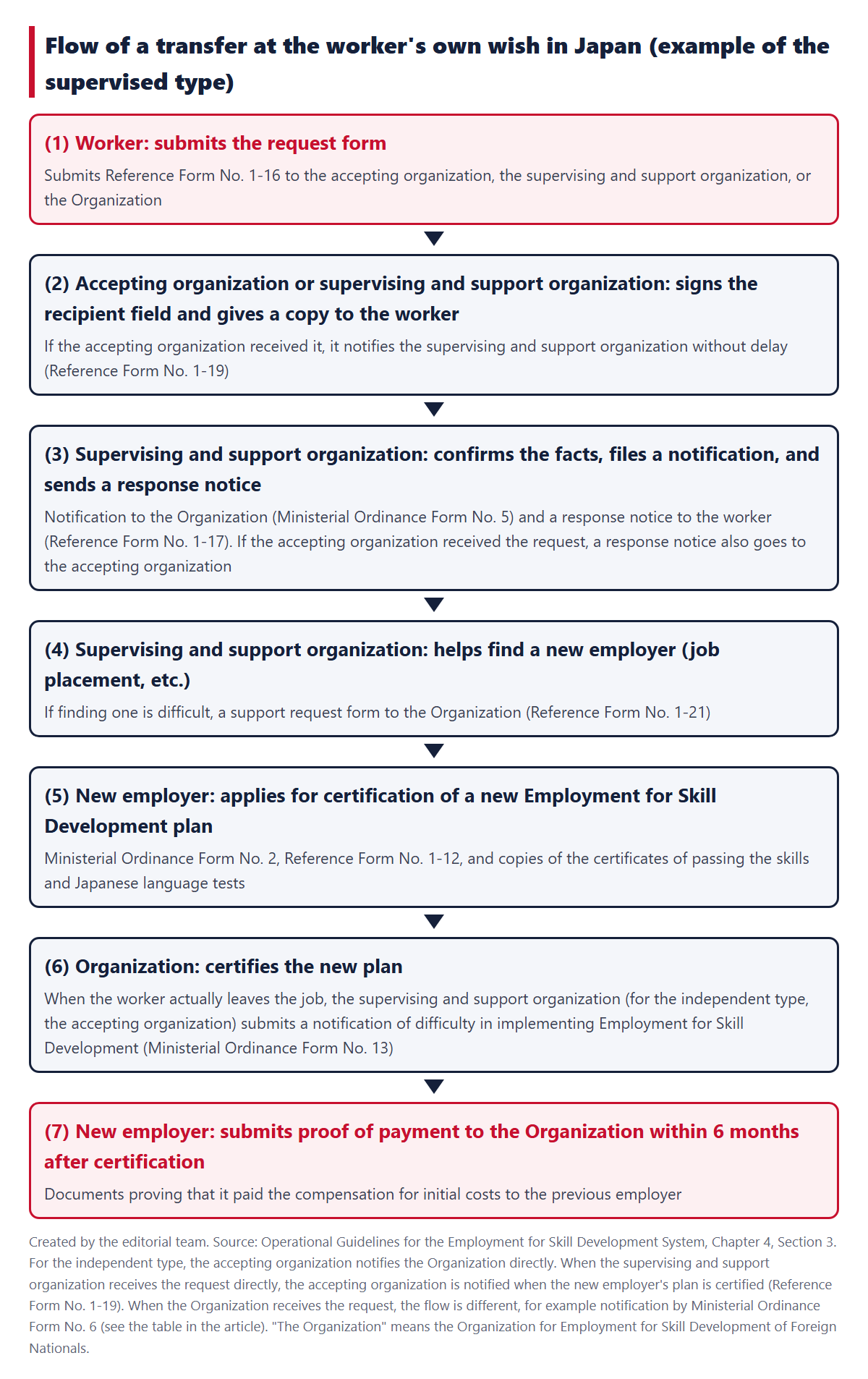
Sources: Created by the editorial team (based on: Operational Guidelines for the Employment for Skill Development System, Chapter 4, Section 3(https://www.moj.go.jp/isa/content/001467946.pdf))
Receiving and Checking the Request Form (Reference Form No. 1-16)
The request must be made in writing. Simply telling someone verbally about the wish to transfer is not recognized as a request, so the accepting organization and the supervising and support organization guide the worker to submit the request form. The form can also be submitted by mail or through an external auditor, etc.
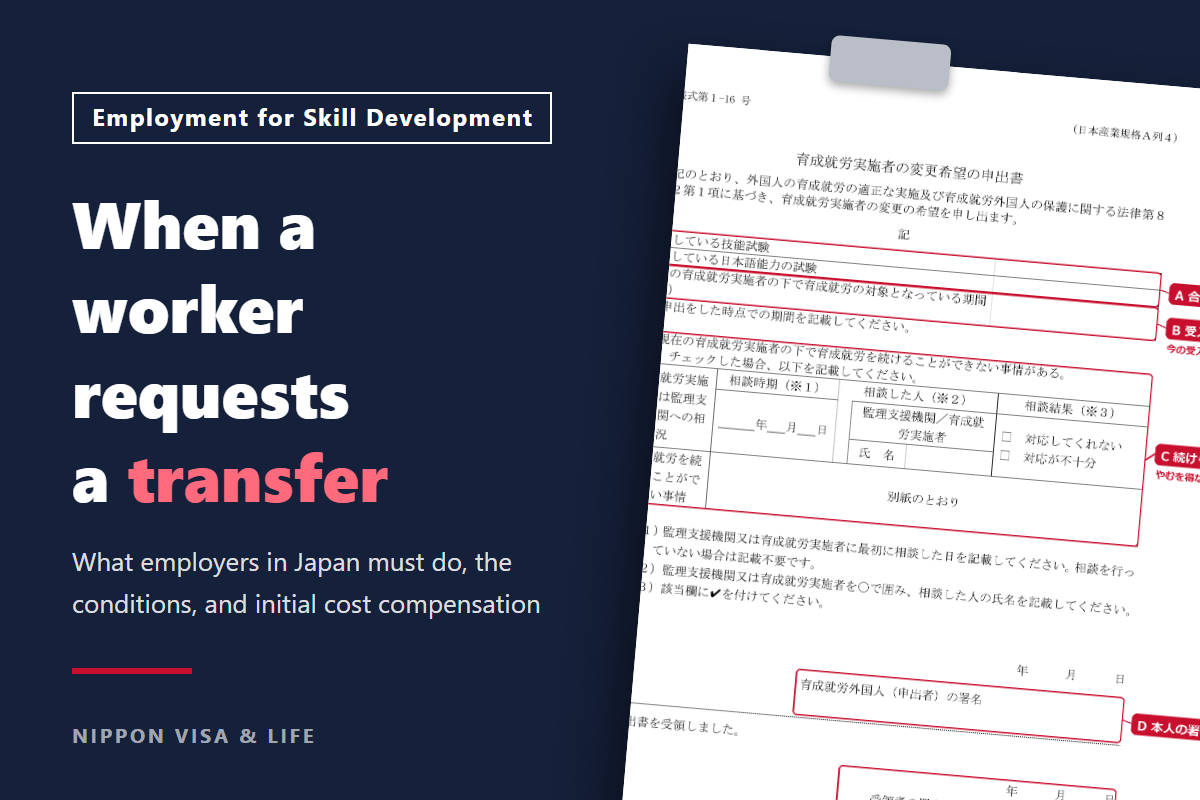
In the image of the form, A is the test the worker passed and B is the period at the current accepting organization. C is filled in only when there are circumstances that make it impossible to continue. D is the worker’s signature, and E is the signature of the person who received the form.
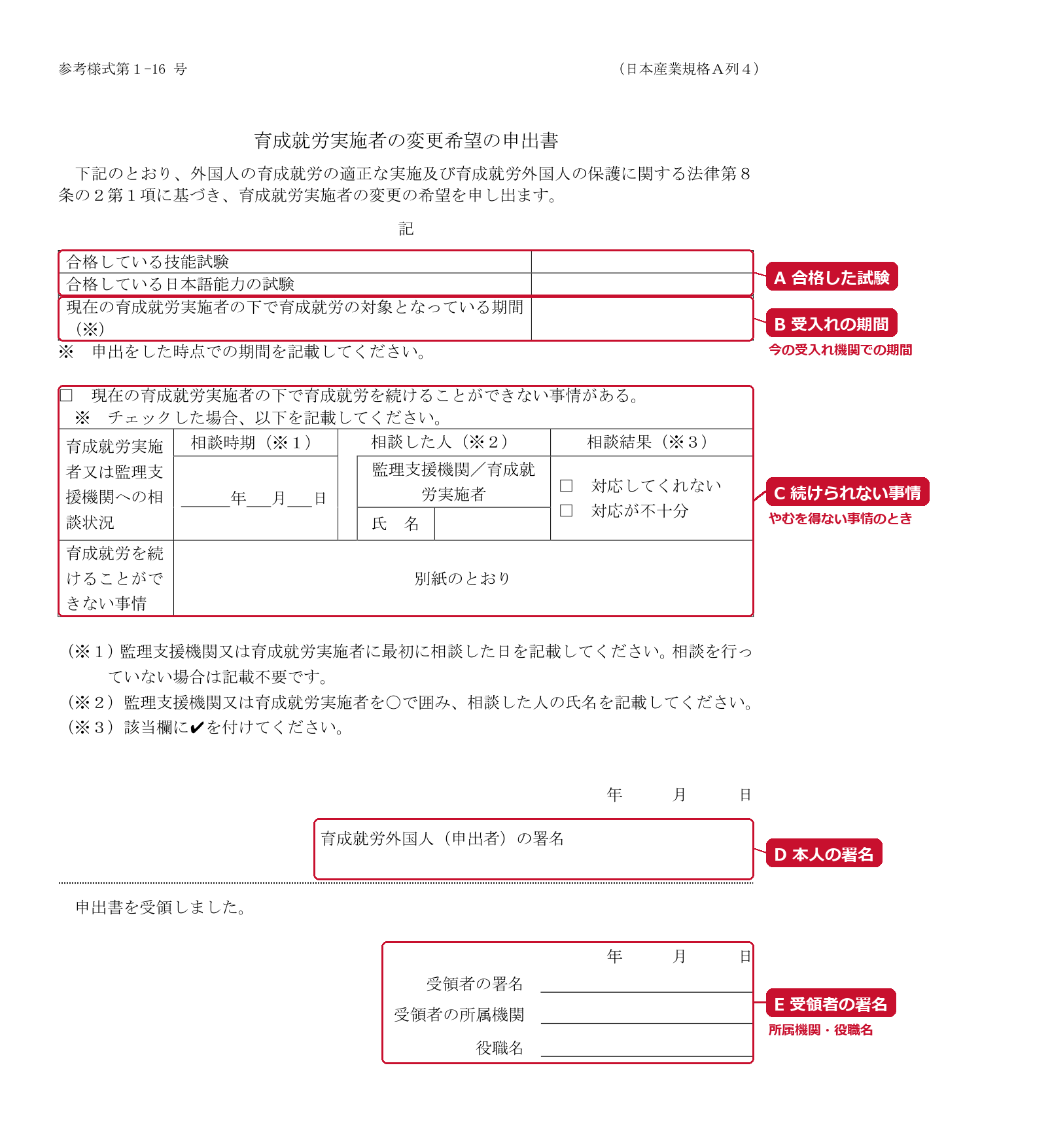
Sources: Immigration Services Agency
The items required by law are the worker’s name, nationality, and date of birth, the name of the current accepting organization, and the reason for wishing to transfer. Even on a different form, if these items are included, it is recognized as a request and cannot be refused.
Procedures by Recipient of the Request and When the Previous Employer Is Notified
The request can be submitted to three places. Which one receives it changes when the previous employer finds out (for the supervised type).
| Recipient of the request | What the recipient does | When the previous employer finds out |
|---|---|---|
| Accepting organization | Gives a copy to the worker and notifies the supervising and support organization without delay (No. 1-19). The supervising and support organization files a notification with the Organization (Ministerial Ordinance Form No. 5) and sends a response notice (No. 1-17) to the worker and the accepting organization | When it receives the request |
| Supervising and support organization | Gives a copy to the worker, files a notification with the Organization (Ministerial Ordinance Form No. 5), and sends a response notice (No. 1-17) to the worker | When the new employer’s plan is certified (No. 1-19) |
| Organization | Notifies the supervising and support organization and the accepting organization using Ministerial Ordinance Form No. 6. If requested, the supervising and support organization submits an investigation result report (No. 1-22) | Promptly. If the worker does not consent, when the worker consents or when the new employer’s plan is certified |
For the independent type (単独型), the accepting organization files the notification directly with the Organization. The notification to the Organization is filed without delay. If confirming the facts takes time, the notification is filed first, with the fields that cannot yet be completed marked “to be reported later.” If the worker gives up on the transfer, the worker is guided to submit a withdrawal form (No. 1-18), and a copy is submitted to the Organization.
The Supervising and Support Organization’s Search for a New Employer and the Application Documents for the New Plan
Once the supervising and support organization confirms facts that may meet the requirements for a transfer at the worker’s own wish, it provides support such as job placement according to the worker’s wishes. Support in finding a new employer is required even if the transfer restriction period has not passed at the time of the request. If finding one is difficult, it can submit a support request form (No. 1-21) to the Organization.
The documents checked in the new employer’s application for certification are Ministerial Ordinance Form No. 2, Reference Form No. 1-12, and copies of the certificates of passing the skills and Japanese language tests. The plan states the name of the previous employer, the period at the previous employer, and the total period in the same job category. A copy of the previous plan is obtained from the worker or the supervising and support organization. Inquiries to the current accepting organization are made only after confirming the worker’s wishes in advance and obtaining the worker’s consent.
Residence Procedures When Transferring
The procedures for the status of residence “Employment for Skill Development” that accompany a transfer (the type of application and its timing) cannot be confirmed in the Operational Guidelines or the Q&A (checked on November 3, 2026). This article does not state the procedure as definite. For individual cases, consult the Regional Immigration Services Bureau (地方出入国在留管理局) or a professional.
(Sources: Operational Guidelines, Chapter 4, Section 3, Parts 1 and 2, Chapter 5 (duties of supervising and support organizations), Key Points of the Operational Guidelines, Q&A Q48)
Standards the New Accepting Organization Must Meet: Excellence Requirements, the Ratio of Workers Who Transferred at Their Own Wish, and the Ban on Private Job Placement
Only accepting organizations that meet all of the following standards can accept workers who transfer at their own wish. They must also stay within the cap on the number of workers.
Being an excellent implementing organization: This is required both at the time of the application for certification and at the start of Employment for Skill Development. It uses a points system: the standard is at least 70% of the total possible score, which depends on the acceptance record (56 to 100 points), and at least 60% in each item except some items. The check is done by submitting a declaration of conformity with the excellence requirements (No. 1-36) when applying for certification of the plan, and the excellent status lasts until December 31 of the fiscal year after the fiscal year in which the notice was received.
Note that the earlier sentence stating that an organization could accept such workers if it was recognized as excellent at the time of the application for certification of the transfer, even without having been recognized as excellent before, was deleted in the revision of August 5, 2026. Organizations that will be checked for the first time should confirm the procedure with the Organization before applying.
The workers it currently accepts are not only transferred workers, etc.: The organization must have workers accepted under a regular Employment for Skill Development plan.
Ratio of workers who transferred at their own wish: Counting the worker in question in both the numerator and the denominator, it must be within one-third of the total after the transfer. If the organization’s head office is outside the designated areas (major metropolitan areas) and it accepts workers from inside the designated areas (regional areas), the number from regional areas must be within one-sixth. If the total after the transfer is 5 or fewer, it can accept up to 1 worker from a regional area within the one-third limit.
| Total after the transfer | Cap on workers who transferred at their own wish | Of which, cap on transfers from regional areas to major metropolitan areas |
|---|---|---|
| 1-2 workers | 0 | 0 |
| 3-5 workers | 1 | 1 |
| 6-8 workers | 2 | 1 |
| 9-11 workers | 3 | 1 |
| 12-13 workers | 4 | 2 |
The areas outside the designated areas are Tokyo, Kanagawa, Chiba, Saitama, Aichi, Kyoto, Osaka, and Hyogo, excluding the municipalities designated as designated areas by public notice. The calculation excludes workers who transferred due to unavoidable circumstances, workers whose period was extended beyond 3 years, and workers whose training was interrupted due to pregnancy, childbirth, etc.
Not using private job placement services, etc.: When looking for a worker to accept through a transfer at the worker’s own wish, the new employer may receive job placement only from the supervising and support organization, the Organization, Hello Work, or the District Transport Bureau (including the Transport Supervision Department). If any of the following applies, the new employer cannot receive certification of the Employment for Skill Development plan for that transfer.
- The new employer received job placement for the employment contract with that worker from someone other than the four above (such as a private job placement business)
- The new employer received specified recruitment information provision (特定募集情報等提供: providing job offer information, etc., by collecting information on people who want to become workers) for the employment contract with that worker from a business other than the four above
- The transferring worker received specified recruitment information provision for the employment contract with the new employer from a business other than the four above
- Within the past year, the new employer asked a business other than the four above to provide specified recruitment information mainly aimed at Employment for Skill Development foreign nationals
(Sources: Operational Guidelines, Chapter 4, Section 3, Part 2 (3) C, Section 2 (caps on the number of workers and excellent implementing organizations), Q&A Q52 and Q53, Partial Revision of the Operational Guidelines (Comparison Table of Old and New Provisions))
Compensation for Initial Costs Paid by the New Employer to the Previous Employer: Proration Rates and the Unpublished Amount Set by Public Notice
The new employer compensates the previous employer for part of the initial costs that the previous employer spent on accepting the worker. The proration rates used in the calculation have been decided, but the amount set by public notice on which they are based has not been published. The Q&A says it is “scheduled to be established in the future,” and as of November 3, 2026 it is not in the list of public notices of the Immigration Services Agency. For this reason, this article does not give examples of amounts.
The compensation for the first transfer at the worker’s own wish is the amount set by public notice multiplied by the following proration rate (amounts under 1,000 yen are rounded down).
| Period of Employment for Skill Development at the previous employer | Proration rate |
|---|---|
| 1 year or more but less than 1 year and 6 months | 5/6 |
| 1 year and 6 months or more but less than 2 years | 2/3 |
| 2 years or more but less than 2 years and 6 months | 1/2 |
| 2 years and 6 months or more | 1/4 |
For a second transfer (Company A → Company B → Company C), the compensation is the first compensation amount multiplied by the following proration rate (amounts under 1,000 yen are rounded down).
| Period at Company A | Total period at Companies A and B | Proration rate |
|---|---|---|
| 1 year or more but less than 1 year and 6 months | 2 years or more but less than 2 years and 6 months | 3/5 |
| 1 year or more but less than 1 year and 6 months | 2 years and 6 months or more | 3/10 |
| 1 year and 6 months or more but less than 2 years | 2 years and 6 months or more | 3/8 |
The new employer pledges in its application for certification that it will pay, and within 6 months after certification it submits documents proving the payment to the Organization. If it does not pay in breach of the pledge, the certification may be revoked as a false application. It is desirable, if possible, for the new and previous employers to agree on the amount in advance. If the previous employer did not incur initial costs (for example, for a worker who came to the previous employer through a transfer due to unavoidable circumstances), compensation is not required.
(Sources: Operational Guidelines, Chapter 4, Section 3, Part 2 (3) C (e), Q&A Q54, System Overview and Related Laws)
What the Previous Accepting Organization Must Do and Must Not Do
The previous employer cannot stop the worker from making the request itself. Whether the transfer actually happens depends on whether the new plan is certified.
| Category | Details |
|---|---|
| Must do | Receive the request form, sign the recipient field, and give a copy to the worker |
| Must do | Check the content and notify the supervising and support organization without delay (for the independent type, file a notification with the Organization) |
| Must do | If continuing becomes difficult because the worker leaves the job, etc., promptly notify the supervising and support organization (the supervising and support organization submits the notification of difficulty in implementing Employment for Skill Development Ministerial Ordinance Form No. 13; for the independent type, the accepting organization submits it) |
| Must do | If asked, give copies of the Employment for Skill Development plan and the receipts for travel expenses |
| Must do | Keep receipts, etc., for the acceptance costs for the purpose of compensation |
| Must do | Do not keep the documents certifying that the worker passed the skills test; give them to the worker promptly |
| Must not do | Refuse to receive the request form or throw it away |
| Must not do | Treat the worker unfavorably, such as dismissing them, because of the request |
| Must not do | Obstruct the transfer, or prevent the worker from taking a test in order to obstruct it |
Obstructing a test can be grounds for revoking the certification. In addition, once such conduct is found, a transfer due to unavoidable circumstances may be allowed. For tests where the testing body comes to the workplace, cooperation such as providing a test venue is necessary. If providing a venue is extremely difficult, arranging another venue for the worker to take the test is also accepted.
On the other hand, the following are not obligations.
- Having a worker who failed the skills test in the first year take it a second time for the purpose of a transfer
- Having the worker take a Japanese language test above A1 level by the end of the transfer restriction period
If the supervising and support organization regularly pays sending management fees to the sending organization, it is desirable to state clearly in advance, in the supervision and support fee schedule or the supervision and support contract, etc., whether it will continue to collect those fees from the accepting organization at the time of a transfer. As a prerequisite, it is also desirable to make clear in the contract with the sending organization how a transfer affects the payment obligation. Check the content of your supervision and support contract.
The Employment for Skill Development Period and the Main Skill After a Transfer
The period the worker can work at the new employer is 3 years minus the past period in the same job category. For example, if the worker spent 2 years at the previous employer, the period at the new employer is 1 year. Periods during which the plan was suspended are not counted.
The main skill (主たる技能) and the target tests of Employment for Skill Development can be changed within the same job category, but it is considered desirable not to change them. The hours of the Japanese language course (the A2 target course) are also carried over. In an example in the Operational Guidelines, if the worker completed 30 hours at the previous employer, at least 70 hours are required at the new employer.
(Sources: Operational Guidelines, Chapter 4, Section 3, Part 2 (1), Section 2, Q&A Q51)
What Has Not Been Published Before the System Takes Effect, and What Accepting Organizations Can Prepare Now
As of November 11, 2026, the following points could not be confirmed.
- The amount set by public notice on which the compensation for initial costs is based
- The field-specific Operational Guidelines for nursing care, construction, shipbuilding and ship machinery, and agriculture
- The residence procedures when transferring, and how residence is treated if the worker leaves the job before a new employer is decided
Accepting organizations can prepare as follows now.
- In fields with a 2-year period, decide whether to set the transfer restriction period at 1 year or 2 years, and if 2 years, check the measures to improve working conditions
- Decide how to keep receipts, etc., for the costs of accepting workers
- Decide who will receive request forms and the procedure for reporting to the Employment for Skill Development manager
- Include the transfer restriction period in the explanation given before the worker enters Japan
- If you want to accept transferring workers, check the standards for excellent organizations
Frequently Asked Questions
Q1. Can the accepting organization refuse a worker’s request to transfer?
It cannot refuse to receive the request form. If the requirements are not met, the transfer cannot be certified, and the supervising and support organization provides information and advice to the worker.
Q2. Can a worker transfer to a different job category or a different field?
No. Whether the transfer is at the worker’s own wish or due to unavoidable circumstances, it is limited to the same job category.
Q3. Can a worker make a transfer at their own wish through a referral from a private recruitment agency?
No, this is not allowed. Referrals may be received only from the supervising and support organization, the Organization, Hello Work, or the District Transport Bureau.
Q4. Can a worker make a request before the transfer restriction period has passed?
Yes, the worker can make the request. The supervising and support organization must support the search for a new employer even if the period has not passed. However, certification requires that the period requirement be met.
Q5. How much are the initial costs that the new employer pays to the previous employer?
The proration rates have been decided, but the amount set by public notice on which they are based has not been published (checked on November 3, 2026).
Q6. Can current technical intern trainees also transfer at their own wish?
The transfer at the worker’s own wish is a procedure established for Employment for Skill Development foreign nationals. Technical intern trainees who are in Japan when the system takes effect continue their Technical Intern Training based on their certified plans. The transitional measures are explained in the following article.
(Sources: Operational Guidelines, Chapter 4, Section 3, Parts 1 and 2, Chapter 5, Q&A Q47, Q54, and Q77)
Summary
- A transfer at the worker’s own wish requires, within the same job category, work longer than the transfer restriction period and passing the skills and Japanese language tests.
- The procedure starts when the worker submits the request form (No. 1-16), and it is completed when the new employer receives certification of a new Employment for Skill Development plan.
- The new employer must meet standards on excellence, the ratio of transferred workers, the ban on private job placement, and compensation for initial costs. The amount set by public notice for the compensation has not been published.
- The previous employer cannot refuse to receive the request form and cannot treat the worker unfavorably or obstruct the transfer. It needs to keep receipts, etc.
The conclusion may change depending on individual circumstances. If you are unsure, consult the supervising and support organization, the Organization, or a professional.
Primary Sources Referenced in Article Creation
- Immigration Services Agency and Ministry of Health, Labour and Welfare, “Operational Guidelines for the Employment for Skill Development System” (full version)
- Immigration Services Agency, “Partial Revision of the Operational Guidelines for the Employment for Skill Development System (Comparison Table of Old and New Provisions)”
- Immigration Services Agency, “Key Points of the Operational Guidelines for the Employment for Skill Development System”
- Immigration Services Agency, “Q&A on the Employment for Skill Development System”
- Immigration Services Agency, “Operational Guidelines for the Employment for Skill Development System” forms page
- Ministry of Justice, Ministry of Health, Labour and Welfare, and Ministry of Agriculture, Forestry and Fisheries, “Operational Guidelines for the Employment for Skill Development System for Specified Fields: Standards for the Fishery Field” (main text)
- Immigration Services Agency, “Reference Form No. 1-16: Request Form for a Change of Employment for Skill Development Implementing Organization”
- Immigration Services Agency, “Main Points of the Field-Specific Operational Policies”
- Immigration Services Agency and Ministry of Health, Labour and Welfare, “Overview of the Employment for Skill Development System”
- Immigration Services Agency, “Employment for Skill Development System: System Overview and Related Laws”
This article is a translation of the original Japanese version.