

In Japan, changes to an approved Construction Specified Skilled Worker Acceptance Plan (建設特定技能受入計画; the “Acceptance Plan” below) are handled by two different procedures. Items stated on the certificate of approval and items that concern the core of employment and acceptance require a “change application” (変更申請) before the change; all other items require a “change notification” (変更届出), made without delay after the change. Adding a foreign national is also done by a change application, and you do not create a new Acceptance Plan. When you change a Specified Skilled Worker employment contract, a separate notification to immigration is required within 14 days of the date of the change.
The Acceptance Plan is a plan for which a company needs approval from the Minister of Land, Infrastructure, Transport and Tourism in order to accept foreign nationals as Specified Skilled Worker (i) (特定技能1号) in the construction field. The certificate of approval of the Acceptance Plan is a different document from the Certificate of Eligibility (在留資格認定証明書) issued by immigration. The overall picture of the Acceptance Plan is summarized in the following article.
The contents were checked on November 3, 2026 against MLIT’s guide (April 4, 2025) and the operational guidelines (construction field, partially revised January 31, 2025).
The difference between a change application and a change notification for the Construction Specified Skilled Worker Acceptance Plan
A change application is a procedure done in advance to obtain approval from the Minister of Land, Infrastructure, Transport and Tourism. A change notification is a procedure to report the details after the change has been made.
| Point of comparison | Change application | Change notification |
|---|---|---|
| Legal basis | Article 5, paragraph 1 of the Notice (approval required) | Article 5, paragraph 2 of the Notice (notification of minor changes) |
| Timing | Before the change | After the change, without delay |
| Review | Approved after review by the Regional Development Bureau, etc. | Accepted at the moment it is sent |
| When the change can be put into effect | Until approval, carry out the acceptance as stated in the approved Acceptance Plan | If, after acceptance, it is found not to meet the standards, you may be instructed to correct it and return to the state before the change |
| Contact after the procedure | Wait for contact from the Regional Development Bureau, etc. | No confirmation email or contact from the Regional Development Bureau, etc. |
| Form | Field Reference Form No. 6-7 | Field Reference Form No. 6-8 |
Both are, in principle, done online (Foreign Worker Employment Management System, 外国人就労管理システム). We could not find the specific number of days meant by “without delay” in official materials. Make the notification promptly after the change.
The operational guidelines warn that if you continue accepting workers without carrying out these procedures, the approval of the Acceptance Plan may be revoked under Article 8 of the Notice.
(Source: Notice, Operational guidelines (construction field) p.18, 31, Guide to change applications and notifications, printed p.1, 11, 14)
List of items that require a change application | Core of employment, core of acceptance, and other important items
The guide states that, in principle, items stated on the certificate of approval require a change application, and then lists the following three categories.
| Category | Item | Main attachments |
|---|---|---|
| Core of employment | Decrease in the total basic wage, increase in scheduled working hours, disadvantageous change regarding pay raises, change of job category | Disadvantageous changes are not approved in principle (see below) |
| Core of acceptance | Number of workers to be accepted (applied for together with adding a foreign national) | Documents for each foreign national (see below) |
| Core of acceptance | Acceptance period, matters concerning the foreign nationals to be accepted | Not stated in the guide’s list of documents |
| Core of acceptance | Number of full-time employees | Documents showing the number of full-time employees (documents confirming social insurance enrollment) |
| Other important items | Affiliated organization | Membership certificate of the new organization |
| Other important items | Trade name or name, location of head office | For a corporation, a certificate of registered matters (certificate of all historical registered matters); for a sole proprietor, the representative’s resident record (juminhyo). Issued within 3 months before the application date |
| Other important items | Construction business license number and license period | Construction business license certificate (within its validity period) |
| Other important items | CCUS business operator ID | Not stated in the guide’s list of documents |
When you change your affiliated organization, it is important not to create any period in which you are not a member of an organization. The guide asks you to apply with the membership certificate of the new organization attached and to withdraw from the previous organization after approval. Do not withdraw before applying.
JAC’s quick reference chart of items to change advises that if you change your trade name, the name of the representative, your location, etc., you should also carry out change procedures with your affiliated organization.
(Source: Guide to change applications and notifications, printed p.1, 3, JAC quick reference chart for change applications (supplementary material))
List of items for which a change notification is enough | Wages, allowances, and bonuses only under conditions
Items other than those requiring a change application are handled by a change notification. However, for wages, allowances, bonuses, and retirement allowances, the conditions are limited, for example to cases where the change is not disadvantageous.
| Area | Items handled by change notification | Condition for handling by change notification |
|---|---|---|
| Company information | Name of the representative or the individual, telephone number, fax number, email address, title and name of the person responsible for Construction Specified Skilled Workers | — |
| Efforts for acceptance | Efforts to secure domestic workers, safety and health education, measures to improve skills | — |
| Documents on the working environment | Work rules and wage regulations, Article 36 agreement, agreement documents, notification, and annual calendar for flexible working hours | — |
| Information on foreign nationals | Residence card number, CCUS technician ID and a copy of the card, wage ledger of Japanese employees, documents proving years of practical experience of Japanese employees, copy of the advance explanation of important matters | — |
| Wages and allowances | Basic wage (monthly), whether allowances are paid, names of allowances, amounts and conditions of allowances, explanation of remuneration, employment contract and statement of employment conditions | Only changes that are not disadvantageous changes such as to pay raises |
| Bonuses and retirement allowances | Whether bonuses are paid, amount or number of months’ pay, number of payments; whether retirement allowances are paid, amount, type, and conditions | Only when they are lowered in the same way for Japanese employees |
Even after a change notification is accepted, if it is found not to meet the standards, you may be instructed to return to the state before the change. Before submitting, confirm that the change is not disadvantageous and that it meets the standards.
Fields for bonuses, allowances, and retirement allowances exist not only in the list of foreign nationals but also in “4. Matters concerning ensuring an appropriate working environment” of the Acceptance Plan. According to the screens in the guide and JAC’s quick reference chart, this section is corrected by a change application. Check that both are consistent. Pay raises (items 15 to 17 of section 4) are also items in this section, and if there are foreign nationals affected, also check whether a change notification of the employment contract, etc. is needed (JAC quick reference chart).
The initial basic wage, information on completed Technical Intern Training, information on passed tests, and similar items cannot be changed after approval (adding a passed skills test is possible). JAC’s quick reference chart advises that if the plan was approved with incorrect information, you should consult the Regional Development Bureau with jurisdiction.
(Source: Guide to change applications and notifications, printed p.1, 2, 7, JAC quick reference chart for change notifications (supplementary material))
Quick reference by situation | Whether changes in wages, number of workers, license renewal, or the representative need a change application or a change notification
First check whether the item is stated on the certificate of approval or is in the guide’s list of change application items, and if it is, check whether the change is disadvantageous.
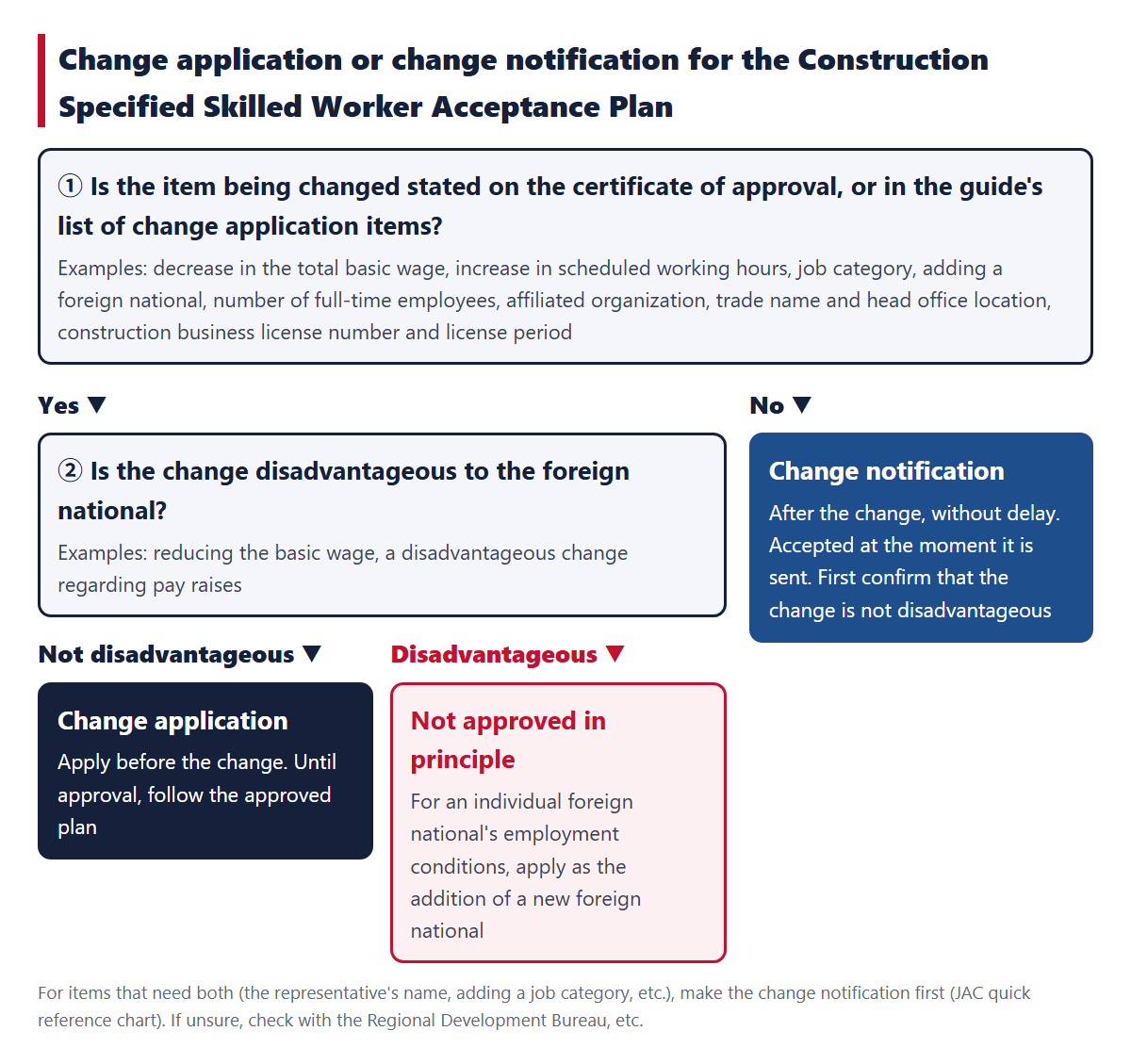
Sources: Prepared by the editorial team (based on MLIT’s “Online application for the Construction Specified Skilled Worker Acceptance Plan [change applications and notifications”)](https://www.mlit.go.jp/tochi_fudousan_kensetsugyo/content/001603432.pdf)
In situations where both are needed, follow JAC’s quick reference chart and make the change notification first.
| Situation | Procedure | Points to note |
|---|---|---|
| Raising the basic wage | Change notification | Also revise the employment contract, statement of employment conditions, etc. |
| Lowering the basic wage | Not allowed in principle | See the next section |
| Replacing part of the basic salary with a fixed overtime allowance | Change notification if it is a pay raise. A reduction is not allowed in principle | Making up the difference with a fixed overtime allowance is not allowed |
| Adding or changing tasks within the same job category | Change notification of the basic salary after a pay raise | Pay remuneration equal to or higher than that of Japanese employees with equivalent skills |
| Adding a job category | Change notification → change application | Employment contract, etc. in the notification; job category and certificate of passing in the application (not needed if exempt from the test) |
| Adding a foreign national | Change application | Steps explained below |
| The construction business license was renewed | Change application | Attach the construction business license certificate |
| The representative was replaced | Change notification → change application | Name in the notification; certificate of registered matters in the application (JAC quick reference chart) |
| Changing the company name or moving the head office | Change application | If the telephone number also changed, a change notification is also needed |
| Changing the affiliated organization | Change application | Withdraw from the previous organization after approval |
| The number of full-time employees increased or decreased | Change application | Official materials do not state when to make the change application |
| The telephone number, email address, or person responsible changed | Change notification | — |
| The Article 36 agreement or work rules were updated | Change notification | — |
| The residence card number changed | Change notification | Can also be corrected from the acceptance report screen (JAC quick reference chart) |
| Merger, company split, or incorporation of a sole proprietorship | Consult the Regional Development Bureau with jurisdiction over the location of the head office | Handling differs depending on the form |
A change application only to change the planned acceptance period is not needed (JAC quick reference chart).
Cases where scheduled working hours decrease and cases where the place of work (prefecture) is added or changed are not clearly stated in the guide’s list. For changes not in the table or changes you are unsure about, check with the Regional Development Bureau, etc. with jurisdiction over your main business office. JAC’s help desk (0120-220-353, weekdays 9:00 to 17:30) also provides guidance on the system in general and how to operate it.
(Source: Guide to change applications and notifications, FAQ 8-3, 8-4, Job category Q&A 7-5, 7-6, Operational guidelines (construction field) p.22, JAC quick reference chart for change applications, JAC quick reference chart for change notifications, MLIT contact information)
How disadvantageous changes such as a reduction in the basic wage or an increase in scheduled working hours are handled
Disadvantageous changes are not approved in principle. The guide asks that a disadvantageous change to an individual foreign national’s employment conditions be applied for as the addition of a new foreign national, and you cannot make a change application from the existing list of foreign nationals.
MLIT’s FAQ gives the example of changing part of the basic salary into a fixed overtime allowance.
- If it is a pay raise, make a change notification
- If it is a reduction, make a change application as the addition of a new foreign national
- A reduction in the basic wage conflicts with “giving pay raises according to skill development,” so it is not allowed in principle
- Making up the difference with a fixed overtime allowance, which is a wage outside scheduled working hours, is not allowed
Bonuses and retirement allowances are handled by a change notification only when they are lowered in the same way for Japanese employees.
Changes that lower the basic wage or increase scheduled working hours also need to be checked from the standpoint of labor laws. The operational guidelines explain that MLIT reviews the employment contract for the purpose of approving the Acceptance Plan, and this does not mean MLIT recognizes it as lawful under labor laws. Because the conclusion can change depending on individual circumstances, consult the Regional Development Bureau, etc. or an expert before carrying it out.
(Source: Guide to change applications and notifications, printed p.1, 2, FAQ 8-3, Operational guidelines (construction field) p.30)
Steps and required documents for the change application when adding a foreign national
When you employ a second or later foreign national, you do not obtain a new ID; you make a change application with your existing ID. A company can have only one approved Acceptance Plan. The operational guidelines warn that if you apply for a separate Acceptance Plan, it will be regarded as approval obtained by fraudulent means and the approval may be revoked.
There are four steps.
- If the work rules and wage regulations, Article 36 agreement, or agreement documents and annual calendar for flexible working hours have been changed or have expired, first correct them by a change notification
- Change the planned number of workers to “the approved number + the number being added this time”
- Press “Add” (追加) in the list of foreign nationals and enter the information of the foreign national being added
- Attach the documents and apply
On the change application screen of the system, items with a white check box are corrected by a change application. Items with a gray check box are corrected by a change notification. You cannot change an item unless you check its box.
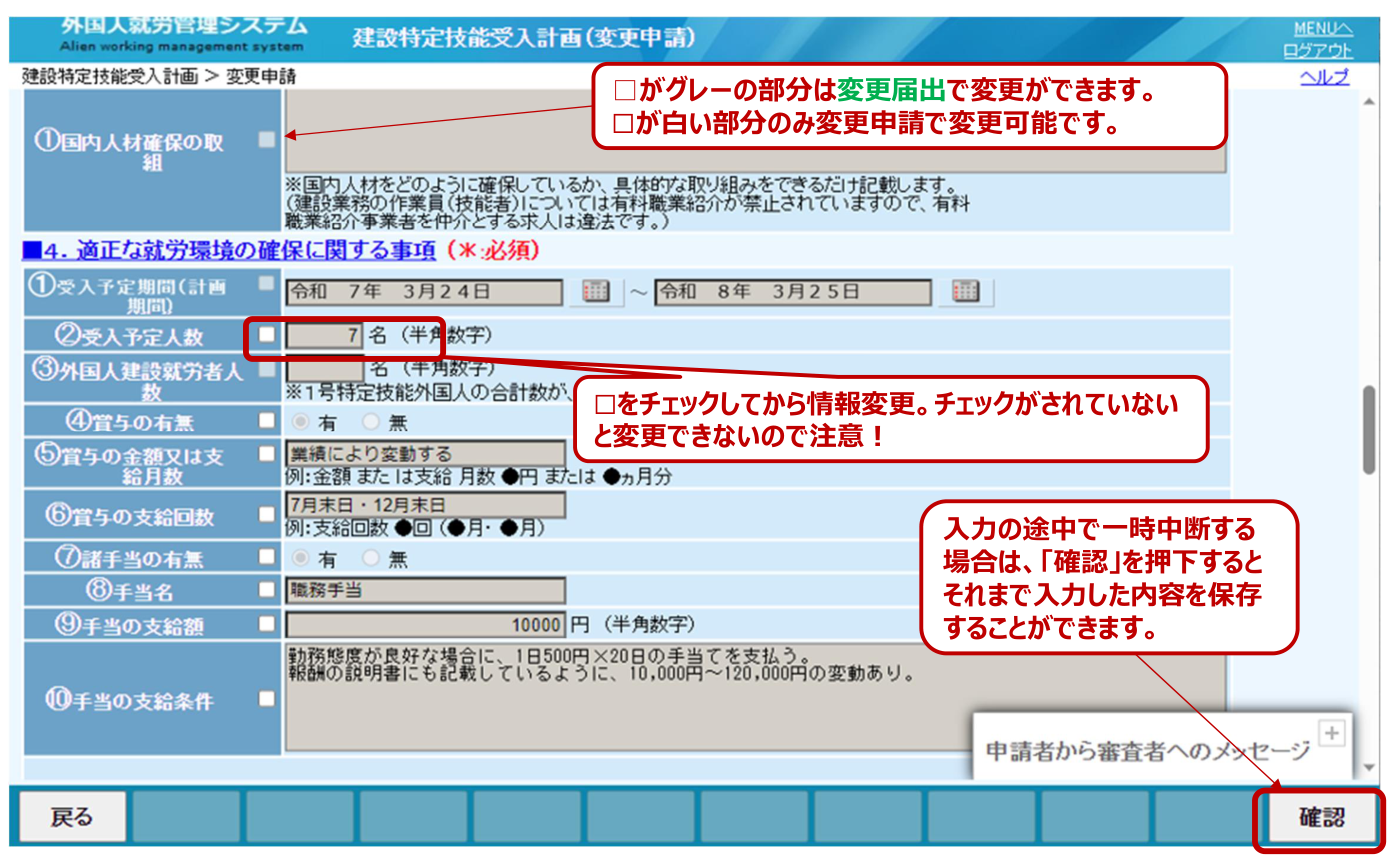
Sources: Created by cropping and editing the screen image in MLIT’s “Online application for the Construction Specified Skilled Worker Acceptance Plan [change applications and notifications”](https://www.mlit.go.jp/tochi_fudousan_kensetsugyo/content/001603432.pdf)
The documents to attach for each foreign national are as follows. Use documents as of the time of the change application (documents from the previous application cannot be used).
| Document | Points to note |
|---|---|
| Document confirming the CCUS technician ID | Copy of the card |
| Explanation that the remuneration is equal to or higher than that of Japanese employees with equivalent skills | Form on MLIT’s website |
| Wage ledger of Japanese employees with equivalent skills | For the most recent 1 year. Including bonuses |
| Documents proving years of practical experience of Japanese employees with equivalent skills | Résumé, etc. Any format |
| Copies of the Specified Skilled Worker employment contract and statement of employment conditions | For all workers |
| Advance explanation of important matters (Notice Form No. 2) | For all workers |
Before applying, check the following points.
- The end of the plan period of the Acceptance Plan is the same as or later than the end date for the foreign national being added
- The total of the planned number of workers and the number of foreign construction workers is no more than the number of full-time employees
- A Hello Work job posting does not need to be attached when adding a worker, but you are continuing to recruit (this is checked during on-site guidance visits)
For notes on each document, see the required documents section of the article on the overall picture of the Acceptance Plan. JAC advises that when you re-employ a person who has left, you can skip some input by using the “re-employment” (再雇用) field. The whole set of procedures for a person changing jobs to your company is summarized in the following article.
A status of residence application to immigration requires a copy of the certificate of approval of the Acceptance Plan.
(Source: Guide to change applications and notifications, printed p.3, 5, 7, FAQ 8-1, 8-2, Operational guidelines (construction field) p.31, JAC: Procedures for change applications (supplementary material), Table 3-5 Construction (for changes))
How to fill in the change application form (Field Reference Form No. 6-7) and the change notification form (No. 6-8), and points to note when applying
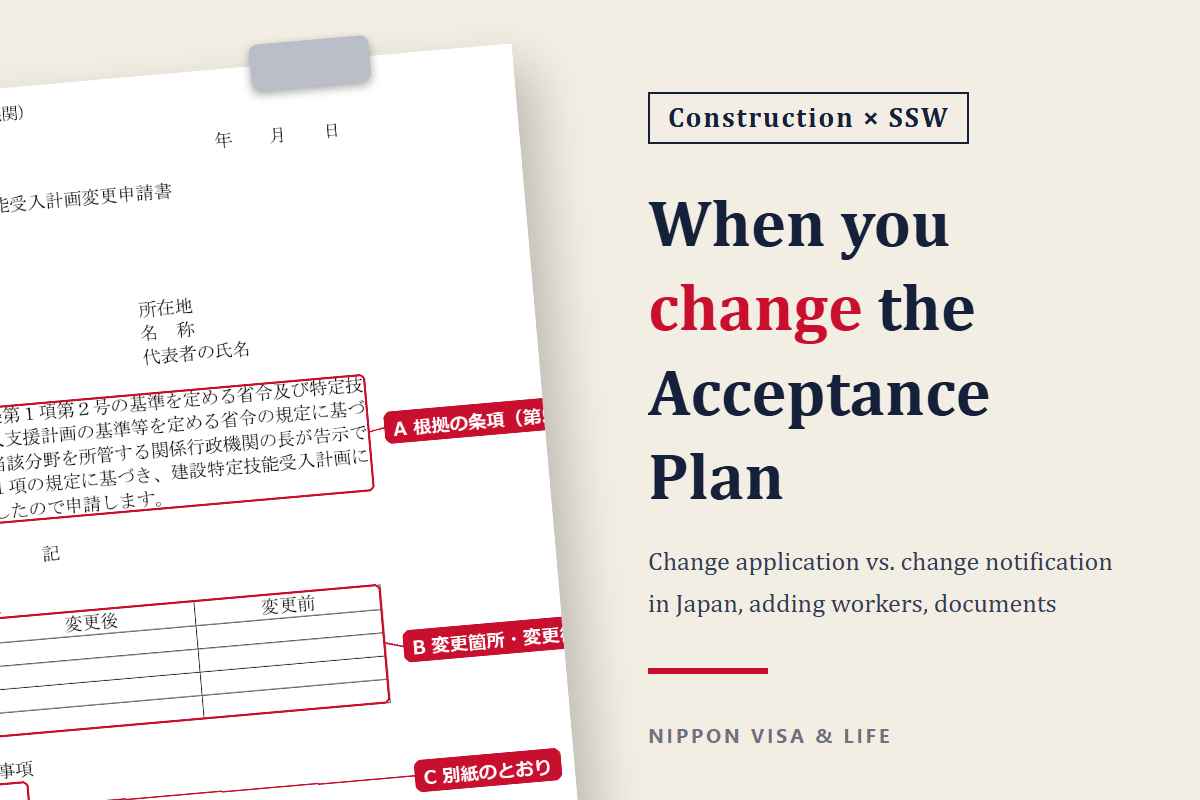
In principle you enter the information in the system, but the forms show how to write the changes so that the changed parts are clear. The change application form (No. 6-7) looks like this.
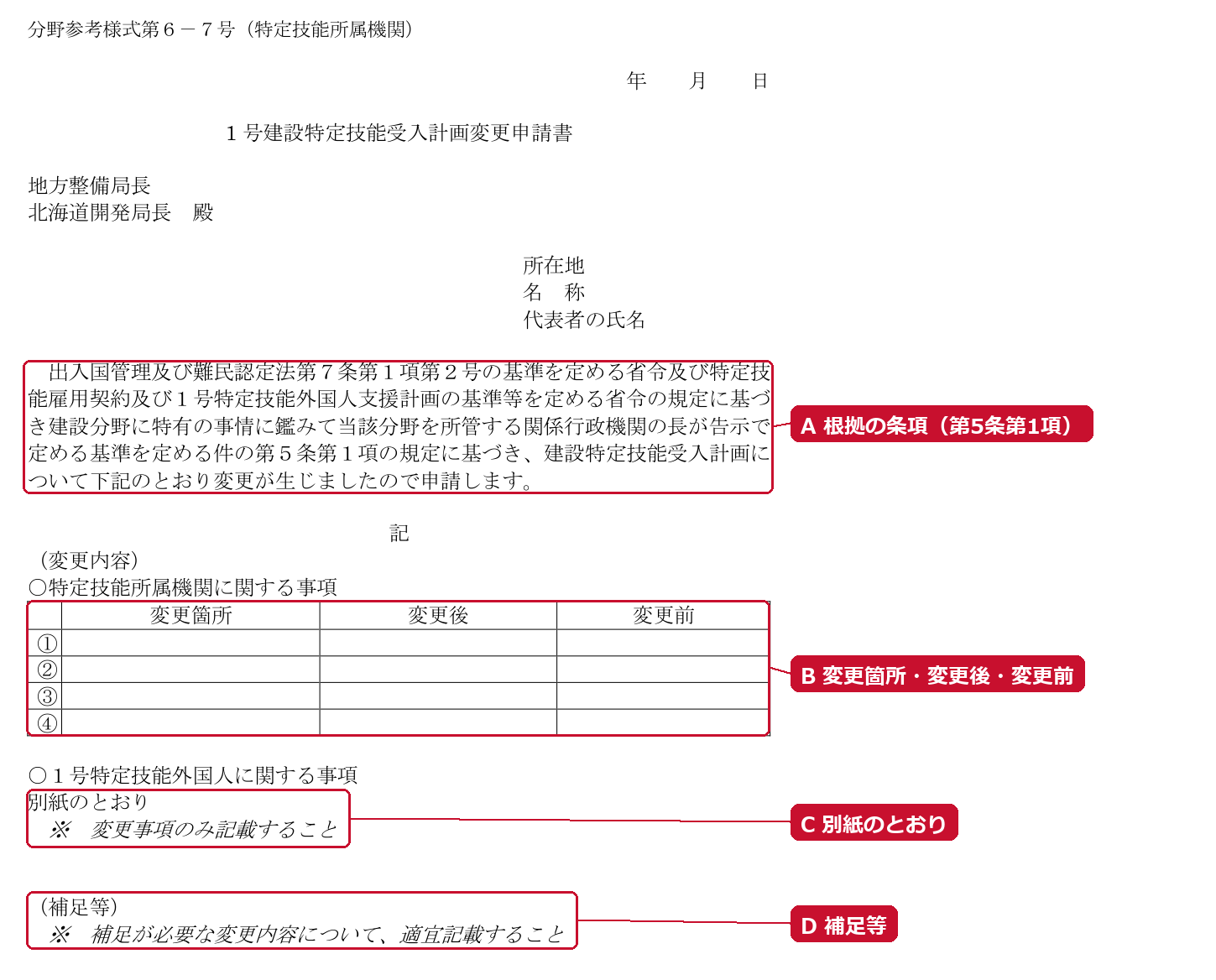
Sources: Immigration Services Agency, Field Reference Form No. 6-7
- A: Wording stating that the application is based on Article 5, paragraph 1 of the Notice
- B: Write matters concerning the company with the changed item, the content after the change, and the content before the change matched in that order
- C: Write matters concerning foreign nationals on the attachment (list of Specified Skilled Workers to be accepted), including only the changed items
- D: Write any changes that need additional explanation
The change notification form (No. 6-8) differs in that its basis is a “minor change” under Article 5, paragraph 2 of the Notice (A in the image).
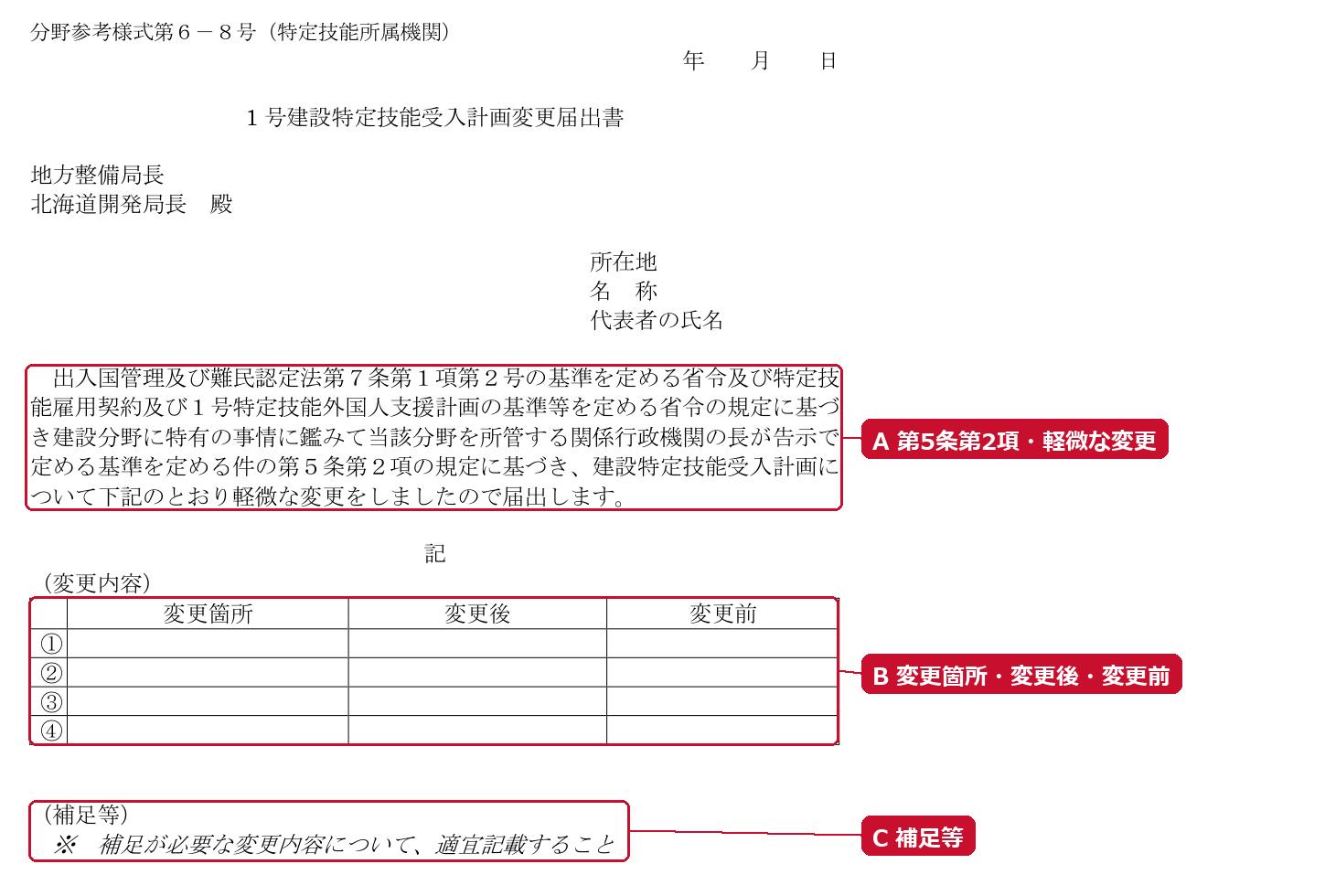
Sources: Immigration Services Agency, Field Reference Form No. 6-8
Points to note when applying:
- While a change application is under review, you cannot make another new change application. Apply with plenty of time to spare
- If you use “withdraw and re-edit” (引戻し・再編集), the review starts in the order of the date of re-application, not the original application date
- Only attorneys and gyoseishoshi lawyers can act as agents; registered support organizations cannot act as agents. For each change application, enter the details of the agency and attach a letter of attorney
We could not find an official estimate of the review period for change applications. “About 1.5 to 2 months (excluding correction periods)” is guidance for new applications for approval. Check the expected period with the Regional Development Bureau, etc.
(Source: Operational guidelines (construction field) p.31, Guide to change applications and notifications, printed p.5, 11, FAQ 4-4, MLIT application guide page)
Procedures needed for the Acceptance Plan when a foreign national leaves, is re-employed, or cancels coming to Japan, and when acceptance ends
When a worker leaves the company, submit a resignation report. A change application only to change the planned number of workers is not needed; correct the number of workers when you make the next, separate change application after the resignation report.
When the same company employs the person again, the procedures are divided as follows.
| Situation at departure from Japan | Procedure with MLIT |
|---|---|
| The employment contract, social insurance, and status of residence of Specified Skilled Worker (i) all continue | No procedure needed |
| Any of the three above has ended, and the content of the employment contract has not changed | Re-employment application (do not submit a resignation report). After the worker resumes work, submit an acceptance report, as a guide within 1 month |
| Any of the three above has ended, and the content of the employment contract has changed | Submit a resignation report, and make a change application as the addition of a new foreign national |
A re-employment application is usually approved in 2 weeks to 1 month, and a new certificate of approval is sent by mail. Apply promptly after the foreign national has actually left the company. If the basic wage only went up through a regular pay raise, this is a raise in line with the original contract, so it counts as “has not changed.” The FAQ limits the re-employment application to cases where the worker leaves Japan with a special re-entry permit while keeping their residence card. If the residence card has expired, a change application is needed regardless of whether the content has changed.
The operational guidelines explain that when a person leaves and then works again at the same company, notifications to immigration (termination of the employment contract and difficulty in acceptance, and conclusion of a new employment contract) are also required.
For a foreign national who has cancelled coming to Japan, select the person on the acceptance report screen and select “Withdrawal” (取下げ) in the work status field.
When you end the acceptance of all foreign nationals and will not conclude any new Specified Skilled Worker employment contract, you can apply for revocation of the approval of the Acceptance Plan (Article 5, paragraph 3 of the Notice). Even if all workers have left, as long as the Acceptance Plan exists, obligations such as membership in JAC, etc. and on-site guidance visits continue. When the application for revocation of the plan is granted, the approval number is deleted and these obligations end. Apply from “Plan revocation application” (計画取消申請) in the system; no particular attachments are required.
(Source: Guide to change applications and notifications, printed p.5, 15, Guide to re-employment applications, FAQ 9-1, 9-2, 9-5, 9-6, Operational guidelines (construction field) p.32)
Notification to immigration within 14 days when a Specified Skilled Worker employment contract is changed
Separately from the MLIT procedures, when you change a Specified Skilled Worker employment contract (excluding minor changes), you notify immigration within 14 days of the date of the change. This is done through the electronic notification system or by submitting documents to the Regional Immigration Services Bureau with jurisdiction.
The appended table of the operational guidelines (main volume) gives the following changes as examples that require notification. The appended table shows specific examples, and notifications are not limited to these.
- Change of job category within the same field
- Change in the number of scheduled working hours or scheduled working days (not needed when reducing the annual number of scheduled working days)
- Reduction of the basic wage, change of payment method
- Abolition of an allowance, reduction of the amount of an allowance
- Introduction or abolition of a fixed overtime pay system
- Reduction of bonuses or retirement allowances
A change that raises the basic wage is a change notification item for MLIT, but it is not listed among the examples in this appended table. Because the appended table only gives specific examples, do not decide that a notification is unnecessary; check the changes in the statement of employment conditions against the appended table. The appended table also describes the attachments needed when the Japanese employee used for comparison changes and the remuneration is changed.
The overall picture of notifications, and what to do if you are late, are summarized in the following articles.
Frequently asked questions
Q If we renewed our construction business license, do we need a change application? A Yes. The construction business license number and license period are change application items.
Q If we gave a pay raise, do we need a change notification? A The basic wage is a change notification item (only for changes that are not disadvantageous).
Q When a foreign national leaves, do we make a change application only for the number of workers? A No. Submit a resignation report, and correct the number of workers when you next make a separate change application.
Q What should we do if another change comes up while a change application is under review? A You cannot make another change application while one is under review. Withdrawing the application changes your place in the review order, so check with the Regional Development Bureau, etc.
Q Can we ask a registered support organization to make the change application for us? A No. A registered support organization cannot act as an agent.
Q How long does the review of a change application take? A We could not find an official estimate. Check with the Regional Development Bureau, etc.
Primary Sources Referenced in Article Creation
- MLIT, “Online application for the Construction Specified Skilled Worker Acceptance Plan [change applications and notifications” (April 4, 2025)](https://www.mlit.go.jp/tochi_fudousan_kensetsugyo/content/001603432.pdf)
- MLIT, “Online application for the Construction Specified Skilled Worker Acceptance Plan [re-employment applications” (April 4, 2025)](https://www.mlit.go.jp/tochi_fudousan_kensetsugyo/content/001709561.pdf)
- MLIT, “Application guides, forms, and system operation [Specified Skilled Worker system (construction field)”](https://www.mlit.go.jp/tochi_fudousan_kensetsugyo/tochi_fudousan_kensetsugyo_tk3_000001_00005.html)
- MLIT, “FAQ and contact information [Specified Skilled Worker system (construction field)”](https://www.mlit.go.jp/tochi_fudousan_kensetsugyo/tochi_fudousan_kensetsugyo_tk3_000001_00004.html)
- MLIT, “Frequently asked questions (system in general)”
- MLIT, “Q&A on the integration of job categories”
- Notice establishing the standards set by the heads of the relevant administrative organs with jurisdiction over the construction field in light of circumstances specific to that field (Notice)
- Operational guidelines on the acceptance of Specified Skilled Workers in specific fields: standards for the construction field (partially revised January 31, 2025)
- Operational guidelines on the acceptance of Specified Skilled Workers (main volume, revised October 19, 2026)
- Field Reference Form No. 6-7 and attachment: Application for change of the Construction Specified Skilled Worker (i) Acceptance Plan
- Field Reference Form No. 6-8: Notification of change of the Construction Specified Skilled Worker (i) Acceptance Plan
- Field Reference Form No. 6-9: Application for revocation of approval of the Construction Specified Skilled Worker (i) Acceptance Plan
- List of documents to be submitted for “Specified Skilled Worker (i)”, Table 3-5 Construction (for applications for change of status of residence)
- Immigration Services Agency, “Specified Skilled Worker operational guidelines”
- Japan Association for Construction Human Resources (JAC), Quick reference chart of items to change: change applications (supplementary material)
- Japan Association for Construction Human Resources (JAC), Quick reference chart of items to change: change notifications (supplementary material)
- Japan Association for Construction Human Resources (JAC), Manual for accepting foreign nationals, Chapter 3, 05-05 Procedures for change applications (supplementary material)
This article is a translation of the original Japanese version.