

In Japan, the agriculture field of Specified Skilled Worker (特定技能) has 2 categories, cultivation agriculture in general and livestock agriculture in general, and foreign workers can be accepted through dispatch as well as through direct employment. The accepting organization joins the Agriculture Specified Skilled Worker Council (農業特定技能協議会) before applying to the immigration authorities. For direct employment, the employer also needs experience of having continuously employed the same worker for 6 months or more within the past 5 years (or equivalent experience). There is no fee for the council, and the membership notice usually arrives roughly 2 weeks after the application date.
We checked the materials on November 3, 2026. For the Operational Guidelines (運用要領) for the agriculture field, the version revised on June 6, Reiwa 7 is still the one posted.
What Specified Skilled Worker in the Agriculture Field Is: The 2 Categories (Cultivation and Livestock) and the Projected Number of Workers to Be Accepted
The agriculture field is under the jurisdiction of the Ministry of Agriculture, Forestry and Fisheries (MAFF). The standards for acceptance are set out in the field-specific Operational Policy (運用方針), MAFF Public Notice No. 524, and the Operational Guidelines for the agriculture field.
| Category | Cultivation agriculture | Livestock agriculture |
|---|---|---|
| Work category for (i) | Cultivation agriculture in general (cultivation management, collection, shipping, and sorting of agricultural products, etc.) | Livestock agriculture in general (feeding and breeding management, collection, shipping, and sorting of livestock products, etc.) |
| Work category for (ii) | Cultivation agriculture in general, and management work related to that work | Livestock agriculture in general, and management work related to that work |
There are 2 forms of employment: direct employment by a business in the agriculture field, and dispatch by a worker dispatching business.
The projected number of workers to be accepted under (i) is 73,300. It is applied as the upper limit on acceptance for the 5 years starting from fiscal Reiwa 6. The agriculture field page of the Immigration Services Agency still shows 78,000 with the label “as of June 6, 2025”. The Operational Policy adopted by Cabinet decision on January 23, Reiwa 8 gives 73,300.
The number of residents and the outlook for reaching the upper limit are covered in the following articles.
(Sources: Operational Policy, Annex 13 (agriculture field, Cabinet decision of January 23, Reiwa 8), Operational Guidelines (agriculture field, partially revised June 6, Reiwa 7), Immigration Services Agency “Agriculture Field”)
Work Allowed under Specified Skilled Worker (Agriculture): Cultivation Management, Feeding Management, and Incidental Related Work
The main work must include cultivation management or feeding and breeding management. Whether this applies is judged on the basis of the worker’s activities over the whole period of stay.
According to MAFF’s Q&A, fruit and vegetable sorting is included in the work, but a worker cannot do only sorting during the period of stay.
Related Work the Worker Can Do Incidentally to Agricultural Work
The worker can incidentally do related work that Japanese employees doing the same work normally do. Doing only related work is not allowed. The Operational Guidelines give the following examples.
- Manufacturing and processing using agricultural and livestock products produced by the company itself (or by the host business, in the case of dispatch)
- Manufacturing and processing using by-products such as rice straw and livestock manure
- Transporting, displaying, and selling the company’s own agricultural and livestock products, processed goods made from them, compost, feed, etc.
- Snow removal in winter
When the Worker Works across Both Cultivation and Livestock Agriculture
The work category is determined by the test or by the technical intern training job category, and in principle the worker cannot do work that crosses categories.
- A person who passed the test for cultivation agriculture in general basically cannot work in livestock agriculture, and a person who passed the test for livestock agriculture in general basically cannot work in cultivation agriculture
- A person who completed Technical Intern Training (ii) (技能実習2号) in pig farming can work in livestock agriculture in general, including dairy farming. To work in cultivation agriculture, including fruit growing, the person must pass the cultivation agriculture test
- In a combined cultivation and livestock operation where Japanese employees normally do both kinds of work, the worker can do the other kind incidentally as related work
For contractors and TMR centers, the work is cultivation agriculture if the worker mainly produces feed crops, and livestock agriculture if the worker mainly does feeding and breeding management of livestock.
Employers Other Than Farmers and Agricultural Corporations
Organizations that do the work themselves, or that undertake work under contract from farmers, can also employ workers. Examples include JA (agricultural cooperatives), dairy helper cooperatives, and contractor organizations.
If you are not sure whether the work falls under the agriculture field, ask a Regional Agricultural Administration Office or a similar office.
(Sources: Operational Guidelines (agriculture field), MAFF Q&A (agriculture, as of October 20, Reiwa 4), List of Regional Agricultural Administration Offices)
Requirements for the Foreign Worker: The Agriculture Skills Test, Japanese Language, and Moving from Technical Intern Training (ii)
For (i), the worker in principle must pass a skills test and a Japanese language test. For people who have satisfactorily completed Technical Intern Training (ii), the scope of exemption depends on their job category.
| Foreign worker’s route | Skills | Japanese |
|---|---|---|
| People who passed the tests | Passed the Agriculture Skills Assessment Test for (i) (1号農業技能測定試験) (cultivation agriculture in general or livestock agriculture in general) | Passed the Japan Foundation Test for Basic Japanese or the Japanese-Language Proficiency Test (N4 or above) |
| People who satisfactorily completed Technical Intern Training (ii) in a cultivation agriculture job category (greenhouse horticulture, field vegetables, fruit growing) | Exempt for cultivation agriculture in general | Exempt |
| People who satisfactorily completed Technical Intern Training (ii) in a livestock agriculture job category (pig farming, poultry farming, dairy farming) | Exempt for livestock agriculture in general | Exempt |
| People who satisfactorily completed Technical Intern Training (ii) in another job category | Must pass the test | Exempt |
People who completed training in a cultivation or livestock agriculture job category show that they completed it satisfactorily with a copy of the certificate of passing the practical test of the Agricultural Skills Evaluation Test (specialist level) or with the evaluation report on the technical intern trainee (Reference Form No. 1-2). People who completed training in other job categories also need a document proving that they completed it satisfactorily.
How the Agriculture Skills Assessment Test for (i) Is Conducted
The test is conducted by the National Chamber of Agriculture (全国農業会議所) and consists of a written and practical part and a Japanese listening part. Applicants must be 17 or older on the test date, and the tests held in Japan are for people who have a status of residence (在留資格). The test is held in 9 countries overseas. Check the countries, dates, and test fee on the test page of the National Chamber of Agriculture.
Points Where the Operational Policy and the Operational Guidelines Are Written Differently (Test Name and Japanese Level)
The Operational Policy adopted by Cabinet decision on January 23, Reiwa 8 is written differently from the Operational Guidelines.
- Test name: The appended table of the Operational Policy calls it the “Agriculture Specified Skilled Worker (i) Evaluation Test” (農業特定技能1号評価試験). The Operational Guidelines, the list of required documents, and the National Chamber of Agriculture call it the “Agriculture Skills Assessment Test for (i)” (1号農業技能測定試験). MAFF’s report on the implementation of the tests (October 7, Reiwa 8) uses both names, so they are considered to be the same test.
- Japanese level: The Operational Policy states A2.2 level or above (under the “Reference Framework for Japanese Language Education”). The excerpt of the policy in the Operational Guidelines also states A2 level or above. In both cases, the 2 tests in the table above (the Japan Foundation Test for Basic Japanese and the Japanese-Language Proficiency Test N4 or above) are considered to be what is intended.
We could not confirm when the Operational Guidelines for the agriculture field will be revised. Before applying, check the latest version on the Immigration Services Agency’s Operational Guidelines page.
(Sources: Operational Guidelines (agriculture field), Operational Policy, Annex 13, Implementation Guidelines for the “Agriculture Skills Assessment Test for (i)”, National Chamber of Agriculture “Tests Held Overseas”, Report on the Implementation of the Tests)
Conditions for the Accepting Organization: Employment Experience in Agriculture, the Council, and Working Hours Management
In addition to the standards common to all fields, MAFF’s public notice and the Operational Guidelines add the following conditions that apply only to the agriculture field.
| Condition | What the condition requires | Document used to confirm it |
|---|---|---|
| Employment experience (direct employment) | Having continuously employed the same worker for 6 months or more within the past 5 years (or equivalent experience, explained below under “How Employment Experience Is Counted”) | Written pledge (Field Reference Form No. 11-1) |
| Council membership | Having joined the council and become a member before applying to immigration | Certificate showing membership of the council |
| Cooperation with the council | Cooperating with information provision, hearing of opinions, surveys, etc. | Written pledge (No. 11-1) |
| Outsourcing to a registered support organization | If all of the support plan is outsourced, outsourcing it to a registered support organization that cooperates with the council | Written pledge of the registered support organization (No. 11-4) |
| Certification of work experience | Issuing or providing a document certifying the worker’s work experience when the worker requests it | Written pledge (No. 11-1) |
If the organization does not cooperate with the council, or does not issue or provide a document certifying work experience, it no longer meets the standards and cannot accept workers.
The Operational Policy also lists cooperation with MAFF surveys, etc. as a condition. The current public notice and written pledge do not include this item, and we have not been able to confirm when it will be added.
How Employment Experience Is Counted (the Same Worker for 6 Months or More)
Employing technical intern trainees also counts. However, the employer needs experience of continuously employing the same worker; adding up short periods of employment to exceed 6 months does not meet the requirement. For a corporation, experience in which an executive officer who carries out its business employed workers as a sole proprietor also counts.
Experience equivalent to employment experience means having continuously done labor management work for 6 months or more within the past 5 years. As examples, the Operational Guidelines mention a child who did labor management under a parent who runs a farm, and an employee with labor management experience at an agricultural corporation who starts their own business. In this case, the workers managed do not have to be the same worker (as long as the period is continuous). For a corporation, the person with this experience must be an executive officer who carries out its business (note in Form No. 11-1).
Cap on the Number of Workers Each Business Can Accept
MAFF’s Q&A (as of October 20, Reiwa 4) says that a cap on the number of workers per business, like the one in technical intern training, is “not envisaged at present”. The current Operational Policy does not mention a cap on numbers either.
Exemption from Working Hours, Breaks, and Days Off Rules, and How to Manage Them
In agriculture, the provisions of the Labor Standards Act on working hours, breaks, and days off do not apply, in the same way as for Japanese workers. However, the employer must manage working hours so that the worker does not work excessively long hours, with reference to the standards of the Labor Standards Act, and must set breaks and days off.
Provisions such as the premium wage for late-night work are not exempt. Because the treatment under the Labor Standards Act is judged for each workplace, if you also run a processing or manufacturing business, consult the Prefectural Labour Bureau or a similar office.
(Sources: Operational Guidelines (agriculture field), MAFF Public Notice No. 524, MAFF Q&A, Operational Policy, Annex 13, Field Reference Form No. 11-1)
Differences between Direct Employment and Dispatch: Requirements for the Dispatching Business and the Host Business When Accepting Workers through Dispatch
As the reasons for allowing dispatch, the Operational Policy mentions seasonal ups and downs, such as farm work not being possible in winter, and the fact that peak farm work periods differ by crop even within the same area. According to the Immigration and Residence Examination Guidelines (入国・在留審査要領), the dispatch form can be used only in the agriculture and fishery fields.
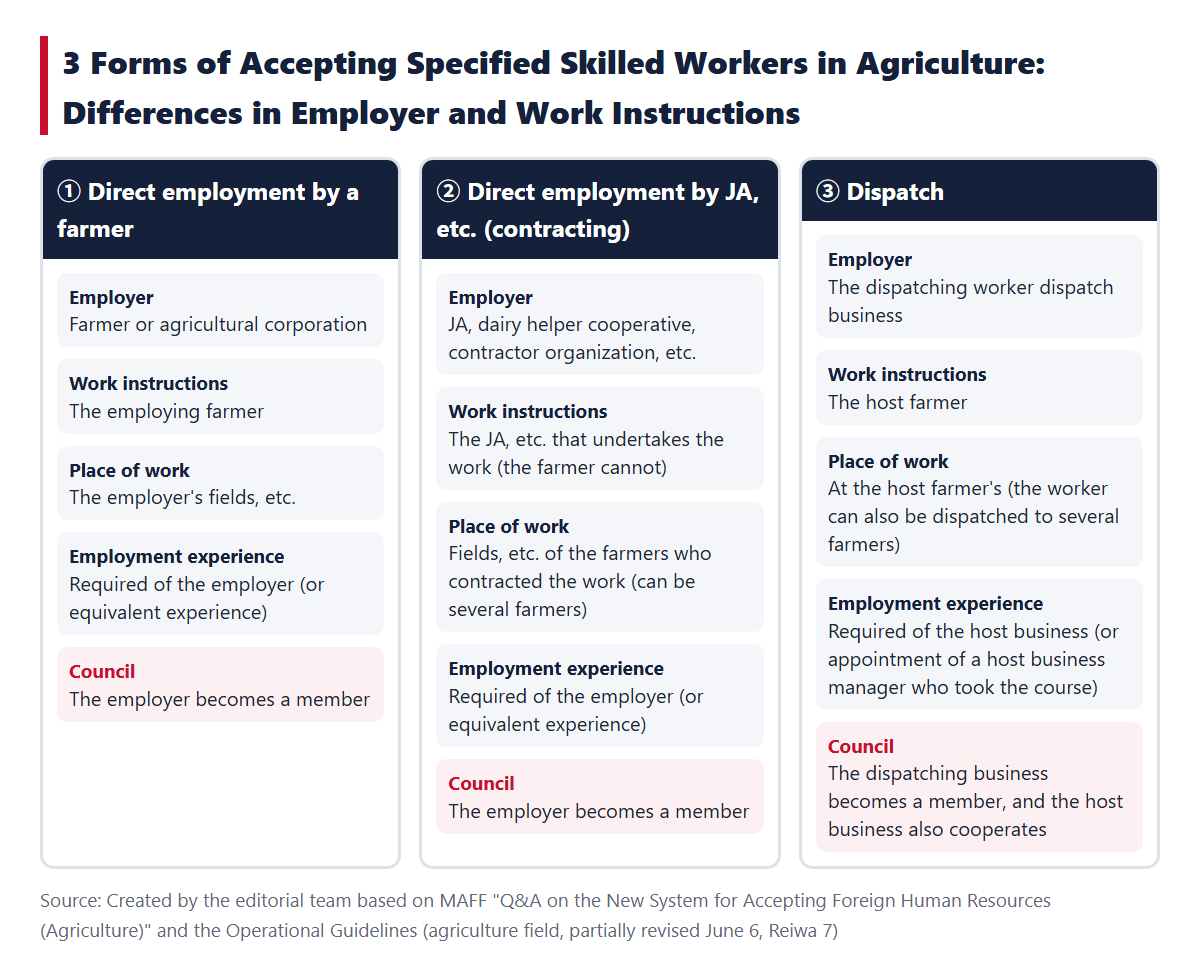
Sources: Created by the editorial team (based on the MAFF Q&A and the Operational Guidelines)
In the contracting form (② in the diagram), the farmer cannot give work instructions to the foreign worker. A form in which several farmers each give work instructions is dispatch (③).
| Item | Direct employment | Dispatch |
|---|---|---|
| Employer (Specified Skilled Worker affiliated organization (特定技能所属機関)) | A farmer, or an organization such as JA | The dispatching worker dispatch business |
| Who gives work instructions | The employer | The host farmer |
| Working for several farmers | Possible if JA, etc. undertakes work under contract from several members. If a farmer employs the worker, the worker signs a contract with another farmer after the employment period ends and obtains Permission for change of status of residence | The worker can be dispatched to several farmers |
| Employment experience | Required of the employer (equivalent experience also accepted) | Required of the host business. Alternatively, the host may have appointed as its host business manager a person who has taken a course such as the host business manager course |
| Council | The employer is a member | The dispatching business is a member. The host business cooperates with the council |
| Documents for immigration | Table 3-13-1 | Tables 3-13-2 and 3-13-3 |
The 4 Types of Businesses That Can Be Dispatching Businesses
The dispatching business must fall under one of the following types and must also be recognized as appropriate by the Minister of Justice after consultation with the Minister of Agriculture, Forestry and Fisheries.
- A person engaged in agriculture or agriculture-related work (a person who runs a farm, an agricultural cooperative, a federation of agricultural cooperatives, a business cooperative organized by farmers, etc.)
- A person in which a local government or a person under 1 has invested more than half of the capital
- A person in whose business execution a local government or a person under 1 is substantially involved, such as one whose officers include an employee of a local government or a person under 1 or its officers or employees
- A specified organization under the National Strategic Special Zones Act (an organization that has had its compliance with the standards confirmed and has properly dispatched foreign agricultural support workers)
Being a staffing agency does not by itself mean you can dispatch workers. The Immigration and Residence Examination Guidelines state that an organization that simply dispatches workers to the agriculture field cannot be regarded as a person engaged in agriculture or agriculture-related work. The same guidelines also provide that shipping slips, delivery notes, etc. are used to confirm that the business is actually carried out repeatedly and continuously and is established as a business. Because individual judgments can differ, consult the Regional Agricultural Administration Office or a professional at the planning stage.
A business is recognized as an appropriate dispatching business for 3 years, and after that period it is checked again. The areas where host businesses can be located are limited to the range in which the dispatching business can properly manage employment, including handling complaints.
What Is Required of the Host Farmer
The host business makes the following pledges in the Written Pledge of the Host Business (Field Reference Form No. 11-2).
- It has experience of continuously employing the same worker for 6 months or more within the past 5 years, or it has appointed as its host business manager a person who has taken a course such as the host business manager course
- It provides the cooperation necessary for the council’s activities
- It complies with laws and regulations on labor, social insurance, and taxes
- It has not involuntarily dismissed workers doing the same kind of work within the 1 year before the date of concluding the contract or after that date
- In the same period, no worker has gone missing for reasons attributable to it
- It does not fall under any grounds for disqualification
Materials on dispatch and how to fill in the documents will be explained in the following article.
(Sources: Operational Policy, Annex 13, Operational Guidelines (agriculture field), MAFF Q&A, Field Reference Form No. 11-2, Immigration and Residence Examination Guidelines, Part 12 (materials disclosed in response to an information disclosure request))
Joining the Agriculture Specified Skilled Worker Council: Apply Using the Web Form before Applying to Immigration
The accepting organization joins the Agriculture Specified Skilled Worker Council before filing residence applications (在留諸申請). Since June 15, Reiwa 6, a document showing that the organization is a member must be submitted even when it is accepting workers for the first time.
A list of the councils across all fields is in the following article.
Beware of the Old Rule of Joining within 4 Months after Acceptance
In the past, when accepting workers for the first time, an organization could join within 4 months after acceptance. Field Reference Form No. 11-1 posted on the MAFF page still includes this option. The No. 11-1 form posted by the Immigration Services Agency does not, so use the Immigration Services Agency’s version.
Steps to Join the Council and the Cost
- Fill in the “Web application (joining)” form on the MAFF page
- The secretariat checks the contents (it contacts you by phone or email if necessary)
- The membership notice arrives by email
- Time: Usually roughly 2 weeks from the application date. If you hear nothing after a reasonable period (for example, 2 weeks to 1 month), contact the secretariat.
- Cost: There is no entrance fee or annual fee.
- Regional councils: Without any additional application, you also become a member of the regional council that covers your location.
- Membership notice: Keep it, because it is also needed for the second and later acceptances.
- Publication: The names of members are published in the list of members on the MAFF page.
When your representative or address changes, submit an application for change. When you are no longer a Specified Skilled Worker affiliated organization in the agriculture field, you must notify the council that you are withdrawing.
How Registered Support Organizations and Host Businesses Are Treated Regarding the Council
Registered support organizations are not eligible to join. However, if a registered support organization is entrusted with all of the support plan, it must cooperate with the council and submit the Written Pledge of the Registered Support Organization (No. 11-4).
In dispatch, the dispatching business becomes a member, and the host business is required to cooperate with the council and submit a written pledge (No. 11-2). The joining form also assumes that, for accepting organizations using the dispatch form, the applicant is the dispatching business.
(Sources: MAFF guidance, About the Agriculture Specified Skilled Worker Council / Steps to join, Council Operating Rules, Operational Guidelines (agriculture field), Field Reference Form No. 11-1 (Immigration Services Agency), Same form (version posted by MAFF), Web application (joining))
Agriculture Field Documents to Submit to Immigration: Table 3-13, Which Differs for Direct Employment and Dispatch
In addition to the documents common to all fields, you submit documents for the agriculture field. The lists for Certificate of Eligibility applications and change applications for (i) have the same contents.
The list for the agriculture field (Table 3-13) is divided into 3 according to the form of employment.
- Table 3-13-1: Direct employment
- Table 3-13-2: Dispatch employment to a corporation (when the host business is a corporation)
- Table 3-13-3: Dispatch employment to a sole proprietor (when the host business is a sole proprietor)
| Document | Direct employment (13-1) | Dispatch (13-2 and 13-3) |
|---|---|---|
| Proof of skills (test pass certificate, or specialist-level pass certificate or evaluation report) | Applicable persons | Applicable persons |
| Proof of Japanese (can be omitted for people who satisfactorily completed Technical Intern Training (ii)) | Applicable persons | Applicable persons |
| Written pledge of the affiliated organization | No. 11-1 | No. 11-3 |
| Certificate showing membership of the council | Everyone | Everyone |
| Written pledge of the registered support organization (No. 11-4) | When all support is outsourced | When all support is outsourced |
| Materials for each type of dispatching business, copy of the worker dispatch business license | ー | Required (may be omitted in some cases) |
| Dispatch plan (No. 1-12), copy of the worker dispatch contract, copy of the written statement of working conditions (No. 1-13) | ー | Everyone |
| Outline of the host business (No. 1-14), Written Pledge of the Host Business (No. 11-2) | ー | Everyone |
| Labor insurance, social insurance, and tax documents of the host business | ー | Required (may be omitted in some cases) |
The difference between 13-2 and 13-3 is the labor insurance, social insurance, and tax documents of the host business. 13-2 lists documents for corporations, and 13-3 lists documents for sole proprietors (such as a certificate of payment of National Health Insurance premiums and a tax payment certificate for individual inhabitant tax). The conditions under which documents already submitted can be omitted are written in the list for each document.
For extension of period of stay (在留期間の更新) (Table 3-2), direct employment requires the council certificate and, when all support is outsourced, No. 11-4. For dispatch, documents of the dispatching business and the host business follow.
The “dispatch recognition period” in the list is the period during which the dispatching business is recognized as an appropriate worker dispatch business in the agriculture field (the 3 years mentioned above). If the end date of this period falls within 7 months after the end date of the foreign worker’s period of stay (or, for an application for a Certificate of Eligibility, the application date), the documents cannot be omitted, because whether the dispatching business meets the standards must be checked again.
What the Organization Pledges in the Written Pledge (Field Reference Form No. 11-1)
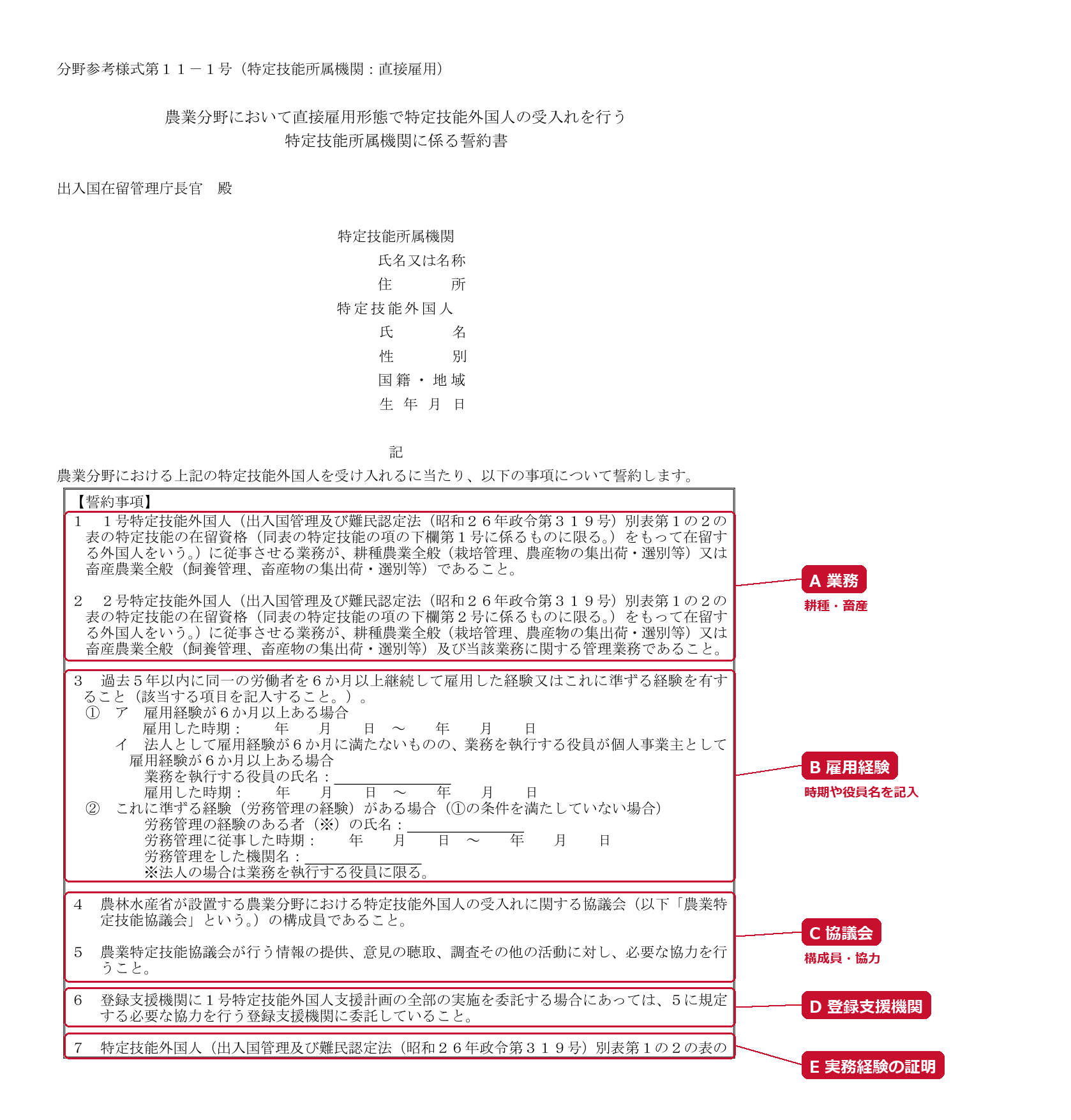
Sources: Immigration Services Agency, Field Reference Form No. 11-1
In the image, A is the work the worker will do, B is employment experience (fill in the period, etc. for the applicable item), and C is council membership and cooperation. D is outsourcing to a registered support organization, and E is certification of work experience. E continues on page 2. If the organization can no longer keep what it pledged, it reports this to the Immigration Services Agency and the government agency with jurisdiction over the field.
The common documents are explained in the following articles.
(Sources: Table 3-13 (Certificate of Eligibility), Table 3-13 (change), Table 3-2 (extension), Immigration Services Agency “Status of Residence ‘Specified Skilled Worker'”, Field Reference Form No. 11-1)
Steps to Accepting a Specified Skilled Worker in Agriculture: Using Direct Employment as an Example
What the agriculture field materials state as an order is that joining the council must be done before applying to immigration. The items on the joining form are about the accepting organization, and there is no field for information about the foreign worker.
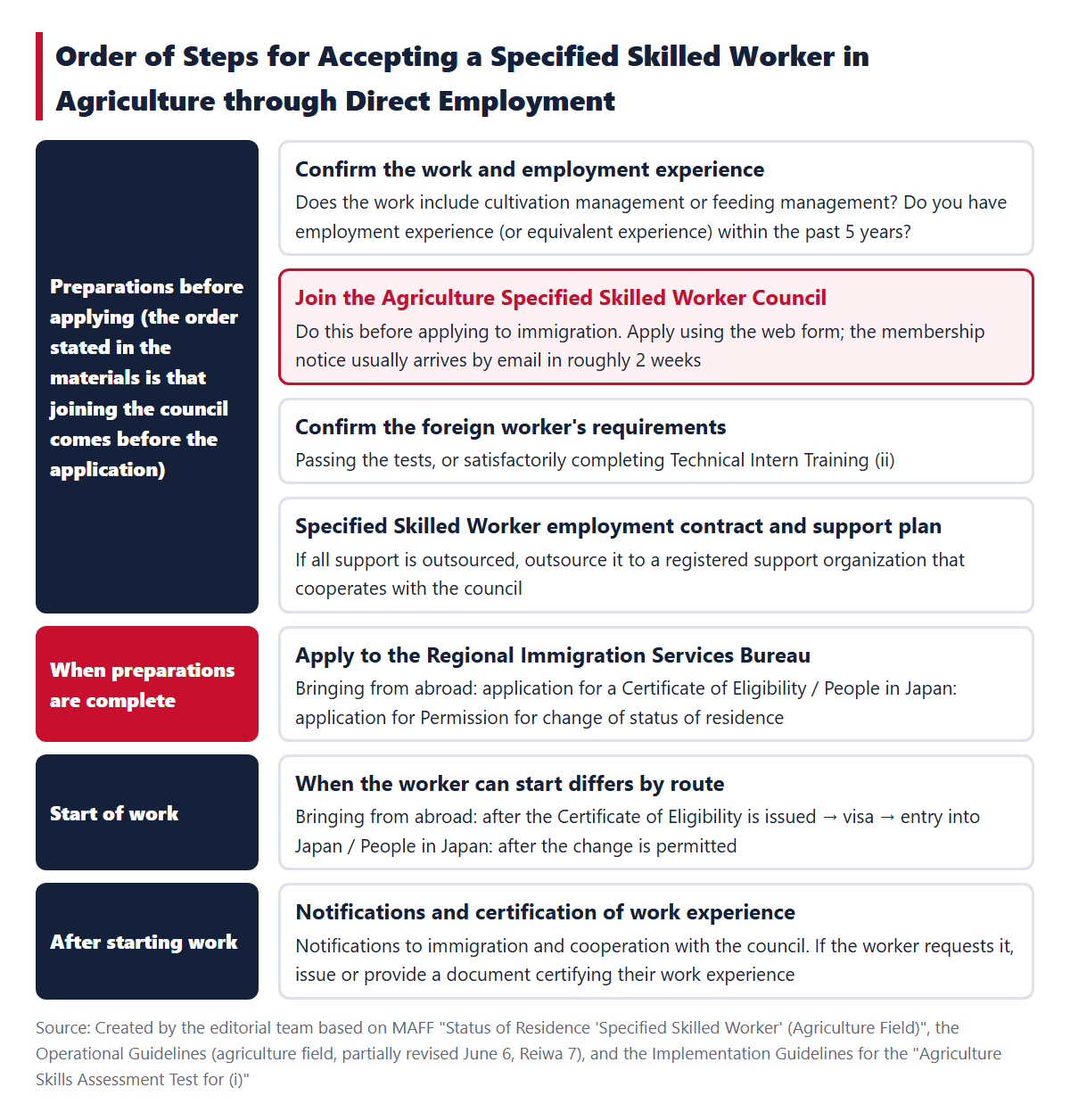
Sources: Created by the editorial team (based on MAFF “Status of Residence ‘Specified Skilled Worker’ (Agriculture Field)”, the Operational Guidelines, and the test implementation guidelines)
The preparations before applying are as follows.
- Confirm whether the work falls under the agriculture field and whether you have employment experience
- Join the council
- Confirm that the foreign worker meets the requirements (passing the tests or satisfactorily completing Technical Intern Training (ii))
- Conclude a Specified Skilled Worker employment contract and prepare a support plan (support the worker yourself or outsource to a registered support organization)
After that, the order is as follows.
- Apply to the Regional Immigration Services Bureau (an application for a Certificate of Eligibility (在留資格認定証明書交付申請) for people you bring from abroad, or an application for Permission for change of status of residence (在留資格変更許可申請) for people already in Japan)
- The worker starts working (for people brought from abroad, after the Certificate of Eligibility is issued, the visa is examined, and the worker enters Japan; for people in Japan, after the change is permitted)
- Submit notifications to immigration, and if the worker requests it, issue or provide a document certifying their work experience
For dispatch, first confirm that the dispatching business falls under one of the 4 types and that the host business meets its conditions. Then conclude a worker dispatch contract and prepare the dispatch plan, the outline of the host business, and other documents. According to the Immigration and Residence Examination Guidelines, whether the business is appropriate is judged by the Immigration Services Agency in consultation with MAFF during the examination of the residence application.
Notifications after acceptance, and the procedures for accepting a foreign Specified Skilled Worker in agriculture who is changing jobs, are explained in the following articles.
(Sources: MAFF guidance, “Agriculture Specified Skilled Worker Council” Web application (joining), Operational Guidelines (agriculture field), Test Implementation Guidelines, Immigration and Residence Examination Guidelines, Part 12)
Specified Skilled Worker (ii) and Employment for Skill Development in the Agriculture Field: Next Options for Accepting Workers
If you want a worker on (i) to work for you longer, consider (ii); for new acceptances from April 2027, consider Employment for Skill Development (育成就労).
Requirements for Specified Skilled Worker (ii) in the Agriculture Field
In addition to passing the Agriculture Skills Assessment Test for (ii) (2号農業技能測定試験) (cultivation agriculture in general or livestock agriculture in general), one of the following kinds of work experience is required. The work experience is checked when the worker takes the test.
- 2 years or more of work experience as a person who does the work while supervising several workers and manages the process (supervising and overseeing 2 or more people)
- 3 years or more of work experience doing farm work based on one’s own judgment at a cultivation or livestock agriculture site
According to the National Chamber of Agriculture, from April 2026 the test for (ii) changed to a format that can be taken year-round.
For Japanese, the Operational Policy states B1 level or above. The current Operational Guidelines do not mention a Japanese test or documents for (ii), and we have not been able to confirm when this will apply. Check before applying.
Key Points of Employment for Skill Development in the Agriculture Field
Agriculture is one of the fields covered by Employment for Skill Development. The projected number of workers to be accepted is 26,300 for the 2 years starting from fiscal Reiwa 9, and the period during which a transfer at the worker’s own wish is restricted is 1 year. There is also a dispatch form.
Unlike Specified Skilled Worker, Employment for Skill Development requires that treatment regarding working hours, days off, breaks, and premium wages for overtime work conforms to the Labor Standards Act.
→ What is the Employment for Skill Development system? A full guide to the differences from Technical Intern Training, transfers, and Japanese requirements [Starts April 2027](https://kisaragi-office.com/immigration_journal/en/archives/4796)
(Sources: Operational Guidelines (agriculture field), Operational Policy, Annex 13, National Chamber of Agriculture “Changes to the Operation of the Test for (ii) from Fiscal 2026”)
Frequently Asked Questions about Specified Skilled Worker (Agriculture)
Q Can I hire a worker only for fruit and vegetable sorting? A No. A worker cannot do only sorting during the period of stay; the work must include cultivation management (or feeding and breeding management).
Q If I have only ever employed technical intern trainees, does that count as employment experience? A Yes. If you have continuously employed the same technical intern trainee for 6 months or more within the past 5 years, that counts as employment experience.
Q Can I hire a person who completed Technical Intern Training (ii) in a job category other than agriculture? A The person must pass the Agriculture Skills Assessment Test for (i). If they completed the training satisfactorily, they are exempt from the Japanese test (a document proving completion is still required).
Q Do registered support organizations also join the council? A They are not eligible to join. If one is entrusted with all of the support, it must cooperate with the council and submit a written pledge (No. 11-4).
Q Can a staffing agency dispatch workers to agriculture? A A worker dispatch business license alone is not enough. The business must fall under one of the 4 types of dispatching businesses and be recognized as appropriate.
Q If an individual farmer incorporates the business, can they keep employing the worker? A MAFF’s Q&A says the worker can continue to be employed even when a sole proprietor incorporates the business and becomes its representative. Submit an application for change to the council (using the form for corporations). For the immigration procedure, an application for Permission for change of status of residence to the Regional Immigration Services Bureau is required.
(Sources: MAFF Q&A, Operational Guidelines (agriculture field), Agriculture Specified Skilled Worker Council FAQ, Immigration Services Agency “Status of Residence ‘Specified Skilled Worker'”)
Summary and Where to Check for Specified Skilled Worker (Agriculture)
- The work must include cultivation management or feeding and breeding management, and in principle the worker cannot do work that crosses the cultivation and livestock categories.
- For direct employment, first confirm your employment experience; for dispatch, first confirm the 4 types of dispatching businesses and the conditions for the host business.
- Join the Agriculture Specified Skilled Worker Council before applying to immigration.
You can check with the following.
- Work and the council: Regional Agricultural Administration Offices, etc., or the Farming Entry and Women’s Division, Management Improvement Bureau, MAFF, 03-6744-2159
- The system in general: the Agriculture Field Specified Skilled Worker Support Site (a MAFF-subsidized project; accessible from the MAFF page)
- Applications for a status of residence: the Regional Immigration Services Bureau
How employment experience is counted and whether a business fits one of the types of dispatching businesses can depend on individual circumstances. If you are unsure, consult a professional.
Primary Sources Referenced in Article Creation
- Operational Guidelines on Accepting Specified Skilled Foreign Workers in Specified Fields: Standards for the Agriculture Field (Ministry of Justice and MAFF, partially revised June 6, Reiwa 7)
- Policy on the Operation of the System for the Status of Residence “Specified Skilled Worker” and Policy on the Operation of the System for Employment for Skill Development in the Agriculture Field (Annex 13, Cabinet decision of January 23, Reiwa 8)
- Immigration Services Agency “Agriculture Field” (label “as of June 6, 2025”)
- MAFF “Status of Residence ‘Specified Skilled Worker’ (Agriculture Field)”
- MAFF “Q&A on the New System for Accepting Foreign Human Resources (Agriculture)” (as of October 20, Reiwa 4)
- Standards Set in View of Circumstances Specific to the Agriculture Field (MAFF Public Notice No. 524 of Heisei 31)
- “Agriculture Specified Skilled Worker Council” Web Application (Joining) (MAFF)
- About the Agriculture Specified Skilled Worker Council / Steps to Join (MAFF)
- Agriculture Specified Skilled Worker Council Operating Rules (partially revised June 25, Reiwa 8)
- Agriculture Specified Skilled Worker Council FAQ
- List of Regional Agricultural Administration Offices (MAFF)
- Implementation Guidelines for the “Agriculture Skills Assessment Test for (i)” (MAFF)
- Report on the Implementation of the Agriculture Field Specified Skilled Worker Evaluation Tests for Fiscal Reiwa 7 (MAFF, October 7, Reiwa 8)
- Agriculture Skills Assessment Test for (i) (National Chamber of Agriculture)
- National Chamber of Agriculture “Tests Held Overseas”
- National Chamber of Agriculture “Changes to the Operation of the Agriculture Skills Assessment Test for (ii) from Fiscal 2026”
- Immigration Services Agency “Status of Residence ‘Specified Skilled Worker'” (lists of required documents)
- Table 3-13, Agriculture Field (Specified Skilled Worker (i), Certificate of Eligibility)
- Table 3-13, Agriculture Field (Specified Skilled Worker (i), change)
- Table 3-2, Agriculture Field (Specified Skilled Worker (i), extension)
- Field Reference Form No. 11-1 (Immigration Services Agency)
- Field Reference Form No. 11-2 (Immigration Services Agency)
- Field Reference Form No. 11-1 (version posted by MAFF)
- Immigration and Residence Examination Guidelines, Part 12 (materials disclosed in response to an information disclosure request)
This article is a translation of the original Japanese version.