

Specified Skilled Worker (ii) (特定技能2号) is a status of residence (在留資格) in Japan for foreign nationals who have proficient skills. It covers 11 of the 19 specified industrial fields, and there is no limit on the total length of stay when the period of stay (在留期間) is extended.
Continuing to work on Specified Skilled Worker (i) (特定技能1号) does not mean that you will automatically move to Specified Skilled Worker (ii). You must pass the test for your field, meet requirements such as practical experience in guiding and managing others, and then receive Permission for change of status of residence (在留資格変更許可). After the transition, you can bring your spouse and children to Japan with the “Dependent” (家族滞在) status, and your time on Specified Skilled Worker (ii) also counts toward the “5 years with a work status” required for Permission for permanent residence (永住許可).
In 2026, the rules on the duties of Specified Skilled Worker (ii) workers and the people they guide were revised on October 19, and the guidelines for the food service industry field were also amended on October 26. From April 1, 2027 (Reiwa 9), Specified Skilled Worker (ii) is expected to require Japanese at the B1 level or higher of the Japanese Language Education Reference Framework.
This article sets out the points that accepting organizations and registered support organizations need to know, in this order: the differences from Specified Skilled Worker (i), the requirements in each field, and the steps for the transition. It then explains what happens after the transition to Specified Skilled Worker (ii): extending the period of stay (the limit on the total length of stay no longer applies), bringing family (your spouse and children can come with the “Dependent” status), and how time on Specified Skilled Worker (ii) is treated for Permission for permanent residence. The content was checked against materials from the Immigration Services Agency (出入国在留管理庁, ISA) on October 26, 2026.
What Is Specified Skilled Worker (ii)? A Table of the Differences from Specified Skilled Worker (i)
Specified Skilled Worker (ii) is a status of residence for people with “proficient skills,” a higher level than Specified Skilled Worker (i). The Operational Guidelines describe this as skills mastered through many years of practical experience and similar means, at a level where the person can carry out highly specialized or technical work based on their own judgment, or at a level where the person can supervise and oversee the work while also doing the work with proficient skills.
The main differences from Specified Skilled Worker (i) are as follows.
| Item | Specified Skilled Worker (i) | Specified Skilled Worker (ii) |
|---|---|---|
| Skill level | Skills that require a considerable degree of knowledge or experience | Proficient skills |
| Eligible fields | 19 fields | 11 fields |
| Period of stay | Designated individually within a range not exceeding 3 years. Up to 5 years in total, in principle | One of 3 years, 2 years, 1 year, or 6 months. No limit on the total length of stay |
| Bringing family | Not allowed, in principle | A spouse and children are allowed with the “Dependent” status |
| Support for Specified Skilled Worker (i) foreign nationals | The accepting organization is obliged to provide it (it can also be entrusted to a registered support organization) | Not covered by a support plan |
| “5 years with a work status” for Permission for permanent residence | Not counted | Counted |
| Duties | Work in the field | Must not be the same work as Specified Skilled Worker (i) workers or technical intern trainees; the worker guides and manages others, among other duties |
| Japanese language test | Required, with tests that differ by field | N3 or higher for the food service industry and fishery fields (the field-specific guidelines for some other fields also list N3 or higher). B1 level or higher is planned from April 2027 |
The skill level is judged by passing a test or by similar means. For this reason, completing Specified Skilled Worker (i) does not automatically let you move to Specified Skilled Worker (ii). On the other hand, if your skill level is recognized as meeting the Specified Skilled Worker (ii) standard by passing a test or by similar means, you can obtain Specified Skilled Worker (ii) without first holding Specified Skilled Worker (i).
The number of people residing on Specified Skilled Worker (ii) was 18,295 at the end of June 2026 (preliminary figure). This is up from 7,955 at the same time in the previous year.
How the period of stay for Specified Skilled Worker (i) is decided is explained in How is the period of stay for Specified Skilled Worker (i) in Japan decided? Limits by company category, and fees that change with a one-month difference.
(Sources: ISA, “Operational Guidelines on the Acceptance of Specified Skilled Workers” (main volume), ISA, “Q&A on the Specified Skilled Worker System”, ISA, “Key Points on the Number of Foreign Residents with Specified Skilled Worker Status (End of June 2026, Preliminary Figures)”)
Specified Skilled Worker (ii) Covers 11 Fields: The Fields Not Covered, and the Job Categories in the Industrial Products Manufacturing Field
Specified Skilled Worker (ii) covers 11 of the 19 fields. The 8 fields of nursing care, linen supply, automobile transportation, railway, logistics warehousing, forestry, wood industry, and resource recycling are not covered.
| Covered by Specified Skilled Worker (ii) (11 fields) | Not covered by Specified Skilled Worker (ii) (8 fields) |
|---|---|
| Building cleaning, industrial products manufacturing, construction, shipbuilding and ship machinery, automobile repair and maintenance, aviation, accommodation, agriculture, fishery, food and beverage manufacturing, food service industry | Nursing care, linen supply, automobile transportation, railway, logistics warehousing, forestry, wood industry, resource recycling |
In the industrial products manufacturing field, only 3 job categories are covered by Specified Skilled Worker (ii): machining and metalworking, electrical and electronic equipment assembly, and metal surface treatment. Specified Skilled Worker (i) workers in other job categories cannot move to Specified Skilled Worker (ii) while they remain in their current job category.
Nursing care is not covered because there is a separate status of residence, “Nursing Care,” in the professional and technical fields. The route of obtaining the certified care worker qualification and changing to the “Nursing Care” status of residence is explained in From Specified Skilled Worker “Nursing Care” to Permission for permanent residence in Japan | The certified care worker route and points to note in the guidelines revised in Reiwa 8.
Before August 31, 2023, Specified Skilled Worker (ii) covered only the construction field and the welding job category of the shipbuilding and ship machinery field. From that date, the range of covered fields expanded greatly.
(Sources: ISA, “Operational Guidelines on the Acceptance of Specified Skilled Workers” (main volume), ISA, “Q&A on the Specified Skilled Worker System” (Q37), ISA, “Addition of Fields Covered by Specified Skilled Worker (ii)”)
Requirements for Specified Skilled Worker (ii): Tests and Work Experience (Experience in Guiding and Managing Others) in Each Field
The skill level for Specified Skilled Worker (ii) is checked through a test and work experience set for each field. In many fields, you need experience in a position where you manage the work process while guiding workers on site. The required number of years and the type of position differ by field.
| Field | Specified Skilled Worker (ii) test (qualifications accepted instead) | Key points of the required work experience |
|---|---|---|
| Building cleaning | Building Cleaning Specified Skilled Worker (ii) Evaluation Test, or Grade 1 of the National Trade Skills Test | 2 years or more of cleaning work while guiding multiple workers, as a person who manages the site |
| Industrial products manufacturing (3 job categories) | Manufacturing Specified Skilled Worker (ii) Evaluation Test plus Business Career Test Grade 3, or Grade 1 of the National Trade Skills Test | 3 years or more at a manufacturing site of a company that has a base in Japan |
| Construction | Construction Specified Skilled Worker (ii) Evaluation Test, Grade 1 of the National Trade Skills Test, or the single-grade National Trade Skills Test | Experience as a person who manages the work process while guiding multiple construction workers (team leader). The required number of days differs by job type |
| Shipbuilding and ship machinery | Shipbuilding and Ship Machinery Specified Skilled Worker (ii) Test, or Grade 1 of the National Trade Skills Test | 2 years or more as a supervisor who directs, instructs, and manages multiple workers |
| Automobile repair and maintenance | Automobile Repair and Maintenance Specified Skilled Worker (ii) Evaluation Test, or Grade 2 of the Automobile Mechanic Skills Test | 3 years or more at a certified repair shop (except for those who have passed Grade 2 of the skills test) |
| Aviation | Aviation Specified Skilled Worker (ii) Evaluation Test (airport ground handling / aircraft maintenance); for aircraft maintenance, an aviation worker’s competence certificate is also accepted | For ground handling, experience working while guiding skilled workers; for aircraft maintenance, 3 years or more of specialized maintenance work |
| Accommodation | Accommodation Specified Skilled Worker (ii) Evaluation Test | 2 years or more of front desk, customer service, and similar work while guiding multiple employees |
| Agriculture | Specified Skilled Worker (ii) Agriculture Skills Assessment Test (cultivation agriculture in general / livestock agriculture in general) | 2 years or more as a person who manages the work process while guiding multiple employees, or 3 years or more on site |
| Fishery | Specified Skilled Worker (ii) Fishery Evaluation Test (fishery / aquaculture) plus the Japanese-Language Proficiency Test N3 or higher | 2 years or more as a person who manages the work process while guiding workers, or in a similar position |
| Food and beverage manufacturing | Specified Skilled Worker (ii) Evaluation Test for food and beverage manufacturing / seafood processing | 2 years or more as a person who manages the work process while guiding multiple workers |
| Food service industry | Food Service Industry Specified Skilled Worker (ii) Evaluation Test plus the Japanese-Language Proficiency Test N3 or higher | 2 years as an assistant store manager, sub-manager, or similar position at a restaurant or similar establishment |
In the construction field, for job types that have competency evaluation standards in the Construction Career Up System (CCUS), the number of working days equivalent to Level 3 (as a foreman plus team leader) is required. For job types without such standards, 3 years (645 working days) or more of working days as a foreman plus team leader are required.
In the food service industry field, the amendment of the guidelines on October 26, 2026 changed the name of the test to the “Food Service Industry Specified Skilled Worker (ii) Evaluation Test.” People who passed the “Food Service Industry Specified Skilled Worker (ii) Skills Assessment Test” (its name before the amendment) are treated as having passed the new test. The place of work experience was also changed to “restaurants and similar establishments.” The 2 years of experience are, as a basic rule, expected to have been completed within 5 years before the application, and they are limited to experience completed no more than 10 years before.
The next schedule for the Building Cleaning Specified Skilled Worker (ii) Evaluation Test is reported in Breaking News Japan Building Maintenance Association Announces Schedule for the Building Cleaning Specified Skilled Worker (ii) Test on December 18 (October 20, 2026).
Japanese Language Requirements for Specified Skilled Worker (ii)
A note in the Operational Guidelines (main volume) on the handling of a total stay of 6 years names the fishery and food service industry fields as fields where the tests needed for the transition to Specified Skilled Worker (ii) include the Japanese-Language Proficiency Test (N3 level or higher). The field-specific guidelines for these 2 fields require a pass in the Japanese-Language Proficiency Test N3 or higher as the Japanese language level for Specified Skilled Worker (ii). N3 counts only when the result is judged to be equivalent to CEFR B1 or higher.
In other fields as well, the field-specific guidelines for building cleaning, industrial products manufacturing, aviation, and food and beverage manufacturing, which were amended in 2026 (Reiwa 8), list the B1 level or higher of the “Japanese Language Education Reference Framework” (Japanese-Language Proficiency Test N3 or higher) as the Japanese language level for Specified Skilled Worker (ii), and include the N3 certificate of passing among the documents used for checking. The field-specific guidelines for industrial products manufacturing state that N3 or higher “is required.”
In addition, each set of field-specific guidelines states that from April 1, 2027 (Reiwa 9), Specified Skilled Worker (ii) will require the B1 level or higher of the Japanese Language Education Reference Framework, and that the handling will be announced separately. To find out whether a certificate of passing a Japanese language test is required for an application now, check the latest field-specific guidelines for that field. If it is unclear, ask the Regional Immigration Services Bureau.
Standards Common to All Fields
The landing standards for Specified Skilled Worker (ii) include being 18 years of age or older, being in good health, and having proficient skills proven by a test or other evaluation method. There are also standards shared with Specified Skilled Worker (i), such as no deposit being collected and no contract with a penalty for breach of contract.
The documents that prove work experience differ by field. In some fields, work experience is checked when you take the test, and in other fields, you submit a certificate when you apply.
(Sources: ISA, “Specified Skilled Worker Operational Guidelines and Forms” (field-specific guidelines), ISA, field-specific guidelines for the food service industry field (amended October 26, 2026), the same, comparison table of old and new provisions, ISA, “Construction Field”, ISA, “Operational Guidelines on the Acceptance of Specified Skilled Workers” (main volume))
The Work Assigned to Specified Skilled Worker (ii) Workers, and What Accepting Organizations Should Check
The work that a foreign national on Specified Skilled Worker (ii) normally does must not be the same as the work of technical intern trainees or Specified Skilled Worker (i) workers. The worker is expected to do guidance work, management work, or specialized or technical work based on their own judgment.
The Operational Guidelines state that the worker normally needs to be guiding at least the number of people set for each field, and that this guidance must be carried out in a stable and continuous way. According to the written pledge (Reference Form No. 1-32), the required number is 2 or more people in many fields. In the automobile repair and maintenance field and the airport ground handling job category of the aviation field, it is 1 or more. In the aircraft maintenance job category of the aviation field, the fishery field, and the food service industry field, it is acceptable even if there is no one to guide.
Since August 20, 2026, accepting organizations have been submitting the “Written Pledge on the Duties of Specified Skilled Worker (ii) Foreign Nationals” (Reference Form No. 1-32) with residence applications for Specified Skilled Worker (ii). The amendment on October 19 made it possible for cases such as the following to be handled flexibly if there are reasonable circumstances.
- When the worker guides people who work at a different workplace
- When counting people who also receive guidance from other Specified Skilled Worker (ii) foreign nationals
- When there is temporarily no one to guide, for example while hiring is in progress
How to fill out the written pledge and how to count the people being guided are explained in How to Fill Out the Written Pledge on the Duties of Specified Skilled Worker (ii) in Japan|Entries for Each Section of the Form and How to Count the People Receiving Guidance.
No Support Plan Is Needed for Specified Skilled Worker (ii), but Notifications and Employment Contract Standards Are the Same as for Specified Skilled Worker (i)
Preparing a support plan for Specified Skilled Worker (i) foreign nationals and providing the support is an obligation of the affiliated organization. Foreign nationals on Specified Skilled Worker (ii) are not covered by a support plan.
On the other hand, the standards for the specified skilled worker employment contract (雇用契約) are the same for Specified Skilled Worker (ii). The pay must be equal to or higher than what a Japanese person doing the same work would receive. The affiliated organization’s notifications (ad hoc notifications and periodic notifications) are also required for as long as it employs a Specified Skilled Worker (ii) foreign national. An overview of the notifications is given in Annual Guide to Japan’s Specified Skilled Worker Notifications: Periodic Notification (April–May) and Ad Hoc Notifications (Within 14 Days).
When a worker whose support had been entrusted to a registered support organization moves to Specified Skilled Worker (ii), the support for that worker no longer needs to be entrusted. If the support entrustment contract with the registered support organization is ended, a notification must be filed within 14 days from the end date (Reference Form No. 3-3-2). If the organization also has other Specified Skilled Worker (i) foreign nationals, it will need to review the scope of the entrustment. Check how the contract will be handled with the registered support organization in advance.
(Sources: ISA, “Operational Guidelines on the Acceptance of Specified Skilled Workers” (main volume, amended October 19, 2026), Comparison table of old and new provisions for the partial amendment of the Operational Guidelines (October 19, 2026), ISA, “List of Application and Notification Forms Related to Specified Skilled Worker”, Immigration Control and Refugee Recognition Act (e-Gov))
Steps for the Transition from Specified Skilled Worker (i) to (ii), and the Options When the Total of 5 Years on Specified Skilled Worker (i) Is Near
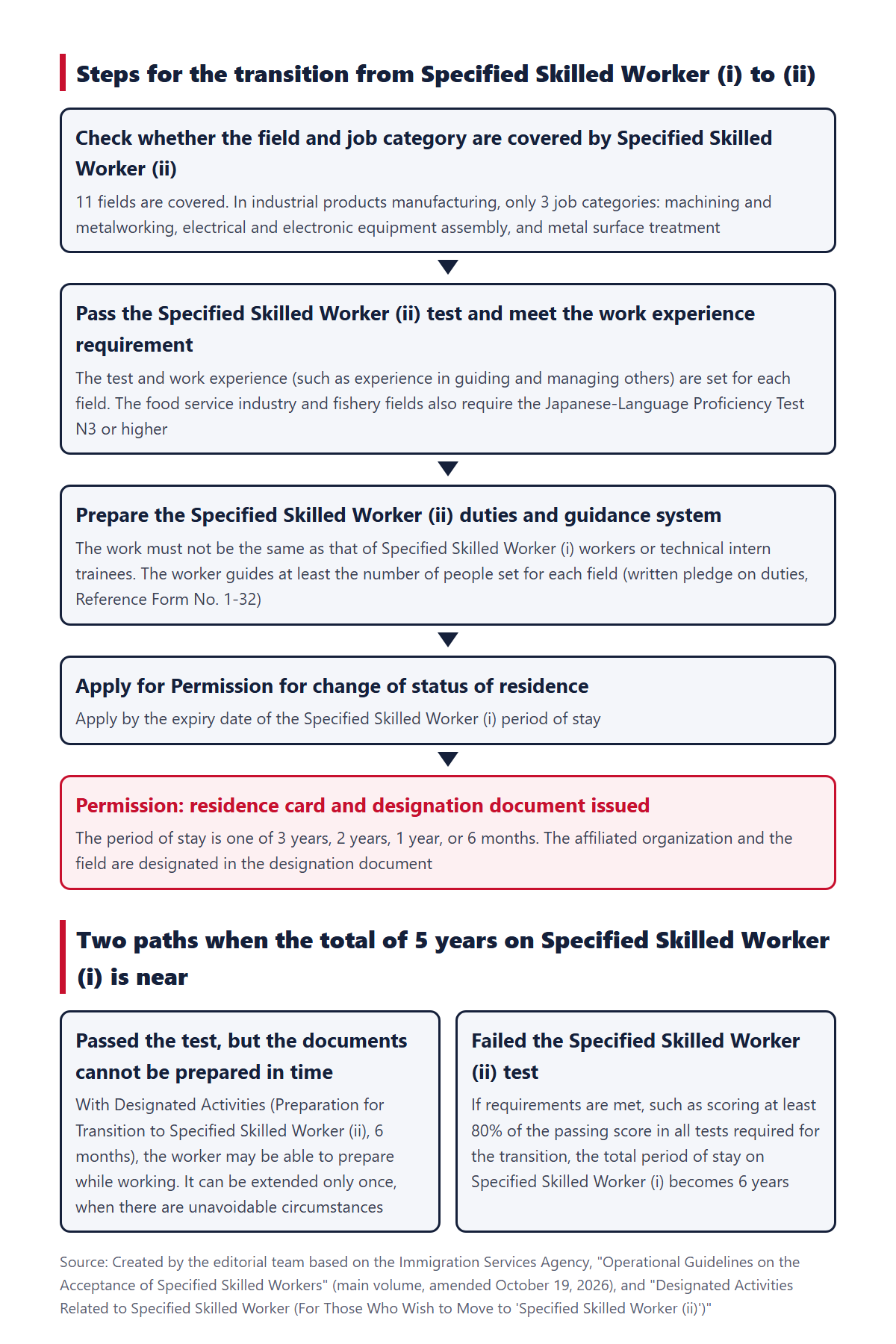
The transition to Specified Skilled Worker (ii) proceeds as shown below. People who are close to the total of 5 years on Specified Skilled Worker (i) may be able to extend their stay by 1 year through an arrangement that is available depending on their test results.
Sources: Created by the editorial team (ISA, “Operational Guidelines on the Acceptance of Specified Skilled Workers” (https://www.moj.go.jp/isa/content/001468647.pdf), Designated Activities Related to Specified Skilled Worker (for those who wish to move to “Specified Skilled Worker (ii)”) (https://www.moj.go.jp/isa/applications/ssw/10_00001.html))
- Check whether the field and job category are covered by Specified Skilled Worker (ii)
- Pass the Specified Skilled Worker (ii) test and meet the work experience requirement
- Prepare the Specified Skilled Worker (ii) duties (guidance, management, and so on) and the system for the people to be guided
- Apply for Permission for change of status of residence (including the written pledge, Reference Form No. 1-32)
- If permission is granted, a designation document is issued together with the residence card (在留カード)
The designation document states the affiliated organization and the specified industrial field. Check the documents to submit in the list of required documents for Specified Skilled Worker (ii) on the ISA page for the “Specified Skilled Worker” status of residence. While the application for permission for change is being processed, you are not allowed to work at the different workplace you plan to move to.
If You Have Passed the Test but Cannot Prepare the Documents in Time
If it is difficult to apply for the change to Specified Skilled Worker (ii) by the expiry date of your Specified Skilled Worker (i) period of stay, you can apply for a change to Designated Activities (Preparation for Transition to Specified Skilled Worker (ii), 6 months) (特定活動〈特定技能2号移行準備・6月〉) (on the ISA page, it is called “Designated Activities (6 months, work permitted)”). This lets you prepare for the transition while working at the accepting organization where you plan to work on Specified Skilled Worker (ii).
The conditions for this Designated Activities status are that you have passed the skills test and the Japanese language test required for Specified Skilled Worker (ii) and that you meet the work experience requirement. The pay must be the same as the amount planned for you on Specified Skilled Worker (ii), and equal to or higher than that of a Japanese person. It can be extended only once, and only when it is recognized that there are unavoidable circumstances.
The ISA says that applications for this Designated Activities status have increased and the examination period has become longer. It asks that, when a transition to Specified Skilled Worker (ii) is expected, the documents be prepared early and that an application for the change to Specified Skilled Worker (ii) be made whenever possible. Designated Activities for preparing to move to Specified Skilled Worker (i) is explained in What Is Designated Activities (Preparation for Transition to Specified Skilled Worker (i)) in Japan? Eligibility, Requirements, Application Process, Use When Changing Jobs, and Points to Note.
If You Failed the Specified Skilled Worker (ii) Test (Total Stay of 6 Years)
Even a Specified Skilled Worker (i) worker who has failed the Specified Skilled Worker (ii) test or other evaluation can have a total period of stay of 6 years if the following requirements are met.
- You scored at least 80% of the passing score in all the tests and other evaluations required for the transition to Specified Skilled Worker (ii)
- You have pledged that, during the period after 5 years have passed, you will take the test in order to pass, that you will promptly apply for the change to Specified Skilled Worker (ii) once you pass, and that you will promptly return to your home country if you cannot pass
- The accepting organization intends to continue employing you and has a system of guidance, training, support, and so on to help you pass
When applying, you submit a statement on staying beyond the total period of stay (Reference Form No. 1-31) and a copy of the test result notice showing that you scored at least 80%. If you are outside Japan at the time of the residence application, another requirement is that you enter Japan within 1 year from the date you left.
(Sources: ISA, “Operational Guidelines on the Acceptance of Specified Skilled Workers” (main volume), ISA, “Designated Activities Related to Specified Skilled Worker (For Those Who Wish to Move to ‘Specified Skilled Worker (ii)’)”, ISA, “Specified Skilled Worker” status of residence (list of required documents))
Period of Stay, Extensions, and Changing Jobs on Specified Skilled Worker (ii): No Limit on the Total Length of Stay, but an Extension Is Needed at the End of Each Period
The period of stay for Specified Skilled Worker (ii) is one of 3 years, 2 years, 1 year, or 6 months. There is no limit on the total length of stay like there is for Specified Skilled Worker (i), and you can keep extending your period of stay. However, there is an examination each time you extend, and whether permission is granted is decided based on the situation at that time.
The Immigration and Residence Examination Guidelines (入国・在留審査要領) set guides for which period is granted, according to the category of the accepting organization (affiliated organization). The Examination Guidelines divide the categories as follows. Categories 2 and 3 also assume that the organization “does not fall under Category 4,” so when an organization does not fall under Category 1, also check that it does not meet the requirements of Category 4.
| Category | How affiliated organizations are classified |
|---|---|
| Category 1 | An organization that has not received written guidance and recommendation or an improvement order in the past 3 years, that has pledged to use electronic applications and electronic notifications, and that falls under any of the following: (1) a company listed on a stock exchange in Japan (2) a mutual company engaged in the insurance business (3) an innovation-creating company (4) a company or similar organization that meets certain conditions (5) an organization or individual whose withholding tax for the previous year was 10,000,000 yen or more (6) a corporation that has a record of 3 consecutive years of accepting workers as a specified skilled worker affiliated organization and has not had liabilities exceeding its assets in the past 3 years |
| Category 2 | An organization that falls under neither Category 1 nor Category 4, has not received written guidance and recommendation or an improvement order in the past 3 years, and has not had liabilities exceeding its assets in the past 3 years (there is one more requirement that has not been made public) |
| Category 3 | A corporation that does not fall under any of Categories 1, 2, or 4 |
| Category 4 | A sole proprietor who does not fall under Category 1 or 2; or a corporation that does not fall under Category 1 and has received written guidance and recommendation or an improvement order in the past 3 years, among others (there are other requirements that have not been made public) |
In the disclosed Examination Guidelines, part of the requirements for Category 2 and Category 4 is blacked out (not disclosed). For this reason, it may not be possible to determine from public materials alone whether an affiliated organization is in Category 2 or Category 3. How to check the category is explained in What Are the Affiliated Organization Categories for Specified Skilled Workers in Japan? How Categories 1 to 4 Are Decided and Which Documents Can Be Omitted.
The guides for the Specified Skilled Worker (ii) period of stay in each category are as follows.
- For corporations in Categories 1 to 3, up to 3 years. If the organization currently accepts specified skilled worker foreign nationals and the employment contract is expected to last 3 years or more in total, the period is 3 years in principle
- For sole proprietors, up to 2 years in Category 1 and up to 1 year in Category 2
- In Category 4, up to 1 year
- 1 year when the worker is employed by a corporation or sole proprietor that does not currently accept any specified skilled worker foreign nationals (including Specified Skilled Worker (i))
- 6 months when this is appropriate in view of the accepting organization’s suitability or the worker’s record of stay
(Source: Immigration and Residence Examination Guidelines, Part 12 (2026 Reiwa 8 edition, materials disclosed in response to an information disclosure request))
You can apply for an extension from 3 months before your period of stay expires. For when to apply and points to note about the special period, see When Can You Apply to Extend Your Period of Stay in Japan? Applying from 3 Months Before, Last-Minute Applications, and the Special Period.
Even on Specified Skilled Worker (ii), if you change jobs and this changes the affiliated organization or the field stated in your designation document, you need Permission for change of status of residence. The new accepting organization must also meet the requirements on Specified Skilled Worker (ii) duties and the people to be guided. The procedures for changing jobs are summarized in Changing Jobs on Specified Skilled Worker Status in Japan: What the Worker, the New Company, and the Former Company Must Do, and in What Order and Changing to a Different Field on Specified Skilled Worker Status in Japan|Passing the Tests, Job Categories, and the Change of Status Process.
(Sources: ISA, “Operational Guidelines on the Acceptance of Specified Skilled Workers” (main volume), ISA, “Specified Skilled Worker” status of residence)
Bringing Family on Specified Skilled Worker (ii): Your Spouse and Children Can Come with the “Dependent” Status
A foreign national on Specified Skilled Worker (ii) can bring a spouse and children whom they support to Japan with the “Dependent” (家族滞在) status of residence. On Specified Skilled Worker (i), bringing family is not allowed in principle.
The Dependent status is for a spouse or child who is supported by the worker. Parents and brothers and sisters are not eligible. The period of stay for the Dependent status is designated individually within a range not exceeding 5 years.
To bring family members who live abroad, you apply for a Certificate of Eligibility (在留資格認定証明書). For family members who are already in Japan, you apply for Permission for change of status of residence. There is an examination of whether you have enough income to support them, and the required documents differ for each family member. For details, see Which statuses of residence can bring family to Japan on a Dependent visa? Whether Specified Skilled Worker, Student, and Engineer/Specialist in Humanities/International Services qualify, and the conditions.
For a person on the Dependent status to work, Permission to engage in an activity other than that permitted under the status of residence previously granted is needed. With comprehensive permission, work is limited to 28 hours or less per week.
(Sources: ISA, “Q&A on the Specified Skilled Worker System” (Q9), ISA, “Dependent” status of residence, ISA, “Permission to Engage in an Activity Other Than That Permitted”)
The Path to Permanent Residence: Time on Specified Skilled Worker (ii) Counts Toward the “5 Years with a Work Status”
One of the requirements for Permission for permanent residence is that, in principle, you have lived in Japan continuously for 10 years or more, and that during that time you have stayed continuously for 5 years or more with a work status or a residence-based status. The guidelines exclude Technical Intern Training and Specified Skilled Worker (i) from this “work status.” Time spent on Specified Skilled Worker (ii) is included in the period with a work status.
The ISA Q&A also explains that time on Specified Skilled Worker (i) is not included in the period with a work status, so changing from Specified Skilled Worker (i) to Permanent Resident is difficult, whereas time on Specified Skilled Worker (ii) is included, so changing to Permanent Resident is possible. However, Permission for permanent residence also has other requirements, such as good conduct, an independent livelihood, and fulfilling public obligations including paying taxes.
The Guidelines for Permission for permanent residence were revised on October 1, 2026, and many of the items apply to applications made from April 1, 2027. Even after the revision, the statuses excluded from “statuses of residence for the purpose of work” are Technical Intern Training, Employment for Skill Development, Specified Skilled Worker (i), Intra-company Transferee, and others; Specified Skilled Worker (ii) is not excluded. The contents of the revision are explained in What changes with the revised Guidelines for Permission for permanent residence? Income level, Japanese B1, and when the new rules apply, compared old vs. new October 2026.
(Sources: ISA, “Guidelines for Permission for Permanent Residence”, ISA, “Guidelines for Permission for Permanent Residence (Revised October 1, 2026)”, ISA, “Q&A on the Specified Skilled Worker System” (Q10))
Frequently Asked Questions About Specified Skilled Worker (ii)
Q1. If I work for 5 years on Specified Skilled Worker (i), will I automatically move to Specified Skilled Worker (ii)?
No. You must pass the test for your field, meet requirements such as work experience, and then receive Permission for change of status of residence.
Q2. Can a company bring a worker directly from abroad on Specified Skilled Worker (ii) without the worker first holding Specified Skilled Worker (i)?
If the worker’s skill level is recognized as meeting the Specified Skilled Worker (ii) standard by passing a test or by similar means, the worker can obtain Specified Skilled Worker (ii) without first holding Specified Skilled Worker (i). However, many fields have a work experience requirement, so check the field-specific guidelines to see where that experience can be gained.
Q3. Is support from a registered support organization also needed for Specified Skilled Worker (ii)?
The support plan for Specified Skilled Worker (i) foreign nationals is only for Specified Skilled Worker (i) foreign nationals, and Specified Skilled Worker (ii) is not covered. The affiliated organization’s notifications and the employment contract standards, such as pay equal to or higher than that of a Japanese person, still apply on Specified Skilled Worker (ii).
Q4. Can I bring my parents to Japan on Specified Skilled Worker (ii)?
The people you can bring with the Dependent status are a spouse and children whom you support. Parents are not eligible for the Dependent status.
Q5. How long is the period of stay for Specified Skilled Worker (ii)? Is there a limit on extensions?
It is one of 3 years, 2 years, 1 year, or 6 months. There is no limit on the total length of stay, but there is an examination each time you extend.
Q6. If I fail the Specified Skilled Worker (ii) test, do I have to return to my home country when my 5 years on Specified Skilled Worker (i) end?
If you meet requirements such as scoring at least 80% of the passing score in all the tests and other evaluations required for the transition, your total period of stay becomes 6 years. The accepting organization must also intend to continue employing you and have a system of guidance to help you pass.
Supervisor’s Comment
Our office handles many Specified Skilled Worker (ii) applications, and we sense that the examination of Specified Skilled Worker (ii) applications is gradually becoming stricter. From now on, unless the contents of the field-specific Operational Guidelines are understood accurately, there may be cases where an applicant passes the test but still does not meet the requirements for permission. If you are aiming for Specified Skilled Worker (ii), we recommend finding out in advance what standards apply and what you need to prove at the time of application, and then preparing for the transition.
Summary
- Specified Skilled Worker (ii) is a status of residence for proficient skills, and it covers 11 fields. In the industrial products manufacturing field, only 3 job categories are covered.
- You do not move automatically from Specified Skilled Worker (i). A test and work experience (such as experience in guiding and managing others) set for each field are required, and the food service industry and fishery fields also require the Japanese-Language Proficiency Test N3 or higher. There are also other fields whose field-specific guidelines list N3 or higher.
- The duties of Specified Skilled Worker (ii) workers must not be the same as those of Specified Skilled Worker (i) workers or technical intern trainees. The duties and the people being guided are declared in the written pledge (Reference Form No. 1-32).
- When the total of 5 years is near, there is the option of preparing through Designated Activities (Preparation for Transition to Specified Skilled Worker (ii), 6 months), and there is also the total stay of 6 years for those who scored at least 80%.
- After the transition, there is no limit on the total length of stay when extending the period of stay, a spouse and children can come with you, and time on Specified Skilled Worker (ii) counts toward the period with a work status for Permission for permanent residence.
When to take the test and whether your guidance system meets the requirements depend on the field and the company’s situation. If you are unsure, consult the Regional Immigration Services Bureau or a specialist early.
Primary Sources Referenced in Article Creation
- Immigration Services Agency, “Specified Skilled Worker” status of residence
- Immigration Services Agency, “Specified Skilled Worker System”
- Immigration Services Agency, “Q&A on the Specified Skilled Worker System”
- Immigration Services Agency, “Operational Guidelines on the Acceptance of Specified Skilled Workers” (main volume, amended October 19, 2026)
- Immigration Services Agency, Partial amendment of the “Operational Guidelines on the Acceptance of Specified Skilled Workers” (October 19, 2026, comparison table of old and new provisions)
- Immigration Services Agency, “Specified Skilled Worker Operational Guidelines and Forms”
- Immigration Services Agency, Operational Guidelines on the Acceptance of Specified Skilled Workers in Specific Fields (building cleaning field)
- The same (industrial products manufacturing field)
- The same (construction field)
- The same (shipbuilding and ship machinery field)
- The same (automobile repair and maintenance field)
- The same (aviation field)
- The same (accommodation field)
- The same (agriculture field)
- The same (fishery field)
- The same (food and beverage manufacturing field)
- The same (food service industry field, amended October 26, 2026)
- Immigration Services Agency, Partial amendment of the “Operational Guidelines on the Acceptance of Specified Skilled Workers in Specific Fields: Standards for the Food Service Industry Field” (October 26, 2026, comparison table of old and new provisions)
- Immigration Services Agency, “Construction Field”
- Immigration Services Agency, “Addition of Fields Covered by Specified Skilled Worker (ii)”
- Immigration Services Agency, “Designated Activities Related to Specified Skilled Worker (For Those Who Wish to Move to ‘Specified Skilled Worker (ii)’)”
- Immigration Services Agency, “List of Application and Notification Forms Related to Specified Skilled Worker”
- Immigration Services Agency, “Key Points on the Number of Foreign Residents with Specified Skilled Worker Status (End of June 2026, Preliminary Figures)”
- Immigration Services Agency, “Dependent” status of residence
- Immigration Services Agency, “Permission to Engage in an Activity Other Than That Permitted”
- Immigration Services Agency, “Guidelines for Permission for Permanent Residence”
- Immigration Services Agency, “Guidelines for Permission for Permanent Residence (Revised October 1, 2026)”
- Immigration Control and Refugee Recognition Act (e-Gov)
- Immigration and Residence Examination Guidelines, Part 12 (2026 Reiwa 8 edition, materials disclosed in response to an information disclosure request)
This article is a translation of the original Japanese version.