This article was written by the NIPPON VISA & LIFE editorial team based on information from public organizations such as the national government and local governments. Rules and fees may differ depending on the city, ward, town or village where you live.
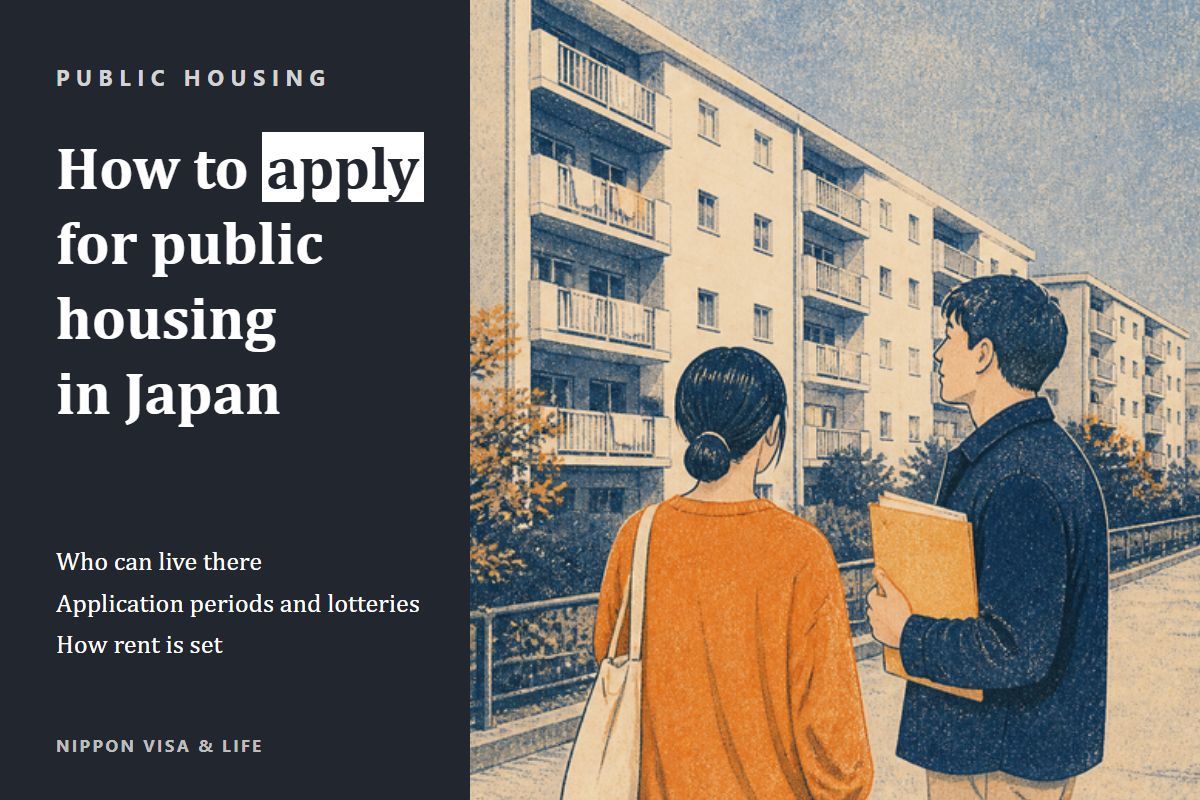
In Japan, public housing (公営住宅, koei jutaku) is housing that prefectures and municipalities rent at low rent to people with low incomes who are having trouble finding housing. Examples include Tokyo Metropolitan Housing (都営住宅, toei jutaku), Osaka Prefectural Housing (府営住宅, fuei jutaku), prefectural housing (県営住宅, kenei jutaku) and municipal housing (市営住宅, shiei jutaku). You apply during a set application period, and in many cases the people who can move in are decided by lottery. The conditions and application periods differ depending on the local government that manages the housing.
The overall flow of renting a home (how to find a private apartment, contracts, moving out, etc.) is explained in How to Rent an Apartment and Move in Japan: Finding a Home, Contracts, Move-in Costs, Moving In, House Rules and Moving Out.
The Short Answer: The Flow from Applying for Public Housing to Moving In
How to apply differs depending on the local government and the application round. Here, we show a common flow.
- Look up the housing and application rounds: Check the public housing application information on the website of the prefecture or municipality where you want to live.
- Check the conditions for moving in: Check whether you meet conditions such as address, family, income and having trouble finding housing.
- Apply during the application period: Apply online or by mailing the application form.
- Wait for the lottery result: When there are many applications, the people who can move in are decided by lottery or other methods.
- Submit documents if you win: Submit documents such as your resident record (juminhyo) and income certificates, and go through a screening to check whether you meet the conditions.
- Complete the move-in procedure and move in: If you pass the screening, you complete the procedure for moving in.
Public housing is housing set out in a law called the Public Housing Act (公営住宅法, koei jutaku ho). Its purpose is for the national government and local governments to work together to rent housing at low rent to people with low incomes who are having trouble finding housing.
(Source: e-Gov Laws and Regulations Search, “Public Housing Act”, Immigration Services Agency, “Guidebook on Living and Working,” Chapter 11)
What Kind of Housing Public Housing Is
| Item | Details |
|---|---|
| Who rents it out | Prefectures and municipalities (local governments) |
| Who can rent it | People with low incomes who are having trouble finding housing. The conditions are set by local government ordinances |
| Rent | Decided by the income of the people moving in and by the location, size, age and other features of the housing |
| How residents are chosen | In principle, by public application (open recruitment). When there are many applications, residents are chosen by a fair method |
| Security deposit (敷金, shikikin: money you leave with the landlord when you move in) | Set by the local government within a limit of up to 3 months’ rent |
Under the Public Housing Act, local governments must not collect money such as key money (権利金, kenrikin) in addition to the rent and security deposit.
Example: In the case of Osaka Prefecture, the guarantor system for moving into Osaka Prefectural Housing (public housing) was reviewed, and a guarantor is no longer required.
(Source: e-Gov Laws and Regulations Search, “Public Housing Act”, Osaka Prefecture, “Notices on Applications and Moving into Osaka Prefectural Housing”)
Conditions for Moving into Public Housing
Under the Public Housing Act, people moving in must meet at least the following 2 conditions.
- Their income does not exceed the amount set by the local government’s ordinance
- It is clear that they are currently having trouble finding housing
Other conditions are set by each local government. For example, there are conditions such as the following.
| Condition | Example: Tokyo Metropolis (Tokyo Metropolitan Housing, for families) | Example: Osaka Prefecture (Osaka Prefectural Housing) |
|---|---|---|
| Address, etc. | The applicant lives in Tokyo | The applicant lives or works in Osaka Prefecture (including when it is certain that they will work there) |
| Family | The applicant has relatives who will live with them | For housing for general households, the applicant has relatives who will live with them |
| Income | The family’s total income is within the limit | The monthly income calculated by a set method is at or below the limit |
| Having trouble finding housing | No one in the family owns a house or land, etc. | In principle, people who own their home cannot apply |
Example: In the case of Tokyo Metropolis, people who will live alone (single persons) can apply if they have lived in Tokyo continuously for at least 3 years and meet conditions such as being 60 years old or older or having a specified disability. Example: In the case of Osaka Prefecture, in the “ongoing applications” (随時募集, zuiji boshu) for housing that received no applications, single persons under 60 years old can also apply.
Conditions That May Be Required of Foreign Residents
The Immigration Services Agency’s “Guidebook on Living and Working” explains that, in addition to the usual conditions, foreign residents may have to meet conditions such as having a status of residence of 1 year or longer or a record of having lived in Japan.
Example: In the case of Tokyo Metropolis, foreign residents applying for Tokyo Metropolitan Housing (for families) must continuously fall under one of the following from the application period until the day of the screening, and must be able to prove this with a copy of the resident record (certificate of residence).
- Special Permanent Residents (特別永住者) and their spouses, etc.
- Mid- to long-term residents (中長期在留者) whose status of residence is “Permanent Resident” (永住者), “Spouse or Child of Permanent Resident” (永住者の配偶者等), “Spouse or Child of Japanese National” (日本人の配偶者等) or “Long-Term Resident” (定住者)
- Mid- to long-term residents with other statuses of residence who, during the application period, have a record of having lived in Japan continuously for at least 1 year
Conditions for foreign residents differ depending on the local government. Before applying, check with the local government that manages the housing. For procedures related to your status of residence itself (such as extensions), see the Immigration Services Agency’s information.
(Source: e-Gov Laws and Regulations Search, “Public Housing Act”, Immigration Services Agency, “Guidebook on Living and Working,” Chapter 11, Bureau of Housing Policy, Tokyo Metropolitan Government, “Eligibility for Tokyo Metropolitan Housing (Regular Applications in May and November)”, Osaka Prefecture, “General Application Round”, Osaka Prefecture, “Notices on Applications and Moving into Osaka Prefectural Housing”)
Income Limits for Public Housing
The income limits differ depending on the local government and the number of family members. For households with elderly people or people with disabilities, households with children and others, the limits may be less strict.
Example: In the case of Tokyo Metropolis, the guideline income limits (approximate) for Tokyo Metropolitan Housing are as follows. The “Guideline annual salary” column applies when only one family member has income and that income is a salary.
| Number of family members | Guideline annual salary | Guideline income amount (annual) |
|---|---|---|
| 2 | Up to 3,510,000 yen | Up to 2,270,000 yen |
| 3 | Up to 3,990,000 yen | Up to 2,650,000 yen |
| 4 | Up to 4,470,000 yen | Up to 3,030,000 yen |
| Single person | Up to 2,960,000 yen | Up to 1,890,000 yen |
The “income amount” is, for example, the amount in the “amount after employment income deduction” (給与所得控除後の金額) box of your withholding tax statement (源泉徴収票, gensen choshuhyo: a document from your company showing your salary for one year).
Example: In the case of Osaka Prefecture, people whose monthly income calculated by a set method is 158,000 yen or less can apply. For people who fall under the “discretionary households” (裁量世帯, sairyo setai) set by Osaka Prefecture, such as people with a Physical Disability Certificate of grade 1 to 4, the limit is 214,000 yen or less, and for child-rearing households it is 259,000 yen or less.
How to calculate income is explained in the local government’s application guide. When two or more family members have income, be sure to calculate it by following the guide.
(Source: Bureau of Housing Policy, Tokyo Metropolitan Government, “Eligibility for Tokyo Metropolitan Housing”, Osaka Prefecture, “General Application Round”, Osaka Prefecture, “I Would Like to Apply for Osaka Prefectural Housing. What Are the Eligibility Requirements?”)
When Public Housing Applications Open and How to Apply
You cannot apply for public housing at any time. You apply during a set application period.
| Example local government | Application period | How residents are chosen |
|---|---|---|
| Example: Tokyo Metropolis (Tokyo Metropolitan Housing) | Regular applications: early May, August, November and February. Monthly applications: mid-month every month (housing for single persons, etc.) | Lottery. For family housing in August and February, a point system |
| Example: Tokyo Metropolis (Tokyo Metropolitan Housing) | Ongoing applications: all year round (family housing, etc.) | First come, first served |
| Example: Osaka Prefecture (Osaka Prefectural Housing) | General application round: 6 times a year, in April, June, August, October, December and February | Lottery |
| Example: Osaka Prefecture (Osaka Prefectural Housing) | Ongoing applications: all year round (housing that received no applications in past rounds) | First come, first served |
Here are examples of how to apply.
- Example: In the case of Tokyo Metropolis, you can apply online through the “Tokyo Metropolitan Housing Resident Recruitment Site” (都営住宅入居者募集サイト). If you apply by mail, you can get the “application guide” (募集案内) and “application form” (申込書) free of charge during the application period at places such as the Tokyo Metropolitan Government Building, ward offices, city offices, and town and village offices.
- Example: In the case of Osaka Prefecture, application forms are handed out at places such as the prefecture’s housing consultation office, city offices, ward offices, and town and village offices. You can also apply online.
In addition to prefectural housing, there is also housing for which wards, cities and towns accept applications from people living in their own area. Example: Tokyo Metropolis advises you to check the public relations newsletters of wards, cities and towns, or to ask at the local government office.
(Source: Bureau of Housing Policy, Tokyo Metropolitan Government, “Timing, Details and Overview of Tokyo Metropolitan Housing Applications”, Bureau of Housing Policy, Tokyo Metropolitan Government, “How to Apply, Usage Fees (Rent), and From Application to Moving In”, Osaka Prefecture, “Notices on Applications and Moving into Osaka Prefectural Housing”)
Public Housing Lotteries and the Documents to Submit After Winning
When there are many applications, the candidates who can move in are decided by lottery or other methods.
- Example: In the case of Tokyo Metropolis, in the regular applications in May and November, there is a system that makes it easier to win when a family of two or more people who meet set conditions applies for an area with a “preferential lottery” (優遇抽せん, yugu chusen).
- Example: In the case of Tokyo Metropolis, in the regular applications in May and November, in addition to “winners” (当せん), there are numbered “alternates” (補欠, hoketsu). When a vacant unit becomes available, alternates become winners in order. The alternate period is about 4 months from the lottery. If no vacant unit becomes available during that time, alternates do not move up.
Even if you win, you cannot always move in right away. Example: In the case of Tokyo Metropolis, in the eligibility screening for moving in, the information you wrote when applying is compared with the documents you submit. If they differ, you may not be able to move in.
Example: In the case of Tokyo Metropolis (when applying as a family), the main documents to submit for the screening are as follows. They are not needed when you apply.
| Condition to be checked | Main documents |
|---|---|
| Living in Tokyo | Resident record (juminhyo) |
| Having a status of residence (for foreign residents) | Resident record (juminhyo), passport |
| Having relatives who will live with you | Resident record (juminhyo), certificate of all matters in the family register (for foreign residents, a certificate from your embassy) |
| Income within the limit | Resident tax certificate (課税証明書), certificate from your employer, copy of your final tax return, etc. |
| Having trouble finding housing | Lease agreement for your current home, proof that you have paid rent, etc. |
Example: In the case of Tokyo Metropolis, items such as rent receipts are needed starting from the month you applied. Keep them and do not throw them away until the screening.
(Source: Bureau of Housing Policy, Tokyo Metropolitan Government, “How to Read the List of Available Housing”, Bureau of Housing Policy, Tokyo Metropolitan Government, “Preferential Lottery for Tokyo Metropolitan Housing”, Bureau of Housing Policy, Tokyo Metropolitan Government, “Main Documents Required for the Eligibility Screening”, e-Gov Laws and Regulations Search, “Public Housing Act”)
How Rent (Usage Fee) for Public Housing Is Set
Every year, the local government sets the rent for public housing based on the income reported by the residents and on the location, size, number of years since construction and other features of the housing. When your income changes, your rent also changes.
Example: In the case of Tokyo Metropolis, the rent for Tokyo Metropolitan Housing is called a “usage fee” (使用料, shiyoryo). The usage fee from April of the following year is set based on the income determined by the income report every June. Households whose income is below a certain level and others can have their usage fee reduced by applying. In principle, the usage fee is paid by automatic bank transfer (automatic withdrawal from your bank account) or other methods.
Example: In the case of Tokyo Metropolis, the usage fee for a household of 2 people living in a certain Tokyo Metropolitan Housing unit in Nerima Ward (2DK, 36 m², built in FY Showa 44) is 17,600 yen to 38,600 yen a month depending on income (an example given in the Tokyo Metropolitan Government’s information).
(Source: e-Gov Laws and Regulations Search, “Public Housing Act”, Bureau of Housing Policy, Tokyo Metropolitan Government, “How to Read the List of Available Housing”, Bureau of Housing Policy, Tokyo Metropolitan Government, “How to Apply, Usage Fees (Rent), and From Application to Moving In”)
Rules After Moving into Public Housing
Under the Public Housing Act, residents must follow these rules.
- Use the housing with care and keep it in normal condition
- Do not rent the housing to other people or transfer the right to live there to other people
- Do not remodel (模様替え, moyogae) or extend the housing without the local government’s approval
- Get the local government’s approval before having someone other than the relatives who lived with you when you moved in newly live with you
If you have lived there for at least 3 years and your income exceeds the set limit, you are expected to make efforts to vacate (move out of) the housing. If you have lived there for at least 5 years and your income has been very high for the most recent 2 years in a row, the local government may ask you to vacate it.
(Source: e-Gov Laws and Regulations Search, “Public Housing Act”)
When You Have Trouble: Frequently Asked Questions About Public Housing
Can One Family Submit Multiple Applications?
In some local governments, you cannot. Example: In the case of Osaka Prefecture, only one application per household is allowed in the general application round. If you submit two or more applications, you are disqualified. You are also disqualified if you apply both by mail and online.
Can I Change the Family Members Who Will Live with Me After Applying?
Example: In the case of Tokyo Metropolis, after applying, you cannot change the applicant or the relatives who will live with them. However, this does not apply when a child is born or when someone dies.
Is It Possible to Win but Still Not Be Able to Move In?
Yes. You may not be able to move in if the eligibility screening shows that you do not meet the conditions, or if the information in your application differs from your documents. Example: In the case of Tokyo Metropolis, even after winning, it may take time before you can move in because of repairs to the housing or other reasons.
Where Can I Ask About Public Housing?
Ask the housing office of the prefecture or municipality that manages the housing you want to live in. You can search the prefecture’s or municipality’s website by entering “公営住宅” (public housing), “県営住宅” (prefectural housing) or “市営住宅” (municipal housing) together with the name of the local government. Example: In the case of Tokyo Metropolis, information on Tokyo Metropolitan Housing applications is provided by the Tokyo Metropolitan Housing Recruitment Center of the Tokyo Metropolitan Housing Supply Corporation (03-3498-8894).
If you are worried about doing the procedures in Japanese, you may be able to ask how to read the information at your municipality’s consultation desk for foreign residents.
Primary Sources Referenced in This Article
- e-Gov Laws and Regulations Search, “Public Housing Act”
- Immigration Services Agency, “Guidebook on Living and Working,” Chapter 11: Housing
- Bureau of Housing Policy, Tokyo Metropolitan Government, “Eligibility for Tokyo Metropolitan Housing”
- Bureau of Housing Policy, Tokyo Metropolitan Government, “Eligibility for Tokyo Metropolitan Housing (Regular Applications in May and November)”
- Bureau of Housing Policy, Tokyo Metropolitan Government, “Timing, Details and Overview of Tokyo Metropolitan Housing Applications”
- Bureau of Housing Policy, Tokyo Metropolitan Government, “How to Apply, Usage Fees (Rent), and From Application to Moving In”
- Bureau of Housing Policy, Tokyo Metropolitan Government, “Preferential Lottery for Tokyo Metropolitan Housing”
- Bureau of Housing Policy, Tokyo Metropolitan Government, “How to Read the List of Available Housing”
- Bureau of Housing Policy, Tokyo Metropolitan Government, “Main Documents Required for the Eligibility Screening”
- Osaka Prefecture, “Notices on Applications and Moving into Osaka Prefectural Housing”
- Osaka Prefecture, “General Application Round”
- Osaka Prefecture, “I Would Like to Apply for Osaka Prefectural Housing. What Are the Eligibility Requirements?”
This article is a translation of the original Japanese version.