This article was written by the NIPPON VISA & LIFE editorial team based on information from public organizations such as the national government and local governments. Rules and fees may differ depending on the city, ward, town or village where you live.
In winter in Japan, when the temperature drops to minus 4℃ or below, the water inside the water pipes of your home freezes easily. When pipes freeze, no water comes out, and a water pipe may even burst and leak water. Before it gets cold, insulate your water pipes, and if they freeze, thaw them slowly with lukewarm water. If a pipe bursts, first close the stopcock (the valve that shuts off the water), and then ask for repairs.
→ How to Rent a Room and Move House in Japan: The Basic Steps
The Short Answer: What to Do Before Pipes Freeze, When They Freeze, and When They Burst
| Situation | What to do |
|---|---|
| Before it gets cold | Wrap insulation around water pipes that are exposed outdoors. In cold regions, check how to drain the water (empty the water from the pipes) |
| When you are away from home for a few days | Close the valve inside the meter box (the box that holds the water meter). In cold regions, drain the water from the pipes |
| When pipes are frozen and no water comes out | Wait for the pipes to thaw naturally, or wrap a towel or similar around the frozen part and pour lukewarm water over it. Do not pour boiling water |
| When a water pipe bursts | Close the stopcock to stop the water → if you rent, contact your landlord or management company → ask a designated water supply equipment contractor (shitei kyusui sochi koji jigyosha: a plumbing contractor designated by the waterworks bureau) to make the repairs |
- Example: The waterworks bureaus of Sapporo City, Sendai City and Nagano City state that the cost of repairs and thawing work (work to thaw frozen water pipes) due to freezing is paid by the resident. Check the information from the waterworks bureau in your area.
- If you live in a rented room (rental housing), contact your landlord or management company before asking for repairs.
(Sources: Ministry of Land, Infrastructure, Transport and Tourism “Be Careful About Frozen Water Supply Pipes” (国土交通省「給水管の凍結に注意してください」), Tokyo Metropolitan Government Bureau of Waterworks “About Frozen Water Pipes” (東京都水道局「水道管の凍結について」), Sapporo City Waterworks Bureau “About Frozen Water Supply” (札幌市水道局「水道の凍結について」), Sendai City Waterworks Bureau “When It Gets Cold, Be Careful About Frozen Water Pipes” (仙台市水道局「寒くなったら水道管の凍結にご注意ください」), Nagano City “Be Careful About Frozen Water Pipes” (長野市「水道管の凍結に注意してください」))
When and Where Water Pipes Freeze Easily
The Temperatures and Times of Year When Water Pipes Freeze Easily
The Ministry of Land, Infrastructure, Transport and Tourism asks people to be especially careful at times like these:
- When the lowest temperature drops to minus 4℃ or below
- In winter, when you are away from home on a trip or similar and do not use the water for a long time
The Tokyo Metropolitan Government Bureau of Waterworks says that in places exposed to wind or places that get little sunlight, pipes may freeze even if the temperature does not drop to minus 4℃. It also gives December to early March as the period when there is a risk of freezing. According to the Sapporo City Waterworks Bureau, many freezing accidents occur in Sapporo City from December to February.
It is a good idea to make a habit of checking the next morning’s lowest temperature in the weather forecast.
(Sources: Ministry of Land, Infrastructure, Transport and Tourism “Be Careful About Frozen Water Supply Pipes”, Tokyo Metropolitan Government Bureau of Waterworks “About Frozen Water Pipes”, Sapporo City Waterworks Bureau “About Frozen Water Supply”)
Places Where Water Pipes Freeze Easily
- Exposed water pipes, such as those along the outside walls of a building
- Water pipes in north-facing shade or in places hit by strong wind
- Exposed pipes in the pipe space next to the front door of an apartment building (the place that holds the water meter)
- Outdoor faucets and the piping of the water heater (the machine that makes hot water)
Take a look once at where the water pipes of your home run and whether any part of them is outdoors.
(Sources: Ministry of Land, Infrastructure, Transport and Tourism “Be Careful About Frozen Water Supply Pipes”, Tokyo Metropolitan Government Bureau of Waterworks “About Frozen Water Pipes”, Sendai City Waterworks Bureau “When It Gets Cold, Be Careful About Frozen Water Pipes”)
How to Keep Water Pipes from Freezing
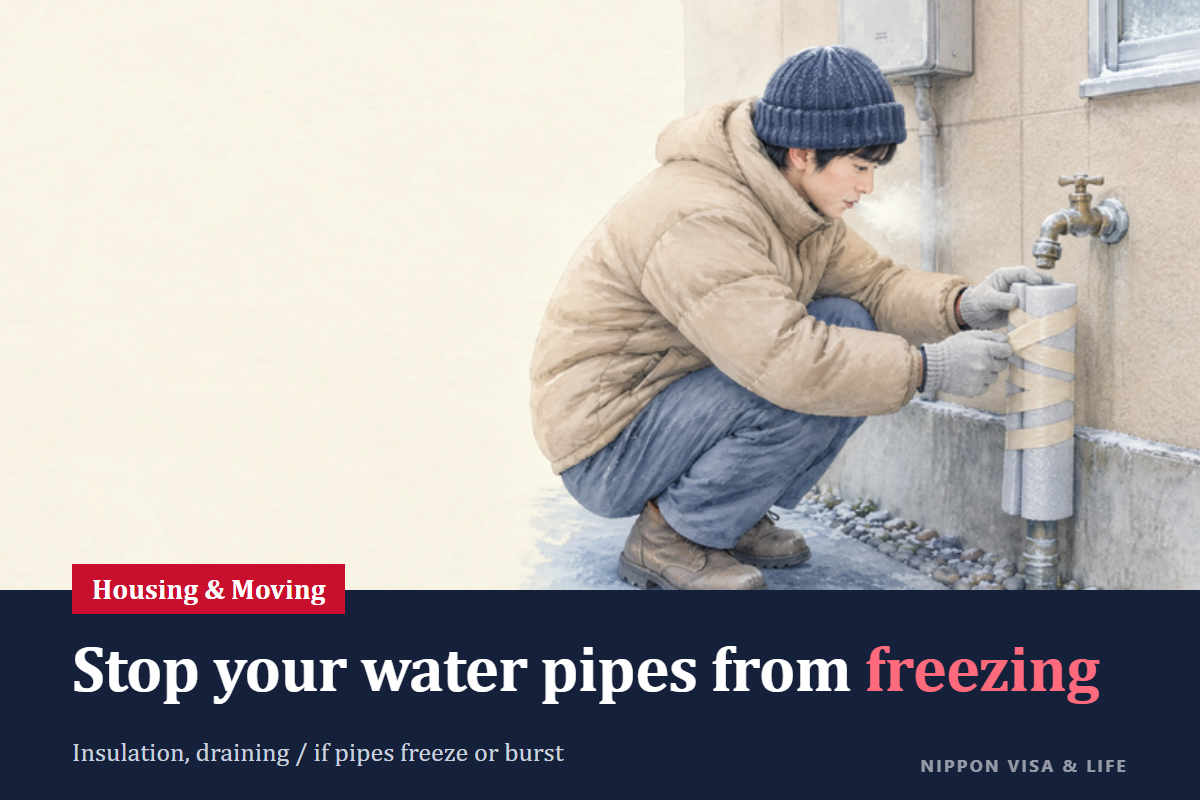
1. Wrap Insulation Around Water Pipes That Are Exposed Outdoors
This is the method introduced by the Tokyo Metropolitan Government Bureau of Waterworks.
- Wrap insulation around the parts of the water pipe that are directly exposed to the outside air
- Tie it with string to hold it in place
- To keep the insulation from getting wet, wrap vinyl tape or similar over it with no gaps. Wrap it all the way to the base of the faucet
Besides insulation sold at home centers and similar stores, blankets or styrofoam you have at home can also be used instead.
(Sources: Tokyo Metropolitan Government Bureau of Waterworks “About Frozen Water Pipes”)
2. In Cold Regions, Drain the Water from the Pipes (“Mizunuki”)
Homes in cold regions may have a drain valve (mizunuki-sen: a device for draining the water from the water pipes; also called “futo-sen”, an antifreeze valve). Draining the water from the pipes before going to bed at night or before leaving home prevents them from freezing. The Sapporo City Waterworks Bureau and the Sendai City Waterworks Bureau say that draining the water is effective in preventing freezing.
There are drain valves operated with a handle or lever, and electric ones operated with a button. How to drain the water differs depending on the home and the device.
- After you move, check with your landlord or management company where the drain valve is and how to operate it
- According to the Sendai City Waterworks Bureau, do not turn off the power to an electric drain valve during the winter
- The Sapporo City Waterworks Bureau shows in videos how to drain the water for each type of housing: detached houses, condominiums and apartments
When you start using the water again, there are steps such as closing the faucets and then returning the drain valve to its original position. Check the steps in the information from the waterworks bureau in your area or in the device’s manual.
(Sources: Sapporo City Waterworks Bureau “How to Keep Your Water Supply from Freezing” (札幌市水道局「水道を凍結させないためには」), Sapporo City Waterworks Bureau “About Frozen Water Supply”, Sendai City Waterworks Bureau “When It Gets Cold, Be Careful About Frozen Water Pipes”)
3. Check Whether Your Pipes Have an Antifreeze Heater
Some homes have an antifreeze heater (a device that warms the water pipes with electricity) on their water pipes. Nagano City warns that the heater will not work if the power part is broken or if the electrical breaker has been switched off. Before winter, check that the plug is in the outlet and that electricity is flowing to the heater.
(Sources: Nagano City “Be Careful About Frozen Water Pipes”, Sendai City Waterworks Bureau “When It Gets Cold, Be Careful About Frozen Water Pipes”)
4. Letting a Small Amount of Water Run from the Faucet
Nagano City introduces leaving a small amount of water running from the faucet as one way to prevent freezing. The Tokyo Metropolitan Government Bureau of Waterworks asks that when you use this method, you catch the water in a container and use it for the bath or similar, so that the water is not wasted.
However, the Sendai City Waterworks Bureau says that if many households let water run at the same time, the amount of water used by the whole city increases greatly, and there is a risk of a water shortage. In homes with a drain valve, draining the water is more effective. Follow the information from the waterworks bureau in your area.
(Sources: Nagano City “Be Careful About Frozen Water Pipes”, Tokyo Metropolitan Government Bureau of Waterworks “About Frozen Water Pipes”, Sendai City Waterworks Bureau “When It Gets Cold, Be Careful About Frozen Water Pipes”)
5. Close the Valve When You Are Away from Home for a Few Days
When you are away from home for a few days in winter, for example on a temporary trip back to your home country or a vacation, close the valve (stopcock) inside the meter box before you leave. The Tokyo Metropolitan Government Bureau of Waterworks asks people to close the valve when they are away from home for a few days between December and early March, because if a water pipe cracks due to freezing, water may keep leaking from the crack.
According to Nagano City, closing the stopcock does not drain all the water from the water pipes, so they may still freeze, but it prevents water from gushing out if a pipe bursts. In cold regions, drain the water from the pipes as well.
→ How to Start and Stop Electricity, Gas and Water in Japan
(Sources: Tokyo Metropolitan Government Bureau of Waterworks “About Frozen Water Pipes”, Nagano City “Be Careful About Frozen Water Pipes”)
When Water Pipes Freeze and No Water Comes Out
Thaw Frozen Water Pipes Slowly with Lukewarm Water
The Ministry of Land, Infrastructure, Transport and Tourism advises that when pipes freeze, you should wait for them to thaw naturally, or wrap a towel or similar around the frozen part and pour lukewarm water over it. The detailed steps, such as the water temperature and whether to open or close the faucet, differ slightly depending on the local waterworks bureau.
- Example: The Tokyo Metropolitan Government Bureau of Waterworks advises that, with the faucet closed, you either wait for the pipe to thaw naturally or cover the frozen part with a towel and slowly pour lukewarm water at about skin temperature (about 40℃) over it.
- Example: Nagano City introduces a method of wrapping a towel around the frozen part, opening the faucet, and slowly pouring lukewarm water of about 30-40℃ over it, as well as a method of blowing warm air on it with a hair dryer or similar.
Follow the information from the waterworks bureau in your area. The Sendai City Waterworks Bureau explains that the towel is used to transfer the heat of the water for a longer time.
(Sources: Ministry of Land, Infrastructure, Transport and Tourism “Be Careful About Frozen Water Supply Pipes”, Tokyo Metropolitan Government Bureau of Waterworks “About Frozen Water Pipes”, Nagano City “Be Careful About Frozen Water Pipes”, Sendai City Waterworks Bureau “When It Gets Cold, Be Careful About Frozen Water Pipes”)
Is It OK to Pour Boiling Water on Frozen Water Pipes?
Do not pour boiling water. The Ministry of Land, Infrastructure, Transport and Tourism and waterworks bureaus in various areas warn that suddenly pouring boiling water on pipes can cause the water pipes or faucets to burst.
(Sources: Ministry of Land, Infrastructure, Transport and Tourism “Be Careful About Frozen Water Supply Pipes”, Tokyo Metropolitan Government Bureau of Waterworks “About Frozen Water Pipes”)
What If No Water Comes Out Even After Pouring Lukewarm Water?
Nagano City names plumbing contractors (designated water supply equipment contractors) as the place to ask for thawing work, and states that the cost is paid by the resident. The Sendai City Waterworks Bureau also states that the cost of thawing work is paid by the customer. For who to ask, see “Who to Ask to Repair Water Pipes, and the Cost of Repairs” below. If you rent your room, contact your landlord or management company first.
(Sources: Nagano City “Be Careful About Frozen Water Pipes”, Sendai City Waterworks Bureau “When It Gets Cold, Be Careful About Frozen Water Pipes”)
When a Water Pipe Bursts and Leaks Water
1. First, Stop the Water
- Close the valve (stopcock) inside the meter box. In cold regions, close the antifreeze valve (drain valve)
- If you cannot close the stopcock, wrap cloth or tape around the broken part and tie it with string or similar as an emergency measure (Nagano City’s guidance). Hamamatsu City advises that if you do not know where the stopcock is, you should wrap a towel, vinyl tape or similar around the broken part as an emergency measure
When you close the stopcock, no water can be used in that home. Check where the stopcock is in advance. According to the Tokyo Metropolitan Government Bureau of Waterworks, in apartment buildings, the water meter is located in the pipe space next to the front door.
(Sources: Tokyo Metropolitan Government Bureau of Waterworks “About Frozen Water Pipes”, Nagano City “Be Careful About Frozen Water Pipes”, Ministry of Land, Infrastructure, Transport and Tourism “Be Careful About Frozen Water Supply Pipes”, Hamamatsu City “Please Be Careful About Frozen Water Pipes” (浜松市「水道管の凍結にご注意ください」))
2. If You Rent Your Room, Contact Your Landlord or Management Company
If you rent an apartment or condominium, contact your landlord or management company before asking for repairs yourself. The Tokyo Metropolitan Government Bureau of Waterworks advises that in apartment buildings, you should consult the building owner or management company. The Sendai City Waterworks Bureau advises that if the water supply freezes or breaks in a mid- or high-rise building such as a condominium, you should contact the person who manages the building.
What to do if leaking water causes damage to the floor below is explained in the following article.
(Sources: Tokyo Metropolitan Government Bureau of Waterworks “About Frozen Water Pipes”, Sendai City Waterworks Bureau “When It Gets Cold, Be Careful About Frozen Water Pipes”)
Who to Ask to Repair Water Pipes, and the Cost of Repairs
Ask a “Designated Water Supply Equipment Contractor” to Repair Water Pipes
Ask a designated water supply equipment contractor (shitei kyusui sochi koji jigyosha: a plumbing contractor that the waterworks bureau in your area has recognized as able to do water supply work properly and has designated) to repair the water pipes in your home. The Ministry of Land, Infrastructure, Transport and Tourism advises that if you do not know who to ask, you should contact the water supplier in your area (such as the waterworks bureau).
- Lists of designated water supply equipment contractors are posted on the websites of many waterworks bureaus. Search for “(name of your city, ward, town or village) 指定給水装置工事事業者”.
- Example: In Tokyo, the Tokyo Metropolitan Government Bureau of Waterworks website provides a list of plumbing contractors that can make repairs, and a service desk (Maintenance Center) that introduces plumbing contractors to do the repairs.
- Example: In Sapporo City, the waterworks bureau does not repair frozen pipes. Find a designated water supply equipment contractor that can repair frozen pipes in the list on the Sapporo City Waterworks Bureau website, and ask them directly.
(Sources: Ministry of Land, Infrastructure, Transport and Tourism “Be Careful About Frozen Water Supply Pipes”, Tokyo Metropolitan Government Bureau of Waterworks “About Frozen Water Pipes”, Sapporo City Waterworks Bureau “About Frozen Water Supply”)
Who Pays for Repairing Frozen Water Pipes?
The waterworks bureaus of Sapporo City, Sendai City, Nagano City and others state that you pay yourself for repairs and thawing work due to freezing. The Sendai City Waterworks Bureau explains that the water pipes of a home are the property of the owner of that home, and that the water charges for the leaked water will not necessarily be reduced.
If you rent your room, first consult your landlord or management company before asking for repairs yourself.
(Sources: Sapporo City Waterworks Bureau “About Frozen Water Supply”, Sendai City Waterworks Bureau “When It Gets Cold, Be Careful About Frozen Water Pipes”, Nagano City “Be Careful About Frozen Water Pipes”)
Things to Keep in Mind When Asking a Plumbing Contractor for Repairs
The Tokyo Metropolitan Government Bureau of Waterworks states that a contract for water supply work is made between the customer and the plumbing contractor, and that the waterworks bureau is not involved in the contents of the contract, such as the price. To avoid trouble later, keep the following in mind:
- Explain the details of the work and the condition of your home well in advance
- If possible, get written estimates (documents showing the cost of the work) from several plumbing contractors and compare them. Estimates may cost money, so check first
- Before the work starts, receive an explanation of the details of the work, the cost, and the follow-up after the work
(Sources: Tokyo Metropolitan Government Bureau of Waterworks “About Frozen Water Pipes”)
If You Have Trouble: Frequently Asked Questions About Frozen Water Pipes
What If I Find Water Leaking from a Vacant House in My Neighborhood?
The Tokyo Metropolitan Government Bureau of Waterworks asks that if you find water leaking from a vacant house or vacant lot, you contact the waterworks bureau’s Customer Center. In other areas as well, contact the waterworks bureau in your area.
(Sources: Tokyo Metropolitan Government Bureau of Waterworks “About Frozen Water Pipes”)
Can the Inside of the Water Meter Box (Meter Box) Freeze Too?
According to the Sendai City Waterworks Bureau, depending on the type of lid on the meter box, the inside may freeze. The Sendai City Waterworks Bureau introduces a way to keep the meter box warm by putting styrofoam or cloth in a plastic bag and placing it inside the meter box. Hamamatsu City also asks people to check the water meter from time to time, because it can freeze and break.
(Sources: Sendai City Waterworks Bureau “When It Gets Cold, Be Careful About Frozen Water Pipes”, Hamamatsu City “Please Be Careful About Frozen Water Pipes”)
Where Is the Waterworks Bureau for My Area?
Water supply is often run by municipalities, so the information and contacts for frozen pipes differ by area. Search for “(name of your city, ward, town or village) 水道局 凍結”, or look at the waterworks bureau’s contact details written on your water “Notice of Water Usage” (検針票, meter reading slip).
Primary Sources Referenced in This Article
- Ministry of Land, Infrastructure, Transport and Tourism “Be Careful About Frozen Water Supply Pipes”
- Tokyo Metropolitan Government Bureau of Waterworks “About Frozen Water Pipes”
- Sapporo City Waterworks Bureau “About Frozen Water Supply”
- Sapporo City Waterworks Bureau “How to Keep Your Water Supply from Freezing”
- Sendai City Waterworks Bureau “When It Gets Cold, Be Careful About Frozen Water Pipes”
- Nagano City “Be Careful About Frozen Water Pipes”
- Hamamatsu City “Please Be Careful About Frozen Water Pipes”
This article is a translation of the original Japanese version.