This article was written by the NIPPON VISA & LIFE editorial team based on information from public organizations such as the national government and local governments. Rules and fees may differ depending on the city, ward, town or village where you live.
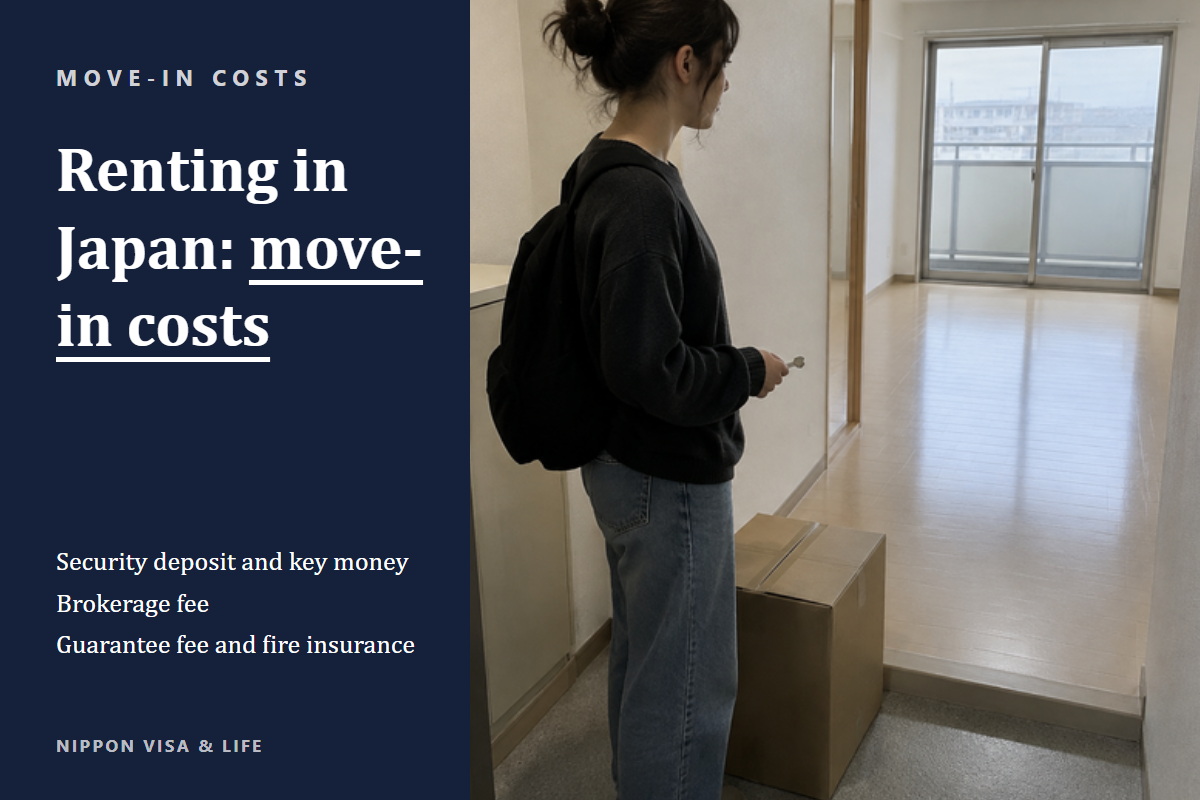
When you rent a room in Japan, the amount you pay at the time of signing the contract differs by region, but a guide is about 4 to 7 months’ worth of rent. Some of this money is returned later, and some is not. Before you sign the contract, ask the real estate agency for a breakdown of the costs and check each item one by one.
The overall flow from finding a room to moving out is summarized in How to Rent an Apartment and Move in Japan: Finding a Home, Contracts, Move-in Costs, Moving In, House Rules and Moving Out. This article explains the money you pay as move-in costs in detail.
(Sources: Ministry of Land, Infrastructure, Transport and Tourism “Apartment Search Guidebook”)
The Flow Up to Paying the Move-in Costs
- Look for a room on the internet or at a real estate agency, and do a viewing (shitami: going to actually see the room)
- Fill out a tenancy application form and submit the documents needed for the screening
- Go through the screening by the real estate agency and the landlord (yanushi: the owner of the room)
- Listen to the explanation of important matters (juyo jiko setsumei: an explanation of the important points of the contract)
- Sign the contract and pay the move-in costs
- Receive the key and move in
Check what the costs are before you sign the contract in step 5. Payment is generally in cash or by bank transfer.
(Sources: Ministry of Land, Infrastructure, Transport and Tourism “Apartment Search Guidebook”)
Breakdown of the Move-in Costs and Whether Each One Is Returned
| Cost | What it is | Guide | Is it returned? |
|---|---|---|---|
| Security deposit (shikikin) | Money deposited with the landlord in case you do not pay the rent or the room needs repairs that are the tenant’s responsibility | Differs by region and room | When you hand back the room, the remainder is returned after subtracting what the tenant should pay |
| Key money (reikin) | Money paid to the landlord as a thank-you for letting you move in | Differs by region and room. Some rooms have no key money | Not returned |
| Brokerage fee (chukai tesuryo, also called baikai tesuryo) | A fee paid to the real estate agency that introduced the room | The maximum the tenant pays is 1.1 months’ worth of rent (including 10% consumption tax) | Not returned once the contract is concluded |
| Guarantee fee (hoshoryo, also called hosho itakuryo) | Money paid when you use a rent guarantee company (yachin saimu hosho gaisha) | Often 0.5 months’ worth of rent for a 2-year guarantee | Depends on the contract |
| Property insurance premium (fire insurance, etc.) | Money for insurance against fire, water leaks and so on | Depends on the insurance coverage | Depends on the insurance contract |
| Rent and common service fee | Money for living in the room. In Japan, rent is paid in the previous month | The amount of the rent and the amount of the common service fee | Check the contract for how these are settled if you move out partway through a period |
The common service fee (kyoekihi) is money for maintaining areas outside your room, such as the stairs and hallways. It may also be written as a management fee (kanrihi).
(Sources: Ministry of Land, Infrastructure, Transport and Tourism “Apartment Search Guidebook”, Ministry of Land, Infrastructure, Transport and Tourism “Collection of Consultation Cases on Private Rental Housing (Second Revised Edition)”, Tokyo Metropolitan Consumer Affairs Center “I Signed a Contract to Rent an Apartment but Changed My Mind. Will the Money I Paid Be Returned?”)
The Difference Between the Security Deposit and Key Money
The Security Deposit Is “Money You Leave with the Landlord”
The security deposit is money deposited with the landlord to cover situations such as not paying the rent or damaging the room through the tenant’s carelessness. It is sometimes called a “hoshokin” (guarantee money). When you hand back the room, what the tenant should pay is subtracted, and the remainder is returned.
While you are living in the room, you cannot ask the landlord to “use the security deposit for this month’s rent.”
What is subtracted when you move out is explained in Restoration and Security Deposits When Moving Out of a Rental Home in Japan: Who Pays for Repairs? Examples from the National Government’s Guidelines.
Watch Out for Shikibiki and Shokyaku
Some contracts have a rule that a fixed amount is always subtracted from the security deposit when you hand back the room. This is called “shikibiki” or “shokyaku”. Shikibiki is said to be common in western Japan. Even if it is called a “security deposit”, the full amount may not be returned, so check the contract and the document explaining important matters (juyo jiko setsumeisho).
Key Money Is “Money That Is Gone Once You Pay It”
Key money is not returned later. In a survey by the Ministry of Land, Infrastructure, Transport and Tourism (October 2021, responses from 217 property management companies), the percentage of contracts in a typical rent range for which key money was received, and the average amount, were as follows.
| Region | Percentage receiving key money | Average amount |
|---|---|---|
| Nationwide | 61.1% | 1.1 months’ worth of rent |
| Tokyo | 86.0% | 1.0 months’ worth of rent |
| Osaka | 76.9% | 1.3 months’ worth of rent |
If a security deposit or key money is a condition of the contract and you agree to it, you need to pay it.
The Maximum Brokerage Fee
The brokerage fee is paid when a contract is concluded through the real estate agency’s introduction. If you only viewed a room or only withdrew your application, there is no reason to pay the brokerage fee, because it is a fee paid for success.
The maximum amount is set by a public notice of the national government.
- The maximum total the agency can receive from the landlord and the tenant is 1.1 times 1 month’s rent (including 10% consumption tax)
- For rooms used as homes, the maximum the agency can receive from either the landlord or the tenant alone is 0.55 times 1 month’s rent
- However, if that person gives consent when asking the agency to act as a broker, the agency can receive more than 0.55 times from one side, within the maximum total
If the tenant has given consent when asking the agency to act as a broker, there are also contracts in which the tenant pays 1.1 months’ worth of rent. Ask the real estate agency before you apply and confirm how much you are expected to pay.
There is a special rule for properties such as vacant houses that have not been used for a long time, and the amount the real estate agency receives from the landlord may be higher than the maximum above. Even in that case, the amount received from the tenant stays within the range above.
(Sources: Amount of Remuneration That Real Estate Brokers May Receive for Sales and Other Transactions of Land or Buildings (public notice posted on the Osaka Prefecture website), Ministry of Land, Infrastructure, Transport and Tourism “Collection of Consultation Cases on Private Rental Housing (Second Revised Edition)”)
Guarantee Fees and Guarantee Companies
A rent guarantee company is a company that pays the landlord in place of the tenant when the tenant cannot pay the rent. For rooms where using a guarantee company is a condition of the contract, you need a contract with a guarantee company.
- Guarantee fee: It is often 0.5 months’ worth of rent for a 2-year guarantee. The exact amount differs by contract.
- When you cannot pay: Money that the guarantee company pays on your behalf will later be charged to you by the guarantee company. Unlike insurance, it does not mean you no longer have to pay.
- Joint guarantor (rentai hoshonin: a person who promises to pay instead of the tenant): If you sign a contract with a guarantee company, it is relatively common not to need a joint guarantor. Some rooms may require both.
The Ministry of Land, Infrastructure, Transport and Tourism has a registration system for guarantee companies. Registration is voluntary, and some companies are not registered. The list of registered companies has 125 companies (as of September 30, 2026). There is also a list of registered companies that offer support in foreign languages.
If it is hard to rent a room because you have no guarantor, see Where to Get Help When It Is Hard to Rent an Apartment in Japan: Safety Net Housing, Housing Support Corporations, Rent Guarantee Companies and Help in Foreign Languages.
(Sources: Ministry of Land, Infrastructure, Transport and Tourism “Apartment Search Guidebook”, Ministry of Land, Infrastructure, Transport and Tourism “Collection of Consultation Cases on Private Rental Housing (Second Revised Edition)”, Ministry of Land, Infrastructure, Transport and Tourism “Registration System for Rent Guarantee Companies”)
How to Take Out Fire Insurance (Property Insurance)
The insurance the landlord has is insurance for the building. The insurance the tenant takes out is mainly for the following 2 purposes.
- To cover damage to your own furniture and electrical appliances (household goods)
- To cover compensation when you cause damage to the landlord or your neighbors through a fire, water leak or similar accident
The law does not require you to take out insurance. However, for rooms where it is a condition of the contract, you sign the contract on the assumption that you will take it out. Do not sign up without knowing what it covers just because the real estate agency recommended it. Check what is covered before you take it out.
If you already have mutual aid insurance (kyosai) or similar coverage, it is a good idea to compare its content with the designated insurance and talk to the real estate agency.
(Sources: Ministry of Land, Infrastructure, Transport and Tourism “Collection of Consultation Cases on Private Rental Housing (Second Revised Edition)”, Tokyo Metropolitan Consumer Affairs Center “A Real Estate Agency Recommended Fire Insurance When I Was Signing a Rental Contract. Do I Need It?”)
What to Check in the Estimate Before Signing the Contract
Have the real estate agency explain what costs there are and how much each one is, and compare this with the content of the contract. It is difficult to change the content after the contract is finished. Also look at sections of the document explaining important matters such as “amounts exchanged other than rent” (karichin igai ni juju sareru kingaku).
Ask about the following points.
- What is the total cost, and how much is each item?
- Is there a rule that a fixed amount is subtracted from the security deposit (shikibiki or shokyaku)?
- How many months’ worth of rent is the brokerage fee?
- Do you need to use a guarantee company? How much is the guarantee fee, and do you also have to pay it at renewal?
- Do you need to take out insurance? What is covered?
- From what date do you pay rent (when does the contract start)?
- If there are costs with names not in the table above, what are they for? Can you not sign the contract unless you pay them?
- Are there any special rules (tokuyaku) about the costs when you move out?
(Sources: Tokyo Metropolitan Consumer Affairs Center “Watashi wa Shohisha” (I Am a Consumer), Tokyo Metropolitan Government “Guidelines for Preventing Rental Housing Trouble”, Ministry of Land, Infrastructure, Transport and Tourism “Apartment Search Guidebook”)
Frequently Asked Questions
Do I have to pay rent for the period when I have not moved in yet?
If the room is ready for you to enter, you are basically obligated to pay rent from the start date of the contract, even if you have not actually moved in. If your move will be late, try discussing the date the contract starts.
Can I cancel after paying an application fee?
You can cancel if the contract has not yet been concluded. If the real estate agency asked you to pay an application fee (moshikomi-kin) before the contract, you can ask for it to be returned as money held on deposit (azukarikin). The Building Lots and Buildings Transaction Business Act prohibits the agency from refusing to return it.
However, it can be difficult to determine when the contract was concluded. If you want to cancel, contact the agency right away. When you pay an application fee, check whether it will be returned if the contract is not signed.
(Sources: Ministry of Land, Infrastructure, Transport and Tourism “Collection of Consultation Cases on Private Rental Housing (Second Revised Edition)”, Ministry of Land, Infrastructure, Transport and Tourism “Apartment Search Guidebook”)
What if I want to cancel after signing the contract?
Once the contract is concluded, you cannot cancel it one-sidedly. If the contract has a rule allowing cancellation partway through, you may be able to cancel according to that rule. Even in that case, according to the guidance of Tokyo’s consultation office, the security deposit is returned, but key money is usually not returned, and the brokerage fee is not returned either. There have also been consultations in which a person who asked to cancel before moving in was told that almost none of the money paid would be returned.
(Sources: Tokyo Metropolitan Consumer Affairs Center “I Signed a Contract to Rent an Apartment but Changed My Mind. Will the Money I Paid Be Returned?”, National Consumer Affairs Center of Japan (NCAC) “A New Life in a New Room! Understand Your Lease Contract and Prevent Trouble!”)
Who pays the cost of replacing the key?
Regarding costs when moving out, the national government’s view is that it is reasonable for the landlord to pay for replacing a key that has not been broken or lost. On the other hand, if you lose or break the key, the tenant often has to pay. If key replacement is listed in the costs for moving in, ask whether it is a condition of the contract.
(Sources: Tokyo Metropolitan Government “Guidelines for Preventing Rental Housing Trouble”)
Where to Get Help With Problems About Costs or Contracts
For trouble with contracts or money, the Consumer Hotline “188” (no area code needed) connects you to a nearby consumer consultation office. For details, see Where to Get Help With Shopping and Contract Problems in Japan: Consumer Hotline 188, Consumer Affairs Centers and Cooling-off.
(Sources: Consumer Affairs Agency “Consumer Hotline”)
Room-Search Information You Can Read in Foreign Languages
The Ministry of Land, Infrastructure, Transport and Tourism’s “Apartment Search Guidebook” explains the flow of finding a room and the documents and costs you need. From the Ministry of Land, Infrastructure, Transport and Tourism’s page, you can read the files in English, Chinese, Korean, Vietnamese, Nepali, Thai, Indonesian, Burmese, Tagalog, Portuguese and other languages.
Primary Sources Used for This Article
- Ministry of Land, Infrastructure, Transport and Tourism “Apartment Search Guidebook” (Japanese version)
- Ministry of Land, Infrastructure, Transport and Tourism “Smooth Move-in of Foreign Nationals to Private Rental Housing”
- Ministry of Land, Infrastructure, Transport and Tourism “Collection of Consultation Cases on Private Rental Housing (Second Revised Edition)” (March 2022)
- Amount of Remuneration That Real Estate Brokers May Receive for Sales and Other Transactions of Land or Buildings (public notice posted on the Osaka Prefecture website, revised June 21, 2024)
- Ministry of Land, Infrastructure, Transport and Tourism “Registration System for Rent Guarantee Companies”
- Ministry of Land, Infrastructure, Transport and Tourism “List of Registered Rent Guarantee Companies”
- Ministry of Land, Infrastructure, Transport and Tourism “List of Registered Rent Guarantee Companies Offering Language Support for Foreign Nationals”
- Tokyo Metropolitan Government “Guidelines for Preventing Rental Housing Trouble”
- Tokyo Metropolitan Consumer Affairs Center “I Signed a Contract to Rent an Apartment but Changed My Mind. Will the Money I Paid Be Returned?”
- Tokyo Metropolitan Consumer Affairs Center “A Real Estate Agency Recommended Fire Insurance When I Was Signing a Rental Contract. Do I Need It?”
- Tokyo Metropolitan Consumer Affairs Center “Watashi wa Shohisha” (I Am a Consumer)
- National Consumer Affairs Center of Japan (NCAC) “A New Life in a New Room! Understand Your Lease Contract and Prevent Trouble!”
- Consumer Affairs Agency “Consumer Hotline”
This article is a translation of the original Japanese version.