Life in Japan– category –
-

The Basics of Money and Shopping in Japan: Bank Accounts, Ways to Pay, Consumption Tax, Smartphone Contracts, Sending Money Abroad and Where to Get Help
This article summarizes, situation by situation, the basics of money and shopping that foreign nationals who have started living in Japan should know. Based on information from the Immigration Services Agency and the Financial Services Agency, it explains how to open a bank account, how to pay utility bills, consumption tax (10% and 8%), what you need for a smartphone contract, points to note when sending money abroad, things you must not do, and where to get advice when you have trouble with shopping or contracts. -
Procedures at the City Office After You Arrive in Japan: The Basics of the Moving-in Notification, My Number, National Health Insurance, National Pension and Resident Tax
After you come to Japan and decide where to live, there are procedures to complete at your city, ward, town or village office. Based on information from the Immigration Services Agency, the Japan Pension Service and others, this article explains in order the moving-in notification (within 14 days), My Number, National Health Insurance, National Pension, resident tax, the procedures when you move or return to your home country, and where you can get advice. -
My Number and the My Number Card in Japan: What Foreign Residents Should Know (When It Is Used, Applying, Extending the Expiration Date, and If You Lose It)
Foreign residents in Japan who have a resident record receive a 12-digit My Number. Based on information from the Immigration Services Agency, the Digital Agency, and the Ministry of Internal Affairs and Communications, this article explains when the number is used, how to apply for and receive a My Number Card, how to extend the card's expiration date after renewing your period of stay, and which phone numbers to call (with foreign-language support) if you lose the card. -
Where to Get Help With Shopping and Contract Problems in Japan: Consumer Hotline 188, Consumer Affairs Centers and Cooling-off
Something you bought online never arrived, you were pushed into a contract, or you were charged a lot of money. In such cases, call the Consumer Hotline "188" and you will be connected to a nearby Consumer Affairs Center. Based on information from the Consumer Affairs Agency and the National Consumer Affairs Center of Japan, this article explains how to call, the call charges, what you can consult about, and the period and method for cooling-off (a system for cancelling a contract). -
Rules for Alcohol and Tobacco in Japan: From Age 20, Penalties for Drunk Driving, and Where You Can Smoke
In Japan, alcohol and tobacco are allowed from age 20. Based on information from the law, the National Police Agency, the Ministry of Health, Labour and Welfare and the Immigration Services Agency, this article explains the penalties for drunk driving (after the July 2026 amendment), the penalties for people who lend a car, serve alcohol or ride along, the rule that indoor areas are in principle non-smoking, and littering. -
Getting Around in Japan: The Basics of Walking, Trains, Buses, Bicycles, Driving, and Traffic Accidents
The basics of getting around in Japan, organized by situation, based on the Immigration Services Agency's "Guidebook on Living and Working" and information from the National Police Agency. Covers the rules for walking on the street, how to ride trains and buses, the rules for bicycles and electric kick scooters, whether you can drive with a foreign driver's license, and what to do if you are in a traffic accident. -
How to Ride a Local Bus in Japan: Which Door to Use, Numbered Tickets, Paying the Fare, and the Stop Button
How to ride local buses in Japan, based on the Immigration Services Agency's "Guidebook on Living and Working" and the official information from city buses (Yokohama, Sendai, Sapporo and Kagoshima) and PASMO. Covers the difference between paying when you get on and paying when you get off, how to use numbered tickets, touching your IC card, changing money, the stop button, and what to do when you do not have enough money. -
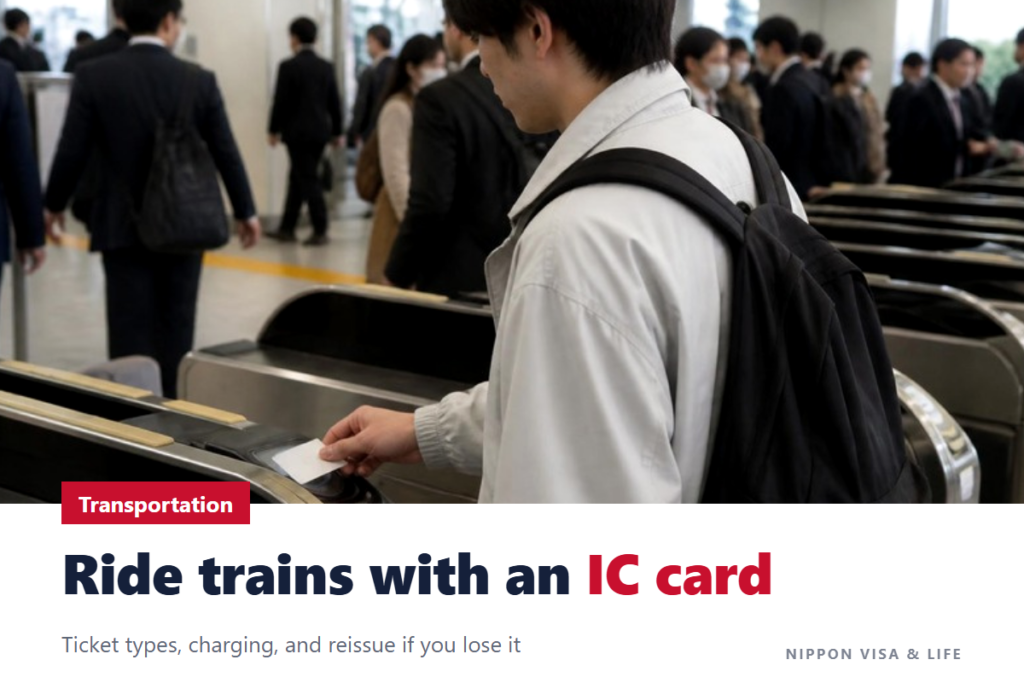
How to Ride Trains in Japan and Use IC Transit Cards: Buying Tickets, Going Through Ticket Gates, Charging, and What to Do If You Lose Your Card
How to ride trains in Japan, based on the Immigration Services Agency's "Guidebook on Living and Working" and the official information on the IC transit card PASMO. Covers the difference between tickets and IC cards, how to go through ticket gates, charging (adding money), what to do when your balance is not enough, limited express tickets and commuter passes, and getting a card reissued if you lose it. -
How to Put Out Oversized Garbage in Japan: Basics of Applying, Disposal Tickets (Stickers), and the Day and Place to Put It Out
How to put out large items such as furniture, futons and bicycles (oversized garbage), based on information from local governments, the Ministry of the Environment and the National Consumer Affairs Center of Japan. Covers applying, how to buy and attach disposal tickets (stickers), the day and place to put it out, items that cannot be put out as oversized garbage, and why you should be careful with businesses that say "we collect for free." -
When You Are Sick or Injured in Japan: The Basics of Hospitals, Ambulances, Medicine, Medical Insurance and Where to Get Advice
Based on information from the Immigration Services Agency, the Fire and Disaster Management Agency and the Ministry of Health, Labour and Welfare, this article sums up, situation by situation, where to go and what to use when you are sick or injured in Japan: how to see a doctor for everyday problems, the phone lines for when you are not sure whether to call an ambulance (#7119 and #8000), pharmacies and drugstores, public medical insurance and medical costs, what to do when you become pregnant, health checkups, and where to talk when you are struggling.